Nixie Calculators · Volume 3
The Machines
This volume takes the Nixie calculators maker by maker. Dates are the announcement or first sale; where the sources disagree, both are given. Prices are original list prices. Several popular accounts credit Nixie displays to machines that never had them, so the volume ends with a list of the near misses.
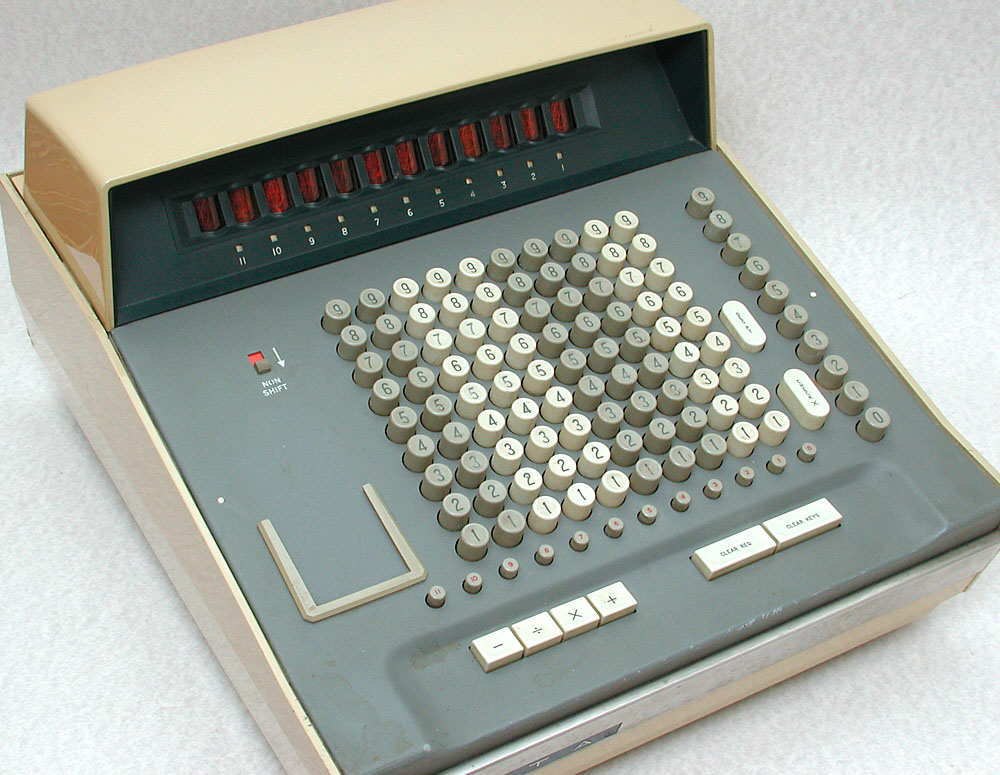
3.1 Bell Punch and Sumlock: the ANITA
The Bell Punch Company of Uxbridge, near London, made bus-ticket punches and, from the 1930s, the Sumlock, a key-driven mechanical adding machine of the Comptometer type. In 1956 it began work on an electronic calculator under Norbert (later Norman) Kitz, who had worked on the Pilot ACE computer at the National Physical Laboratory. Kitz, with Robert Milburn and Christopher Webb, filed the first British patent application in September 1956 (granted as GB 868,753); the American version, US 3,280,315, “Key controlled decimal electronic calculating machine”, was filed in December 1961 and granted in 1966. A working prototype was shown to the Bell Punch board in December 1958. The project’s code name was ANITA, later explained as “A New Inspiration To Arithmetic”.
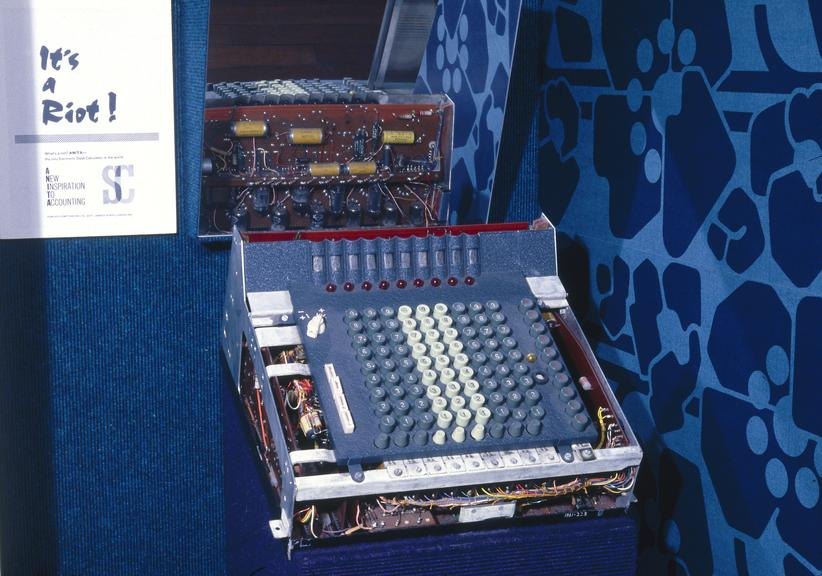
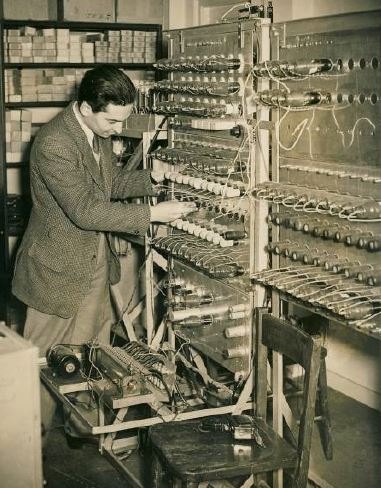
In 1961 Bell Punch’s calculator business merged with the British arm of the Comptometer Corporation to form Sumlock Comptometer Ltd, and it was under that name that the machines were sold. The ANITA Mk VIII was shown at the Business Efficiency Exhibition in London, 2–11 October 1961, and the Mk VII at a business fair in Hamburg a week later; deliveries began early in 1962. The Mk VII was meant for continental Europe and the Mk VIII for Britain and the rest of the world.
The two differ inside. The Mk VII counted with three Dekatron tubes, which suffered from “poisoning” under constant starting and stopping and made errors; fewer than 1,000 were made. The Mk VIII kept one Dekatron as its master timer and keyboard scanner and did its counting in rings of small thyratron tubes. Wikipedia adds that the Mk VII used a more complicated method of multiplication.
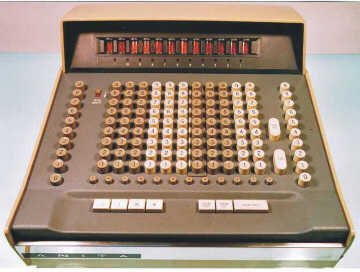
The Mk VIII, as described by the Old Calculator Web Museum from its serial 3108 of 1963:
- Logic: about 177 sub-miniature cold-cathode thyratrons (Hivac XC27 and XC31), 120 of them on twelve digit cards as ring counters of ten; one Hivac GS10D Dekatron; 11 ECC81 (12AT7) double triodes; a couple of hundred selenium rectifiers as logic gates; and a single transistor, in the power-supply regulator.
- Arithmetic: decimal throughout, “one of ten” rather than binary-coded; master clock about 3 kHz; 12 digits; no zero suppression, no minus sign (negative results appear as ten’s complements) and no overflow warning.
- Display: twelve Nixie tubes made by Hivac, with red-tinted envelopes, wired into the counting logic itself. (The Museum’s specification page names the tube as a ZM1080, which conflicts with its exhibit text.)
- Keyboard: a full Comptometer keyboard of ten columns plus a separate multiplier column, a CHECK X key, and a 37-pin socket at the back for an external memory unit and an output typewriter.
- Supply: about 495 volts from a constant-voltage transformer, with the ECC81 heaters in series across the mains.
- Weight and size: 28 to 33 lb by different accounts (the Science Museum records 15.15 kg); roughly the size of a cash register.
- Price: about £355 in Britain in 1964; about $2,700 through the American importer.
Kitz said in 1964 that the factory at Portsmouth was making about 10,000 a year. The Old Calculator Web Museum estimates 50,000 to 60,000 in all by about 1967. Early cases were ABS plastic; later ones were polycarbonate, for fire resistance, which is one way to date a machine.
Successors followed quickly:
- Mk 9 (1964): still cold-cathode, with a full keyboard and twelve Nixies; adds chain multiplication.
- Mk 10 (1965): adds a mode for pre-decimal British currency, pounds, shillings and pence; sold as the “Sterling ANITA”.
- Mk 12 (1966): a hybrid of cold-cathode tubes and transistors, with a ten-key keyboard, 12 digits and a memory register.
- Mk 11 (1969): a hybrid, ten-key, 9 digits, cheap. (The numbers are out of date order; this is the order Wikipedia gives.)
- 1000 series (1969–70): transistors and integrated circuits with ten Nixies: the 1000, the 1010 with rounding (£285 in 1970), the 1011 with a memory, the 1011P printing model and the 1020 and 1021 with square root. The Anita 1011 uses Mullard ZM1080 tubes.
- 1000 LSI and 1011 LSI (1971), built on MOS chips; the “B” versions ran on batteries.
- 1200 series: Nixie at first; the 1211 D-suffix machines have Panaplex displays.
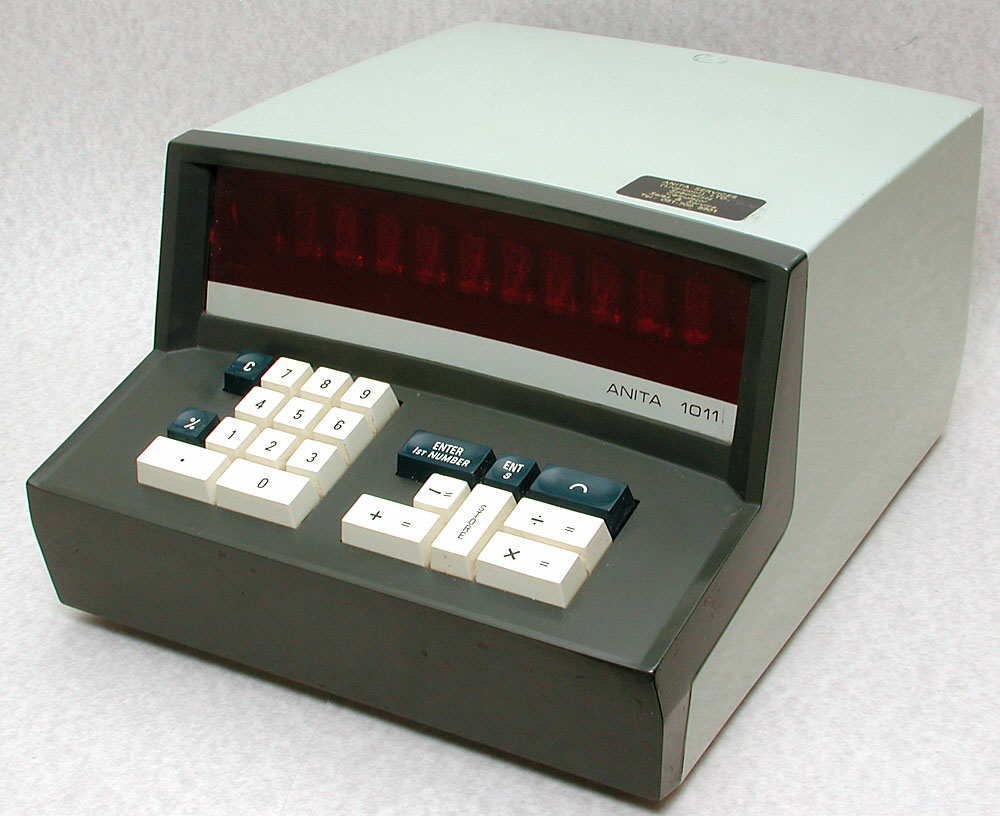
The company became Sumlock-Anita Electronics in 1966. Its main supplier of integrated circuits, Rockwell, bought it in 1973 and closed it in 1976 when Rockwell left the calculator business.
3.2 Sharp (Hayakawa Electric)
Hayakawa Electric, which sold under the name Sharp, began work on a solid-state calculator in 1960 with a team under Atsushi Asada. The CS-10A Compet, announced in March 1964 and on sale in June, was the first all-transistor calculator made in Japan. It used 530 germanium transistors, many of them radio-grade parts that Sharp aged and screened itself, and 2,300 diodes, about 4,000 parts in all. It weighed 25 kg, measured 440 × 420 × 250 mm, drew 90 W, and cost ¥535,000, about the price of a 1,300 cc car. It has a full keyboard of ten columns and shows up to twenty digits in Nixie tubes, with separate neon lamps for the decimal point. Addition took 12 milliseconds, multiplication 0.4 seconds, division 0.8. The Information Processing Society of Japan lists it as part of the country’s information-processing heritage.
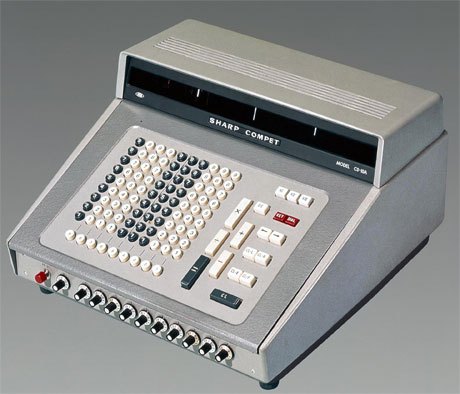
The Compet 20 (CS-20A, September 1965) moved to silicon transistors in its logic, kept germanium in the Nixie drivers, and changed to a ten-key keyboard: 14 digits and a sign tube, 16 kg, ¥379,000, with a +185 V Nixie supply. It won a Good Design award; the CS-21A added square root. Facit in Sweden sold it as the 1121. The CS-31A of 1966 was the first calculator with bipolar integrated circuits, 28 of them. The Compet 22 (CS-22A, late 1967) used 83 first-generation Hitachi MOS chips and 14 multiplexed Hitachi CD-81 Nixies, cost $1,175 in 1969, and had a socket for a keystroke-recording “Memorizer”. The CS-16A of December 1967, Sharp’s first machine with NEC MOS chips, weighed only 4 kg; it used the new vacuum-fluorescent tubes, but its siblings the CS-16C and CS-16S of 1968–69 had twelve multiplexed NEC Nixies. The Compet 32 (CS-32A, August 1967) was sold by Burroughs as the C-3350.
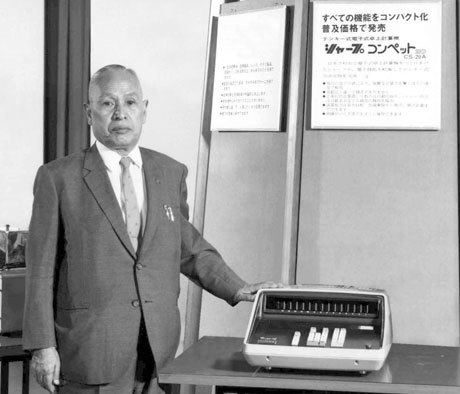
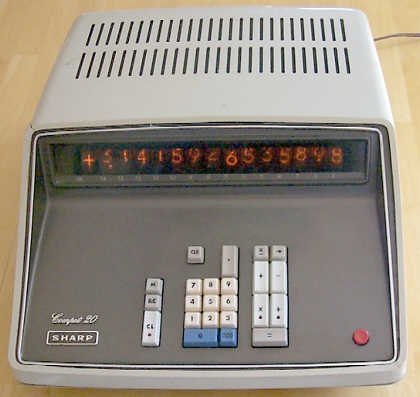
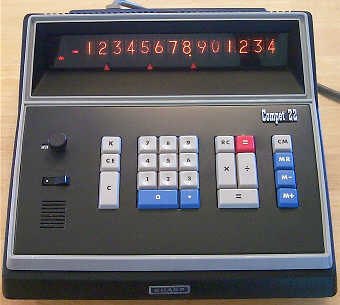
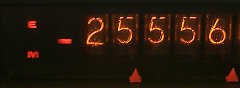
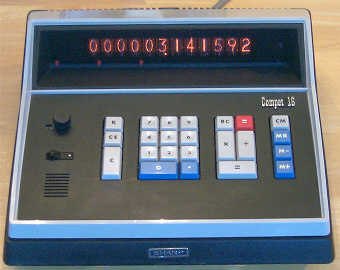
Many Compets were sold under other names: as Facit 1121, 1123, 1124, 1125 and 1127 in Europe, and as Burroughs C-series machines in America. The Compet 17 schematic, drawn by Brent Hilpert from a working machine, is in the Library.
3.3 Casio
Casio’s first calculator, the 14-A of 1957, was built of 342 telephone relays and showed its answer on a lamp panel: a remarkable machine, but not electronic and not Nixie. Its first electronic calculator was the 001 of September 1965: discrete transistors on plug-in boards, a ten-digit Nixie display, a ten-key keyboard, and a seven-digit constant set on rotary switches on the front panel, carried over from the relay machines. Casio describes it as the first electronic calculator with a memory. It weighed about 17 kg and drew 40 W; the price is given as ¥380,000.
The 101 of 1966 used more than 10,000 discrete components on nine boards and ten NEC Nixie-type tubes, cost A$1,670 in Australia, and was also sold as the Remington and, as the 101E, the Commodore 500E. The AL-1000 of October 1967 was programmable: 30 linear steps held in a ferrite core memory, more than 400 transistors and 1,500 diodes, 14 digits in NEC LD-866 Nixies, $1,495 in America under the Commodore badge. The AL-2000 of 1969 added integrated circuits. The 121-K and 121-A of late 1970 were built on four MOS-LSI chips and showed 12 digits in multiplexed Hitachi CD-71 mini-Nixies.
The AL-1000 schematic and 121-B schematic are in the Library.
3.4 Canon
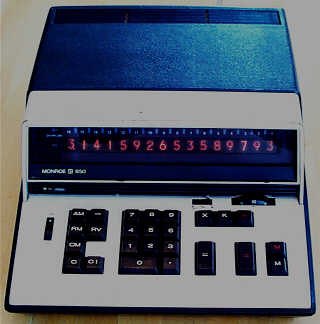
Canon’s first calculators, the Canola 130 of 1964 and the 130S, 151 and 161, did not use Nixies, although they are often said to. Their displays are edge-lit: each digit is a stack of twelve engraved plastic panels, lit from the side by small incandescent lamps; the 130 has 143 of them. The Old Calculator Web Museum suggests Canon avoided Nixies because of Burroughs’ patents and the cost of importing tubes. The lamp displays proved expensive and the lamps tedious to replace, and Canon’s integrated-circuit machines changed to Nixies: the 141 (late 1960s; 73 TI DTL chips, an NEC delay line, 14 digits), the 163 (1968), the 162P (1969), the 1200 and 1210 (1970), the 164P and 167P (1970–71), and the mini-Nixie L121 (June 1971), built on four MOS-LSI chips. Canon also built the Monroe 950 and 990 of about 1970 for Monroe in America: 16-digit Nixie, 94 TI DTL chips and an NEC delay line.

The Canon 163 is the best-documented Nixie calculator of all, thanks to Brent Hilpert’s reverse-engineered schematic, appendix and theory of operation; the theory volume describes it in detail. The factory logic and timing manual for the Canola 1200 is also in the Library.
3.5 Toshiba
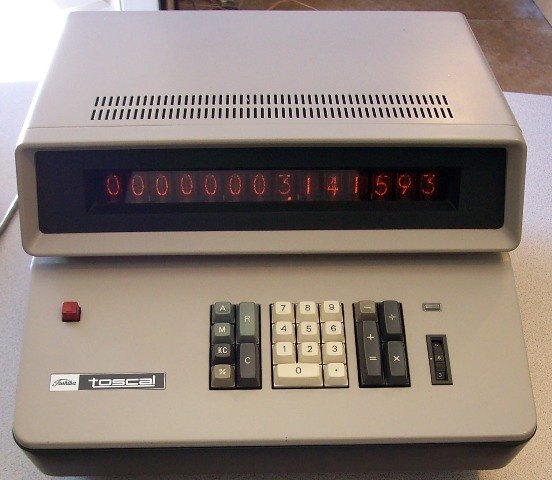
Toshiba’s first calculator, the BC-1001 of December 1965, may never have been sold outside Japan, and no surviving example or photograph has been found. Its successor, the TOSCAL BC-1411, in production from November 1966, is one of the oddest machines in this series. It uses 286 transistors, mostly germanium 2SA50s, and works bit by bit at 40 kHz, but it keeps its numbers in neither a delay line nor magnetic cores. They are stored in capacitors: 180 of them, 15 registers of 12 bits, each holding its bit as a charge that has to be refreshed continually, a dynamic memory built of discrete parts. The display is fourteen multiplexed NEC CD-66 Nixies, 5/8 inch high, on a 180 V supply. The machine is all metal and weighs 37.5 lb. Toshiba followed it with the BC-1412, BC-1201, BC-1211S and the BC-1212, whose schematic is in the Library.
3.6 Sony: the SOBAX
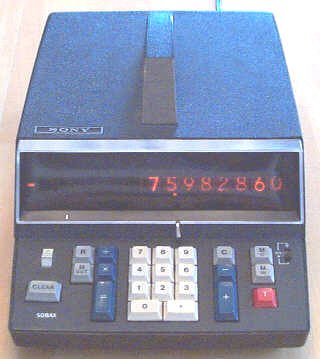
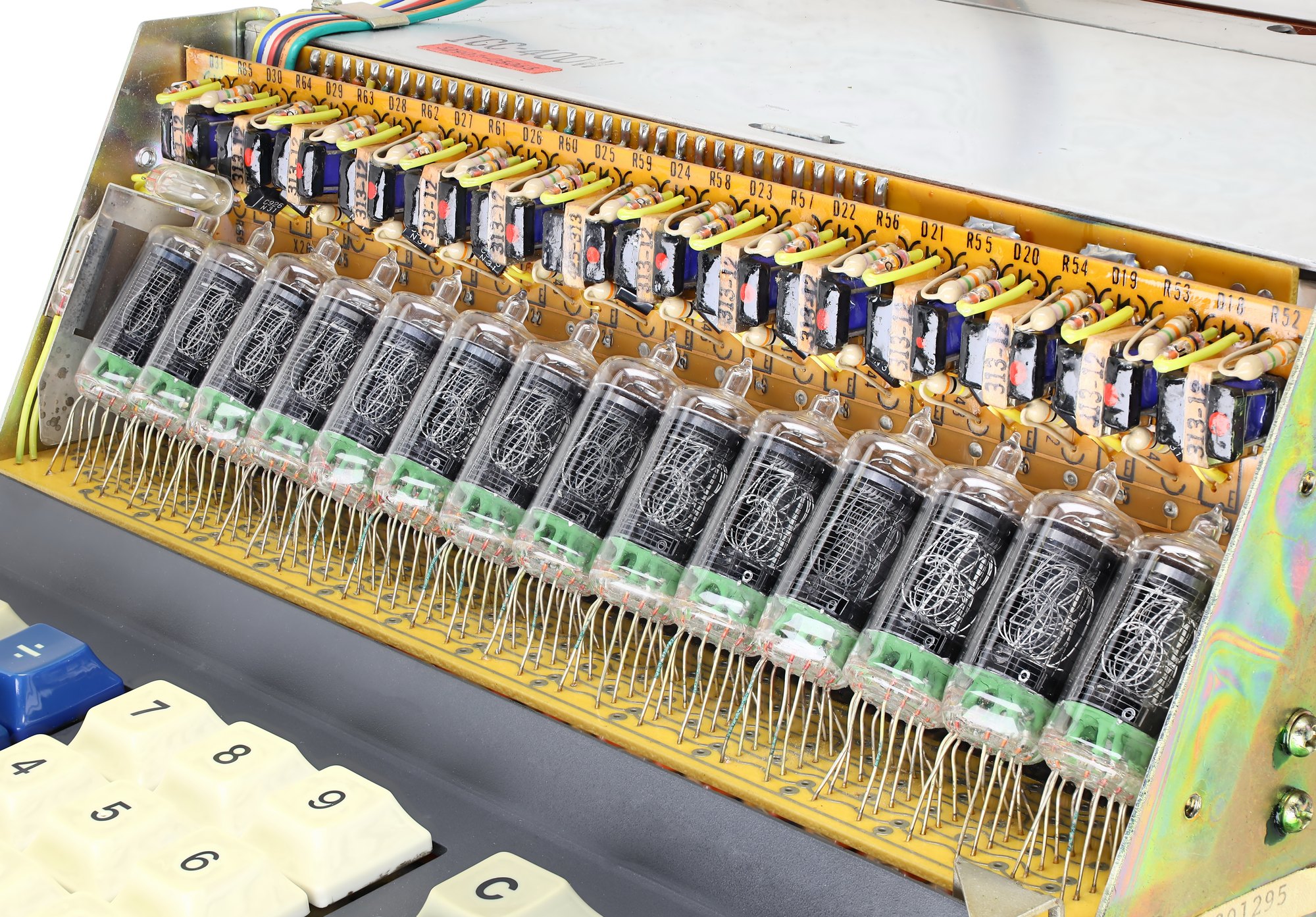
Sony showed calculator prototypes from 1964 (the MD-5 appeared at the New York World’s Fair) and launched the SOBAX ICC-500 (“Solid State Abacus”) in Japan in June 1967 and in North America that autumn. Sony advertised it as built of integrated circuits; it is in fact built of about 500 hybrid modules, small alumina substrates carrying printed resistors and epoxy-packaged transistors and diodes, about 8,000 parts in all. The numbers circulate in a magnetostrictive delay line of about three metres of wire, holding 360 bits. The display has 14 Nixies with a right-hand decimal point and, unusually for 1967, leading-zero suppression, and an overflow lamp. With the optional BP-11E battery pack or a car adapter it was one of the first calculators that could be used away from a mains socket. The ICC-400W is its sibling.
The later SOBAX 2500 of 1969–70 is programmable, uses Sony’s own 500-series integrated circuits, and keeps 15 registers of 16 digits in a single delay line; Hilpert’s 52-page theory of operation, schematic and appendix are in the Library. Sony left the calculator business in 1973.
3.7 IME (Industria Macchine Elettroniche)
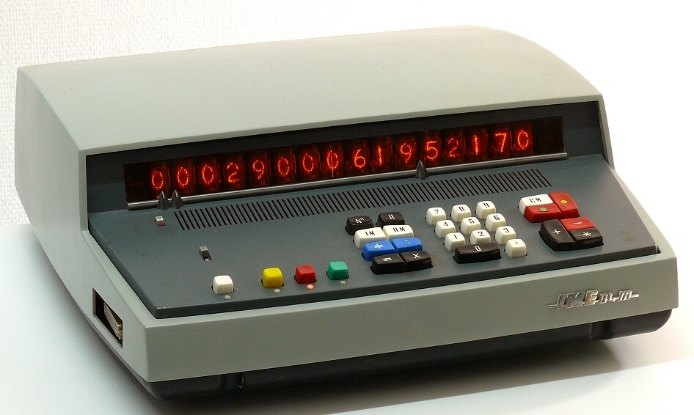
IME of Pomezia, near Rome, showed the IME 84 at the Milan fair in April 1964 and claimed it as the first transistorised desk calculator. It used germanium transistors in diode-transistor logic, a magnetic core memory and a 16-digit Nixie display. Hilpert counts 408 transistors and 1,045 diodes on its 32 boards. It cost 4,750 DM in West Germany and $1,295 in America in 1966, and had a fast-entry peripheral, the ROBOX 103. Its successor, the IME 86 and 86S of about 1966–69, added a programmer and an external memory unit. IME’s later IME 26 is a simpler commercial machine; its instruction manual is in the Library. So are Hilpert’s IME 84 schematic and theory of operation, and his IME 86S schematic and theory.
3.8 Wang Laboratories
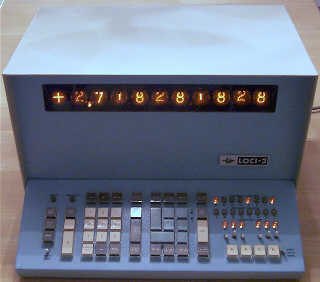
An Wang, who had invented a form of magnetic-core memory at Harvard, founded Wang Laboratories in 1951. Its first calculator, the LOCI (“LOgarithmic Calculating Instrument”), appeared in September 1964, and the LOCI-2 in January 1965 at $2,750. It multiplied, divided and took roots by generating and adding natural logarithms, using a method that needs only shifts and additions, described in the theory volume. The LOCI-2 has more than 1,200 transistors in diode-transistor logic, flip-flop working registers, a core memory for four storage registers (sixteen on the LOCI-2A), and a 10-digit display of top-view Nixies made by National Electronics, with a sign tube and neon decimal points. It reads programs of 80 steps from punched cards.
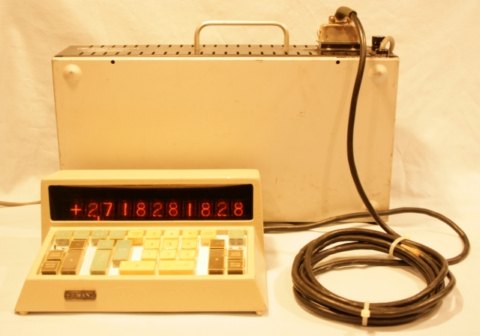
The Wang 300 series, shown in October 1965 and made from March 1966, separated the calculator into two parts. The electronic package (models 300E, 310E, 320E, 360E, 362E) held the logic and the core memory and could sit up to 200 feet away from the small keyboard and display units (300K, 310K, 320K, 360K, 362K, and the trigonometric KT and KR models), each with its own row of Nixies. The SE packages could serve up to four keyboards at once. Registers held 14 digits, of which 10 were displayed. The 360E package used 491 transistors on 22 boards. The 370 card programmer and 380 tape programmer added programs, and the Wang 4000 computer of 1967 used a 320E as its arithmetic unit. In 1970 a 360E package cost $1,995 and each keyboard $500. Wang’s 1968 catalogue and price list, the 300 series instruction manual and Hilpert’s 320K keyboard schematic are in the Library.
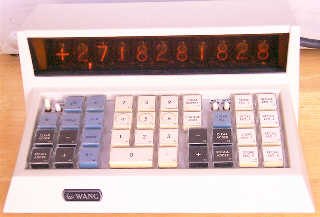
The programmable Wang 700 of 1969 also has a Nixie display; its manual and the 720A/B reference manual are in the Library, with the Wang 500 schematic.
3.9 Friden: Hitachi-built Nixies
Friden’s own electronic calculators, the EC-130 and EC-132, and the Singer-Friden 1160 series used cathode-ray tubes, and its 1150 series printed. Its Nixie machines were all built for it by Hitachi in Japan:
Table 1 — Friden's own electronic calculators, the EC-130 and EC-132, and the Singer-Friden 1160 series used cathode-ray tubes, and its 1150 series printed. Its Nixie machines were all built for it by Hitachi in Japan
| Model | Introduced | Price | Logic | Tubes |
|---|---|---|---|---|
| EC-1113 | February 1969 | $895 | 108 Hitachi HD700 PMOS chips (Hitachi ELCA-22) | 12 Hitachi CD-71 or CD-79 |
| EC-1114 | November 1969 | $895 | 59 HD31xx PMOS chips (Hitachi ELCA-24) | 14 CD-79 |
| EC-1115 | February 1970 | $695 | 45 HD31xx PMOS chips | 12 CD-79 |
| EC-1117 | early 1971 | $445 | 9-chip Hitachi MOS-LSI | 12 Hitachi CD-90 |
| EC-1117A | 1971 | the same | vacuum-fluorescent |
The EC-1115 weighs 10 lb, draws 12 W, adds in 0.05 seconds and multiplies or divides in 0.4. The EC-1113 service manual of June 1969, the EC-1115 service manual, the Hitachi HD3100 chip data sheets and Friden’s internal project lists for 1961–1968 and 1961–1979 are in the Library.
3.10 Olympia, Monroe and Diehl
Olympia of Wilhelmshaven in West Germany made its RAE 4/15 from 1964, with 15 Nixies; it cost 5,890 DM in 1965, and an FAU Erlangen data sheet for the RAE 4/15-2 is in the Library. The RAE 4/30 was sold in America by Monroe as the 770 (late 1967, $1,350): all-transistor, with a hand-threaded core memory of 384 bits, three memories and 15 Telefunken ZM1080 Nixies. Sources disagree whether the 770 is the RAE 4/30-2 or 4/30-3. Olympia’s later CD200 and CD700 of about 1971 also have Nixie displays, the CD200 with Matsushita CD88P tubes. Monroe’s other Nixie machines are the 740, the Canon-built 950 and 990, the 920 (its service manual is in the Library), and the 925, 610 and 650; the Monroe 925 logic and timing manual and Hilpert’s 925 schematic are in the Library.
Diehl of Nuremberg is best known for its Combitron of 1966, which printed and had no display; its own history of its electronic calculators is in the Library.
3.11 Busicom, Denon, Commodore and others in Japan
- Busicom 162 (Nippon Calculating Machine Co.; November 1967 by one account, August 1968 by another): designed under contract by Computer Design Corporation of Santa Monica, with Signetics DTL chips, a 256-bit core memory, 16 Nixie digits, two memories and square root. NCR sold it as the 18-3. Busicom’s 202 and 207 were CRT machines, and its famous 141-PF of 1971, the calculator for which Intel designed the 4004 microprocessor, printed.
- Denon DEC-61A4 (September 1968): Mitsubishi DTL, 14-digit Nixie; also sold as the Columbia COLCA 61A.
- Commodore 1121 (1969, $795): 12 digits, Hitachi CD-71 tubes. Commodore also sold the Casio AL-1000 and 101E under its own name.
- Sanyo ICC-82D (May 1970): a portable with eight Nixie-style tubes; its second version of January 1971 had seven-segment gas tubes.
3.12 SCM: the Cogito 412 and the Marchant I
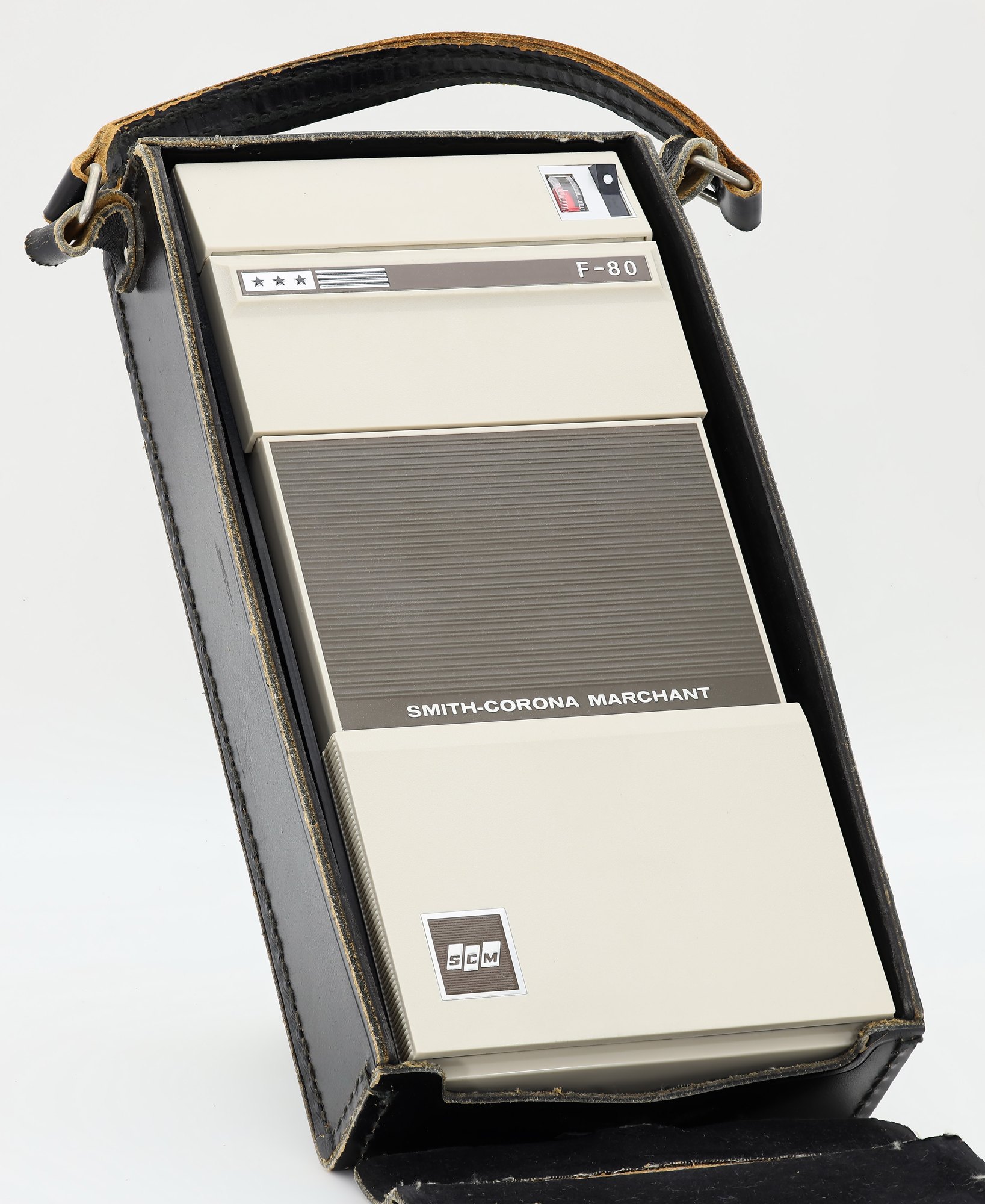
SCM (Smith-Corona Marchant) used a CRT in its first electronic calculator, the Cogito 240. Its Cogito 412 and 414 of August 1969 were among the first calculators built on large MOS chips: eight of them, designed jointly with American Microsystems (AMI). The 12-digit Nixie display dims the insignificant zeros to a quarter of full brightness rather than blanking them, and the machine has a switch-mode power supply. SCM claimed it as the smallest and lightest calculator of its class.

The SCM Marchant I, also sold as the F80, of autumn 1970 is the oddity of the whole series: a hand-held, battery-powered calculator with Nixie tubes. It has eight multiplexed Burroughs B-5750s, an AMI or TI chip set, a 6 V nickel-cadmium pack of five AA cells, a sliding key cover and a flip-up display cover, weighs 2.4 lb, and cost $495. The Old Calculator Web Museum calls it probably the only portable calculator ever made with Nixies, though the Sanyo ICC-82D has a claim too.
3.13 The Soviet Union and Eastern Europe
The Soviet Union’s first electronic keyboard calculating machine, the Vega, appeared in 1964. The discrete-transistor Elektronika 68 has a 14-digit Nixie display, and the Iskra series, from the Iskra 11 and 12 to the Iskra 111, the first Soviet calculator with MOS chips, and the 122, used Soviet IN-series tubes. Bulgaria’s Elka 6521 also has Nixies. Their story belongs to a separate series on Soviet calculators.
3.14 Near misses: machines often called Nixie that are not
Table 2 — Near misses: machines often called Nixie that are not
| Machine | Its display |
|---|---|
| Canon Canola 130, 130S, 151, 161 | edge-lit lamp panels |
| Casio 14-A (1957) | lamp panel; a relay machine |
| Mathatronics Mathatron (1963) | none; it prints |
| Monroe EPIC 2000 and 3000 | none; they print |
| Diehl Combitron (1966) | none; it prints |
| Friden 1150, 1151, 1152 | none; they print |
| Friden EC-130, EC-132, 1160, 1162, 1166 | cathode-ray tube |
| Busicom 202, 207 | cathode-ray tube |
| Busicom 141-PF | none; it prints |
| Sharp CS-16A, QT-8D | vacuum-fluorescent |
| Sanyo ICC-1141 (1968), ICC-0081 (1971) | seven-segment gas discharge |
| Canon L100S (1972) and later | seven-segment neon, then VFD |
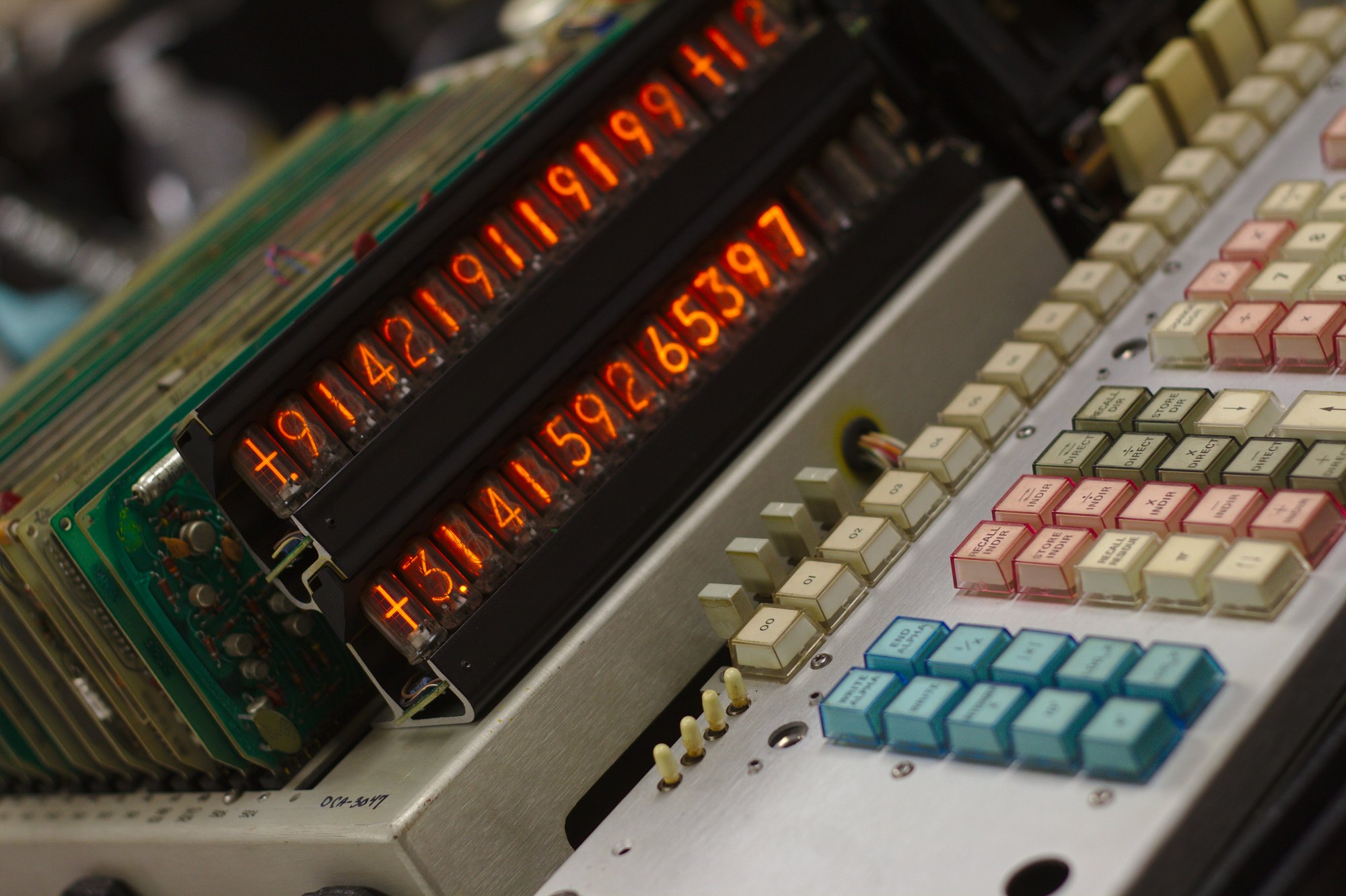
The test at a glance: a Nixie numeral is a complete, curved figure made of wire, glowing orange, and the other numerals can be seen faintly behind it. A seven-segment display, whether neon, VFD or LED, makes every figure from the same seven straight bars. A CRT draws its figures on a single screen, usually green. A lamp display has flat, evenly lit figures on a panel of plastic sheets.
Comments (0)