Nixie Calculators · Volume 1
Nixie Calculators: Numbers in Neon
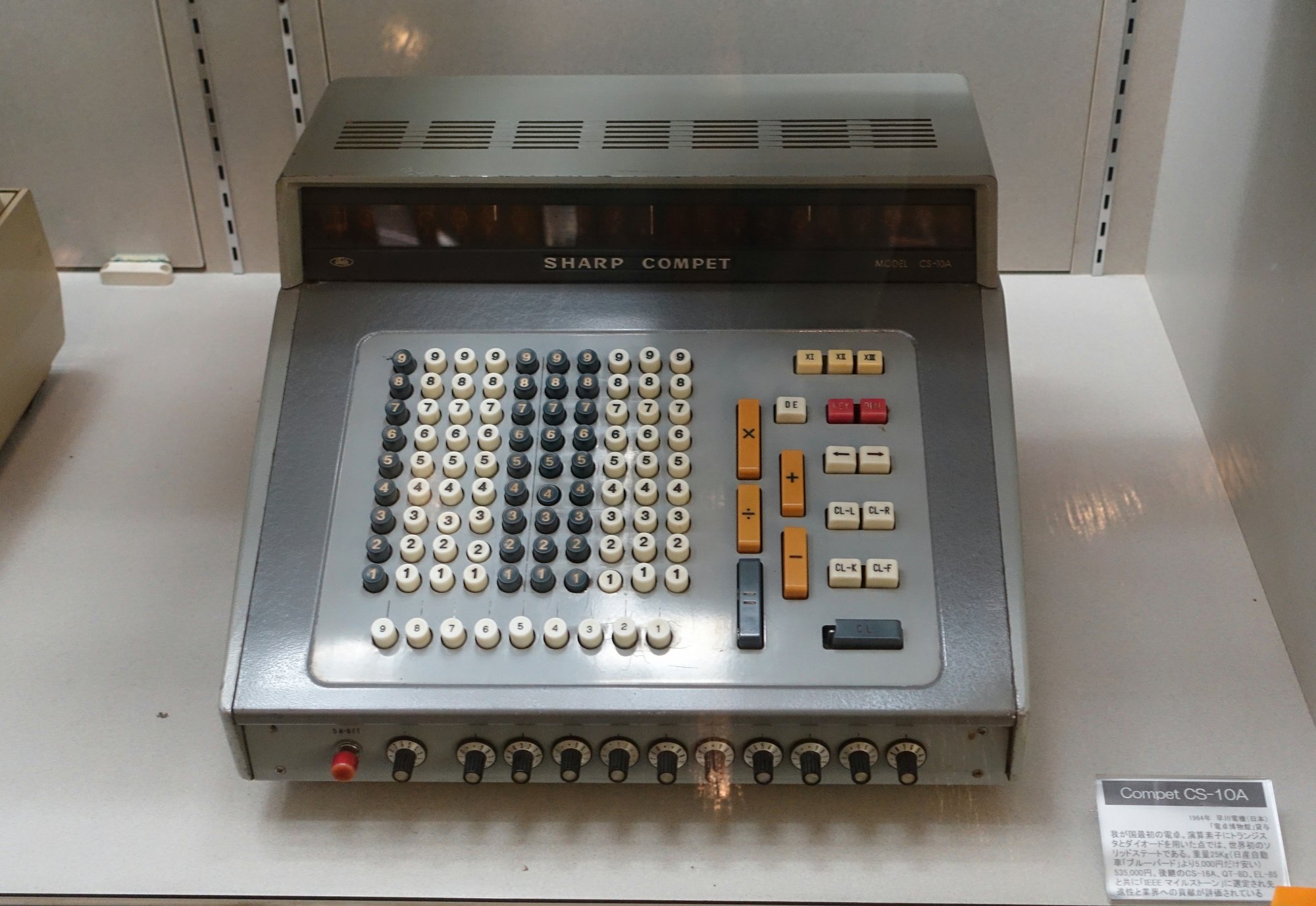
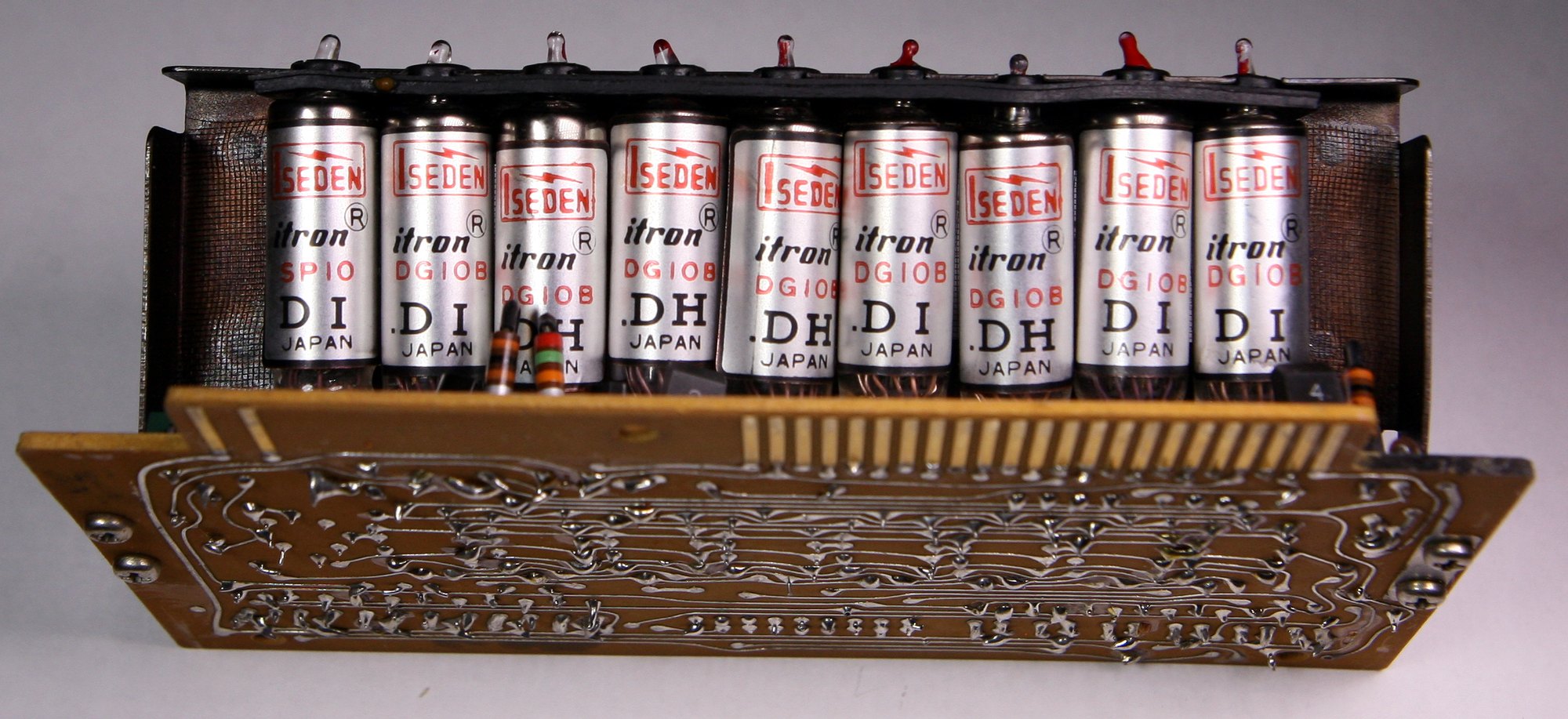
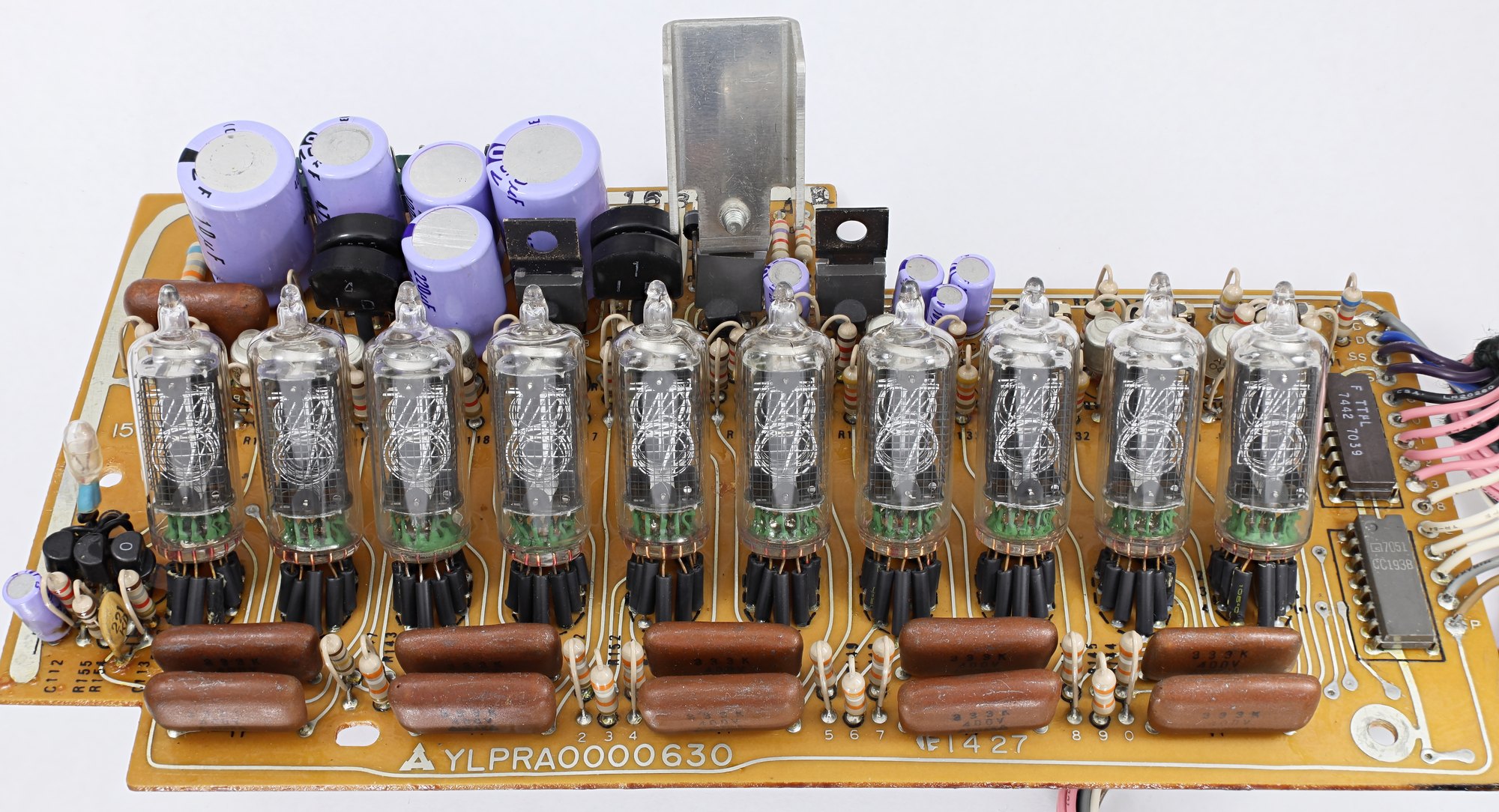
For about twelve years, from the autumn of 1961 to the early 1970s, the electronic calculator showed its answers in glowing orange numerals. Each digit sat in its own small glass tube, a Nixie tube, holding ten wire-thin cathodes shaped like the figures 0 to 9 and stacked one behind another. Light one cathode and its numeral glows in the neon gas, floating a little in front of or behind its neighbours. A row of twelve or sixteen of them across the front of a desk machine is one of the defining images of early electronics, and the machines that carried them are among the most handsome calculators ever made.
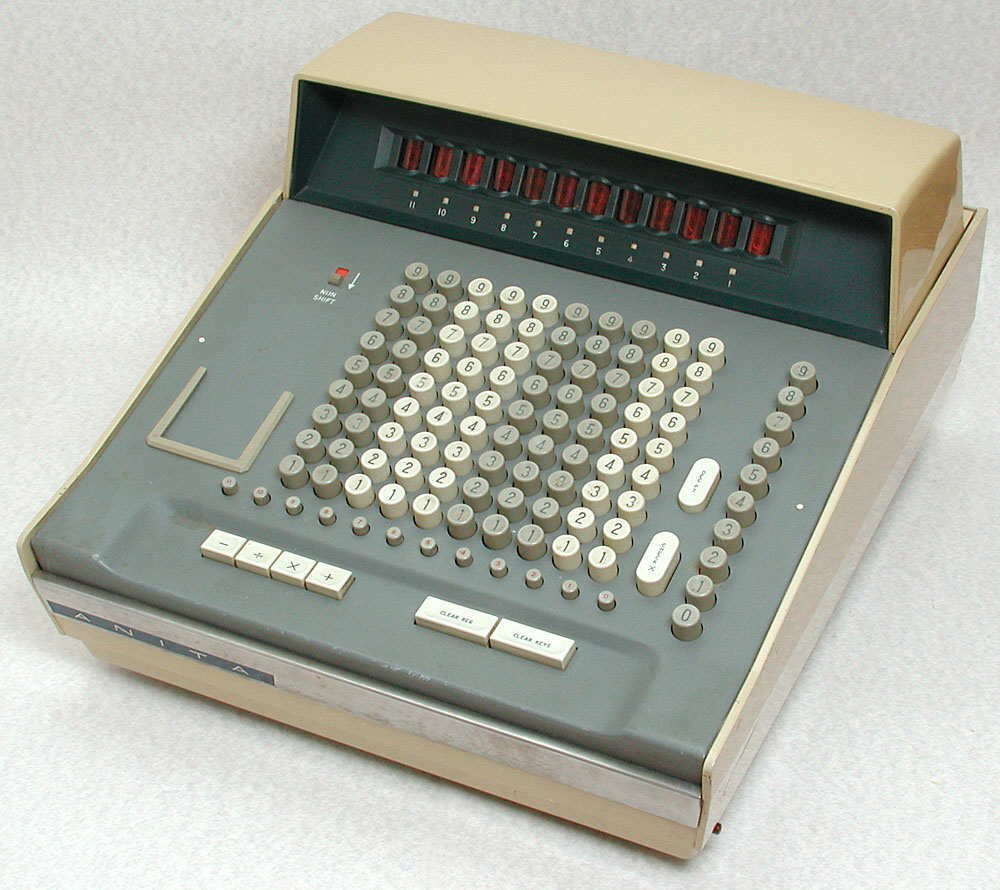
I do not have a Nixie calculator in my collection yet.
1.1 What they are
A Nixie calculator is an electronic desk calculator whose display is a row of Nixie tubes. The name is the collectors’ shorthand; the makers never used it. Burroughs owned “Nixie” as a trademark, and the calculator companies described their displays as “numerical indicator tubes”, “electronic numerical indicators” or simply “glow tubes”. The machines themselves span the whole first generation of electronic calculation:
- Cold-cathode machines (1961–66), whose logic, as well as the display, was made of gas-filled tubes: the British ANITA Mk VII and Mk VIII and their successors.
- Discrete-transistor machines (1964–68): hundreds of germanium or silicon transistors and thousands of diodes on plug-in cards, with memory in flip-flops, magnetic cores, capacitors or a delay line. The Sharp CS-10A, IME 84, Casio 001, Wang LOCI-2 and 300, Toshiba BC-1411 and many more.
- Integrated-circuit machines (1966–70), first with bipolar DTL and TTL chips, then with MOS chips made in Japan and the United States: the Canon 163, Busicom 162, Sharp Compet 22, Friden EC-1113 and EC-1114.
- MOS-LSI machines (1969–72), in which a handful of large chips do almost everything and the Nixies and their high-voltage drivers are much of what is left on the board: the SCM Cogito 412, Casio 121, Friden EC-1117 and the little SCM Marchant I portable.
They were expensive. The ANITA cost about £355 in Britain in 1964, around $1,000 then. Sharp’s first electronic calculator, the CS-10A of 1964, cost ¥535,000, about the price of a small car. Prices fell fast: by 1969 a Hitachi-built Friden EC-1113 cost $895, and by 1971 the EC-1117 cost $445.
1.2 Why Nixies?
In 1961 there were few ways to show a number electrically, and the Nixie was the best of them. It was bright, legible from across a room and from a wide angle, decimal by nature, and available off the shelf from Burroughs in America and from licensees in Britain and Europe. It also needed no heater, unlike a vacuum tube, so it ran cool and lasted for years.
The alternatives each had a drawback. A cathode-ray tube could show several numbers at once, and Friden, Wyle, SCM and Victor used one, but it needed deflection circuits and a high-voltage supply of its own; the sister series on CRT calculators tells that story. Edge-lit lamp displays, sheets of engraved plastic lit from the side by tiny bulbs, were used by Canon on its first calculators, but they cost a great deal to make and the bulbs burned out. Printing calculators, such as the Mathatron, the Monroe EPIC and the Diehl Combitron, had no display at all.
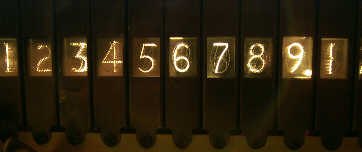
The Nixie had a second advantage that the designers of the ANITA used directly. A Nixie is a one-of-ten device: one cathode glows and the other nine are dark. The ANITA counted in decimal with rings of ten gas-filled switching tubes, also one-of-ten devices, and it could light a Nixie straight from the counting ring with no decoding at all. The theory volumes explain how.
1.3 The machines
Several dozen makers in Britain, Japan, the United States, Germany, Italy, Sweden and the Soviet Union built Nixie calculators. The model volume takes them one by one; in brief:
- Bell Punch / Sumlock Comptometer, England: the ANITA Mk VII and Mk VIII (shown in October 1961), the first all-electronic desktop calculators sold anywhere, followed by the Mk 9, 10, 11 and 12 and the transistor and IC 1000 and 1200 series.
- Sharp (Hayakawa Electric), Japan: the CS-10A Compet (1964), Japan’s first all-transistor calculator, then the Compet 20, 22, 16 and 17, many of them also sold under the Facit and Burroughs names.
- Casio, Japan: the 001 (1965), the 101, the programmable AL-1000 (1967) and AL-2000, and the 121 series of 1970.
- Canon, Japan: after the lamp-display Canola 130 and 161, Nixie machines from the 141 and 163 to the 1200, 1210 and the mini-Nixie L121.
- Toshiba, Sony, Busicom, Denon and Hitachi in Japan: the BC-1411 with its capacitor memory, the SOBAX ICC-500, the Busicom 162, and the machines Hitachi built for Friden.
- Wang Laboratories, USA: the LOCI-2 (1965) and the 300 series (1966), which multiplied and divided by adding logarithms, and the programmable 700.
- Friden, Monroe, SCM and Commodore in the USA, mostly selling Japanese-built machines under their own names: the Friden EC-1113 to EC-1117, the Monroe 770 and 950, the SCM Cogito 412 and Marchant I.
- IME in Italy (the IME 84 of 1964), Olympia and Diehl in Germany, Facit in Sweden, and the Elektronika and Iskra machines of the Soviet Union.
1.4 The end of the Nixie
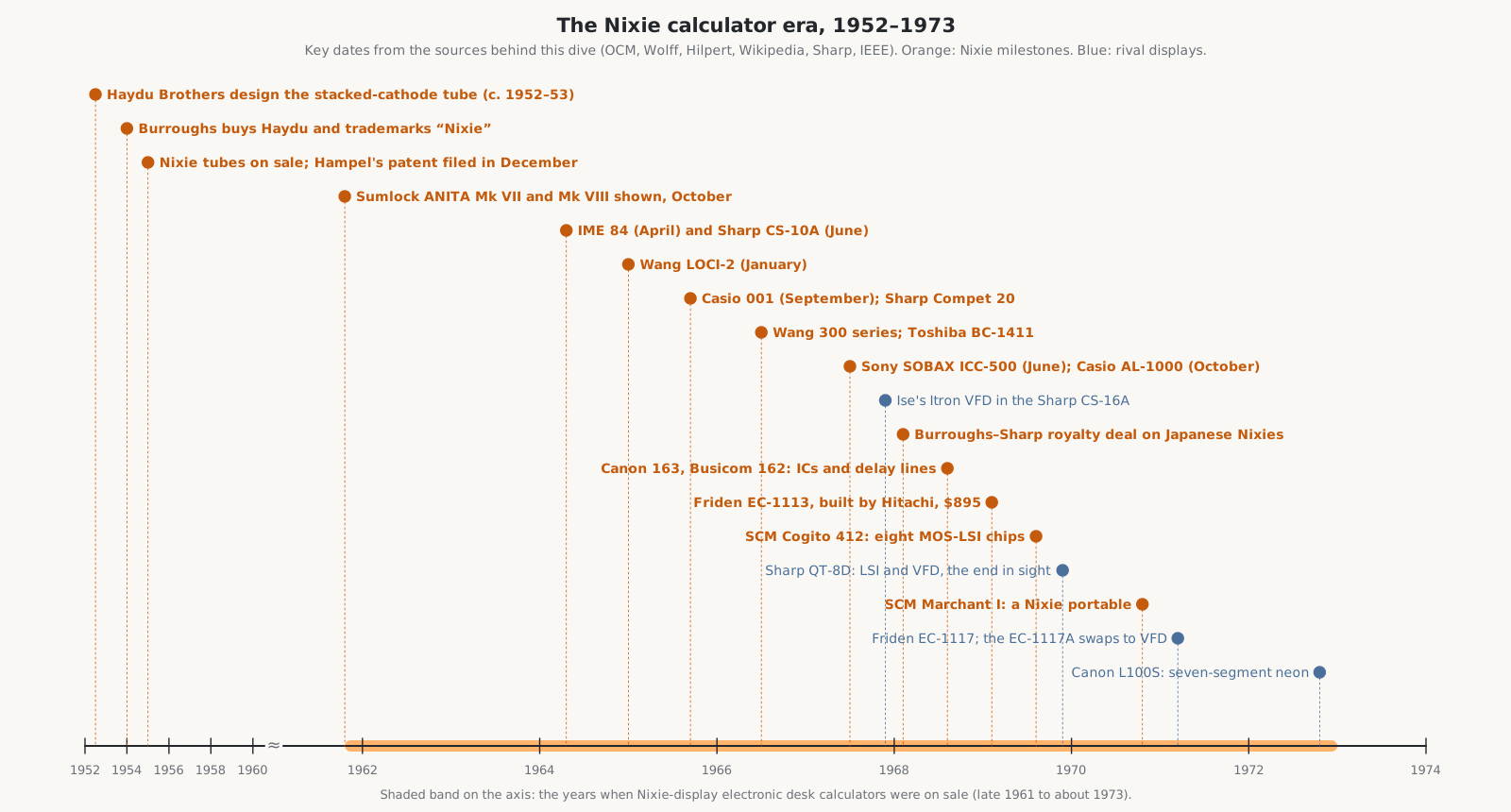
The Nixie’s weakness was its voltage. It needs about 170 volts to strike and 140 to keep glowing, while the transistors and integrated circuits that replaced vacuum tubes ran on 5 to 25 volts. Every Nixie calculator therefore carries a high-voltage supply and a set of high-voltage driver transistors or chips, and the tubes themselves were hand-assembled glass parts. In Japan there was a further cost: Burroughs claimed royalties on every Japanese-made copy of the Nixie, and early in 1968 Sharp agreed to pay one.
The answer came from Japan. In 1967 Ise Electronics, encouraged by Sharp, began making the vacuum-fluorescent display (VFD), a low-voltage tube with a hot filament that glows green-blue and can be driven directly from MOS chips. Sharp put VFDs in its CS-16A at the end of 1967 and in the QT-8D Micro Compet of 1969, the first calculator built on a few large MOS chips. Burroughs’ own Panaplex flat seven-segment neon displays, the Sanyo Eightron and then LEDs did the rest. Canon’s line shows the change neatly: Nixies on its 162P of 1969, the 1210 of 1970 and the mini-Nixie L121 of 1971, seven-segment neon from the L100S of October 1972, and vacuum-fluorescent tubes from 1975. Friden’s EC-1117 of 1971 had Nixies; its EC-1117A successor, otherwise the same machine, had a VFD. By about 1973 the Nixie desk calculator was finished, though Soviet factories went on making Nixie tubes in quantity into the 1980s.
1.5 What is in this series
- Numbers in Neon: this introduction.
- The Nixie Tube: where it came from, how it is made, and why it glows.
- The Machines: every important Nixie calculator, maker by maker, with dates, prices and specifications.
- Driving the Display: the circuits that light a Nixie, from the anode resistor and the pre-bias trick to multiplexing a row of sixteen tubes.
- Inside the Machines: how the calculators themselves work: the ANITA’s gas-tube counters, Wang’s logarithms, the Canon 163’s delay line, Toshiba’s capacitor memory and the MOS chips that ended it all.
- Operating Them: step-by-step instructions and worked examples for the main machines, from the factory manuals.
- Repair and Restoration: what fails, how to find it, high-voltage safety, and how to test and rejuvenate a tube.
- Building One Today: modern Nixie calculators, kits and reproductions, and what goes into one.
- Collecting: what to look for, what they cost, where to find them, and the documents in the Library.
1.6 A note on the sources
The history of these machines has been gathered over many years by a few collectors and museums, and this series leans on them throughout: Rick Bensene’s Old Calculator Web Museum, Nigel Tout’s Vintage Calculators Web Museum, John Wolff’s Web Museum, the Calcuseum database, the DoPECC collection, and above all Brent Hilpert’s Early Electronic Calculators pages, whose reverse-engineered schematics and theories of operation for a dozen Nixie machines explain how they work better than anything the makers published. Where sources disagree on a date, a figure or a tube type, the text says so. The schematics, service manuals, patents and tube data behind the series are in the Reference Library.
Comments (0)