Nixie Calculators · Volume 9
Collecting
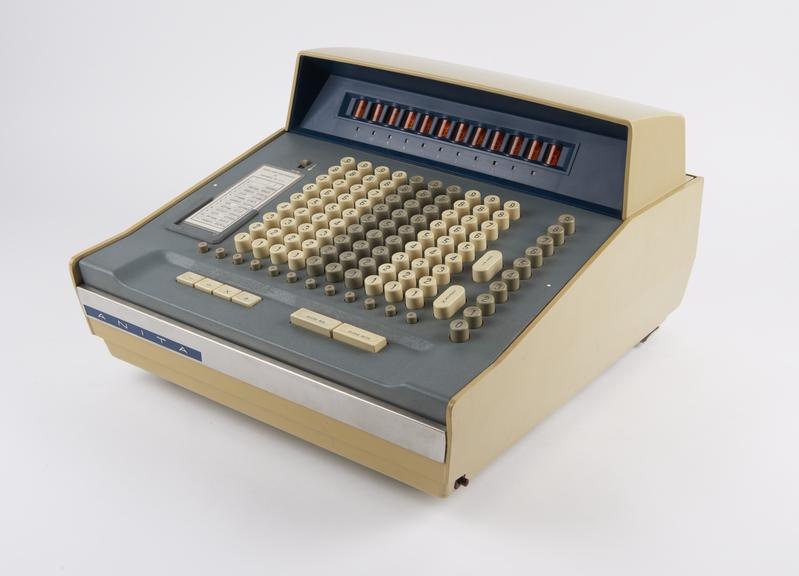
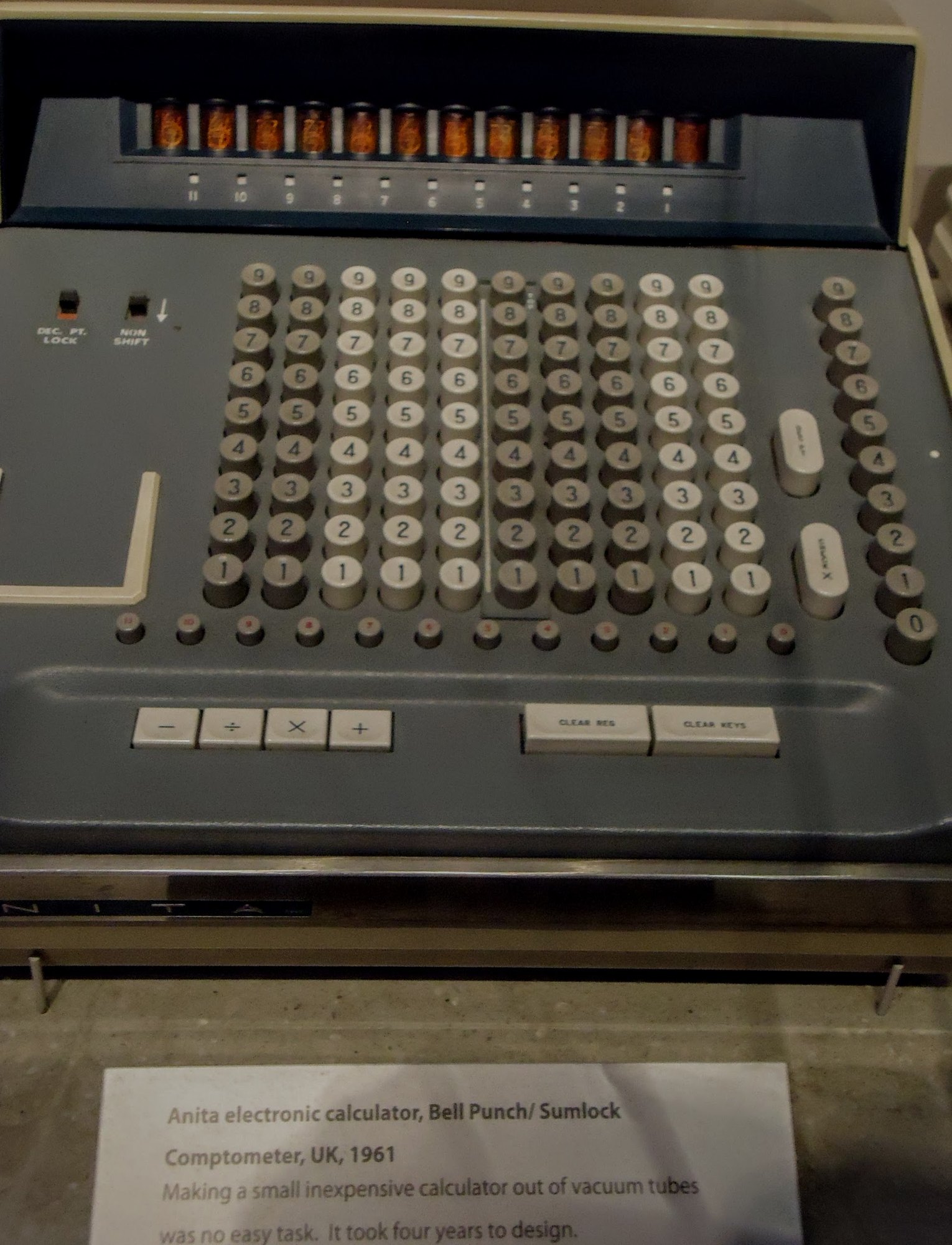
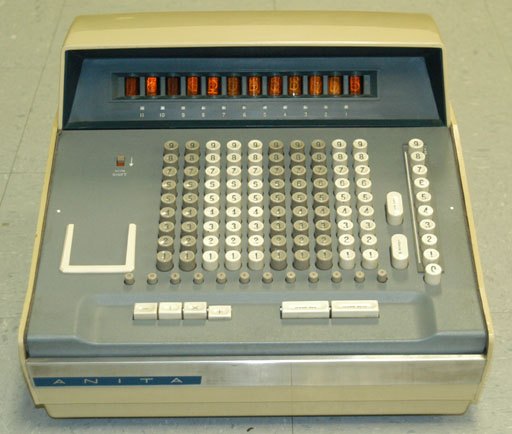
Nixie calculators are easier to find than CRT calculators, and far easier than the cold-cathode ANITAs. The late-1960s Japanese desk machines, built in their tens of thousands and sold under a dozen brand names, still turn up regularly, particularly from Japan. At the other end of the market the ANITA Mk VIII is a museum piece that sells at auction for thousands of dollars. This volume covers what to look for, what they cost, where to find them, what to check before buying, and the documents a collector needs.
9.1 What is common and what is rare
The following judgements come from the production figures and survival reports in the sources, and from the frequency of listings; they are impressions, not a census.
- Rarest. The ANITA Mk VII, with fewer than 1,000 made; the Toshiba BC-1001, of which no surviving example has been found online; the Wang LOCI-1, quickly withdrawn; the early Japanese all-transistor machines, the Sharp CS-10A and Casio 001; the IME 84; and the Nixie portables, the SCM Marchant I and the first Sanyo ICC-82D. The Calcuseum database gives the CS-10A, the IME 84 and the Casio AL-1000 its highest collector rating, ten out of ten.
- Scarce but findable. The ANITA Mk VIII, made in tens of thousands but sought by museums and collectors everywhere; the Wang LOCI-2 and the Wang 300 electronic packages (the keyboards are fairly common, the packages rare and often broken); the Sony SOBAX ICC-500; the Toshiba BC-1411; the Casio AL-1000, which was also sold as the Commodore AL-1000, so search for both.
- Common. The Japanese 12- to 16-digit integrated-circuit desk machines of 1968–71: Canon’s 1200 and 1210, Sharp’s Compets, Toshiba’s BC series, Casio’s 121, the Hitachi-built Friden EC-1113 to 1117, the Busicom 162, the Facit and Monroe rebadges, and the later Anitas of the 1000 series. These are the machines to start a collection with.
9.2 What they cost
Prices are scattered and mostly asking prices rather than sales. The figures found:
Table 1 — Prices are scattered and mostly asking prices rather than sales. The figures found
| Machine | Price | Where and when |
|---|---|---|
| ANITA Mk VIII, “fine, untested” | $7,463 with premium (estimate $1,000+) | RR Auction, 17 March 2022 |
| ANITA Mk VIII | $2,295 with premium | Bonhams New York, 25 October 2022 |
| Canon Canola 1210, “tested, working” | asking about $291 | eBay, private seller in Japan, c. 2025 |
| Canon Canola 1210, “fully functional” | asking $600 plus about $130 shipping | eBay, dealer in Chiba, c. 2025 |
| Singer/Friden EC-1114 | sold about $250 | eBay, July 2025 (listing not seen; from a search summary) |
| Burroughs C-3155 Nixie adding machine | sold about $150 | eBay, July 2025 (from a search summary) |
| Olympia CD401, described as Nixie and working | asking £199 | eBay (Hilpert lists the CD401A as vacuum-fluorescent, so check) |
| Wang 300 electronic package | asking $1,500–2,000 | eBay, 2019–21, as reported by a builder |
| Soviet IN-8, IN-14, IN-18 tubes | €30–200 a lot | eBay Germany, 2025 |
No reliable sale prices were found for the Casio AL-1000 or AL-2000, the Sharp Compets, the Wang keyboards on their own, the later ANITAs or the Soviet machines. Price-history sites such as Worthpoint and Aucfan (for Yahoo Japan Auctions) need a paid subscription. For comparison, a few original list prices: Casio AL-1000 $1,495; Friden EC-1113 $895; Wang 360SE package $3,990 and 360K keyboard $500; Olympia RAE 4/15 5,890 DM in 1965.
9.3 Where to look, and what to search for
Most Nixie calculators are not listed as “Nixie calculators”. Search by model name and number, and in the language of the country where they were sold.
- English (eBay and auction sites): “nixie calculator”, “nixie tube calculator”, “nixie adding machine”, “cold cathode calculator” (the term Bonhams used), and model names: “Canola 1210”, “Canola 163”, “Compet CS-”, “Toshiba BC-”, “Casio 121”, “AL-1000”, “Commodore AL1000”, “Friden EC-1114”, “Wang 360”, “Wang 320K”, “Busicom 162”, “Sumlock Anita”.
- German (eBay.de, Kleinanzeigen): “Nixie Röhrenrechner”, “Nixie Tischrechner”, “Nixieröhren Rechner”, “Olympia RAE”.
- Japanese (Yahoo Auctions Japan, through a proxy buying service): ニキシー管 電卓 (“Nixie tube calculator”), キャノーラ ニキシー (Canola Nixie), コンペット ニキシー (Compet Nixie). In Japanese listings, ジャンク means junk or sold as-is, and 通電OK means it powers on. Japan is the best source for Canon, Sharp, Casio and Toshiba machines, but they are 100 V machines and shipping a heavy desk calculator from Japan costs about $130.
- Russian (Avito, Meshok): “калькулятор газоразрядный”, “Искра 111”, “Искра 122”, “Электроника 155”, “ЭКВМ”. Expect noise: the Lada Iskra is a car.
- Collector groups: the Old Calculator Forum and neonixie-l Google Groups and the cctalk mailing list, where machines change hands among collectors.
- Auction houses for the ANITA and other important machines: Bonhams, RR Auction and the European technical auctions.
9.4 What to check before buying
- Mains voltage. 100 V for Japanese machines, 220 V for the ANITA, 117 V for American machines. A 100 V machine needs a step-down transformer outside Japan.
- The tubes. Are they all present and unbroken? Is any a replacement of a different type, standing out by its height, colour or numeral style? Darkened glass means heavy use.
- The display, if it can be tested. Look for dark tubes, missing numerals, numerals that are only partly lit (poisoning), and faint extra digits or numerals that stay on (driver faults). A dark display may be a timing fault rather than a tube or high-voltage fault, and is not necessarily fatal.
- The keyboard. Every key, and any latching keys, should work and return.
- Corrosion, cracked boards and leaking capacitors. Ask for photographs of the inside if the seller will open it.
- Completeness. A Wang 300 keyboard is useless without its electronic package and the 30-conductor cable that joins them, or a modern replacement such as Bob Alexander’s board; one builder’s console arrived with its cable cut. Check for the card readers, printers and memory units that some machines were sold with.
- Delay-line machines. A dead delay line may be impossible to repair.
- Weight and packing. Most of these machines are heavy and fragile, and the tubes break in transit. Insist on double boxing with plenty of foam, and remove nothing from inside unless it is loose.
Table 2 — What to check before buying
| Machine | Weight |
|---|---|
| ANITA Mk VIII | about 30–33 lb |
| Toshiba BC-1411 | 37.5 lb |
| Casio AL-1000 | 24 lb |
| Wang 360SE package | 25 lb, 25 in wide |
| Friden EC-1113 | 12 lb |
| Friden EC-1115 | 10 lb |
| Wang 300 keyboard | 6 lb |
| SCM Marchant I | 2.4 lb |
9.5 Telling a Nixie from the rest
Sellers often call any old calculator with a glowing display a “Nixie”. A true Nixie numeral is a complete, curved, wire-outline figure in orange, with the other numerals visible faintly behind it, and each digit is a separate round glass tube. A seven-segment display, whether neon (Panaplex, Sanyo’s Eightron), vacuum-fluorescent (green or blue) or LED (red), builds every figure from the same seven straight bars. A CRT draws all its figures on one screen. A lamp display, like the early Canons’, shows flat, evenly lit figures on a stack of plastic sheets. The model volume lists the machines most often mis-described.
9.6 Museums
Nixie calculators can be seen at the Science Museum in London (ANITA prototype and Mk VIII), the Computer History Museum in Mountain View, the technikum29 museum near Frankfurt (a working ANITA and the IME 84), the Centre for Computing History in Cambridge (ANITA documents), the Ridai Museum of Modern Science in Tokyo (Sharp CS-10A), the Rhode Island Computer Museum (Wang LOCI-2), the Whipple Museum in Cambridge (IME 86S), Museums Victoria in Melbourne (IME 86), and a museum of calculating instruments in Pisa (ANITA). Rick Bensene’s Old Calculator Web Museum is the largest online collection.
9.7 The documents in the Library
Every document found for these machines is in the Reference Library. The most useful:
- Operating manuals: the Wang 300 series instruction manual (1968), the Wang LOCI-2 reference manual (1966), the Wang 700 and 720A/B manuals, the IME 26 instruction manual, and Bob Alexander’s Wang 300 modern package manual.
- Service manuals: Wang LOCI, Friden EC-1113, Friden EC-1115, Monroe 920, and the logic and timing manuals for the Canon Canola 1200 and Monroe 925.
- Brent Hilpert’s schematics and theories of operation: the Canon 163, Sony SOBAX 2500, IME 84 and IME 86S, with schematics for those and for the Casio AL-1000 and 121-B, Sharp Compet 17, Monroe 925, Toshiba BC-1212 and Wang 320K.
- Patents: Hampel’s Nixie tube, Kitz’s ANITA and Wang’s logarithm method.
- Catalogues, data and history: Wang’s 1968 catalogue and price list, the Hitachi HD3100 chip data sheets, the Russian Nixie tube data, the Olympia RAE 4/15-2 data sheet, Diehl’s history of its electronic calculators and Friden’s project lists for 1961–1968 and 1961–1979.
Documents known to exist but not online: the ANITA Mk VIII’s 59-page operating instructions (sold only as a paper reproduction); the ANITA Mk 9, 10 and 12 circuit diagrams at the Centre for Computing History; the Sony SOBAX ICC-500 owner’s manual at the Smithsonian; and the Wang 300 service manual, 03-0007-0.
Sources
The main web sources for this series, beyond the documents above:
- Rick Bensene, The Old Calculator Web Museum: exhibits and specifications for nearly every machine in this series. https://www.oldcalculatormuseum.com/
- Brent Hilpert, Early Electronic Calculators: schematics, theories of operation, display and chip tables, repair logs. http://madrona.ca/e/eec/
- Nigel Tout, The Vintage Calculators Web Museum: the ANITA story. https://www.vintagecalculators.com/
- John Wolff’s Web Museum: Canon, Casio and ANITA chronologies and technical pages. https://www.johnwolff.au/calculators/
- Serge Devidts, Calcuseum. https://www.calcuseum.com/
- DoPECC calculator collection: Wang LOCI-2 and 360E technical notes. https://dopecc.net/
- technikum29 computer museum. https://technikum29.de/
- Dieter Wächter, tube-tester.com Nixie data archive, including Burroughs Catalogue 616 and Bulletins 1104D and 1132C. https://www.tube-tester.com/sites/nixie/
- The sr-ix.com decimal-tube archive, on the Haydu and Burroughs history. https://www.sr-ix.com/Archive/decimal-tubes/
- Philips ZM1000 data sheet (frank.pocnet.net).
- ETHW, “Milestones: Pioneering Work on Electronic Calculators, 1964–1973” and the IEEE milestone proposal on the vacuum-fluorescent display.
- Sharp Corporation, corporate history blog; Casio, corporate history.
- The Science Museum Group, Computer History Museum and Heinz Nixdorf MuseumsForum collection catalogues.
- Hackaday, on Bob Alexander’s Wang boards and the Tech Tangents SOBAX repairs; Scott Baker (smbaker.com); Hack Manhattan wiki.
- Wikipedia: “Nixie tube”, “Sumlock ANITA calculator”, “Bell Punch”, “Sharp QT-8D”.
- The classiccmp (cctalk) mailing list, the Vintage Computer Federation forum, the neonixie-l and Old Calculator Forum groups.
Comments (0)