Soviet Calculators · Volume 9
Collecting
Soviet calculators are among the most affordable of all vintage calculators, and among the most rewarding to collect. The common programmables still turn up new in their boxes, every machine came with its paperwork, the factory’s mark and the price are often moulded into the case, and the history is well documented, if mostly in Russian. The desk machines and the pocket computers are another matter: rare, heavy to ship, and mostly in museums.
9.1 What is common and what is rare
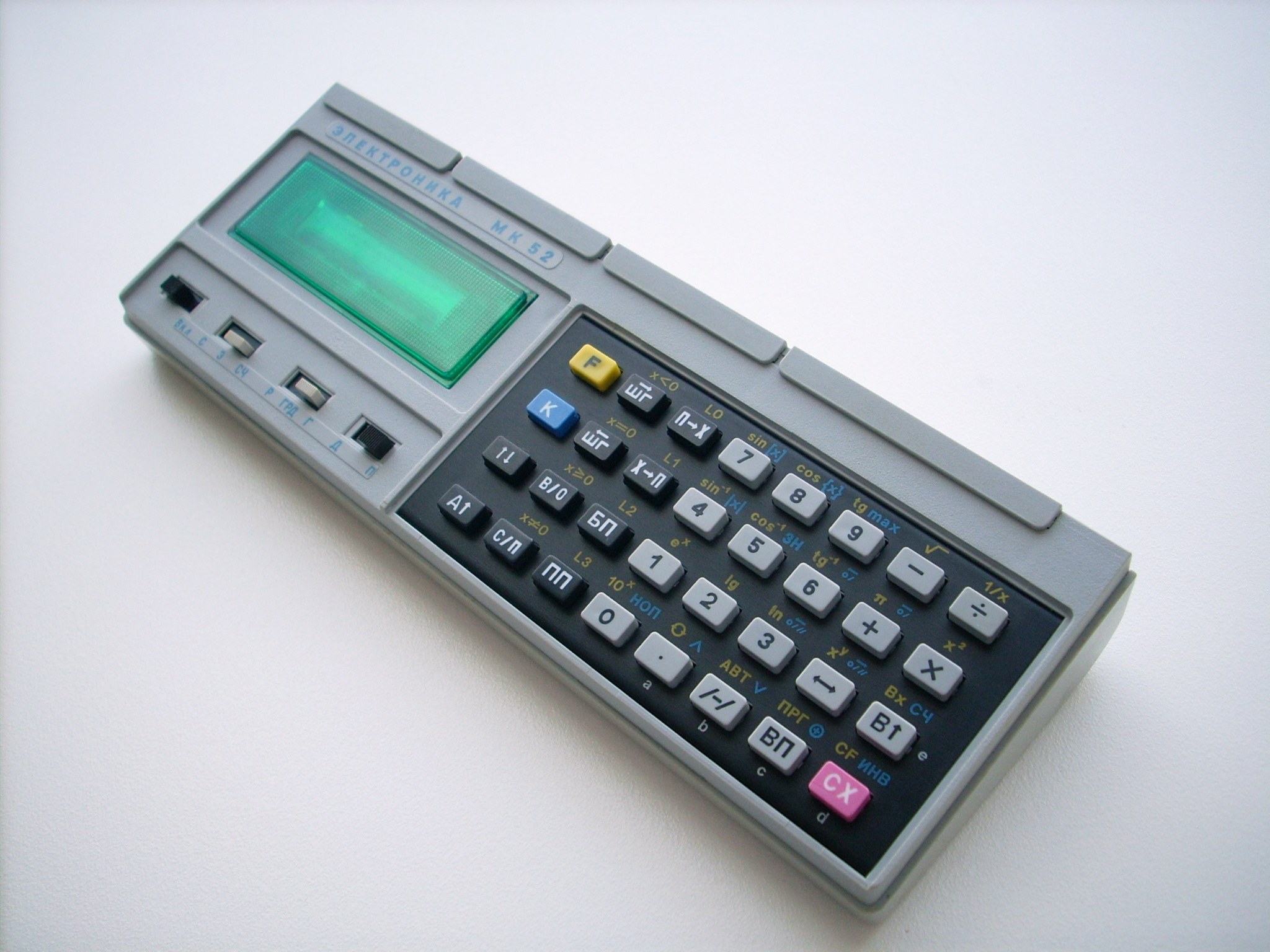
- Common: the MK-61 and MK-52, often as new old stock; the MK-51; the B3-36 and MK-36; the MKSh-2 and MK-71 school and solar machines; most of the later four-function pockets. The common scientifics are traded among collectors for about $10 to $15.
- Less common: the B3-34, the B3-21 (especially the red-LED version), the B3-18 and B3-18A, the B3-19M, the MK-54, and variants with ceramic chips.
- Rare: the MK-85 and especially the MK-90 and MK-87; the С3- desk machines; and anything from the desk era, the Vega, EDVM, Elektronika 68, Iskra Nixie machines and Elektronika 24-71, most of which survive in museums.
The Calcuseum database’s collector ratings, out of ten, give the B3-34 8, the B3-23 7.5, and the MK-36 and MK-85 7.
9.2 What they cost
Market prices are thin; these are from eBay listings and a few sales.
Table 1 — What they cost
| Machine | Price | Kind |
|---|---|---|
| MK-61, boxed, 1988 | $25 | sold |
| MK-61, used | about $24–45 | asking |
| MK-61, new in an opened box | about $98 | asking |
| MK-61 with adapter and case (UK) | £39 | asking |
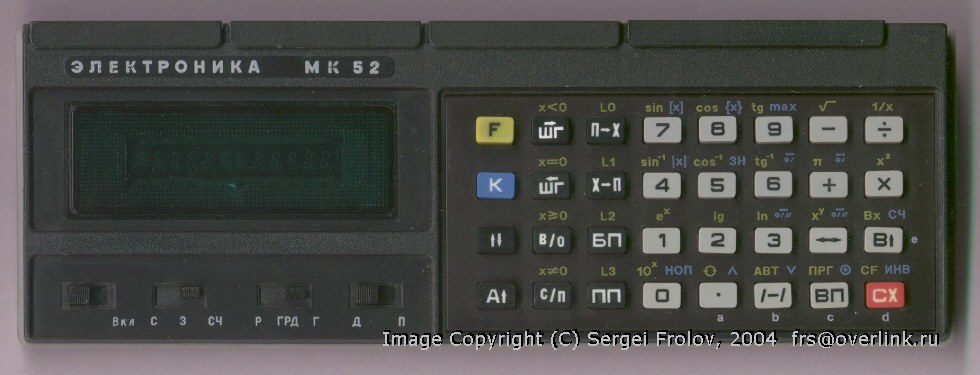
| MK-52 “new”, from Ukraine | $30, plus $20 shipping | asking (many sold) |
| MK-52 used, with a ROM module | about $74, plus shipping | asking |
| B3-23 red LED, from Riga | $85, plus shipping | asking |
| MK-90 | $1,600 | asking |
Prices on the Russian sites Avito and Meshok could not be checked for this series.
9.3 Reading a machine
Serial numbers. On MK-61s and MK-52s from the Kiev plants the serial number appears to begin with the year and month of manufacture: an MK-61 numbered 91 12 608446 came in a box dated December 1991, and others are numbered 90 02 … and 92 09 …. Other plants put the month and year at the end: an MK-54 numbered K 104074 11 85, a B3-32 numbered 191001 01 84, an MK-51 numbered 50301 06 1991. No decoding table has been found; this is a pattern read from about ten machines.
Plant marks. The makers’ logos are embossed on the cases. On MK-61s, collectors have identified Kvazar, Kvantor and Kontinent, with Kristall and Kosmos reported; one has been dated November 1996, years after the Soviet Union ended.
Prices on the case. Many machines carry their price moulded into the plastic or printed on the label: ЦЕНА 65 РУБ on an MK-54, 58 roubles on the label of a B3-30 made in 1979.
The paperwork. A complete machine has its operating manual with the circuit diagram, the warranty card with the seller’s stamp and date of sale, two tear-off repair vouchers matching the serial number, the quality-control (ОТК) stamp, and an unbroken wax seal on the case screw. The warranty was 24 months from the date of sale. A complete set is the best evidence of an untouched machine.
New old stock. Many MK-61s and MK-52s sold as new really are: collectors report machines in perfect order in boxes stained and worn from years in unheated warehouses, “never used, but … stored for years before sellers in Ukraine and Russia found eBay”. No counterfeit Soviet calculators or reproduction boxes have been reported.
9.4 Before buying
- The battery box: corrosion, leaked cells, the state of the contacts.
- The display: every segment of every position lit evenly when the display is filled with 8s; no cracks in the tube.
- The power switch: on an MK-61, switch it on and off several times; an unreliable ПД9-2 is the commonest fault.
- The keys: every key registering once, without bounce; sticky foam shows as keys that wobble or repeat.
- A test: run the circle-area program from the operating volume, and check the angle switch with a sine.
- The adapter: original adapters are often missing, and the Д2-10М is best replaced with a regulated supply anyway.
- The extras: box, manual with schematic, warranty card and vouchers.
9.5 Buying from Ukraine and Russia today
Most new-old-stock MK-61s and MK-52s come from Ukraine, where the Kiev plants were. In 2025, Ukrainian sellers on eBay were quoting delivery of about two to three weeks, with the buyer paying the import fees to the carrier.
- Russia. eBay suspended its Global Shipping Programme to Russia and Ukraine from 21 February 2022, and all transactions with Russian addresses in March 2022; Russian sellers’ listings were hidden. The US Postal Service stopped accepting parcels for Russia at the same time. The US executive order of 11 March 2022 banning imports of certain Russian goods named seafood, alcoholic drinks and non-industrial diamonds, not calculators; later designations were not checked for this series.
- United States duty. Duty-free treatment of low-value imports, the de minimis exemption, ended for all countries on 29 August 2025. A $30 MK-61 from Ukraine now carries duty and possibly a carrier’s fee.
9.6 Emulators
The Soviet programmables are still widely used through emulators, most of them descended from Lazarev’s chip-level work:
- emu145, by Felix Lazarev (2011–12, GPL): the microcode-level emulator of the К145 and К745 chips, built from photographs of the dies, with the ROM dumps.
- МК 61/54 for Android, by Stanislav Borutsky, and its extended version by Vadym Khokhlov (“xvadim”), GPL, on F-Droid and Google Play: microcode-level emulation of the MK-61 and MK-54, “including undocumented features and calculation inaccuracies”, with program import and export.
- Web emulators at mk-61.moy.su (with a view of the memory and the ticks) and on the Kon-Tiki site, pmk.arbinada.com.
- “Калькуляторы 3000” by Yevgeny Troitsky (2003), a Windows emulator of many Soviet calculators at the level of their functions, without the undocumented features.
- Hardware emulators: Sergey Vakulenko’s cycle-accurate MK-61 on a PIC32 microcontroller (2014), the MK61S on an STM32 (2020), and the MK-61s-Mini on a small STM32 board (2024).
9.7 Modern successors
The Novosibirsk firm Semico made two programmable calculators in the 2000s that keep the command set of the B3-34, MK-61 and MK-52: the desktop MK-152 of 2007, at 6,200 roubles, and the portable MK-161 of 2009, at 14,800 roubles in 2019. They are not replicas: inside are an 8051-family microcontroller at 22 MHz, a 128 × 64 dot LCD, 10,000 program steps, 1,000 registers and a 512 KB “electronic disk”, about a thousand times as fast as an MK-52.
The community that grew up around the programmables in the 1980s is still active: the Kon-Tiki site and its library of 117 Russian books and an index of magazine articles from 1975 to 2007, and new programs, among them simulations of the Vostok 1 flight, the first stage of the Saturn V and the launch of Apollo 11, written for the MK-61 in 2022.
9.8 Museums and collections
- Sergei Frolov’s Soviet Digital Electronics Museum (leningrad.su), now offline but preserved in the Internet Archive: the largest collection, with photographs and specifications of hundreds of machines.
- The Mytishchi Museum of Computing Technology (b3mk.ru), near Moscow.
- The Polytechnic Museum, Moscow, which holds the Elektronika-70.
- The Yandex museum, Moscow, with an Iskra-110 and Elektronika C-2.
- Amuseum, Sofia, for the Bulgarian ELKA machines.
- The Jim Austin Computer Collection in England, which holds an MK-90.
9.9 The documents in the Library
Everything in the Reference Library for this series:
- Manuals: MK-61 (Russian, English), MK-52 (book 1, book 2, English), B3-34, B3-21 and its passport, MK-51, MK-90, MK-85, B3-18A, B3-35, MKSh-2, the B3-26 passport, and for the desk machines the Iskra 110, Iskra 111, Elektronika 155, B3-02 and С3-22.
- Schematics: MK-61, B3-34, MK-52 (two sheets), B3-14, B3-18A, B3-26, MK-85, listed in the repair volume.
- Books: Trokhimenko and others, Programmable Microcalculators: Design and Use (1990); Trokhimenko and Lyubich, Microcalculator, Your Move! (1985); Ochkov and Khmelyuk, From the Microcalculator to the Personal Computer (1990); Epanechnikov and Tsvetkov, Handbook of Applied Programs for Microcalculators (1988).
- Magazines: Техника — молодёжи no. 6 of 1985, with Lunolet-1, and its English translation; FunkAmateur of June 1967, on the Soemtron 220.
- Component data: the IN-14 and IN-17 table and the АЛ304 LED datasheet.
9.10 Gaps
No manuals have been found online for the B3-04, MK-54, MK-71 or B3-36, nor any factory schematic of a Soviet Nixie desk machine. Russian market prices, an official table of Soviet wages, and a primary source for the MK-52’s reported flight on Soyuz TM-7 are still to be found.
Comments (0)