Soviet Calculators · Volume 3
The Desk Machines, 1962–1980
The first Soviet electronic calculators were desk machines for offices, planners and the military, built by the instrument-making industry in the same factories that made mechanical arithmometers. They followed the same path as their Western and Japanese counterparts, from discrete transistors to integrated circuits and from glow tubes to fluorescent displays, but on their own timetable and with their own parts: ferrite-transistor cells, potted micro-modules, Soviet Nixie tubes and, from 1971, Soviet fluorescent tubes.
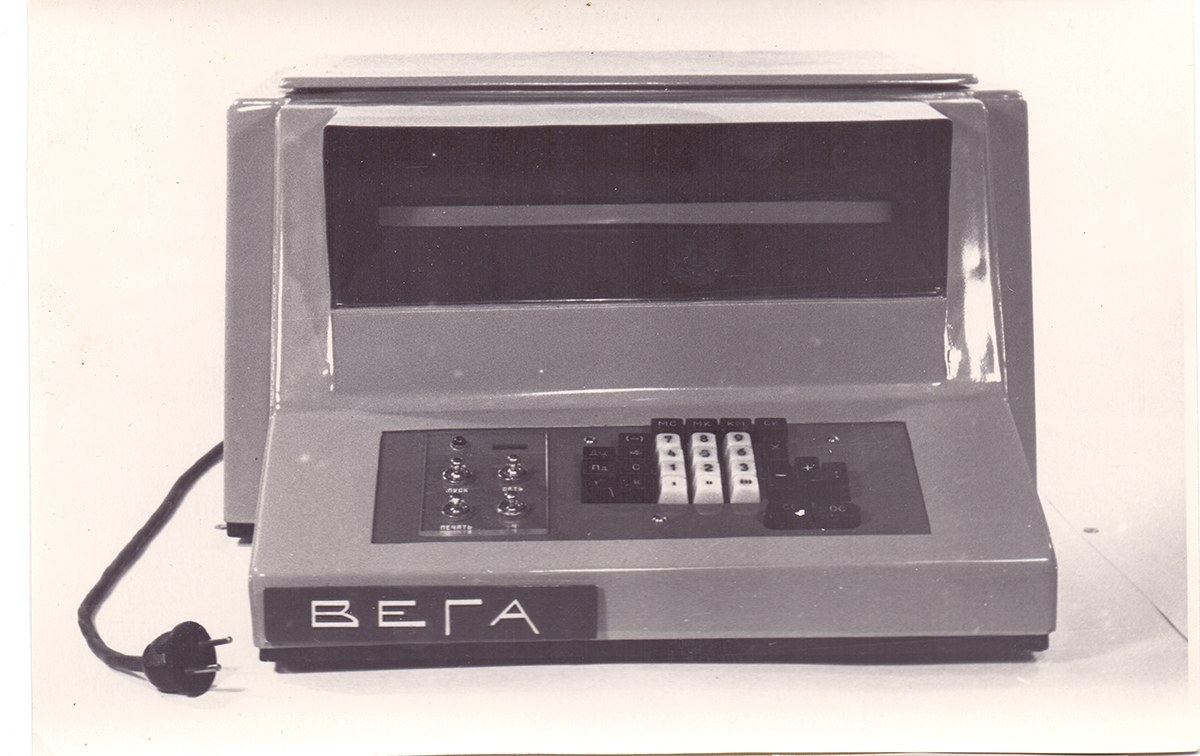
3.1 Vega (1962–64)
According to one Soviet chronology, the decision to build an electronic calculator followed the appearance of the British ANITA at an exhibition in 1961. The Vega (Вега) was designed at the Leningrad branch of the Central Economic-Mathematical Institute of the Academy of Sciences by V. B. Marakhovsky, E. A. Kanevsky and G. I. Menderskaya, worked by November 1962, and went into production at the Kursk accounting-machine works in 1964. One account places the team at the Leningrad branch of the Steklov Mathematical Institute instead.
- It used about 1,500 ferrite-transistor elements: logic built from ferrite cores switched by transistors, not saturated transistor logic.
- Its display was not Nixie tubes, which the Soviet Union was not yet making, but a specially developed electroluminescent display of seven-segment digits, about 25 V, showing twenty decimal places.
- It added, subtracted, multiplied and divided, and could raise to powers and extract roots; addition took at most 0.1 s and a square root up to 7.5 s.
- It measured 500 × 430 × 240 mm, weighed up to 25 kg, and had 28 keys.
It won state trials against rival designs called Lada and Vyatka-E; a relay machine called Neva was built at Penza. Kursk was a reluctant producer, and output grew by only about 20 per cent a year. The inventors’ certificate, with a priority date of 9 May 1963 by one source, is said to have been the first Soviet certificate for an electronic machine, and the design was patented in West Germany, Italy and France.
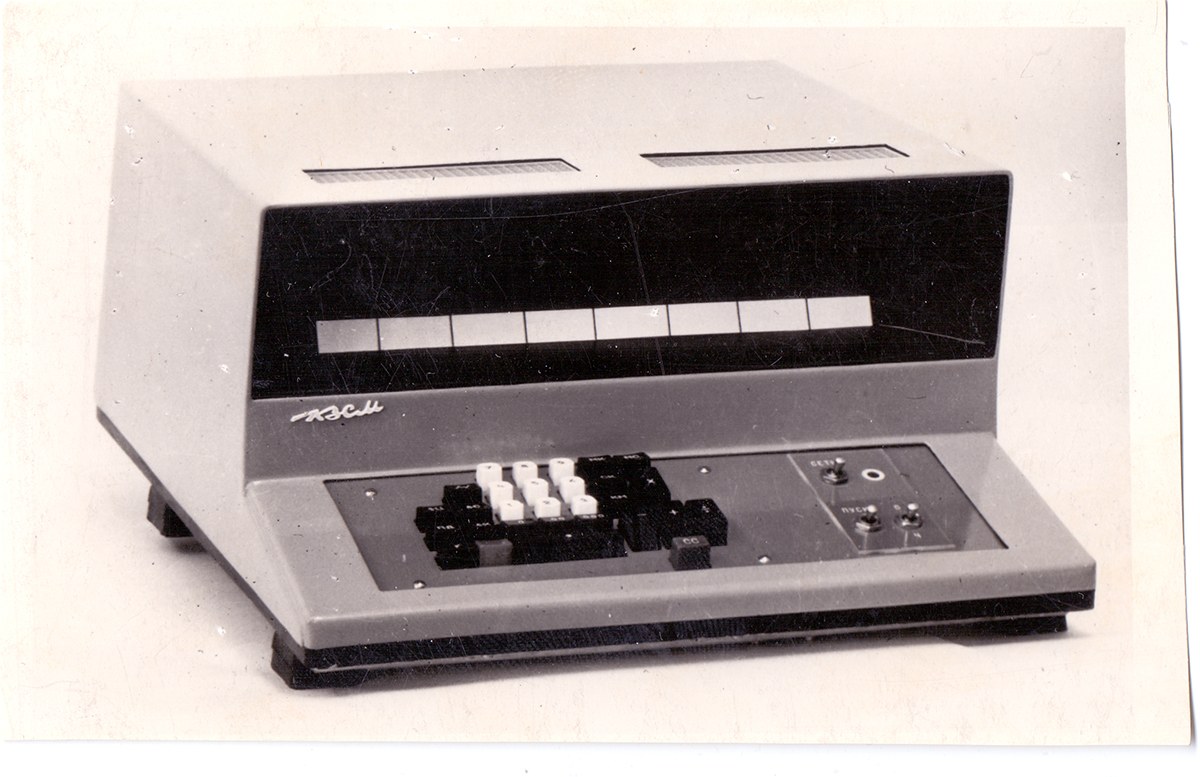
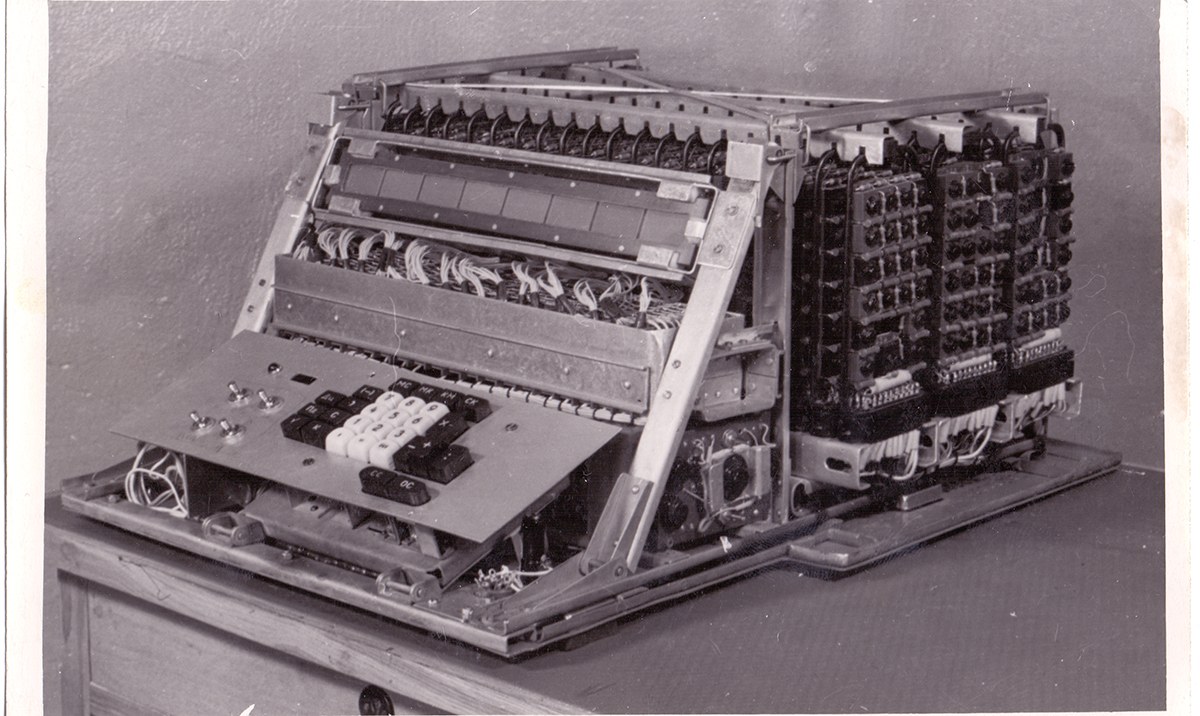
3.2 EDVM (1967): the scientific machine for the army
The EDVM, from the same Leningrad group, was described by Frolov as the first Soviet electronic scientific calculator. It was made for military topographers at the Ufa instrument plant and not sold to the public: sixteen digits, four registers, sine and arctangent, a ten-key keyboard, IN-16 Nixie tubes, ferrite-transistor logic, mains or 12 V DC power, and an output for a telegraph printer. A printing version, the EDVM-P, served the army into the mid-1980s.
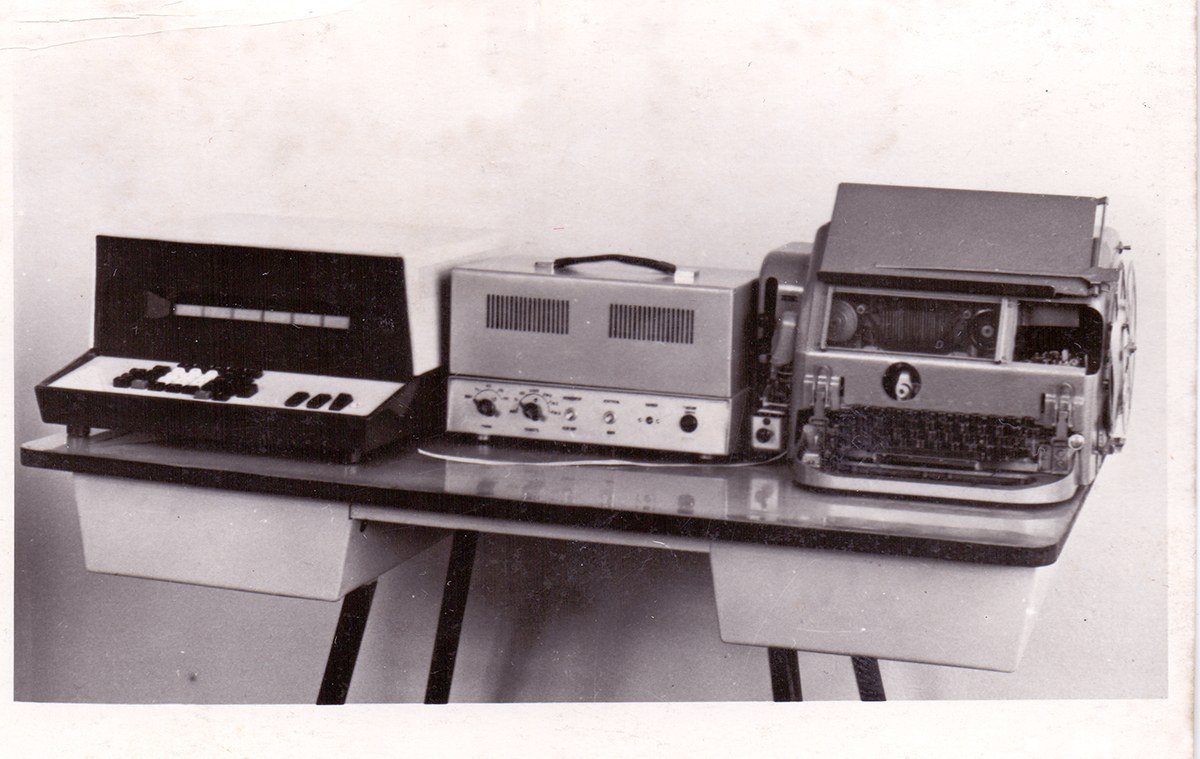
3.3 Rasa (1968–69)
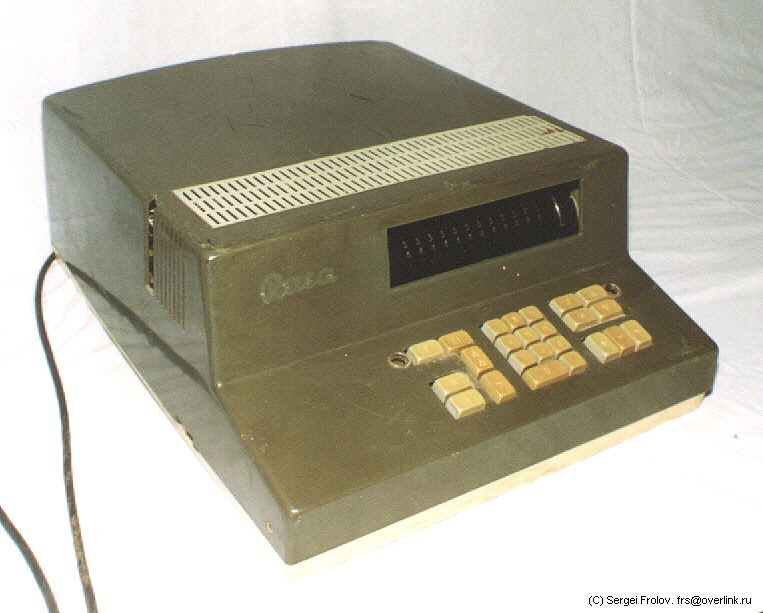
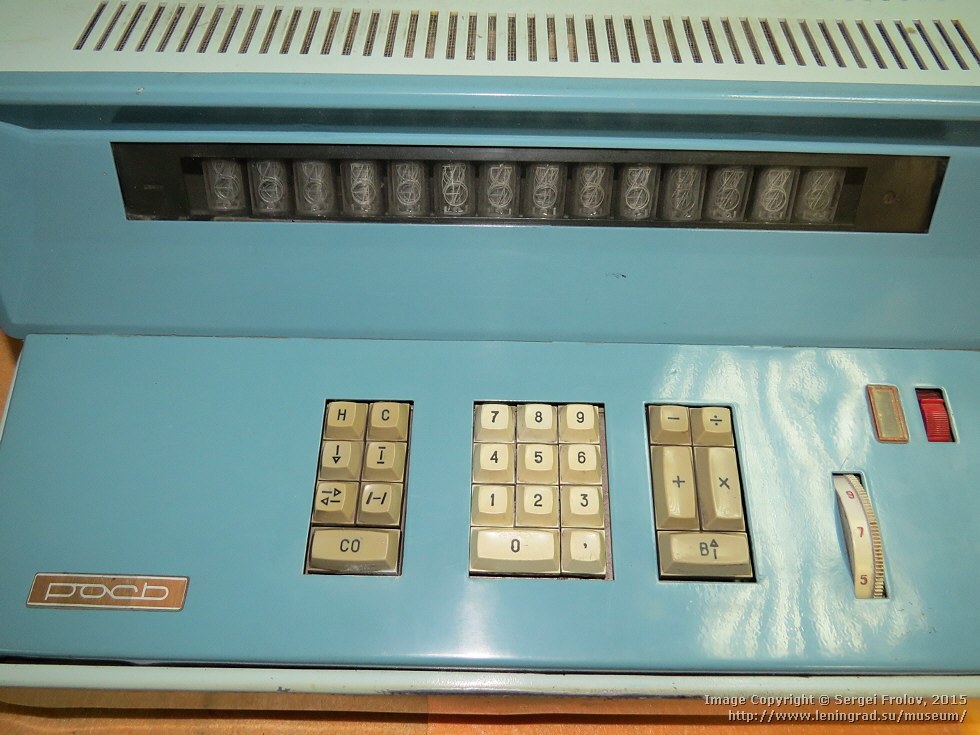
The Rasa is the odd one out: a ferrite-transistor desk machine with reverse Polish notation and a “stroboscopic” display, a rotating drum of figures lit at the right moment, according to Frolov and to a Soviet chronology that dates it to 1969 and mentions thyratrons. Its maker has not been identified.
3.4 Elektronika DD and Elektronika 68 (1968)
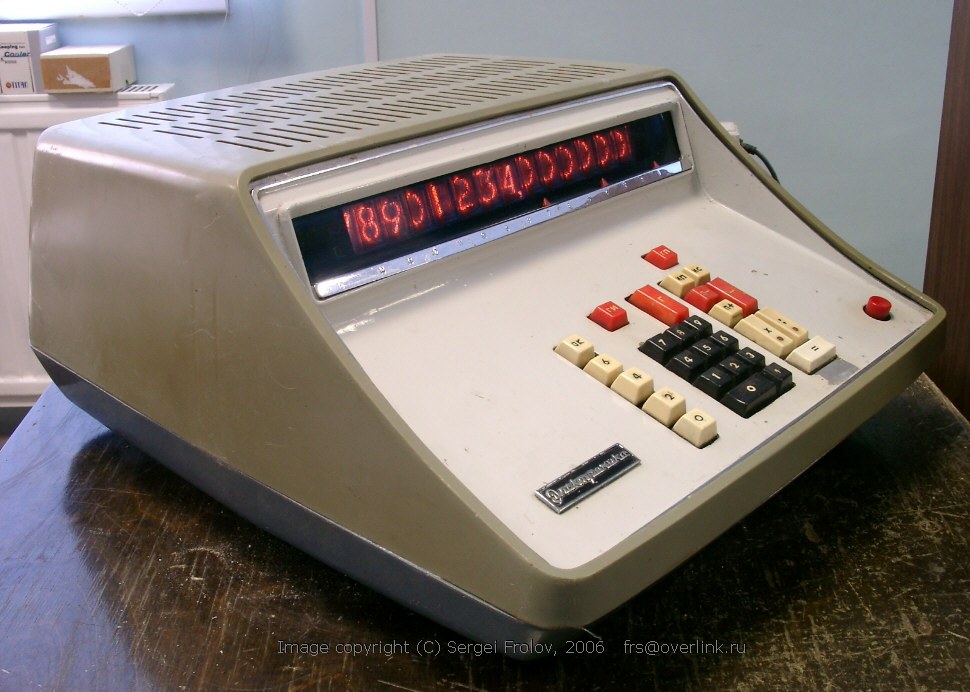
The Elektronika DD and Elektronika 68, developed at the Tsiklon research institute near Moscow in 1968, were fully transistorised: about 400 to 600 KT315 transistors, 700 to 1,500 diodes and some 1,400 resistors and capacitors, on fourteen circuit boards, with fourteen IN-8-2 Nixie tubes. They showed negative results in complement form, with no minus sign. As the industry volume describes, they were closely modelled on the Sharp Compet CS-30. The Elektronika 68 went on to be made in the early 1970s as the B3-01, at Elektronpribor in Fryazino according to one source, at 7,000 to 10,000 a year according to another.
3.5 Elektronika-70 and T3-16: programmables
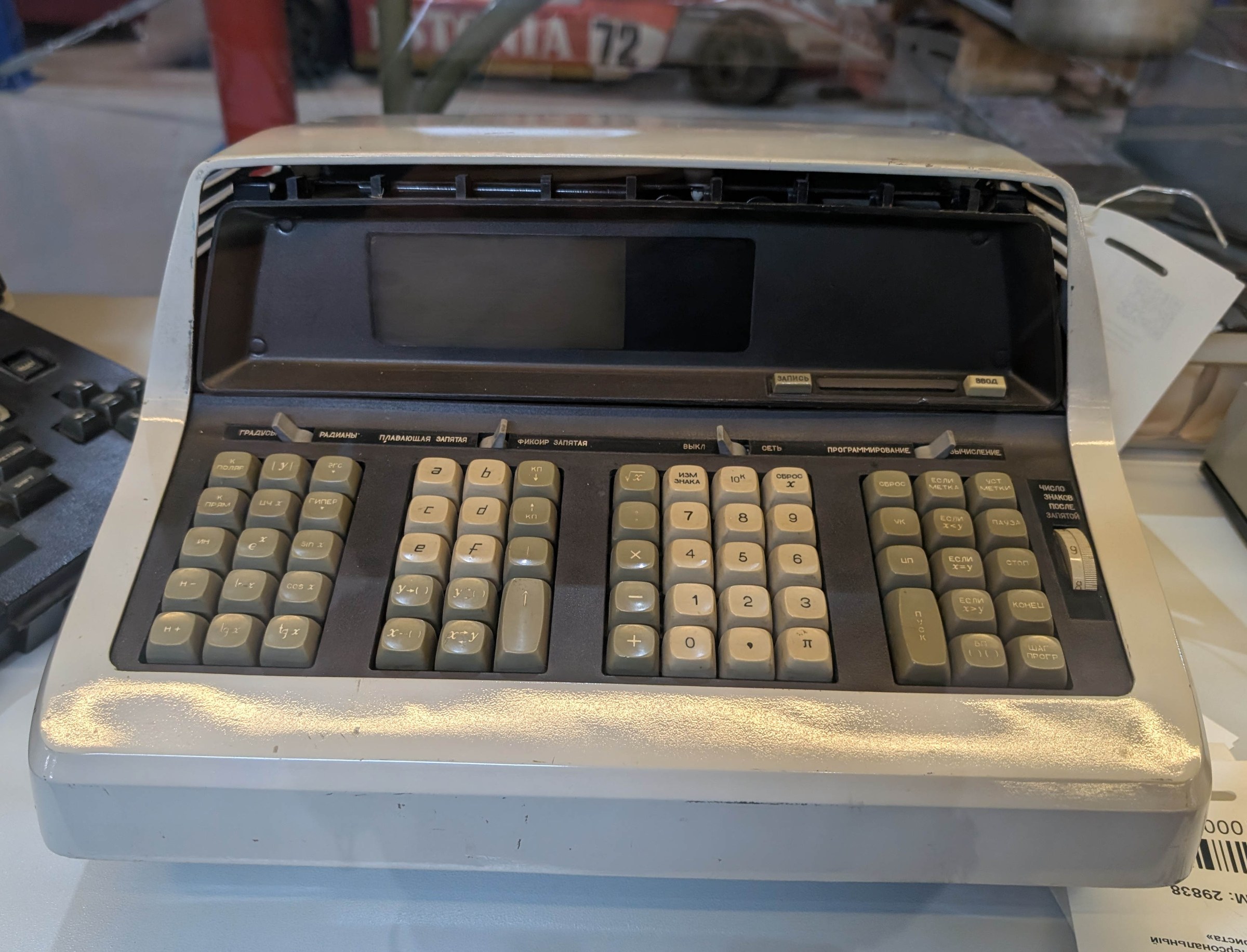
The Elektronika-70 of 1970 is described in two popular articles as the first Soviet desktop programmable and as a clone of the Hewlett-Packard 9100A, needing transistors not previously made in the Soviet Union and accepting input from digital measuring instruments; one says that no example survives, but there is one in the Polytechnic Museum in Moscow, with its magnetic program cards. Its display has not been established; if it really was a copy of the HP 9100, it had a cathode-ray tube, like the machines described in this site’s CRT series.
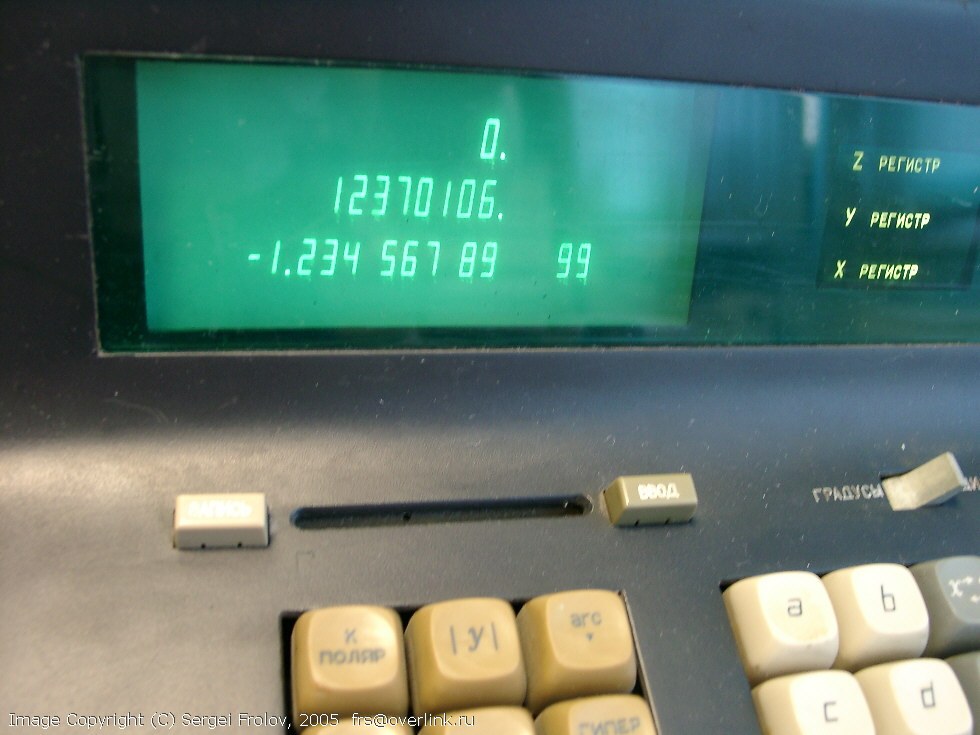
The Elektronika T3-16 of about 1975 certainly had one: a programmable desk machine with reverse Polish notation, 392 program steps shared with 28 memory registers, a magnetic-card reader, and a CRT showing the X, Y and Z registers at once.
3.6 The Iskra family (1969–1980)
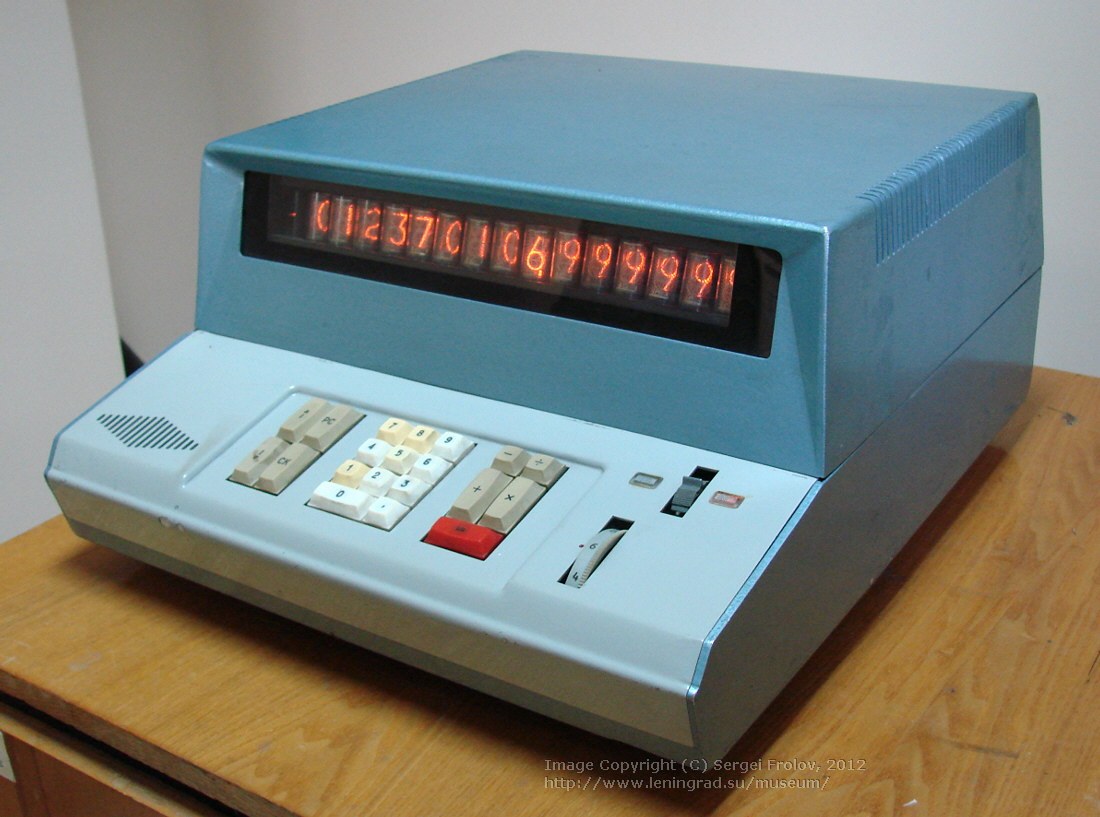
From 1969 the Kursk works made the Iskra (Искра, “spark”) desk machines, designed at the Leningrad Schetmash bureau. Until the early 1980s the Iskra 111 family was the most widely used Soviet desk calculator.
- Iskra 11, 11M, 12 and 22 (1969–72): no integrated circuits. The logic is built from МИР-10 micro-modules, each a potted cell holding a transistor, a diode and a few resistors, with magnetostrictive delay-line memory and IN-14 Nixie tubes. Frolov’s Iskra 11M of 1972 has sixteen digits, one memory register, a decimal-point switch, neon lamps for overflow and mains, and a 110/127/220 V selector. The Iskra 12 cost 992 roubles.
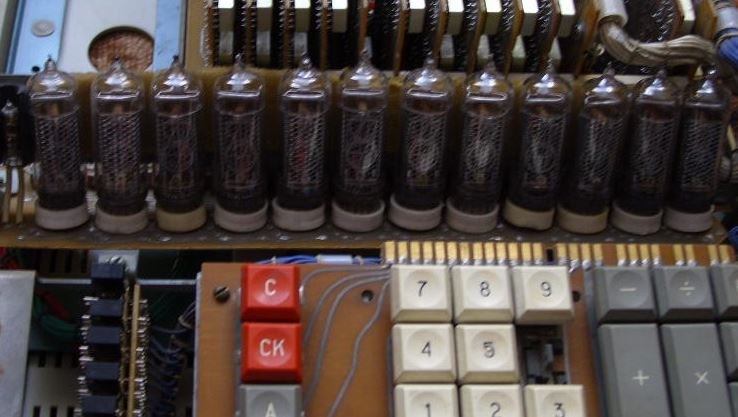
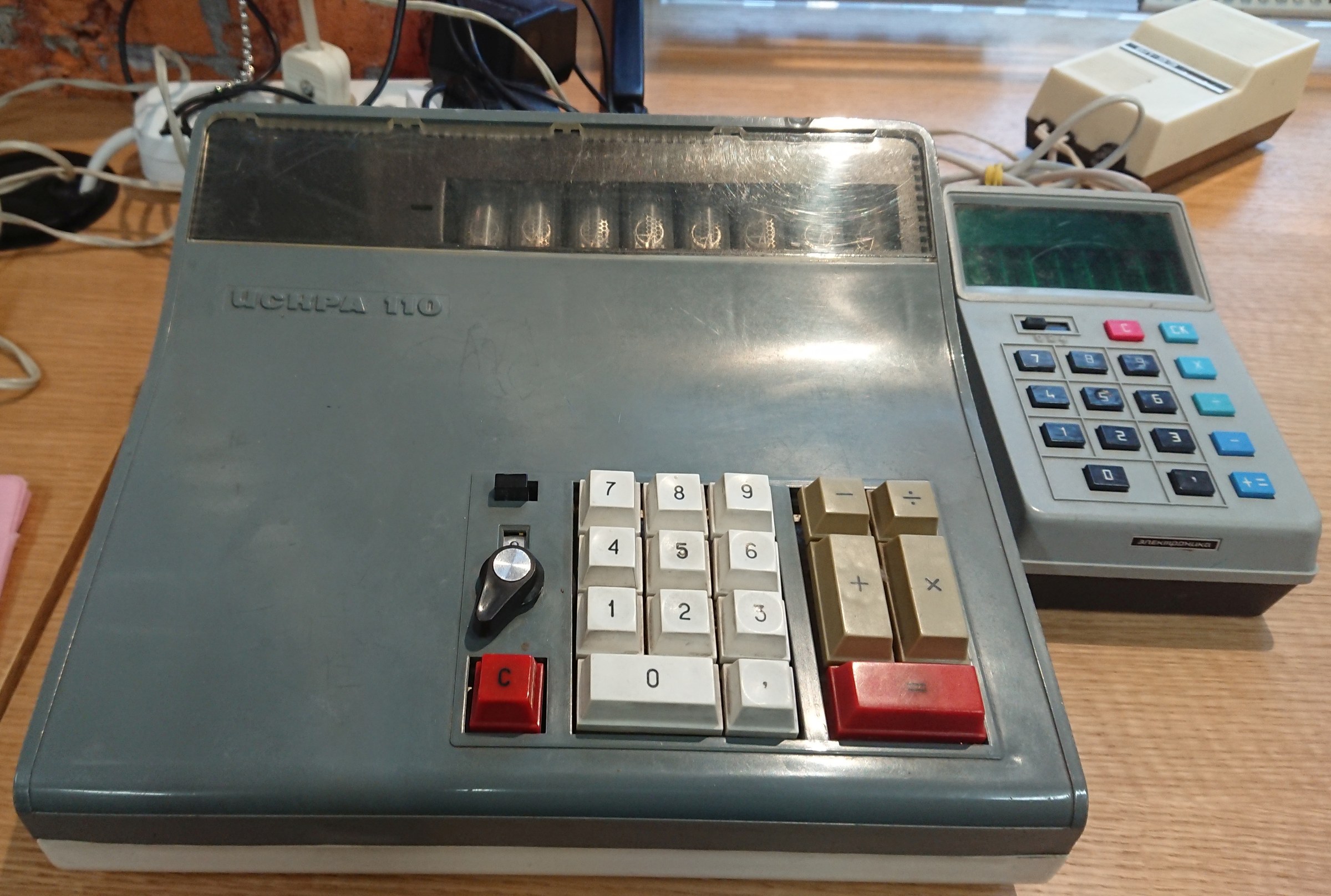
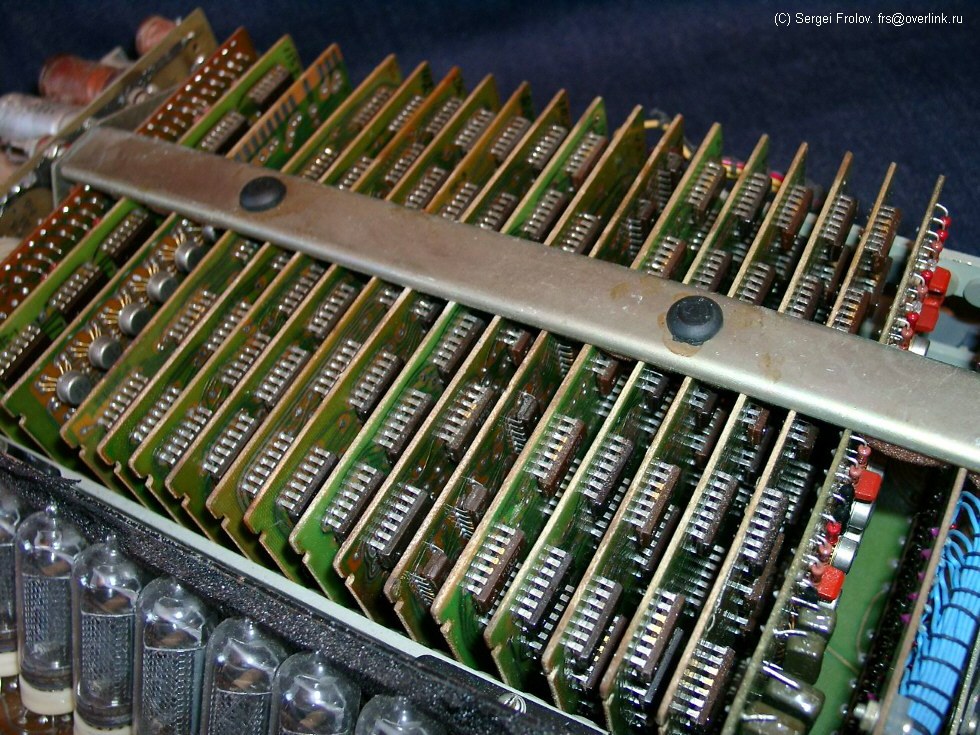
- Iskra 110 and 111T (1971): the first on integrated circuits. Frolov’s own pages give the honour to the Iskra 111T, built on series 201 chips, weighing 12 kg and costing 4,950 roubles 15 kopecks in 1971; other sources name the Iskra 110. A teardown of an Iskra 111M lists 78 ICs, most of them K155 TTL, twelve IN-14 tubes, and twelve KT605 high-voltage transistors, one per tube, which suggests a multiplexed Nixie display.
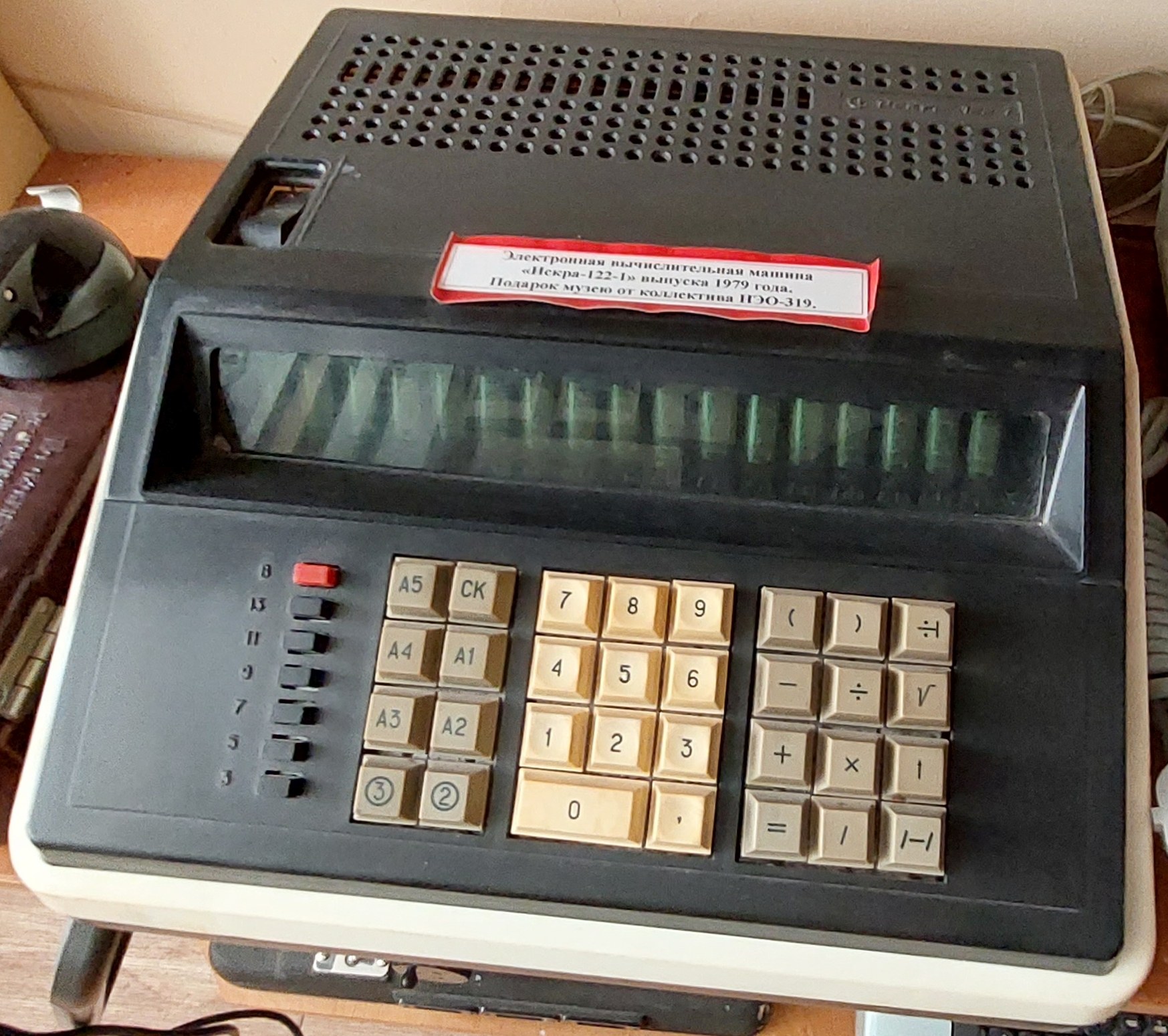
- Iskra 122 (1971–79): sixteen digits, algebraic logic, five memory registers; magnetostrictive delay lines and twelve MOS shift registers for memory, 285 MOS chips, a reed-switch keyboard, 30 W; addition in 0.05 s and multiplication in 0.35 s. The Iskra 122-1 replaced the delay lines with chips, the Nixies with IV-6 fluorescent tubes, and the metal case with plastic, bringing the weight down to 6 kg.
- Iskra 123 (1972–79): the first Soviet programmable calculator, with seventy program steps, five registers and Nixie tubes.
- Iskra 1122: a cathode-ray-tube display showing the working register and the memory registers together, for 4,100 roubles.
- Iskra 210 and 211 (1979–80): thirteen fluorescent tubes, IV-3A and IV-12 respectively; the Iskra 2240, a sixteen-digit fluorescent machine.
3.7 The first Elektronikas on the desk (1971–76)
The Ministry of the Electronics Industry entered the desk market with large-scale integrated circuits.
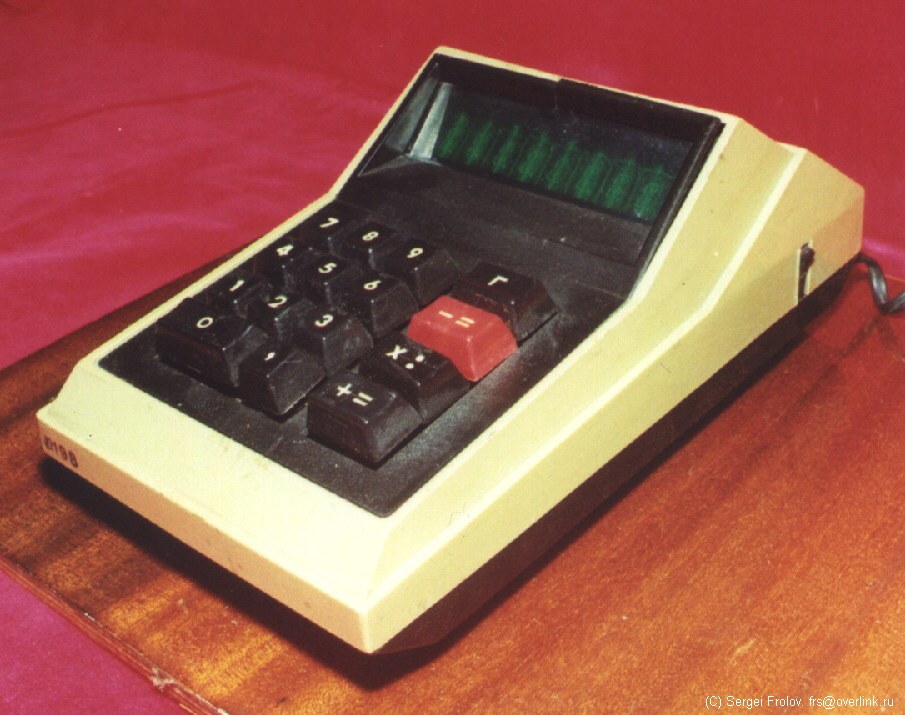
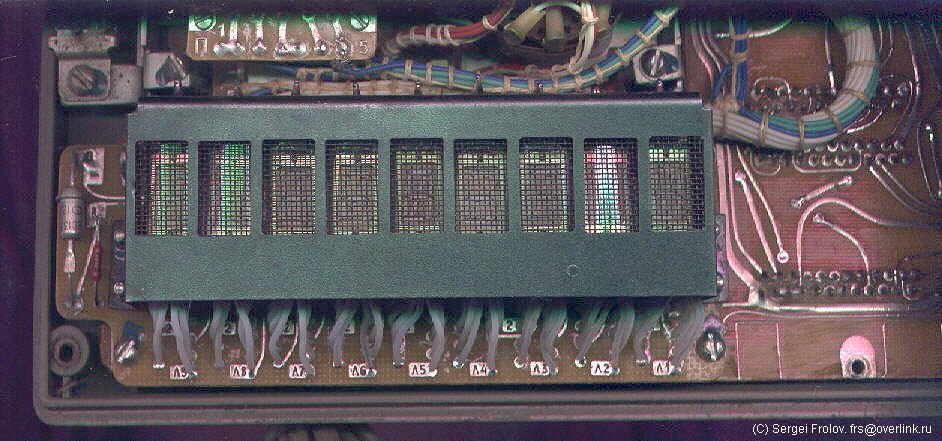
- Elektronika 24-71 (1971–75): Frolov calls it the first Soviet calculator on LSI chips and the first Soviet industrial use of vacuum-fluorescent tubes, types IV-1 and IV-2. “The Sharp QT-8D was taken as the basis”, but “the chips are an entirely domestic development”, and the display behaves slightly differently from the original. It had fifteen keys and was named for the year and the Party congress.
- Elektronika 4-71Б: a desk machine on four LSI chips, with eight fluorescent digits and a fixed decimal point.
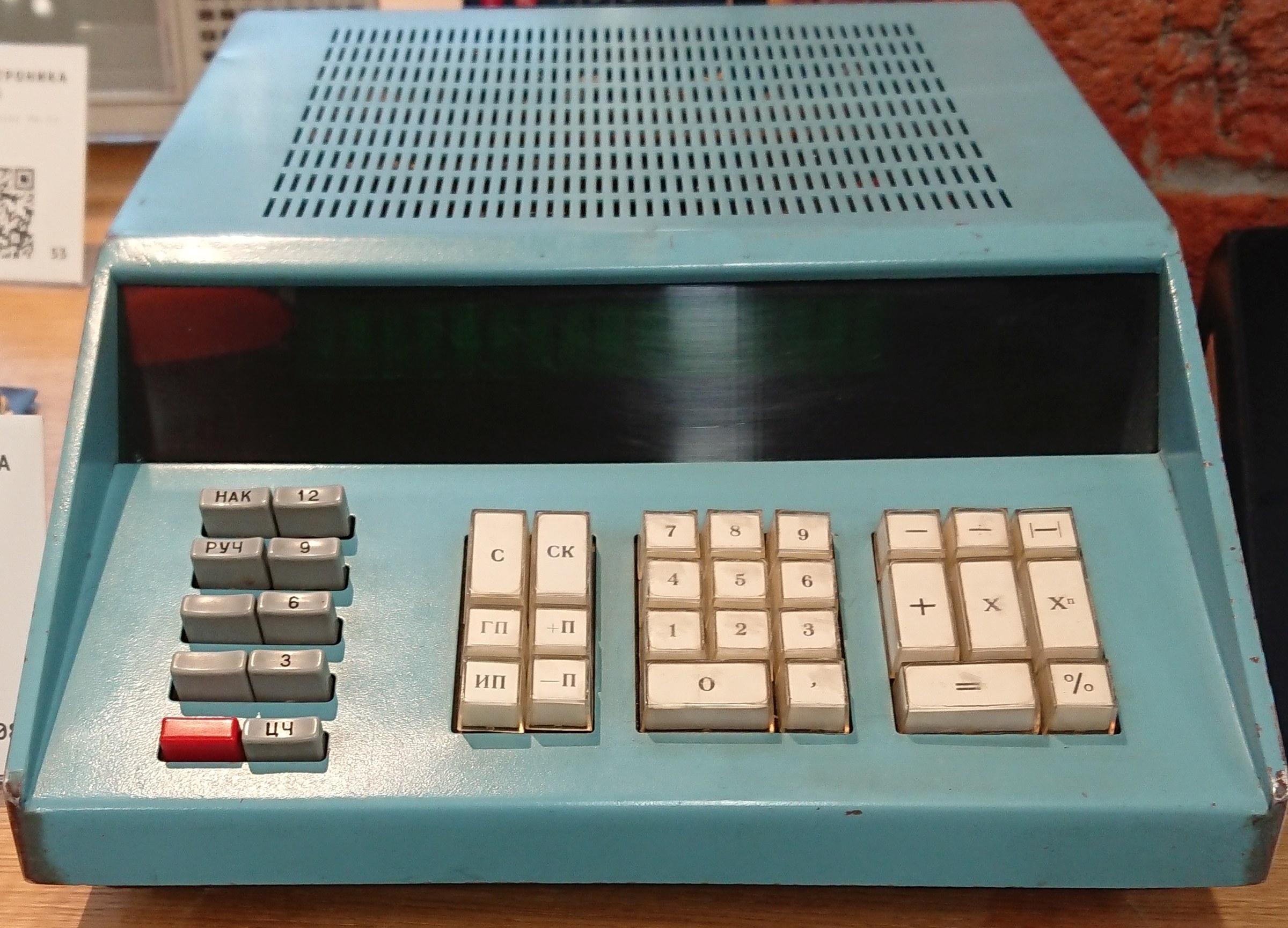
- Elektronika C2 (1971–75): sixteen digits, transistor logic, a fluorescent display, three registers.
- Svetlana С3-07 (1974–77): Svetlana’s first desk machine, eight fluorescent digits, only fifteen keys, with multiplication and division sharing one key, at 200 roubles in 1978. С3-15 (1975–77): the first Soviet scientific desk calculator not copied from a foreign design, with eight levels of brackets, three memories and twelve-digit precision. С3-22 (1976) used IV-27 tubes.
- Elektronika 155 (1975–80): thirteen IV-6 tubes and 147 series-155 TTL chips, drawing 40 W, in Nixie and fluorescent versions.
- B3-02 and B3-05 (1974–80): eight-digit fluorescent machines for the mains; the B3-02 used eight IV-6 tubes.
3.8 Elsewhere in the Eastern Bloc
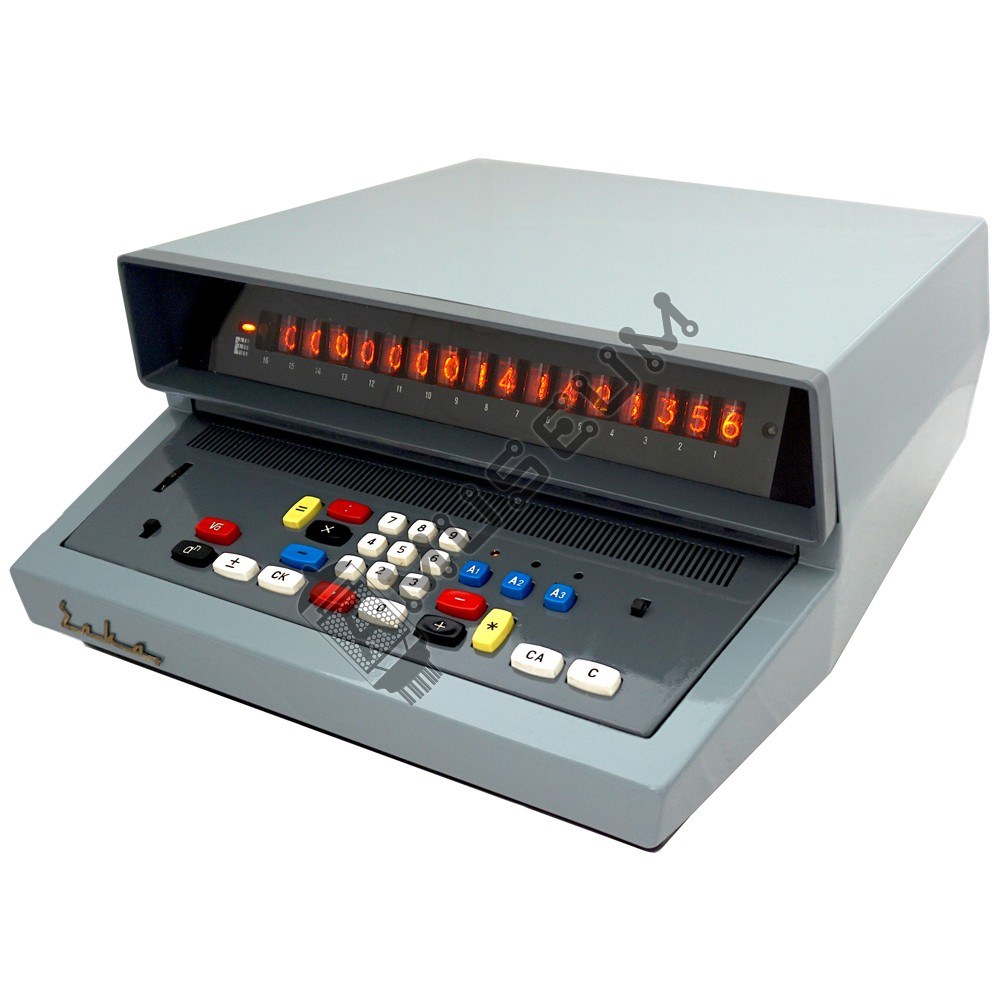
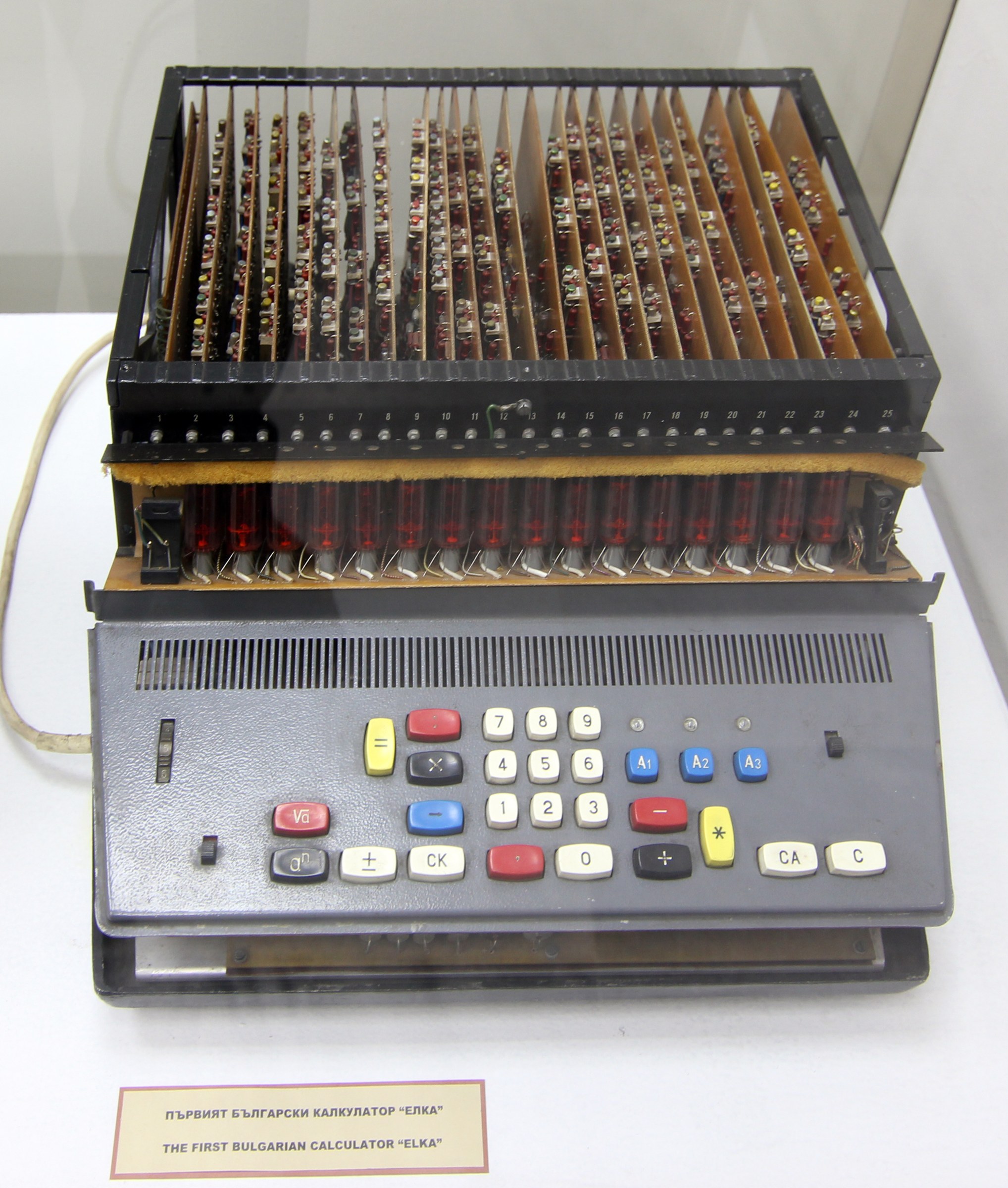
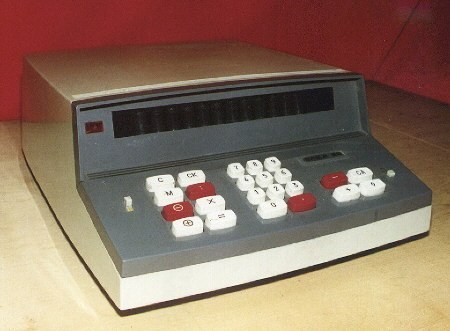
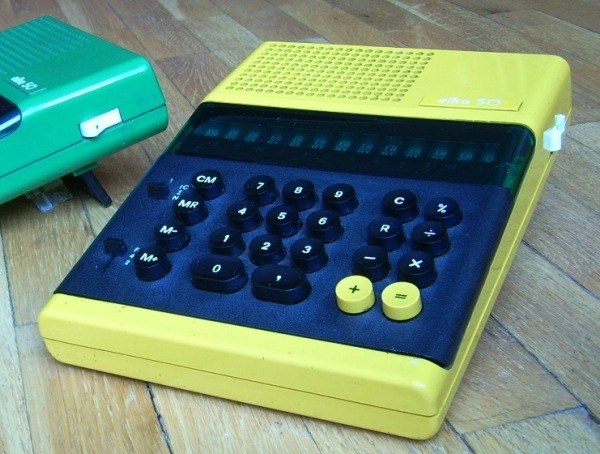
Bulgaria. The ELKA 6521, built at the Elektronika plant in Sofia with germanium transistors and Nixie tubes, was shown to the Bulgarian leader Todor Zhivkov on 17 April 1965 and officially at the INFORGA-65 exhibition in Moscow that May. Its developers, among them Stefan Angelov, Lyubomir Antonov and Petar Popov, received the Dimitrov Prize; the Bulgarian claim that it was the first calculator with a square-root key is disputed. It weighed 16 to 18 kg by different accounts. The ELKA 22 followed in 1966–67, made at Silistra with core memory and Nixies, and the ELKA 25 printed. Later models moved to MOS chips (ELKA 40 and 42, 1972), Hitachi chips (ELKA 41), fluorescent displays (ELKA 50) and, with the ELKA 101 of 1974, the pocket. An ELKA 50 appears on a desk in the Soviet film Office Romance of 1977, alongside a Soemtron 220.
East Germany. The Soemtron 220, from VEB Büromaschinenwerk Sömmerda, had fifteen Nixie tubes; its zero series was announced in FunkAmateur in June 1967, and 155,142 were built between 1966 and 1977, when the works joined Kombinat Robotron. VEB Mikroelektronik “Wilhelm Pieck” in Mühlhausen made the East German pocket calculators from the Minirex of 1973 onward, including the SR1 school calculator of 1984–85 that replaced the slide rule.
Poland. The TMK-204 of 1967 was the first Polish electronic calculator, with domestic silicon transistors and Unitra-Dolam tubes; only about 200 were made. The Elwro works in Wrocław built a line of fluorescent desk machines, many with Soviet IV-18, IV-6 and IVL1-8/13 tubes alongside Japanese Futaba ones.
The Library holds the FunkAmateur of June 1967 announcing the Soemtron 220. It also holds the manuals of the Iskra 110 and Iskra 111, the passports of the Elektronika 155 and the B3-02, and three pages on the С3-22 from a Soviet book, all in Russian.
Comments (0)