Graphing Calculators · Volume 4
The Classroom and the Exam Room
The graphing calculator is a rare piece of consumer electronics whose customer is not really the person who pays for it. A student buys a TI-84 because the teacher asks for one, the teacher asks for one because the textbook and the exam assume it, and the exam boards allow it because it cannot reach the internet. Texas Instruments understood this earlier than anyone, and it is the main reason the American market is TI’s.
4.1 Building the classroom
TI’s approach, as described by T.H.E. Journal in 2001 and Education Week in 1991 and 2007, was to work with teachers rather than sell to them. It consulted the National Council of Teachers of Mathematics, whose Curriculum and Evaluation Standards of 1989 said that “appropriate calculators should be available to all students at all times”, and textbook authors funded by the National Science Foundation; it sent its engineers to teachers’ conferences; and it ran its own focus groups. The TI-81 of 1990 “became widely adopted within two years”.
The training followed. In the summer of 1988 Bert Waits and Franklin Demana of Ohio State ran the first institutes of their Calculator and Computer Precalculus project for 80 teachers; by 1990 it reached twelve states, and in 1992 it became Teachers Teaching with Technology, T³, run with TI. TI said in 2023 that more than 120,000 educators had attended T³ events and more than 500 had become T³ instructors. “Nobody treats teachers like Texas Instruments does,” one of them told TI’s newsletter.
Textbooks followed too. By 2007 Harcourt, Houghton Mifflin, McGraw-Hill and Pearson were working with TI on supplements, and Harcourt’s secondary supplements gave keystrokes for TI calculators only, “because they have overwhelming market share in secondary schools”. Education Week called TI’s position “a fortress of advantages that frustrated rivals find hard to penetrate”, and quoted Casio’s Peter Brinkman: “Certainly there is inertia that needs to be overcome.” Elliot Soloway of the University of Michigan put TI’s success down to “tying it to the existing curriculum”.
Researchers have studied the result for more than thirty years. A review published in The Conversation in 2017 by two University of Montana researchers found that graphing calculators had a positive effect on students’ understanding of how ideas relate, and a slight positive effect on their skill at procedures; it noted that one widely cited earlier review had been funded by a calculator company.
4.2 The exams
The exam boards made the calculator compulsory, or nearly so:
Table 1 — The exam boards made the calculator compulsory, or nearly so
| Exam | Since | Graphing calculator |
|---|---|---|
| SAT | 1994 | allowed; no computer algebra, no QWERTY keys, no wireless; a Desmos graphing calculator is built into the digital test |
| AP Calculus | 1995 | required for part of the exam; also required for parts of AP Precalculus, and expected in AP Statistics |
| ACT | 1996 | allowed, except models with computer algebra, banned by name from the TI-89 to the HP Prime |
| IB Diploma | required for some mathematics papers, in an exam mode | |
| US engineering licences (NCEES) | not allowed: only listed scientific models | |
| UK GCSE and A-level (JCQ) | allowed if it cannot do symbolic algebra or communicate, or has an exam mode that stops it | |
| French baccalauréat | 2020 | programmable calculators must have an exam mode with a blinking light |
The AP Calculus exams from 1995 had a section of free-response problems “designed with graphing calculators in mind”, and the College Board’s current list of approved graphing calculators includes the TI-84 Plus and TI-84 Plus CE. In 2027, AP Biology and Environmental Science will ban calculators with storage such as graphing calculators, and AP Statistics will ban non-graphing ones. The College Board no longer keeps a list of permitted graphing calculators for the SAT; it publishes rules instead. The ACT’s policy is in the Library; the US engineering exams, which allow only listed scientific calculators such as the TI-36X Pro, are covered in the scientific-calculators dive.
4.3 A price that never fell
A TI graphing calculator cost about $100 in 1994 and about $100 in 2018, as NPR’s The Indicator from Planet Money pointed out in a programme first broadcast on 22 March 2018, “Why The Graphing Calculator Hasn’t Changed Much Since 1994”. TI sold, it said, about 6 million graphing calculators a year. Peter Balyta of TI explained the design choice: “We could easily add features to our calculators like a touchscreen, Wi-Fi or a camera, but we don’t”, because such features “can compromise the test security”.
The numbers behind the price have been estimated several times. In 2014 a Barclays analyst, Blayne Curtis, put the cost of building a TI-84 Plus at $15–20 and TI’s margin at over 50 %: “Plastic case, small black and white screen, two semiconductor chips.” In 2006 TI’s Education Technology division earned $525 million in revenue and $200 million in operating profit. The Washington Post called the price “an anomaly”; Desmos’s founder, Eli Luberoff, called the cost of calculators a “horrible inequity”. TI’s answer, from Balyta again, is that “a TI calculator is a one-time investment in a student’s future”.
The TI-84 Plus CE has not escaped the pattern, though its price has drifted down: about $129–150 at launch in 2015, and $110.44 at Target in October 2026, when the monochrome TI-84 Plus was listed at $139.99.
4.4 Desmos
The strongest challenge to the handheld has come from software. Desmos, a free online graphing calculator launched by Eli Luberoff in 2011, was adopted in 2017 for the online tests of the Smarter Balanced consortium of states, and in 2024 the College Board built a Desmos calculator into Bluebook, the software for the digital SAT, for the whole mathematics section. The ACT’s online tests have one too. Students may still bring their own handheld, and The Hustle reported in 2024 that 90 % of American teachers used handheld calculators as their main mathematics tool, against 6 % using software or apps. TI’s 2026 announcement of the TI-84 Evo cited a survey in which 94 % of teachers and administrators agreed that students do better on exams when they use the same calculator throughout.
4.5 Exam modes
A calculator that holds programs and notes can hold the answers, so every exam board that allows one has rules about memory. The traditional answer was to clear the memory before the exam; the modern one is an exam mode that the calculator enforces itself.
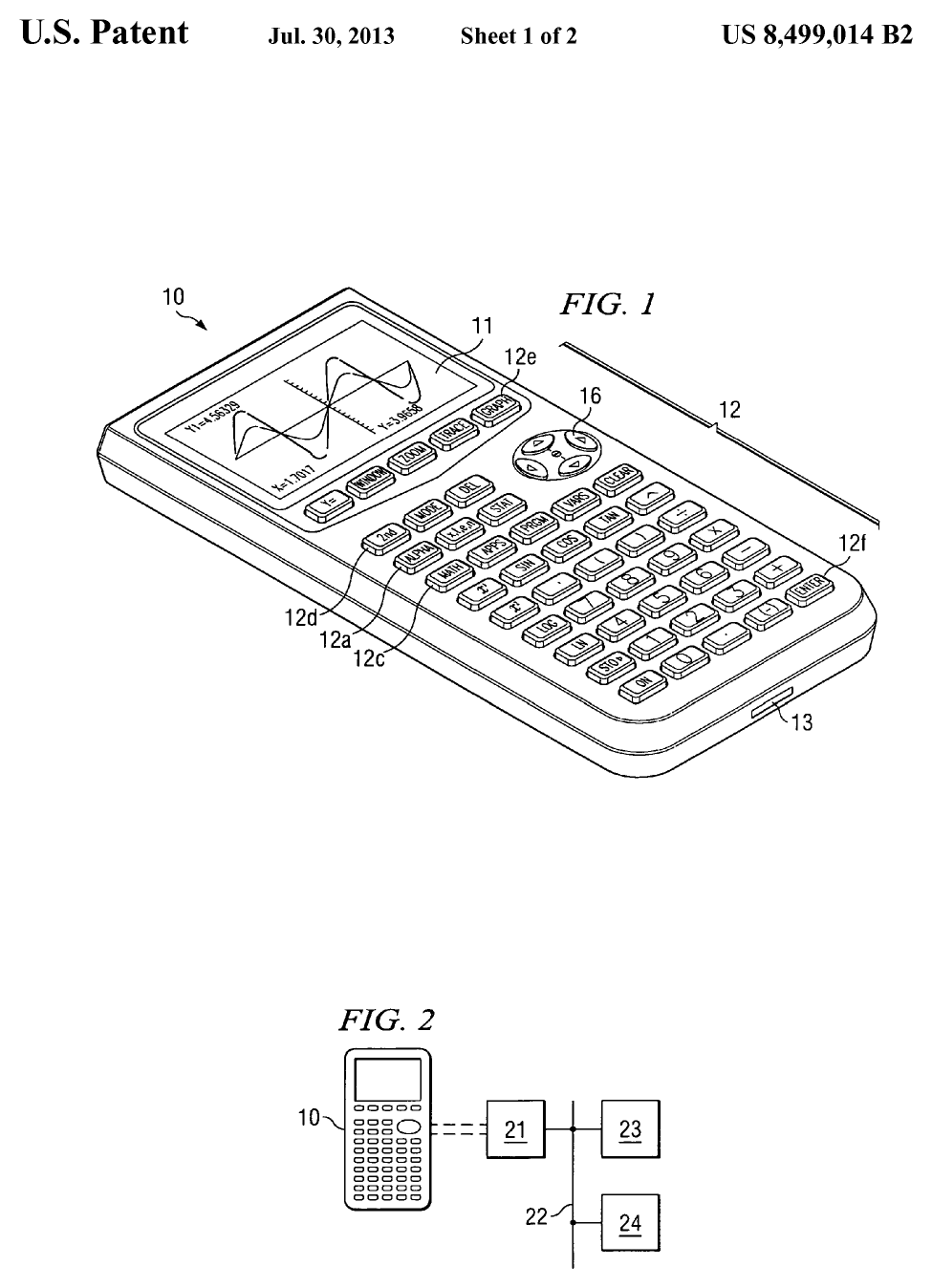
TI’s is Press-to-Test, added to the TI-84 Plus in 2005. On the TI-84 Plus CE it is entered by holding the left-arrow, right-arrow and ON keys with the calculator off. A RESET OPTIONS screen lets the teacher choose what to disable, by default the logBASE and Σ( functions, with the angle set to degrees and statistics diagnostics on; then the calculator disables applications, programs and pictures and deletes the variables in its memory and archive, and its status bar turns blue. Leaving the mode needs another calculator or a computer: sending any file to the calculator over USB ends it. TI’s patent on the idea, US 8,499,014, “Functionality disable and re-enable for programmable calculators”, filed on 1 June 2005, describes flags stored in flash that mark applications and programs so that “they cannot be displayed, executed, or edited”, and is in the Library.
The light came from Europe. The Netherlands made exam mode compulsory for its central exams from 2018 and 2019, and TI’s Dutch TI-84 Plus T of 2015 and the European TI-84 Plus CE-T have a light that blinks while the mode is on, so that an invigilator can see it from across the room. France’s circular of 1 October 2015 required a “mode examen” with a blinking light “dédiée spécifiquement au « mode examen »”, with the mode impossible to leave without connecting to another device; after a postponement in 2018 it applied from the 2020 baccalauréat. No exam light is documented for the plain TI-84 Plus CE sold in the United States; according to Wikipedia, even its charging light was dropped from later units.
Sources
- T.H.E. Journal (1 November 2001); Education Week: Peter West (1 October 1991), Andrew Trotter (17 October 2007) and 23 January 2008; the NCTM Standards (1989) as quoted by Meel (1997); TI’s BulletIn Board, “35 years of the T³ community” (30 January 2023); Peck and Erickson, The Conversation, republished by Salon (15 June 2017).
- College Board: SAT and AP calculator policies (read 27 October 2026); the ACT’s calculator policy; NCEES via third-party summaries and TI’s knowledge base; JCQ Instructions for Conducting Examinations (extracts); French note de service n° 2015-178 via TI-Planet and the Bordeaux academy; Cito and examenblad.nl for the Netherlands.
- NPR, The Indicator from Planet Money (22 March and 24 December 2018); Matt McFarland, The Washington Post (2 September 2014), via Electronic Design and Mental Floss; The Hustle (1 October 2024); ProMarket (8 April 2024); Wikipedia, “Desmos”; CNN Money (12 May 2017).
- Press-to-Test: TI, Getting Started with the TI-84 Plus CE, pp. 58–60, and the Press-to-Test sheet; patent US 8,499,014; Wikipedia, “TI-84 Plus series” and “TI-84 Plus CE series”.
Comments (0)