Graphing Calculators · Volume 2
The First Graphing Calculators, 1985–1999
Calculators drew graphs before there were graphing calculators, but on paper. Hewlett-Packard’s 9125A plotter of 1968 plugged into the back of the HP 9100A desktop calculator and drew while the calculator worked out the next point. The 82143A printer for the HP-41C, which cost $350 in 1980, added plotting functions that drew on its paper tape. The pocket computers of the early 1980s, Sharp’s PC-1500 and Casio’s PB-700 among them, had dot-matrix screens that a BASIC program could draw on: the PB-700’s showed 160 × 32 dots. What none of them did was take a function from the keyboard and draw it on its own screen at the press of a key. That is the narrow sense in which Casio’s fx-7000G of 1985 was first, and the sense in which the Smithsonian’s National Museum of American History describes its example as “the first commercially sold handheld graphing electronic calculator”.
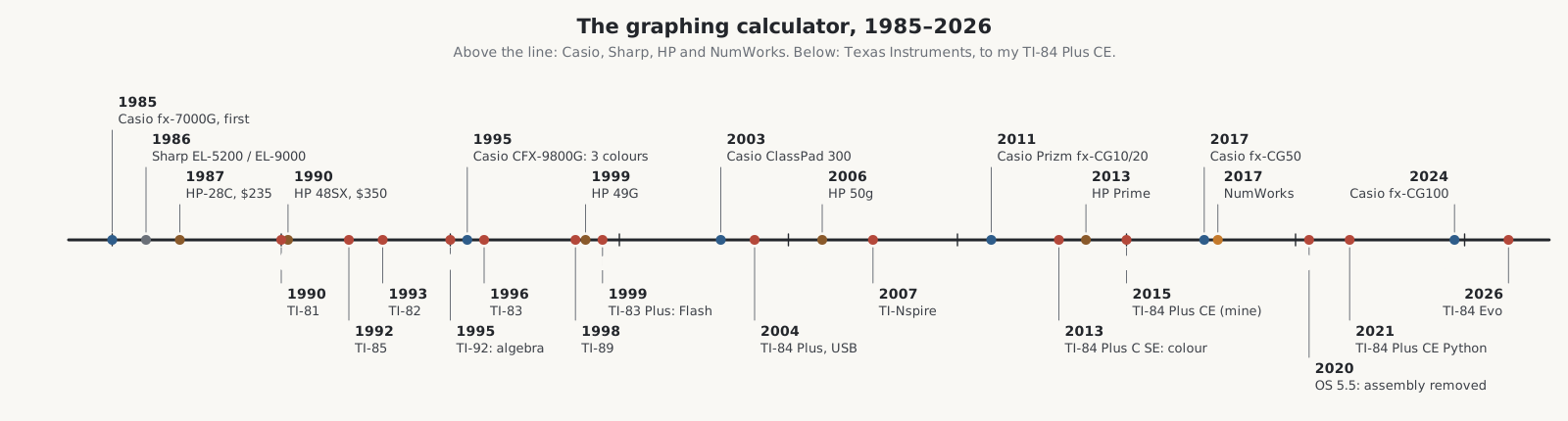
2.1 Casio fx-7000G, 1985
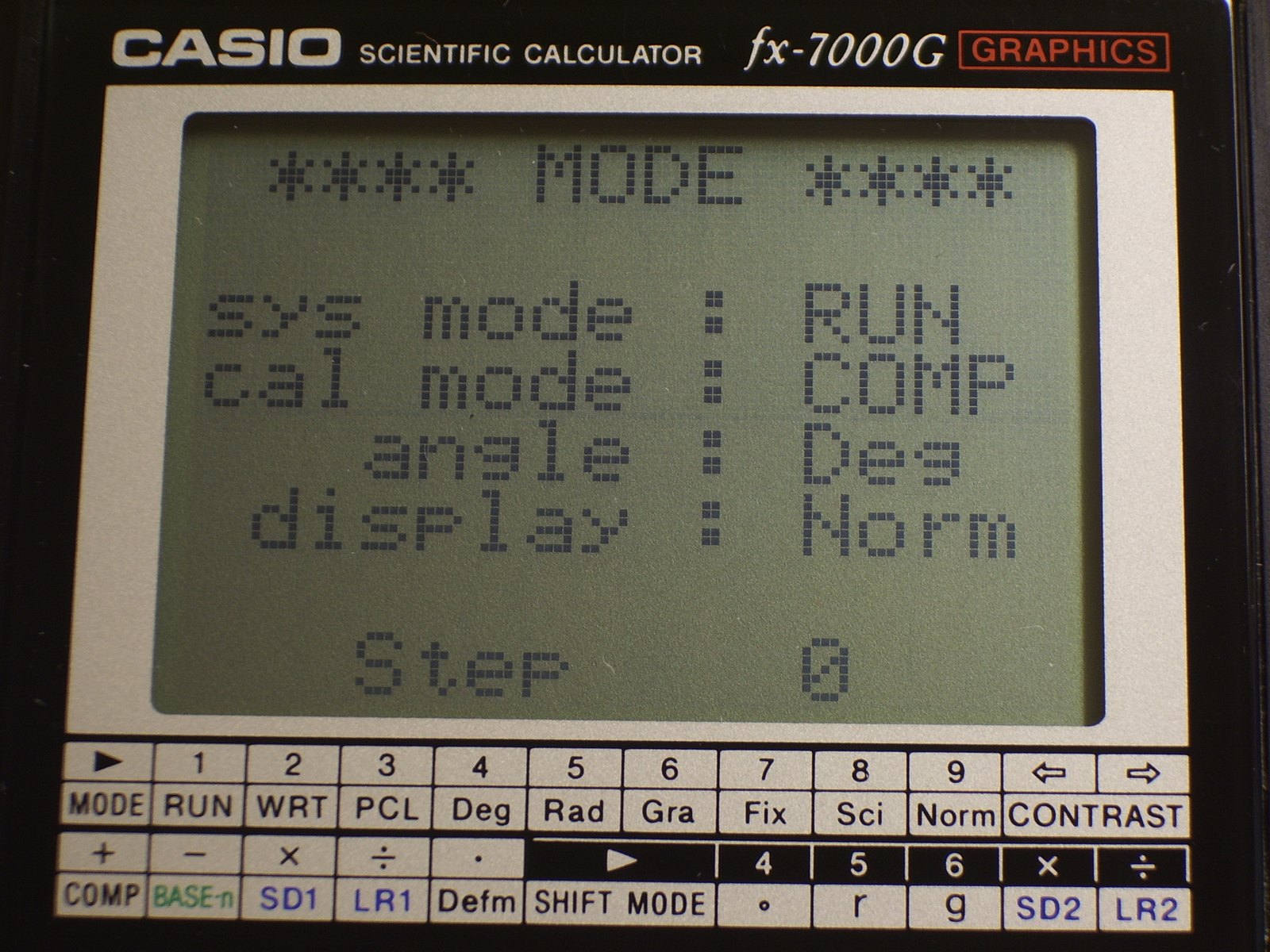
The fx-7000G had a liquid-crystal screen of 96 × 64 dots, eight lines of sixteen characters when it showed text. It had 82 scientific functions, 20 built-in graphs (sine, cosine, tangent and others) and room for graphs of the user’s own functions; statistics graphs, bar charts, line graphs, normal distributions and regression lines; and 422 steps of program memory in a keystroke language like that of Casio’s FX-602P programmable, with 26 memories that could be stretched to 78 by taking program space. It ran on three CR2032 lithium cells for about 100 to 120 hours, depending on the source, and had no mains adapter. Its memory was volatile: changing the batteries erased everything.
The date and the price depend on where one looks. A Casio exhibition timeline, as reported by the Japanese site ITmedia, gives August 1985; the Centre for Computing History and others give October 1985. EE Times Japan gives the Japanese launch price as ¥19,800. In Europe, the French magazine L’Ordinateur Individuel listed it at FF 1,250 in February 1986, and a Dutch department store advertised it at Fl. 299 that August. No American launch price has been found. Production continued until about 1988 or 1989, and the fx-7000GA followed in 1990. The owner’s manual ran to 204 pages, and it is in the Library.
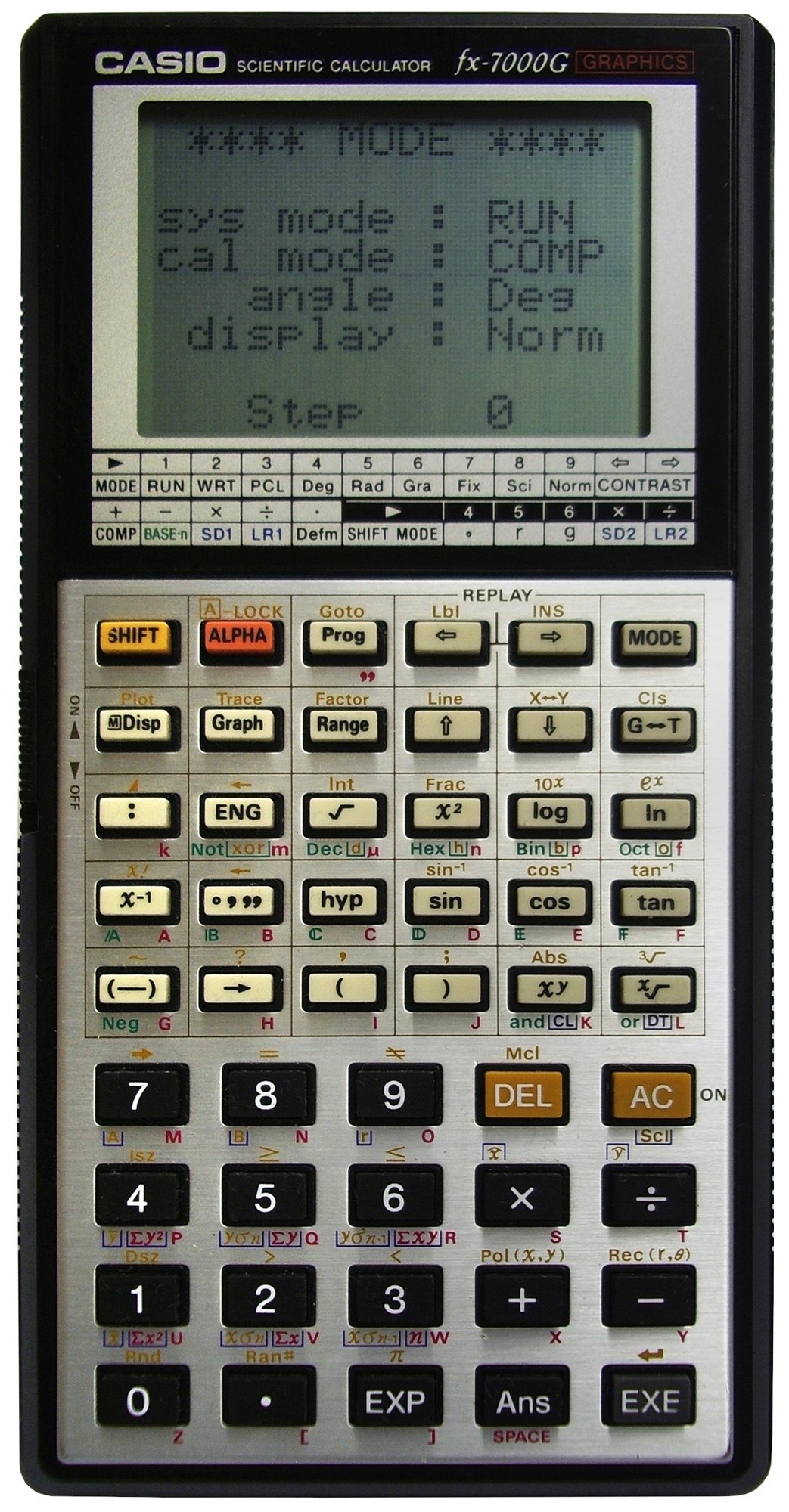
Casio credits the calculator to Hiroyuki Yoshino, who joined the company in 1979 and spent his career on its scientific calculators. In Casio’s own account of the development, “The project began from the pages of mathematics textbooks”: from about 1980, high-school and university students, not only engineers, were using scientific calculators, and the textbooks they used were full of graphs. Early graphs sometimes “wouldn’t show up or would display something unexpected”, and features had to be balanced against cost and schedule. Casio’s patent on the idea, US 4,794,553, “Compact electronic calculator having graph display function”, names Kazuyoshi Watanabe, Hiroyuki Yoshino, Junichi Maeda and Osamu Negishi, claims a Japanese priority of 24 May 1985, and describes exactly the fx-7000G’s method: compute y for each x across the screen and light the dots of a 96 × 64 display. It is in the Library, and volume 6 shows its drawings.
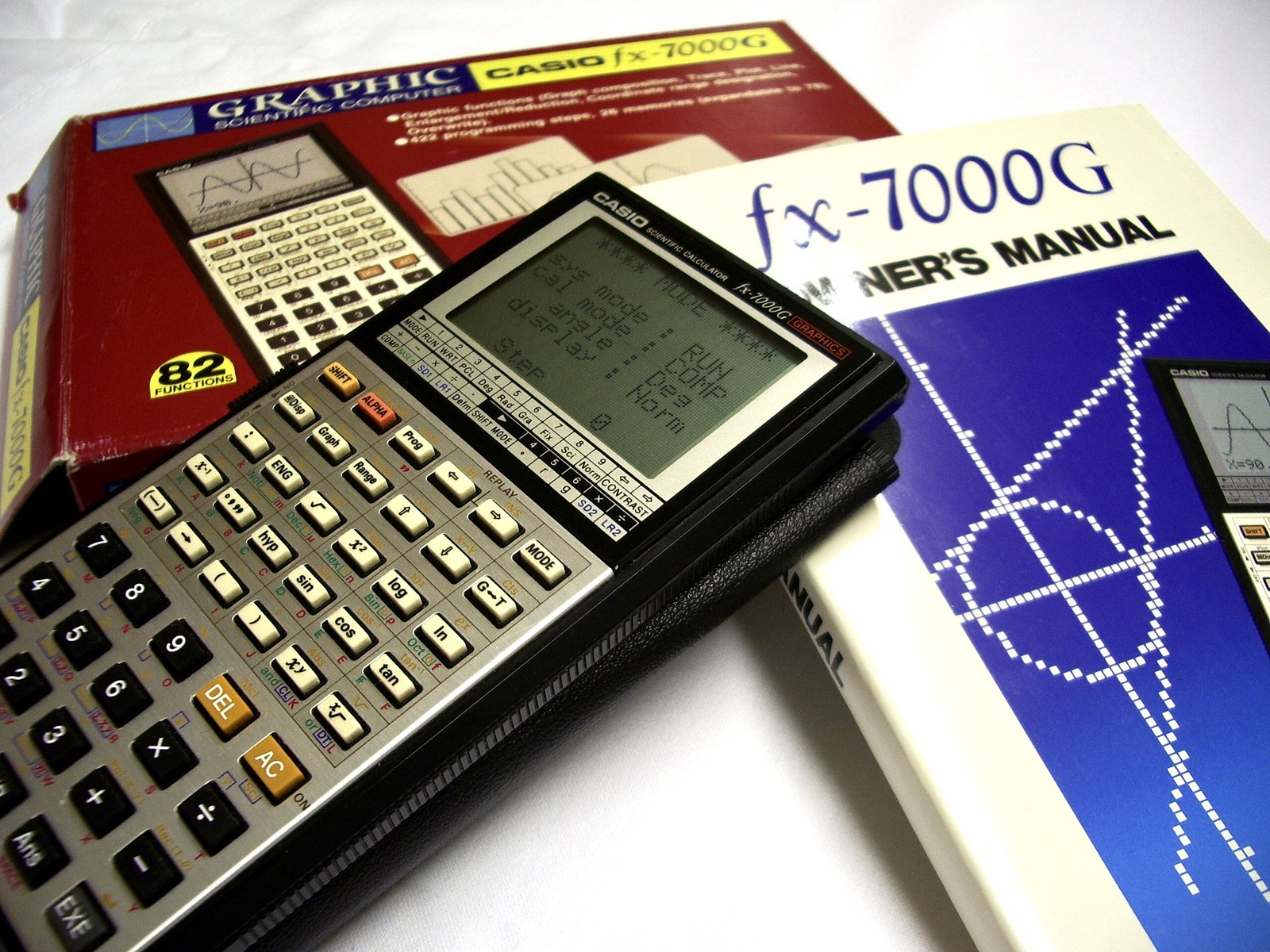
Casio’s line went on: the fx-7700G and fx-8700G “Power Graphic” models around 1990, the icon-menu fx-7700GE and fx-9700GE of 1993–94, and the CFX-9800G of 1995, which showed graphs in three colours, orange, blue and green, made by driving the liquid crystal at different contrasts rather than with coloured pixels. Sources disagree on whether it or the CFX-9900G was the first; the CFX-9850G of 1996 is the best known of them. A Smithsonian set includes an OH-7000G, a version of the fx-7000G made to sit on an overhead projector so that a teacher could show the class its screen.
2.2 Sharp EL-5200, 1986
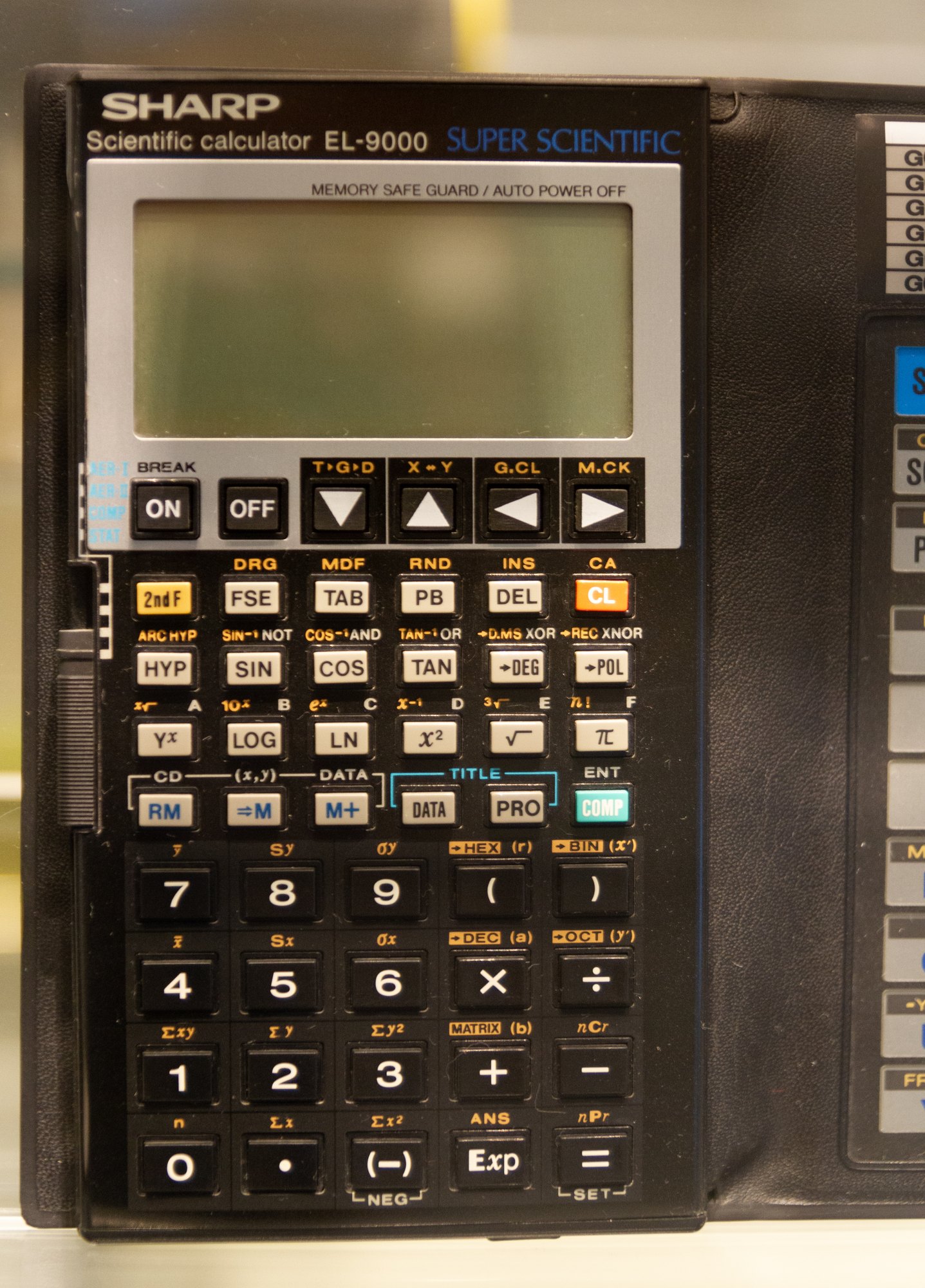
Sharp followed in 1986 with one machine under two names, the EL-5200 and the EL-9000, both covered by a single operation manual. It had a 96 × 32 dot screen, 12-digit precision, 5,120 bytes of memory and Sharp’s “Algebraic Expression Reserve” for storing formulas, and it ran on two CR2032 cells. A 1991 statistics textbook was keyed to it. Sharp’s later models, the EL-9200 and EL-9300 of 1992 and the EL-9600 of 1997, had larger screens; the EL-9600 had a touch screen worked with a stylus.
2.3 Hewlett-Packard: algebra first
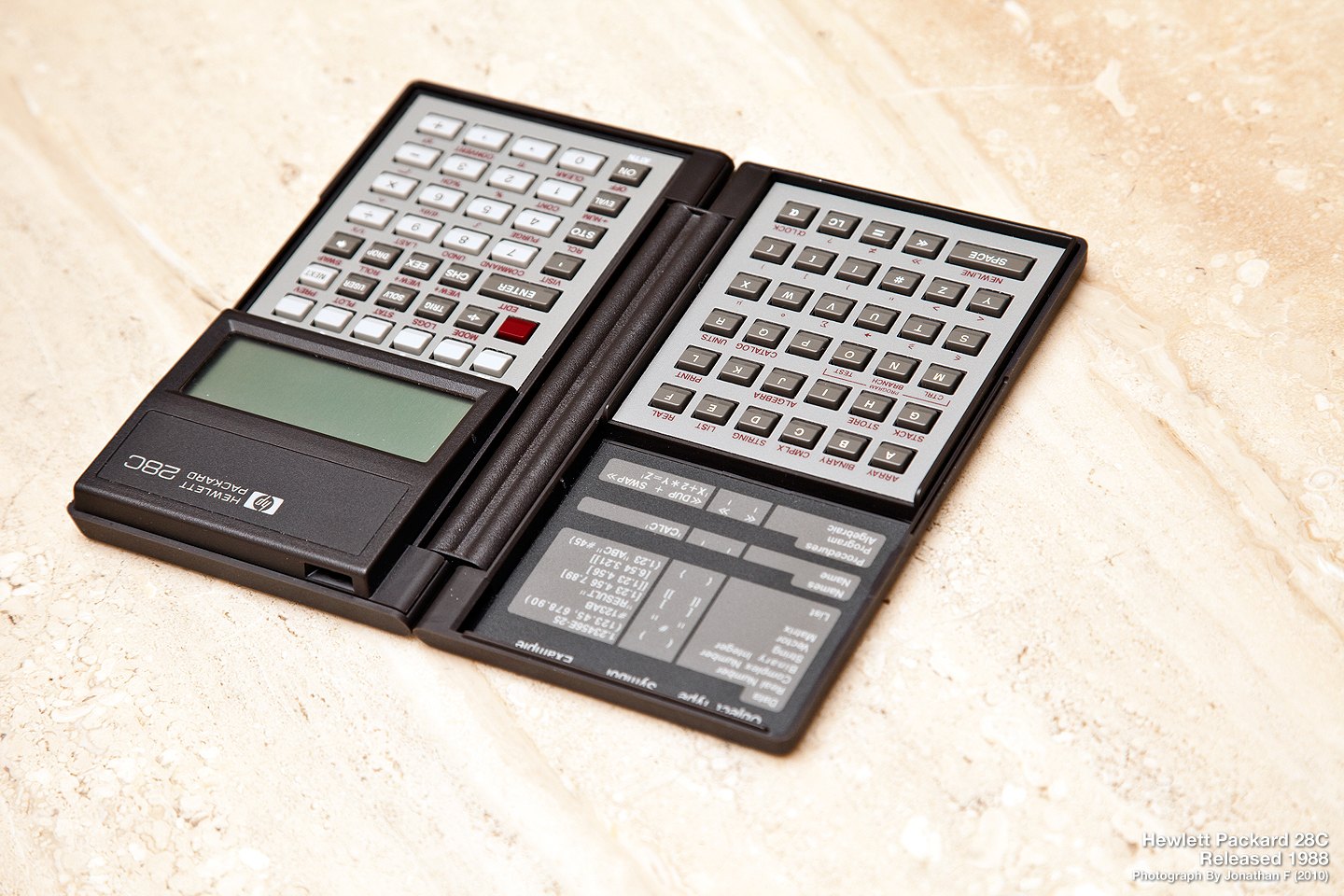
Hewlett-Packard came to graphing by way of algebra. The HP-28C, introduced on 5 January 1987 at $235, folded open like a book, with a keyboard on each half and a four-line screen of 32 × 137 dots. HP calls it “Hewlett-Packard’s first graphing calculator” and “the first handheld calculator from any company to be able to solve algebraic equations”: it could differentiate and integrate symbolically, work with units and complex numbers, and it introduced HP’s RPL language. It had only 2 KB of RAM, 1,621 bytes for the user; the HP-28S of January 1988 had 32 KB.
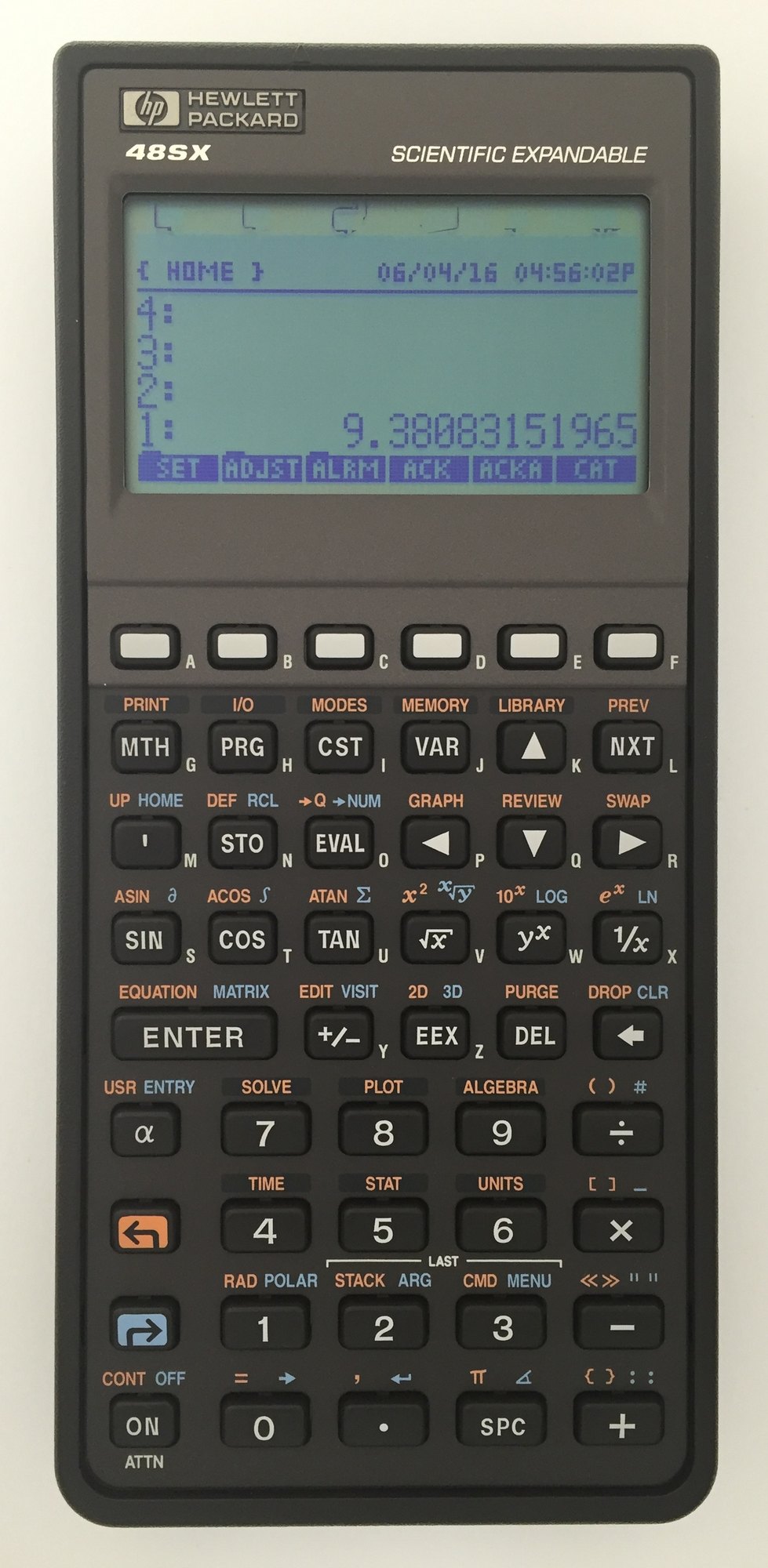
The HP 48SX of 6 March 1990, at $350, had a 131 × 64 screen, 32 KB of RAM that could be expanded to 288 KB with plug-in cards, an infrared link and a serial port, an equation writer and a matrix editor. Its processor was HP’s own Saturn design, a 4-bit-wide CPU with 64-bit registers, in a chip HP called Clarke, running at 2 MHz. The HP 48GX followed in 1993 and stayed in production until 2003. The HP-28C’s Getting Started manual and both volumes of the HP 48SX owner’s manual are in the Library.
2.4 Texas Instruments arrives: the TI-81, 1990
Texas Instruments came late. By the mid-1980s it had been through a disastrous venture into home computers, and its calculator business was small. According to a 2001 account in T.H.E. Journal, the turning point was an order from Connecticut for 10,000 four-function calculators: TI asked why, and found that mathematics teaching was changing. It used its contacts with the National Council of Teachers of Mathematics, then writing its Standards, and with textbook projects funded by the National Science Foundation, sought “10 or more advisors per project”, and ran informal focus groups of teachers, where, the article says, “the teachers were not restrained in their comments”. Education Week reported in 1991 that TI “sent engineers to conferences to watch teachers use existing graphing calculators” and asked them how to do better. Two Ohio State professors, Franklin Demana and Bert Waits, who were already running summer courses for teachers on calculators in precalculus, were, in the words of their National Council biography, “well known for assisting in the design of the Texas Instruments family of graphing calculators”.
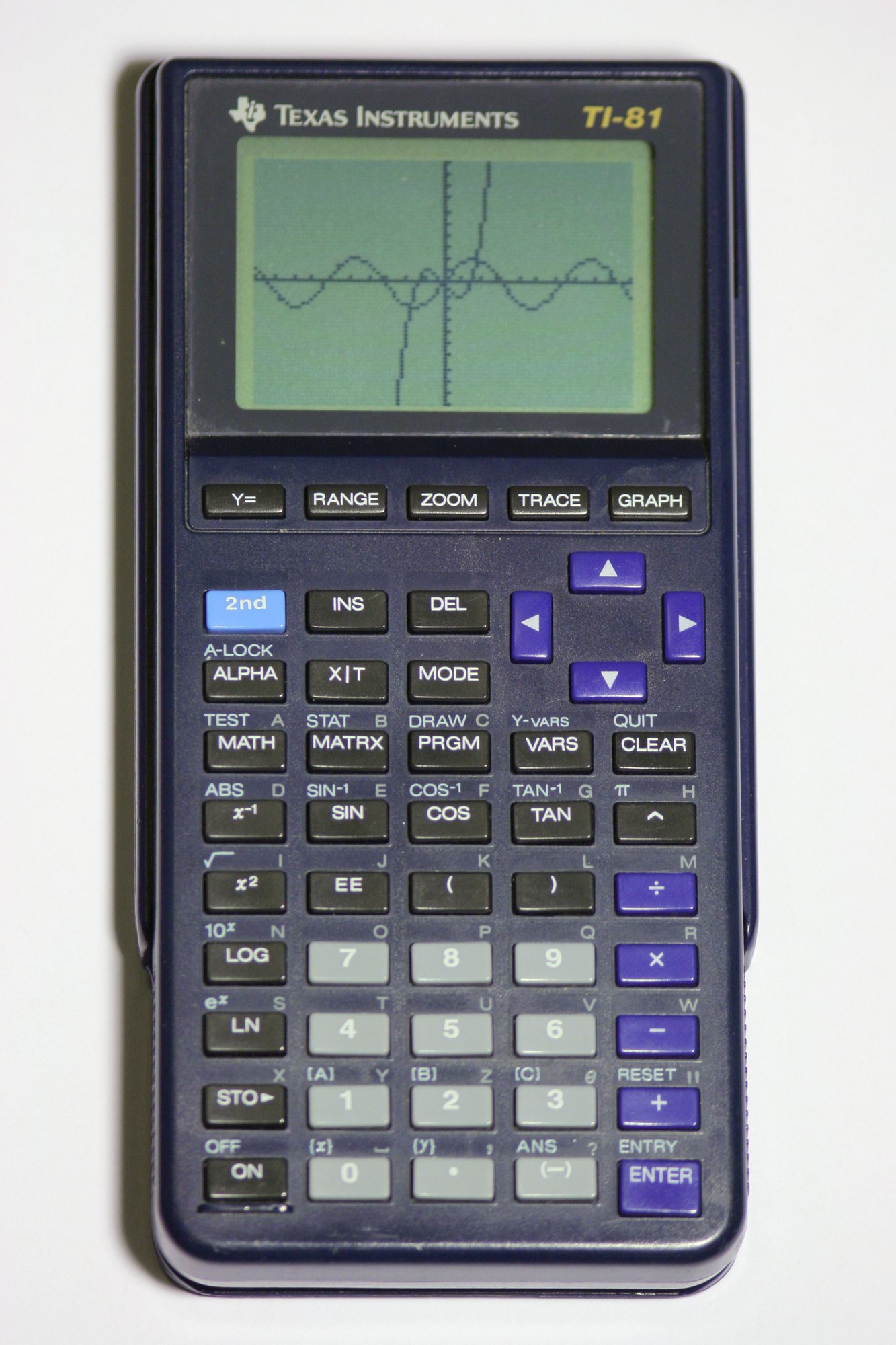
The TI-81 was designed for algebra and precalculus. It had a Z80 processor, 2.4 KB of memory for the user and a 96 × 64 screen, the same size as the fx-7000G’s; sources disagree on its clock, 2 MHz in most, about 5.6 MHz as measured on one unit. Its software, which TI called the Equation Operating System, is the root of every TI-83 and TI-84 since. A Los Angeles Times advertisement of 15 October 1990 offered it at $99.99 against a list price of $129.95; by 1991 Education Week put it at about $80 and called it the most popular graphing calculator, with teachers’ support “near-fanatic”. Pittsburgh’s schools bought a thousand. “We can solve whole classes of equations that we’ve previously avoided in high school,” a teacher at Phillips Academy told the paper. The TI-81 had no link port, and a CR1616 or CR1620 lithium cell kept its memory while the four AAA cells were changed. Its guidebook is in the Library.
2.5 TI-85 to TI-83 Plus, 1992–1999
TI then built a family, each model aimed at a stage of school or college:
Table 1 — TI then built a family, each model aimed at a stage of school or college
| Year | Model | Processor | Screen | Notes |
|---|---|---|---|---|
| 1990 | TI-81 | Z80 | 96 × 64 | algebra and precalculus; no link port |
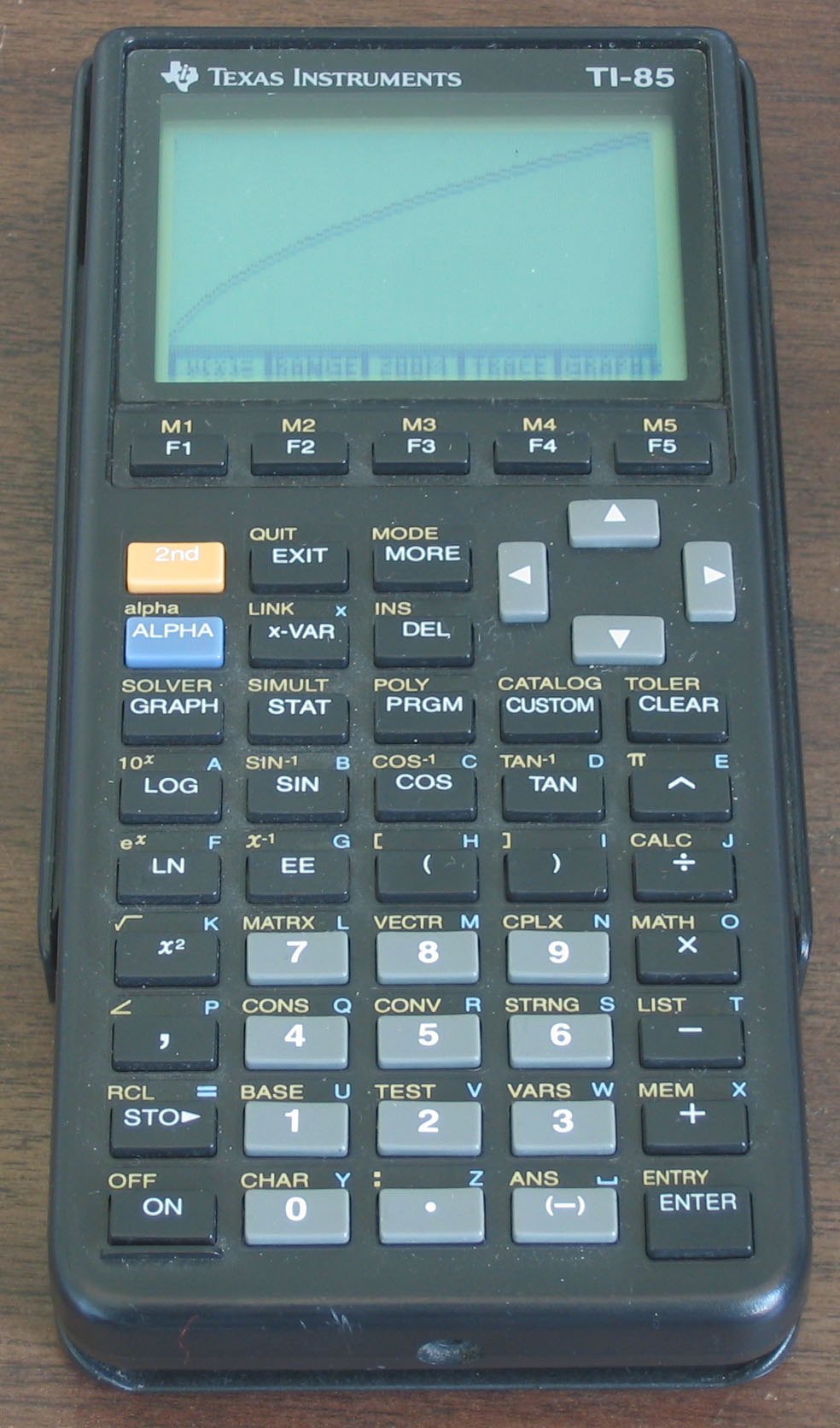
| 1992 | TI-85 | Z80, 6 MHz | 128 × 64 | calculus and engineering, $130 |
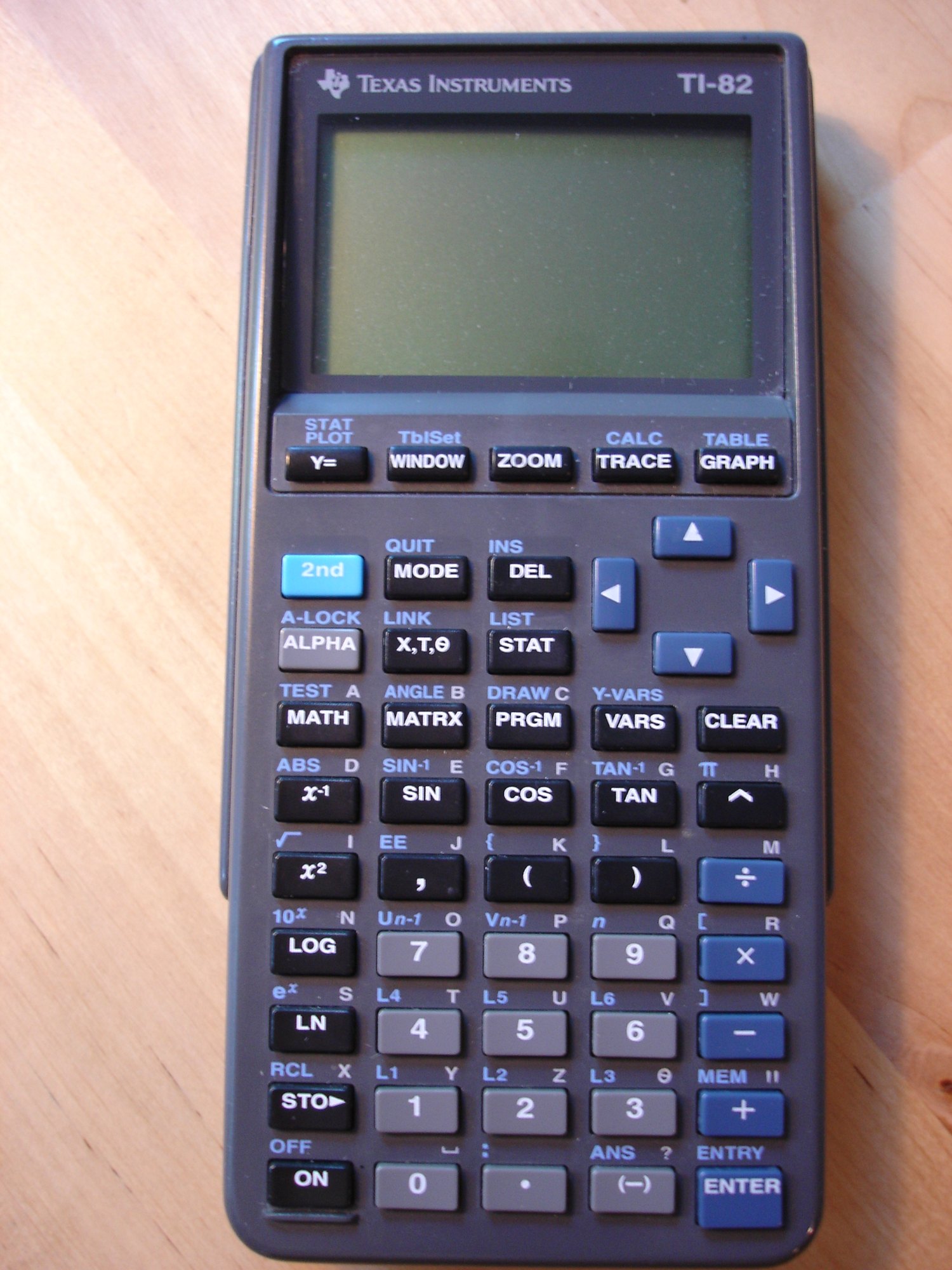
| 1993 | TI-82 | Z80, 6 MHz | 96 × 64 | link port, lists, polar and sequence graphs, $125 |
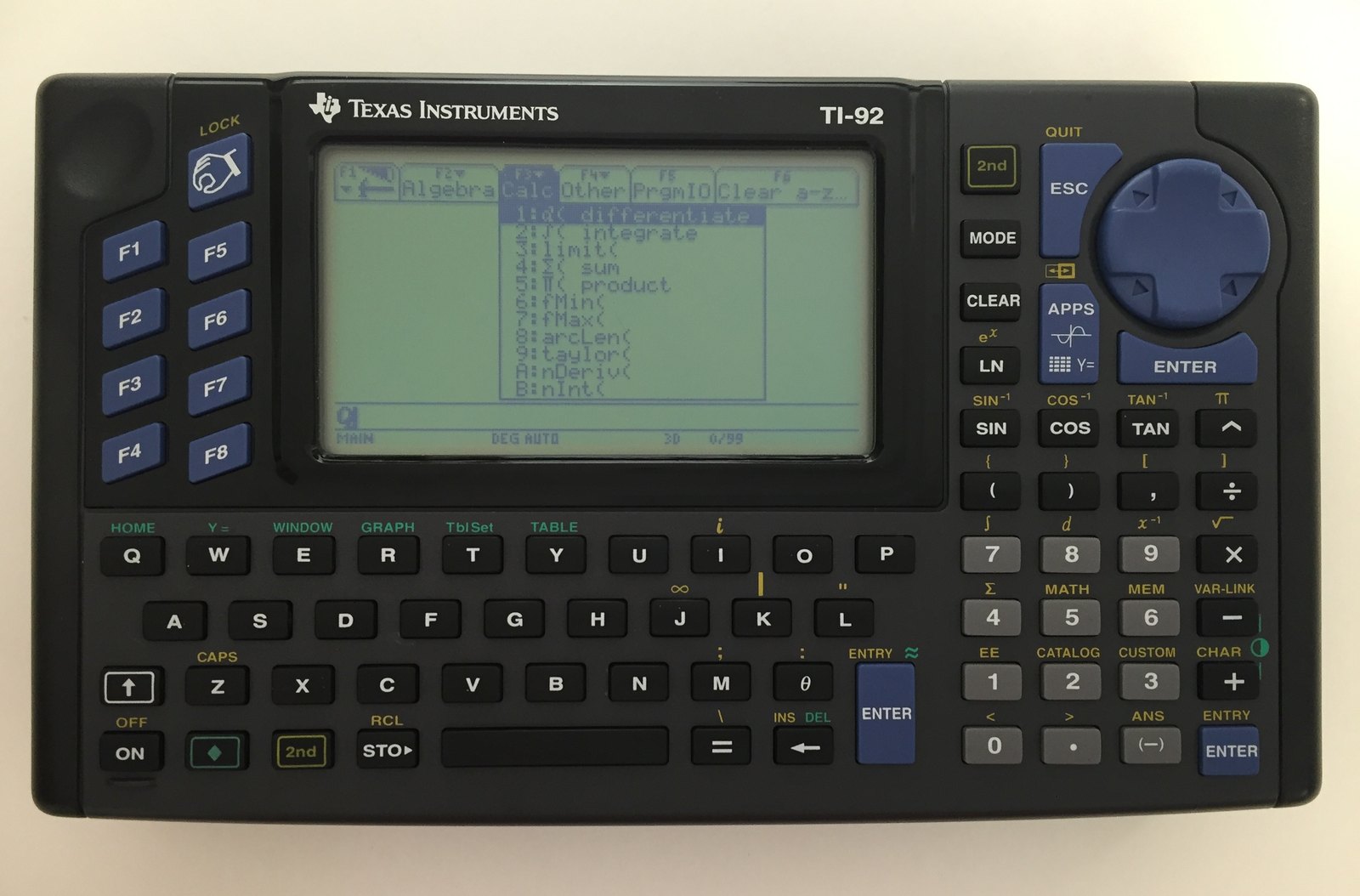
| 1995 | TI-92 | 68000, 10 MHz | 240 × 128 | first TI with symbolic algebra (from Derive), geometry, QWERTY keys, $200 |
| 1996 | TI-83 | Z80, 6 MHz | 96 × 64 | ancestor of the TI-83 Plus and TI-84 Plus, $125 |
| 1996 | TI-86 | Z80, 6 MHz | 128 × 64 | 128 KB memory, $150 |
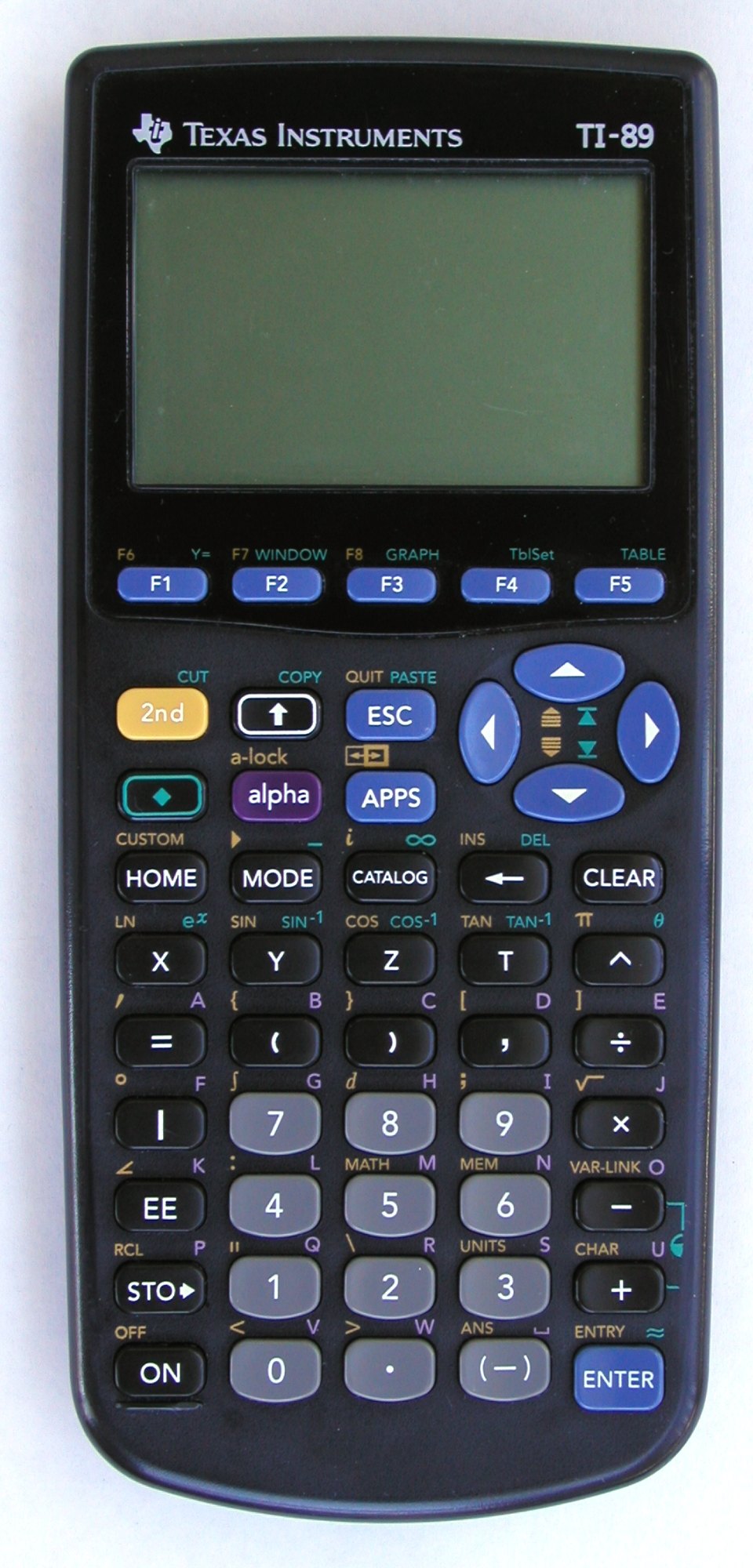
| 1998 | TI-89 | 68000, 10–12 MHz | 160 × 100 | symbolic algebra in a pocket size, $159.99 |
| 1999 | TI-83 Plus | Z80, 6 MHz | 96 × 64 | 512 KB flash, add-on applications, $104.99 |
Dates, processors and starting list prices are from Wikipedia’s comparison of TI graphing calculators. The TI-82’s link port let calculators swap programs, and its unplanned support for machine-code programs, discovered by users, started the community of calculator programmers described in volume 8. The TI-92, with its typewriter keyboard and computer algebra from Soft Warehouse’s Derive, and its pocket-sized successor the TI-89 answered the HP-28 and HP 48. The TI-83 of 1996 was the first TI with a built-in, if hidden, way to run machine code, and the TI-83 Plus of 1999 added flash memory, so that the operating system could be updated and TI and others could sell applications for it. TI bought Soft Warehouse in 1999.
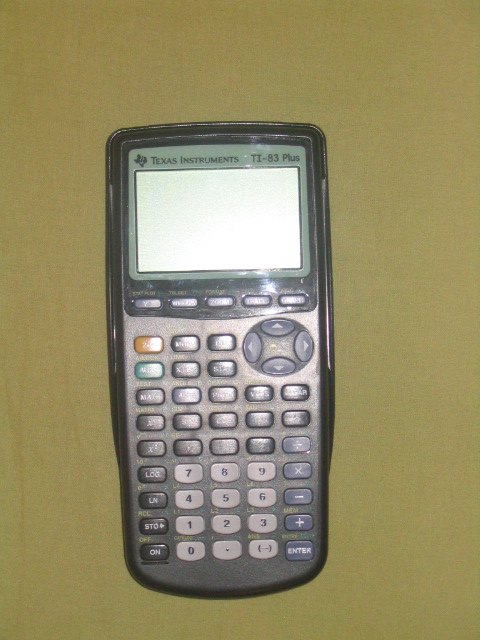
By the end of the decade TI led the American market, for reasons that had more to do with classrooms than with circuits. Volume 4 tells that story; volume 3 follows the machines from 2000 to the present.
Sources
- Casio fx-7000G: Wikipedia, “Casio fx-7000G”; vintage-calculators.nl (prices and the manual); the Centre for Computing History; ITmedia’s report of Casio’s exhibition timeline (March 2017); EE Times Japan (16 April 2025); Casio’s “fx-7000G Development Story” (casio.com, read through search summaries only); the Smithsonian’s records of the fx-7000G, fx-7000GA and OH-7000G; Casio’s fx-7000G Owner’s Manual and patent US 4,794,553.
- Casio’s later line: Wikipedia, “Casio graphic calculators” and “CFX-9970G”; Casio Australia’s brand history; Omnimaga.
- Sharp: Eddie Shore’s blog on the EL-5200 (April 2024); rskey.org; the Centre for Computing History.
- Hewlett-Packard: Craig Finseth’s HP data sheets (finseth.com); HP’s history page “The first graphing calculator”; HP Memory Project and hpmuseum.net on the 9125A and the 82143A; HP-28C Getting Started Manual and HP 48SX Owner’s Manual.
- Texas Instruments: T.H.E. Journal, “Learning From Teachers Beyond the Classroom” (1 November 2001); Peter West, “Sold On A New Machine”, Education Week (1 October 1991); the Smithsonian’s TI-81 record; ProMarket (8 April 2024); Wikipedia, “TI-81”, “TI-82”, “TI-83 series”, “TI-92 series” and “Comparison of Texas Instruments graphing calculators”; ticalc.org on the Soft Warehouse purchase; TI’s guidebooks for the TI-81, TI-82, TI-83, TI-85, TI-86 and TI-89 and TI-92 Plus.
Comments (0)