Curta · Volume 8
Collecting: Serials, Condition, Market, and Which Hazards Are Real
About 141,000 Curtas were made and production stopped around fifty-five years ago. That combination — a large enough run that examples are genuinely available, a small enough one that they are not common, and a mechanism robust enough that a high proportion still work — has produced an unusually stable collecting market. What follows is what can be read off a machine, what examples change hands for, and which of the commonly repeated hazards stand up.
8.1 Reading the bottom plate
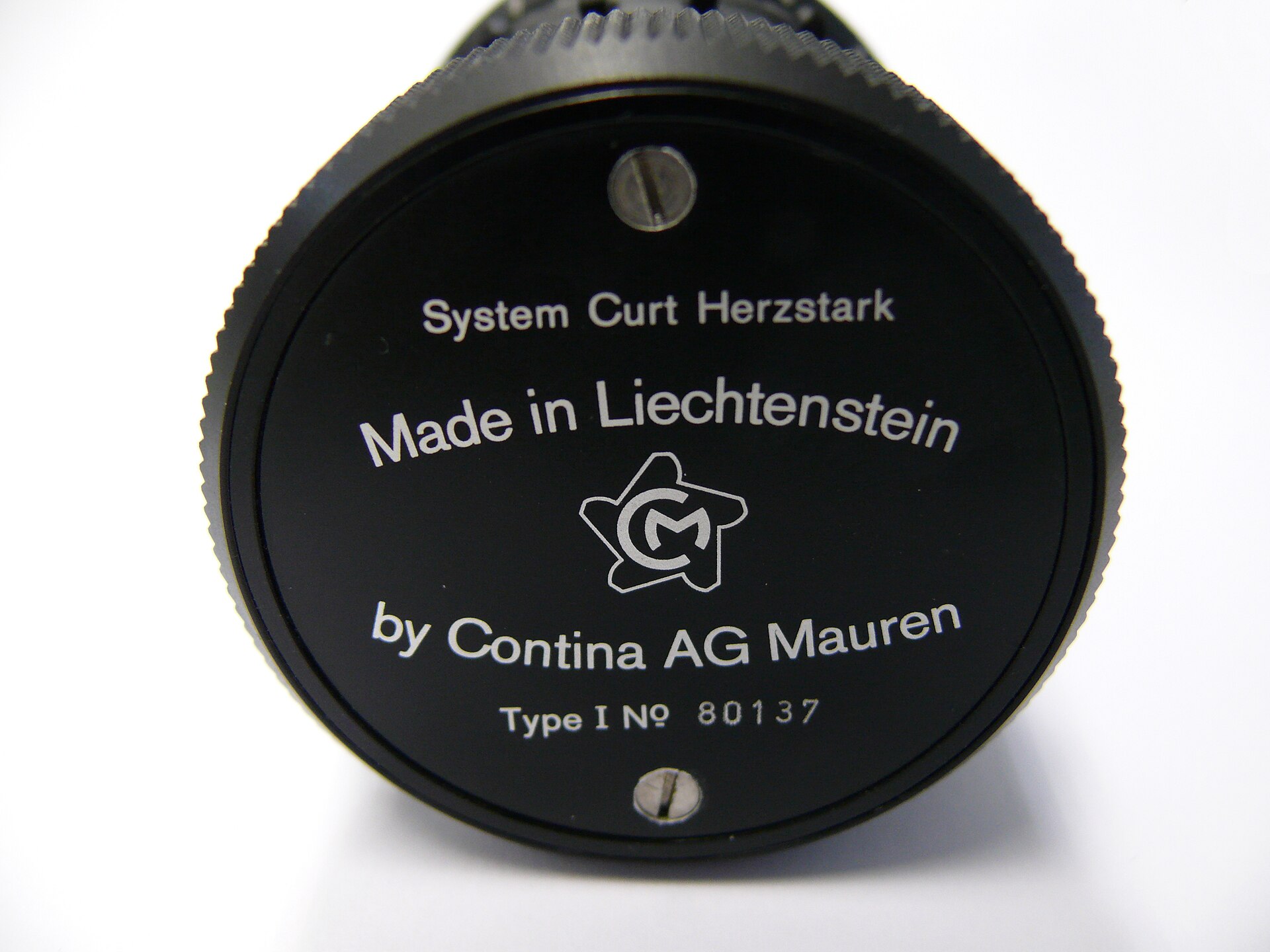
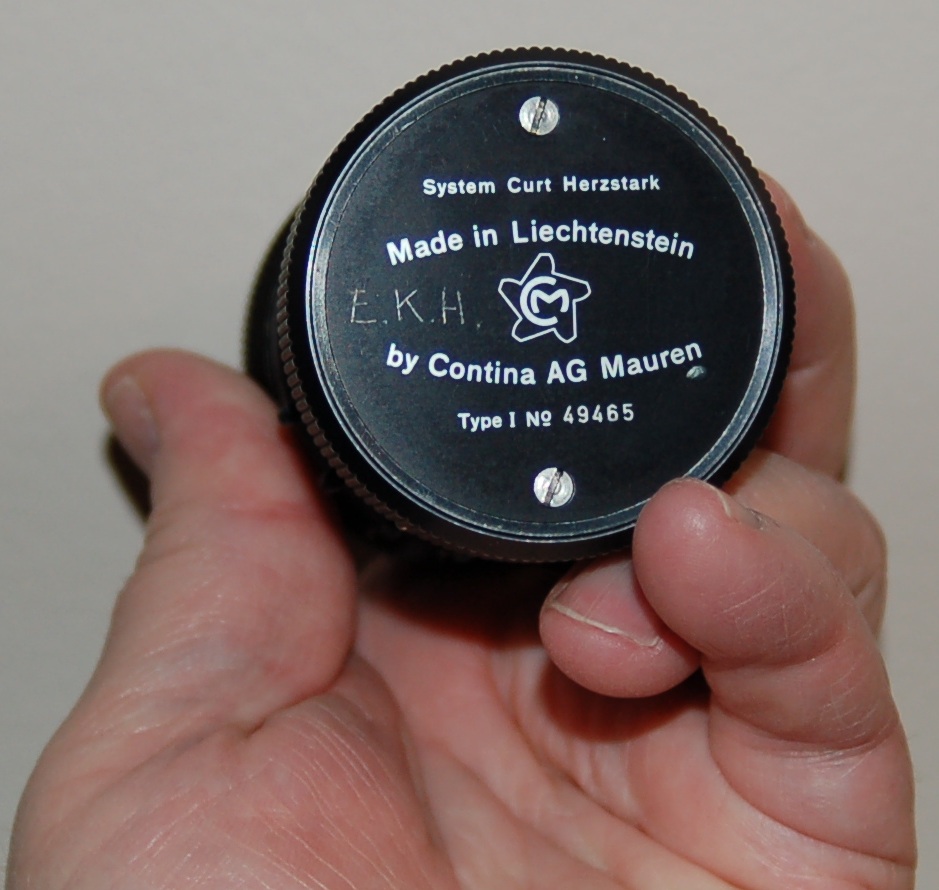
Every Curta identifies itself on its base. The engraving reads:
System Curt Herzstark Made in Liechtenstein by Contina AG Mauren Type I № nnnnn
with the Contina monogram between. The type and the serial number are the two facts that matter.
8.2 The serial blocks
The two models were numbered in separate blocks, and this is a factory fact rather than a collector’s inference: Type I numbering started at 1, Type II numbering started at 500,000. A six-figure serial beginning with a 5 is therefore a Type II, and this is the quickest authentication of a photograph in a listing.
The recorded extremes, from the serial study by Hansjörg Nipp circulated through collector channels:
Table 1 — The recorded extremes, from the serial study by Hansjörg Nipp circulated through collector channels
| Type I | Type II | |
|---|---|---|
| Block starts at | 1 | 500,000 |
| Earliest example recorded | 2019 | 500,084 |
| Latest example recorded | 80,288 | 569,944 |
| Estimated total built | approx. 78,700 | approx. 61,700–69,900 |
The year-by-year allocations for the Type I, from the same study, give a sense of how slowly the factory started and how fast it then ran:
Table 2 — The year-by-year allocations for the Type I, from the same study, give a sense of how slowly the factory started and how fast it then ran
| Year | Serial range | Approx. built |
|---|---|---|
| 1948 | 900–999 | up to 100 |
| 1949 | 1,900–2,200 | 300 |
| 1950 | 2,200–6,900 | 4,700 |
| 1951 | 6,900–12,600 | 5,700 |
| 1952 | 12,601–20,700 | 8,100 |
| 1953–1970 | 20,701–80,427 | the remaining approx. 47,600 |
The shape of that table matches the company history exactly. Almost nothing in 1948, the year the gauge programme consumed the factory’s capacity; a few hundred in 1949; and then a step change from 1950, the year the museum’s account says delivery in large numbers first became possible.
Two cautions apply to dating by serial. First, these allocations are reconstructions from surviving machines and documents, not a factory ledger, and the boundaries are approximate. Second, a specific serial-to-year claim found on a marketplace listing is usually derived from one of these same tables, so it inherits their uncertainty; it is not independent evidence.
8.3 What they sell for
Curta prices are frequently reported as though they were a single number. They are not; they are a range set by type, condition, completeness and — as with any auction good — how many people happen to be bidding that week.
Recent evidence points at a fairly narrow band for ordinary examples in good order:
- A Type I of about 1955, with its original box and manuals, sold at Bonhams in September 2023 for £1,536 including premium.
- A Type I with its metal can and booklets closed on eBay in May 2025 at £1,175, roughly US $1,560.
- An Antiques Roadshow appraisal of a 1956 Type II gave an auction range of $800 to $1,500, though that appraisal is older than the sales above.
A reasonable working expectation for a complete, functioning, cosmetically sound machine is therefore around $1,000 to $1,600, with the caveat that this is a market which has been trending upward for two decades and any figure quoted here will age.
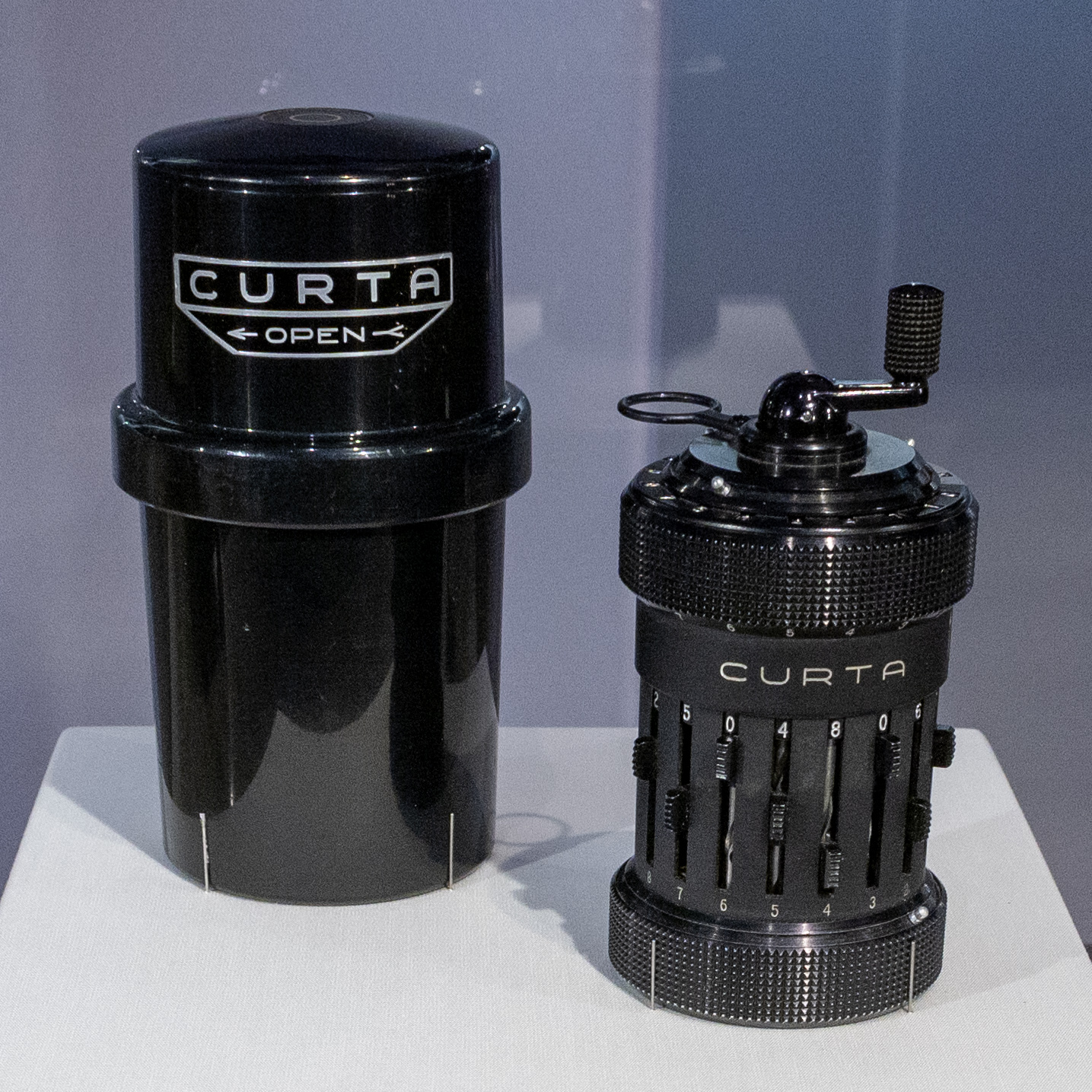
What moves a machine above that band is rarity rather than condition alone: demonstration and cutaway kits are the most valuable Curtas, being both rare as a type and almost never complete. Below the band sit machines with seized mechanisms, missing cans, missing decimal markers, or — the most common real defect — a clearing action that no longer zeros every wheel.
8.4 Condition, and the one thing that ruins machines
Contina claimed that practically no wear could be detected even after years of use, and that the mechanism would stand up to millions of rotations. The claim appears to have been close to true: reported warranty-repair rates were around three per cent, and a large fraction of surviving machines still work.
The damage that shows up in the market is therefore almost never wear. It is disassembly.
The Contina instruction sheet is unusually direct about this, and the sentence is worth having in front of anyone considering a project machine: servicing or repair must be entrusted only to an authorised Curta agency, and “on no account should you attempt to repair or even to lubricate your CURTA yourself.”
The reason is not mystique. It is that a great many Curta parts look identical while differing slightly in dimension, so a machine can be reassembled in a way that appears correct and is not. Enthusiasts have destroyed working machines by taking them apart and being unable to restore them. A machine described as “opened for cleaning” or “partially disassembled, all parts present” is a substantially riskier purchase than one described as stiff but untouched.
The practical inspection sequence for a machine in hand follows the interlocks described in the mechanism volume. Check that the crank turns freely clockwise and stops cleanly at its zero position. Check that it locks against reverse rotation. Check that the carriage lifts, indexes to each position, and snaps down. Sweep the clearing lever and confirm that every wheel in both rings goes to zero and that the lever finishes at a stop. Then set a number and add it to itself repeatedly through a carry — 999,999 plus 1 is the classic test, because it exercises the carry chain end to end.
A Curta that seems seized should be checked against the interlock before being called broken: a clearing lever parked between its two stop positions will lock the crank and prevent the carriage from seating, and looks exactly like a dead machine.
8.5 Reproductions, replicas, and what “fake” actually means here
The reproduction question is usually framed as a counterfeiting risk. On the evidence available, that framing is wrong, and saying so is more useful than repeating the warning.
Searches of the current market turn up a steady supply of Curta-adjacent objects — replica shells, 3D-printed models, Curta-themed jewellery and watches — and they are, as far as could be determined, openly described as replicas by the people selling them. No evidence was found of a trade in modern reproductions passed off as original Contina machines. That is not surprising once the economics are examined: the tolerances are such that making a convincing mechanical copy would cost more than buying a genuine machine, which is exactly the obstacle every serious reproduction effort has run into.
Three categories are worth distinguishing:
Scaled 3D-printed Curtas. Marcus Wu’s 3:1 scale working Curta, modelled from the original engineering drawings and released as free files, is the best known, and it is covered in its own dive. These are three times life size, printed in plastic, and cannot be mistaken for an original by anyone holding one.
Full-scale reproduction attempts. The Curta Project, run by the product designer and mechanical engineer Adam Leeb, aims to build new Type I machines in the original aluminium, bronze and steel from the preserved engineering drawings — which would make them the first true recreations since production ended. As of the material consulted, the project was gauging demand rather than selling, and no machines were available.
Decorative replicas. Non-functional shells and models sold as ornaments, openly marketed as such.
The realistic hazards for a buyer are therefore mundane rather than sinister: over-described condition, a machine that has been opened, a missing can or markers, and serial-based dating claims repeated from collector tables as though they were documented.
8.6 What a collection actually needs
A serious Curta shelf is not a run of serial numbers. It is a small number of objects that document the machine:
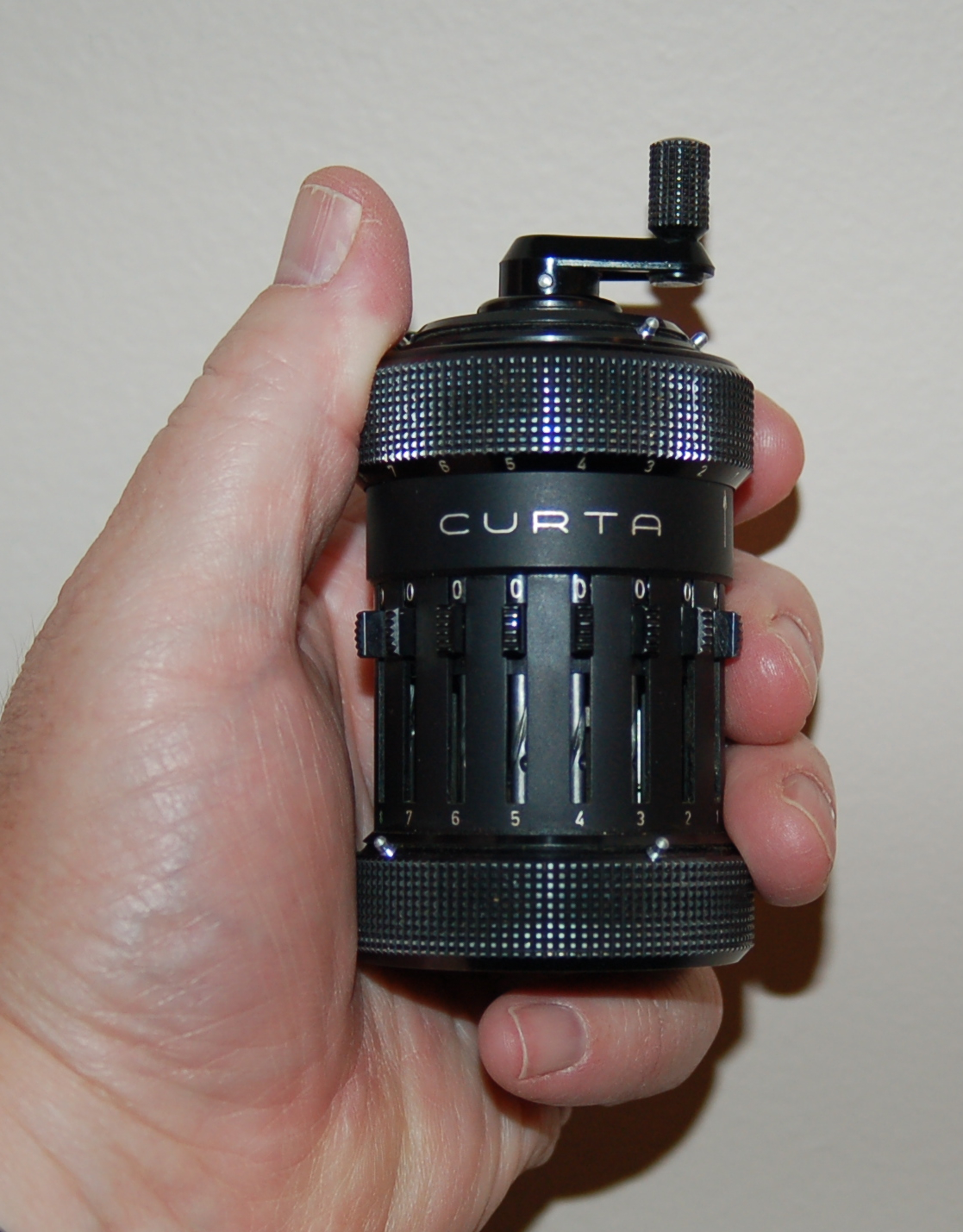
- one working Type I, complete with can, instruction sheet and decimal markers;
- one Type II, to make the capacity argument physically rather than in a table;
- the paper: the Contina instruction sheet, the Computing Examples booklet, and — much harder to find — a dealer technique manual such as the Automatic Business Machines volume, which is where the machine’s real range is recorded;
- and, if one ever surfaces at a price that can be justified, a demonstration kit, which is the only way to see the mechanism without taking a working machine apart.
Comments (0)