Curta · Volume 5
The Complemented Stepped Drum: How the Curta Actually Works
Every mechanical calculating machine has to answer one awkward question: how do you subtract? Addition is easy to mechanise — turn a shaft, advance some wheels. Subtraction is not, because running the mechanism backwards means reversing every gear train, every carry linkage and every safety interlock in the machine, and doing it reliably. The standard nineteenth-century answers were to build a reverse gear, or to build a second set of drums, or to make the operator do the complementing arithmetic in their head.
Herzstark’s answer was to put the subtraction on the drum. That single decision is the reason a four-function calculating machine with automatic tens carry fits in a coat pocket, and everything else in this volume is downstream of it.
5.1 The stepped drum, and what Leibniz left behind
The Curta belongs to the stepped-drum family, a line that runs from Leibniz’s stepped reckoner through Thomas de Colmar’s Arithmometer — the first stepped-drum machine to be mass-produced, from around 1850 — to the desktop machines of the twentieth century.
A stepped drum is a cylinder carrying teeth of staggered length running parallel to its axis. Bruderer’s description is exact: the teeth represent the numerical values 1 to 9, no tooth has the value zero, and all the teeth together correspond to 9. One tooth — the longest — gives 1. The longest and the second-longest give 2. Three teeth give 3, and so on.
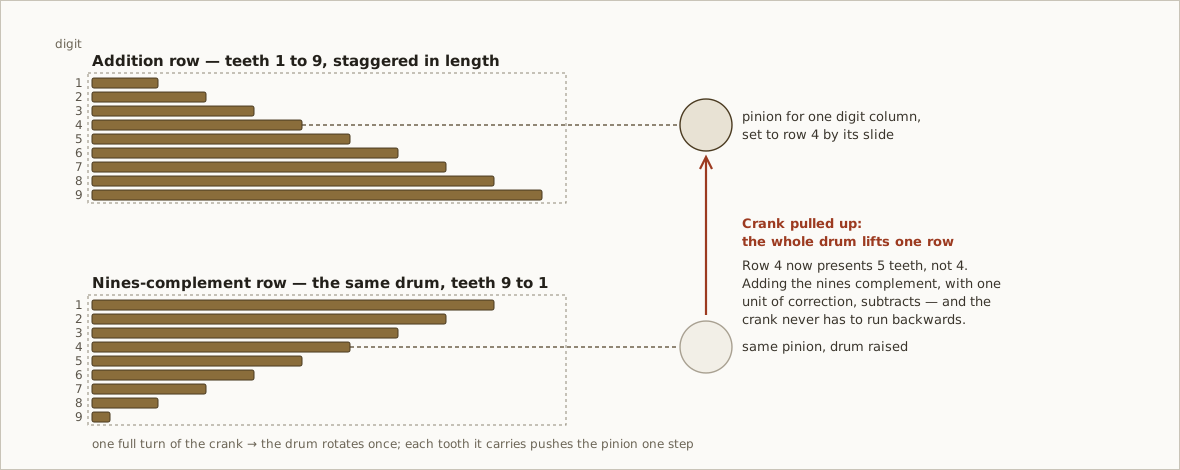
A pinion rides on a shaft alongside the drum and can be slid along it. Where the pinion sits axially determines how many of the drum’s teeth sweep past it during one full revolution, and therefore how many steps the pinion turns. Move the pinion to position 4, turn the drum once, and the pinion advances by exactly four. That is the whole principle: a number is entered by positioning, and it is added by one rotation.
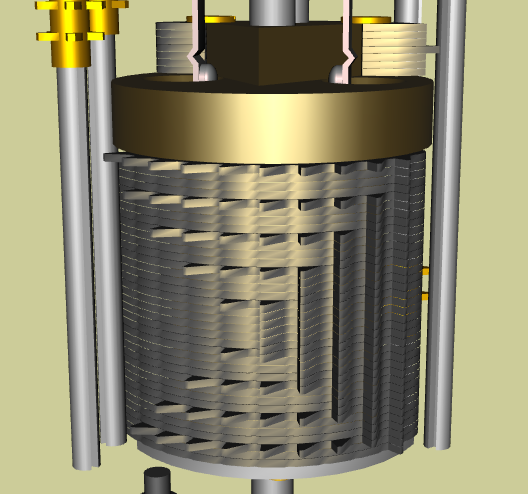
In a conventional stepped-drum machine there is one drum per digit column, and the drums are large. That is why those machines are the size and weight they are. The Curta has one drum for the entire machine, standing on the central axis, with the pinions for every digit column arranged around it. The setting slides on the outside of the body are connected to those pinions; sliding one moves its pinion along the drum to the height that represents its digit.
5.2 The complement, which is the invention
Now the awkward question. To subtract, a machine has two honest options: turn the mechanism backwards, or add the complement.
Adding the complement works like this. To compute 6 − 4 in a register of one decimal place, add the nines complement of 4, which is 5, giving 11, then apply a unit of correction. Generalised across a multi-digit register with the carry allowed to run off the top, the arithmetic comes out right and no wheel ever turns backwards. This is not exotic; it is the same idea that modern computers use when they represent negative numbers in two’s complement.
The cost, in a mechanical machine, has always been the complement itself: something has to generate 9 − d from d, for every digit column, on demand. Doing that with a second set of drums doubles the machine.
Herzstark’s 1938 patent puts both sets of teeth on one drum. The drum carries the digit teeth and, alongside them, a second row of teeth giving the nines complement of each digit position. Raising the drum axially by half a tooth row brings the complement teeth into play instead of the digit teeth, for every pinion at once. The museum’s exhibition panel states it exactly: a further relay roller would be needed to form the nines complement, and “Herzstark integrated it into the relay roller for addition by incorporating extra rows of cog teeth. Combining two relay rollers into one was a key aspect of the ingenious invention.”
The operator’s interface to this is the crank. Pull the crank up before turning, and the drum is raised; a white or red sleeve shows at the base of the crank so the state is visible. Push the crank down and it adds again. The crank itself turns clockwise only, in both modes, and is mechanically locked against reverse rotation — a lock that the instruction sheet warns about directly: any attempt to force the handle backwards may damage the machine.
5.3 The tens carry
Automatic tens carry is the feature that separates a calculating machine from an adding aid, and it is the part that is hardest to make small, because a carry has to propagate: 999 + 1 must ripple through three wheels in one crank turn.
The Curta’s mechanism is visible in the detailed drawings a Wikimedia contributor produced from a dismantled machine. Each display wheel carries a small pin. As the wheel rolls from 9 to 0 — the only transition that generates a carry — that pin presses on a carry lever. The lever, riding on a cam, shifts a sliding pinion downward so that it drops into line with a dedicated carry tooth, which then advances the next wheel up by one. Once the carry has been delivered, a reset section returns the lever to its raised position ready for the next turn.
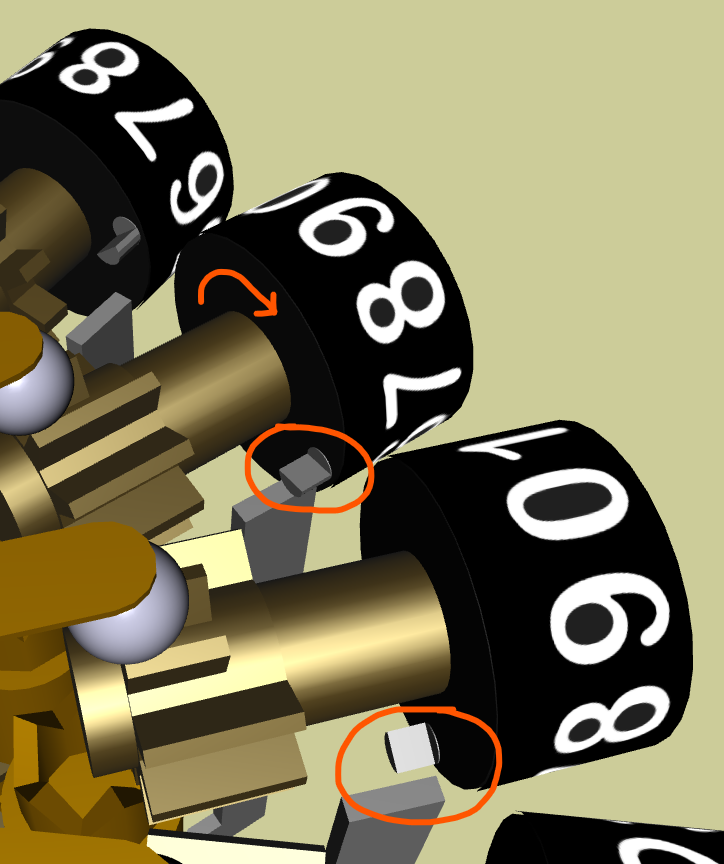
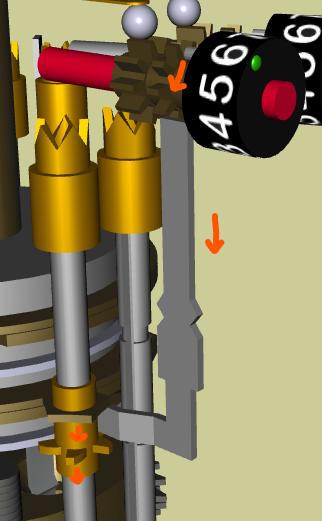
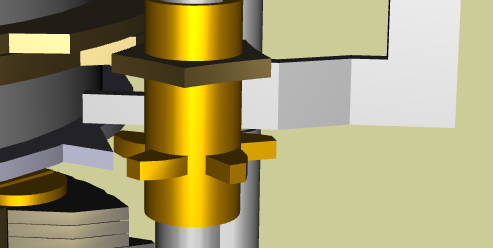
The carry runs in both registers — the result dials and the revolution counter — and the Contina sales literature of the period made a selling point of “continuous tens transfer in the answering and the indicating dial”, contrasting it with machines that stalled on long carries.
5.4 The carriage
The carriage is the knurled ring that forms the top of the machine, carrying both dial rings and the crank. It is the multiplier.
To move it, the crank must first be at its zero stop. The carriage is then lifted straight up, rotated until the indicator arrow on the front of the body points at the required position number engraved on its lower edge, and allowed to snap back down. In position 1 a crank turn adds the set number once. In position 2 the drive is geared to the next decade, so a turn adds ten times the set number; in position 3, a hundred times; and so on to position 6 on a Type I and position 8 on a Type II.
The instruction sheet’s exercise for this is characteristic of the whole document: practise the movement with both hands first, then learn to do it with the thumb and forefinger of the left hand alone — the hand already holding the machine — because one-handed carriage movement is what makes the operator fast.
5.5 Clearing, and the interlock that catches everyone
The clearing lever sweeps around the dial ring and zeroes the registers by driving a rack that returns every display wheel to zero.
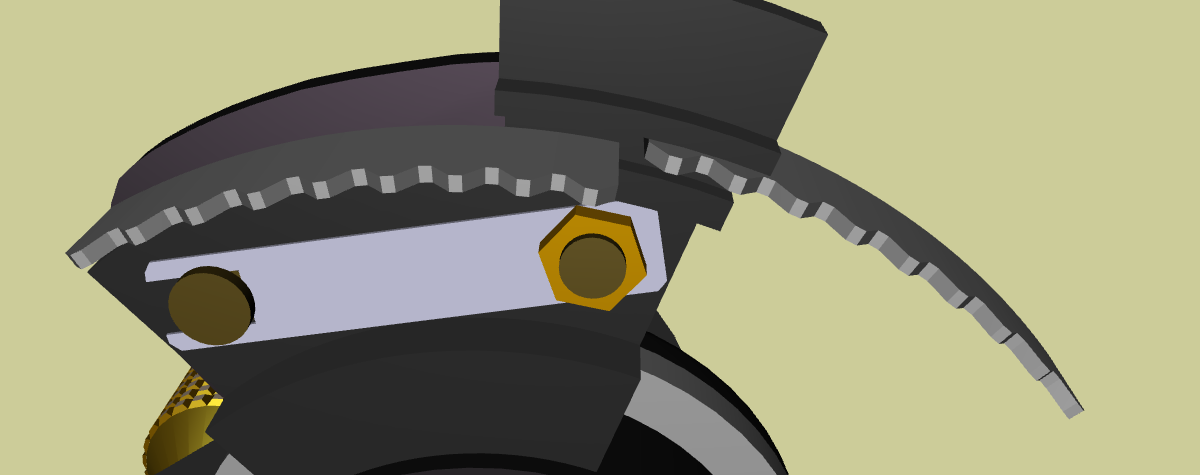
The procedure matters, and it produces the single most common “my Curta is broken” report. There are two stop positions for the clearing lever, A and B, at the two points where the black and white dial rings meet. To clear both registers the carriage is raised and the lever is swept steadily all the way round and back to its initial stop. To clear only one register, the lever is swept around that register alone, to its second stop.
The Contina instruction sheet then gives the warning in bold, and it deserves repeating: after clearing, the clearing lever must always be left in one of its two stop positions, “otherwise the carriage will not snap down and the operating handle will remain locked.” A Curta that seems seized, with a crank that will not turn and a carriage that will not seat, is very often a Curta whose clearing lever is parked between stops.
There is a matching interlock at the other end. The clearing lever itself pulls out to its working position and is pushed back, against a release button, before the machine goes into its case.
5.6 The reversing lever
At the back of the body is a small lever with two positions. Up is normal, and covers all ordinary calculation. Down reverses the gearing of the revolution counter so that it counts negative turns.
It is needed in three situations, which the factory literature lists precisely: when a count of items added and subtracted is required, so that a minus turn decrements the counter instead of incrementing it; for division by the subtractive method; and for direct multiplication of a quotient standing in the white dial by a number set on the slides. For a beginner it is the control most safely left alone — the instruction sheet’s definition of a machine that is “ready” includes the reversing lever being up.
5.7 The interlocks, and why they are there
The Curta is full of mechanisms whose only job is to prevent the operator from breaking it. The crank is locked against reverse turns. The crank must be at its zero stop before the carriage can be lifted or the clearing lever moved. The carriage will not seat unless the clearing lever is at a stop. The sales literature mentions special stops that prevent the axles overspeeding during fast operation, and an exploded diagram in the museum’s exhibition labels a centrifuge lock on the main shaft.
All of these exist because the mechanism is small, precise, and expensive. Contina’s own advice was correspondingly firm: the instruction sheet tells the owner that servicing must go to an authorised agency and that on no account should the owner attempt to repair, “or even to lubricate”, the machine. That instruction has aged into a collecting rule, and it is discussed in the final volume.
5.8 How many parts
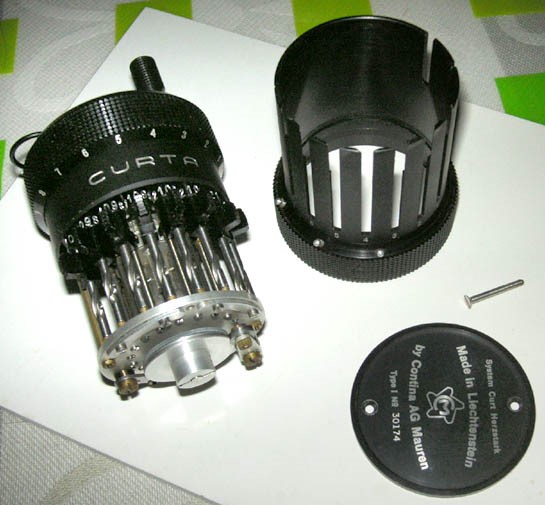
Part counts for the Curta circulate widely and disagree. The Liechtenstein National Museum’s exhibition states that the machine “comprises almost 600 individual components”. Figures of 571 and of 605 both appear in the popular literature.
The disagreement is probably not a dispute about the machine but about what counts as a part — whether screws, springs, balls and pins are counted individually, and whether a sub-assembly supplied as one item is one part or several. The safe statement is the museum’s: on the order of six hundred parts, in an object 53 mm across, assembled by hand in nine to ten hours.
Comments (0)