Curta · Volume 4
Type I and Type II: What Actually Differs
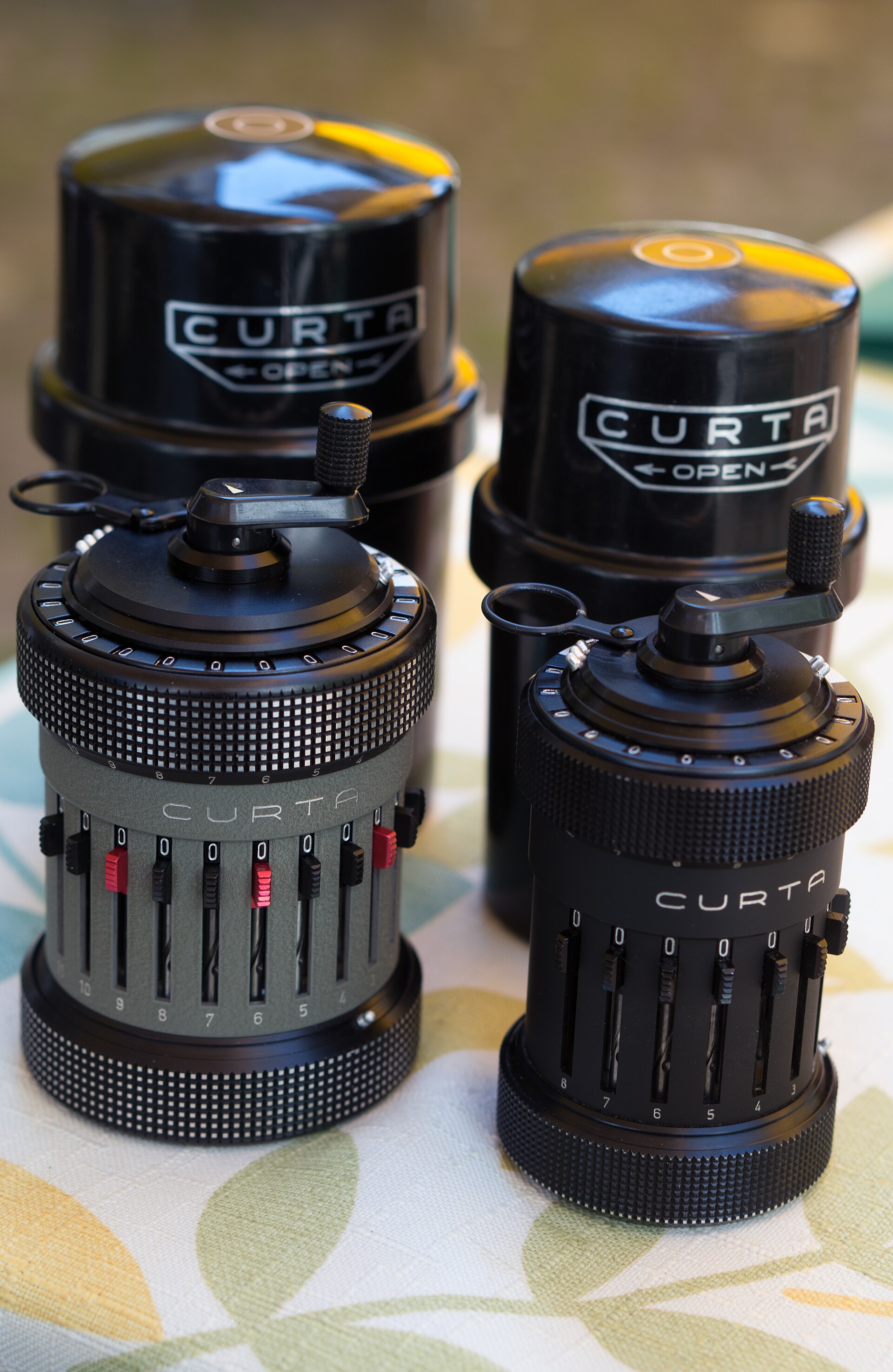
Contina made one machine in two sizes. That sentence is nearly the whole of this volume, and it is worth putting first, because the Curta literature sometimes implies a redesign between the models. There was none of consequence. The Type II is a Type I with more digit columns, a larger body to hold them, and a proportionally taller stack of dials. The mechanism, the operating procedure and the instruction booklets are shared; the Contina instruction sheet says so explicitly, noting that the two models “being identical but for their capacity, it has been deemed sufficient to represent only CURTA model I on the illustrations.”
4.1 The capacity triple
Both machines are described by three numbers, in the order setting register × counter register × result register.
Table 1 — The capacity triple
| Type I | Type II | |
|---|---|---|
| Capacity triple | 8 × 6 × 11 | 11 × 8 × 15 |
| Setting slides | 8 | 11 |
| Revolution counter (white dials) | 6 | 8 |
| Result register (black dials) | 11 | 15 |
| Carriage positions | 1–6 | 1–8 |
| Diameter | 53 mm | 65 mm |
| Height | 85 mm | 90 mm |
| Mass | c. 230 g (c. 330 g with case) | c. 360 g |
| Introduced | 1948 | 1954 |
| Serial range | from 1 (highest recorded c. 80,288) | from 500,000 (highest recorded 569,944) |
The three registers do different jobs and the distinction is the single most common point of confusion about these machines.
The setting register is what the slides control: the number being fed in. Eight digits on the Type I, eleven on the Type II.
The counter register — the white dials — counts crank turns, position by position. In a multiplication it accumulates the multiplier; in a division it accumulates the quotient. Six digits on the Type I, eight on the Type II. This is the register that gets misreported as “the input”.
The result register — the black dials — holds the running total. Eleven digits on the Type I, fifteen on the Type II.
The mass figures need one qualification. Bruderer gives the Type I as 230 g without its sleeve and 330 g with it; Wikipedia gives 228 g. These are not in conflict so much as imprecise — individual machines vary, and it is not always stated whether the case is included. The Type II figure of 360 g is consistent across sources.
4.2 What the extra capacity buys
The practical difference shows up in division, and the factory booklet is explicit about it.
The standing instruction for division is to start with the carriage in its highest position — position 6 on a Type I, position 8 on a Type II — and to work down. The number of carriage positions therefore sets the number of quotient digits the machine will develop before it runs out of places to shift into. The instruction sheet works the same division, 17.29 ÷ 1.2, on both machines and stops at different points: on the Type I the six digits of the white dial are developed and the calculation is finished, while on the Type II two further carriage positions are available and two more quotient digits can be developed.
The remainders quoted for that example give the difference its proper scale. Closing the division on a Type I leaves a remainder of 0.00004; on a Type II, 0.0000004. Two orders of magnitude, for twelve millimetres of diameter.
For a surveyor closing traverses, or anyone chaining multiplications where intermediate rounding accumulates, that is the entire argument for the larger machine. For addition, subtraction and ordinary commercial multiplication, the Type I is sufficient and is the more pleasant object to hold.
4.3 Telling them apart
In a photograph without a scale reference the two are easy to confuse, and collectors use the same shortcuts each time.
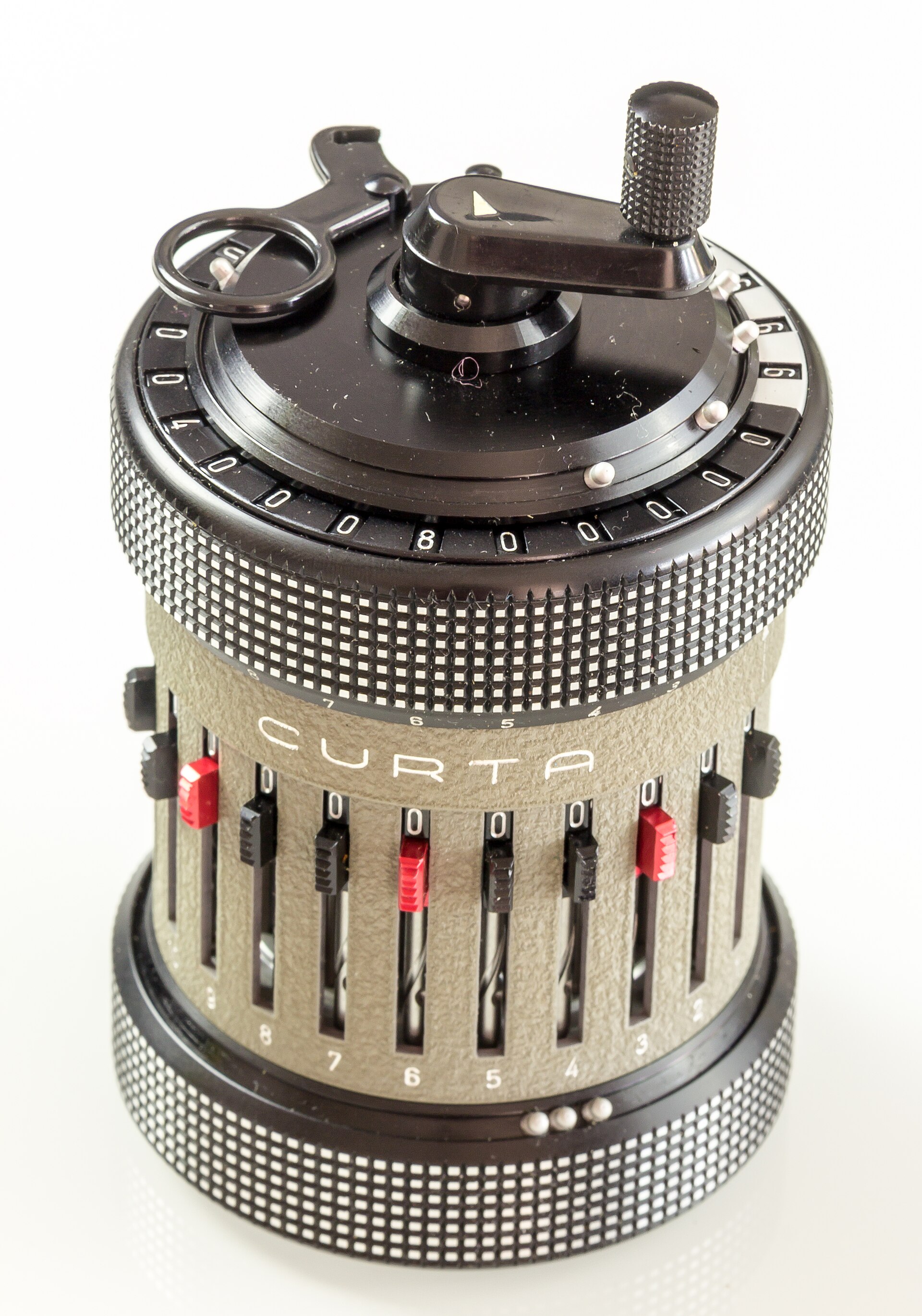
Count the slides. Eight slots around the body is a Type I; eleven is a Type II. This is the only test that does not depend on judgement.
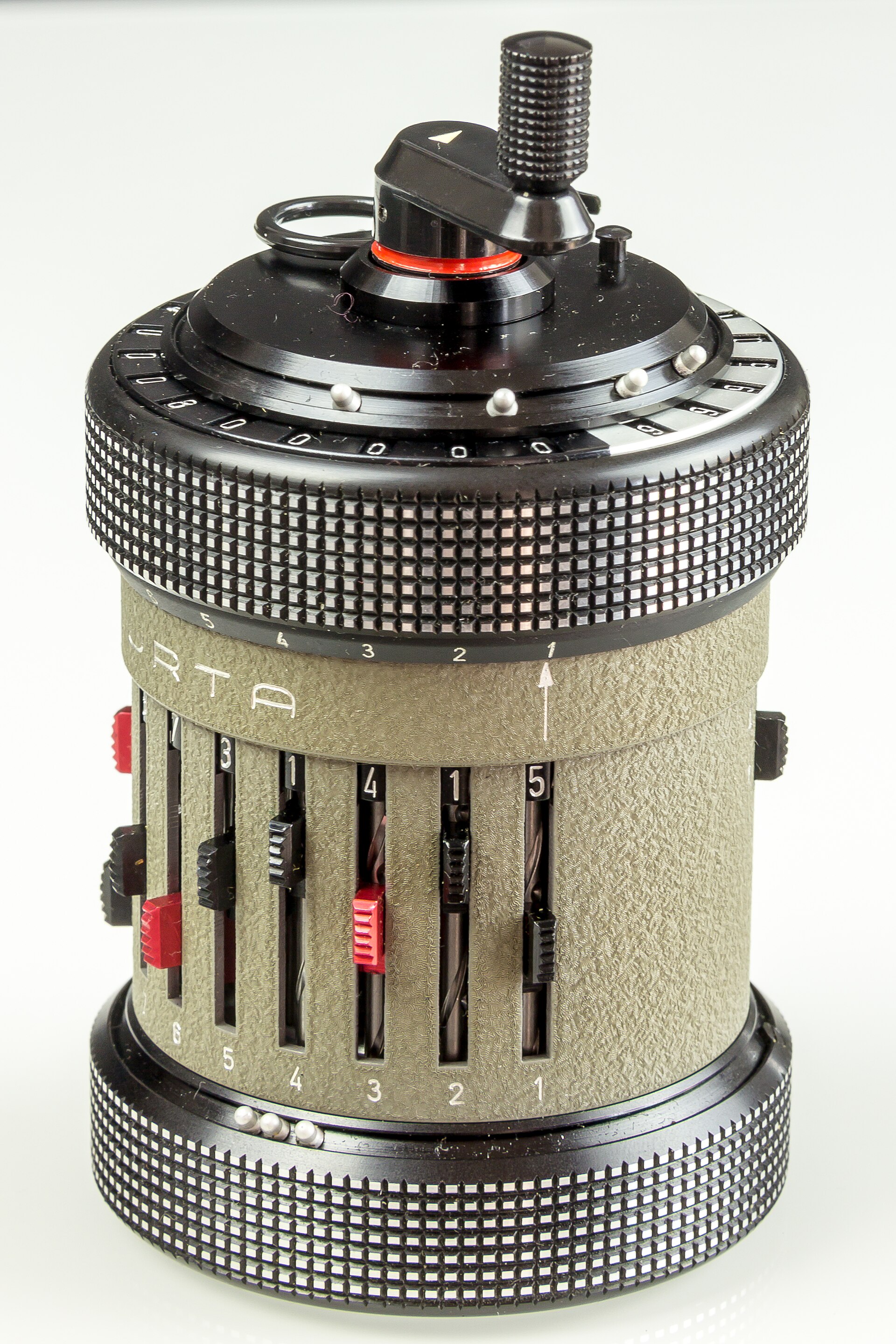
Count the carriage-position numbers engraved on the lower edge of the carriage: 1 to 6, or 1 to 8.
Read the bottom plate. It is engraved “System Curt Herzstark / Made in Liechtenstein / by Contina AG Mauren” with the type and serial number below.
Look at the serial number. Type I serials start at 1; Type II serials start at 500,000. A six-digit serial beginning with a 5 is a Type II. This is a hard boundary set at the factory rather than a collector’s inference.
Proportion is the least reliable test on its own, but the Type II is visibly broader relative to its height — 65 mm across and 90 mm tall against 53 by 85 — and in side-by-side photographs the difference is obvious.
4.4 When the Type II actually started
The Type II is conventionally dated to 1954, and that is the date given in most reference accounts, including Wikipedia. The serial evidence complicates it.
Bruderer’s production chart for the Curta 2 runs from 1953. The serial study circulated by Nipp allocates serials 500,000–502,500 — about 2,500 machines — to 1952–53, before allocating 502,501–506,500 to 1954–55. If those allocations are right, then a couple of thousand Type II machines were built before the model’s conventional introduction date.
The most likely explanation is the ordinary one: 1954 is the date of general market introduction, and the earlier machines are pre-series and early production. It is stated here as a probable reconciliation rather than a documented fact, because no source consulted addresses the discrepancy directly.
4.5 Colours, variants, and one machine that was never sold
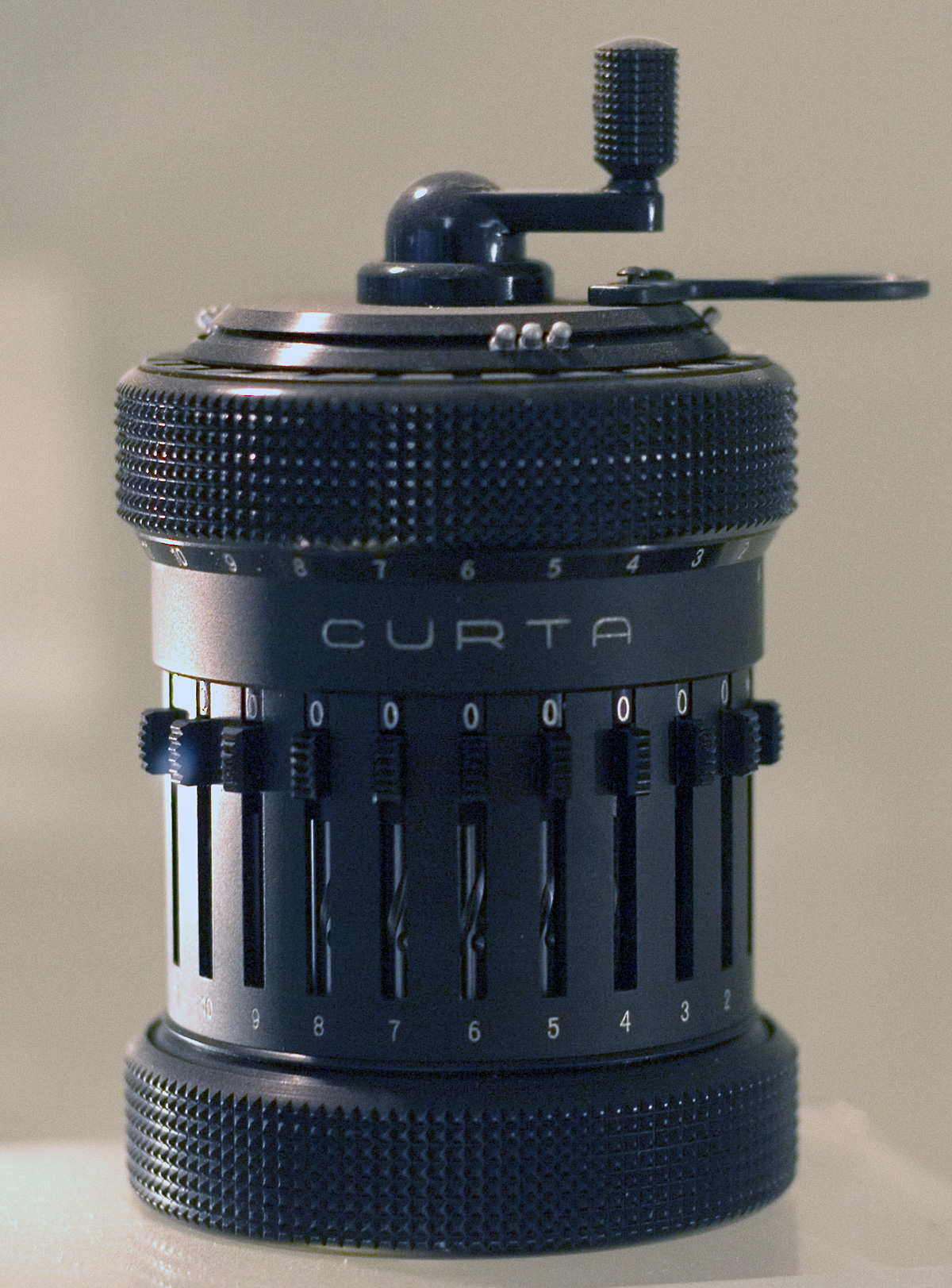
Most Curtas are black, with the crank, carriage and base in bright machined or anodised finishes. Lighter-bodied machines — cream or grey — exist and appear in museum collections, and some Type II bodies were produced in grey rather than black. Colour is not a reliable guide to type or date.
More interesting than the colours are the variants that never reached the market. Bruderer, drawing on an account by Herzstark’s development engineer Elmar Maier, records further development work on a Curta 1a and a Curta 2a and on electrification of the machine. The Schreibmaschinenmuseum Beck holds a “Curta Typ 1a” of about 1968 which, as the museum’s own caption states, never went on sale.
This is the same point the production history makes from the other direction. The ideas for developing the machine existed — more places, lighter materials, a motor — and they were documented, patented and in some cases built. What did not exist was a company willing to invest in them.
Comments (0)