Curta · Volume 6
Operating the Curta: The Four Rules, the Short Cuts, and the Square Root
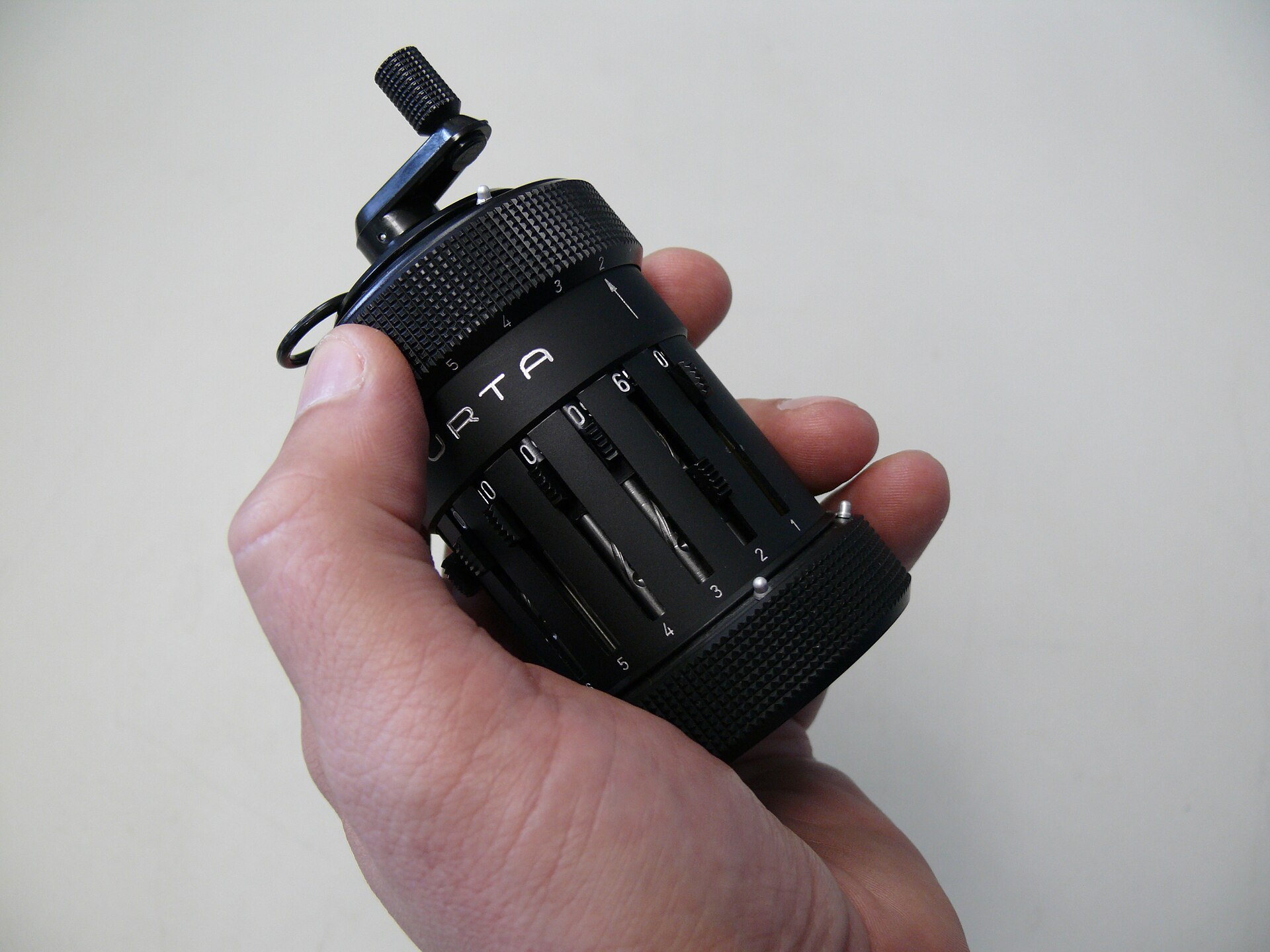
This volume is drawn almost entirely from period documents: the Contina instruction sheet Your CURTA Calculator that came with every machine, the Contina booklet Computing Examples for the CURTA Calculating Machine issued from Vaduz, a Contina mathematical handbook with five-place logarithm tables, and a technique manual issued free to customers by Automatic Business Machines Limited of 15 Cromwell Road, London S.W.7. The worked examples below are the factory’s and the dealer’s, not reconstructions.
The point of assembling them is not nostalgia. A Curta is not a calculator in the modern sense — it does not evaluate an expression. It performs repeated addition extremely well, and everything else is a procedure the operator supplies. The London manual states this plainly in its preface: “Basically, the Curta only performs repeated addition, but there are few operations of numerical analysis and virtually no commercial calculations which cannot be reduced to a process of repeated addition.” The skill was never in the machine. It was in knowing the programme.
6.1 Machine ready
Every procedure in the factory literature begins from a defined state. The Curta is “ready for use” when:
- the crank is at its zero stop position;
- both counting dials are cleared;
- all setting knobs are at zero;
- the carriage is in position 1;
- the reversing lever is in its upper position.
The crank is always returned to the zero stop before touching anything else. Every procedure that follows assumes the machine is ready unless it says otherwise.
6.2 Multiplication
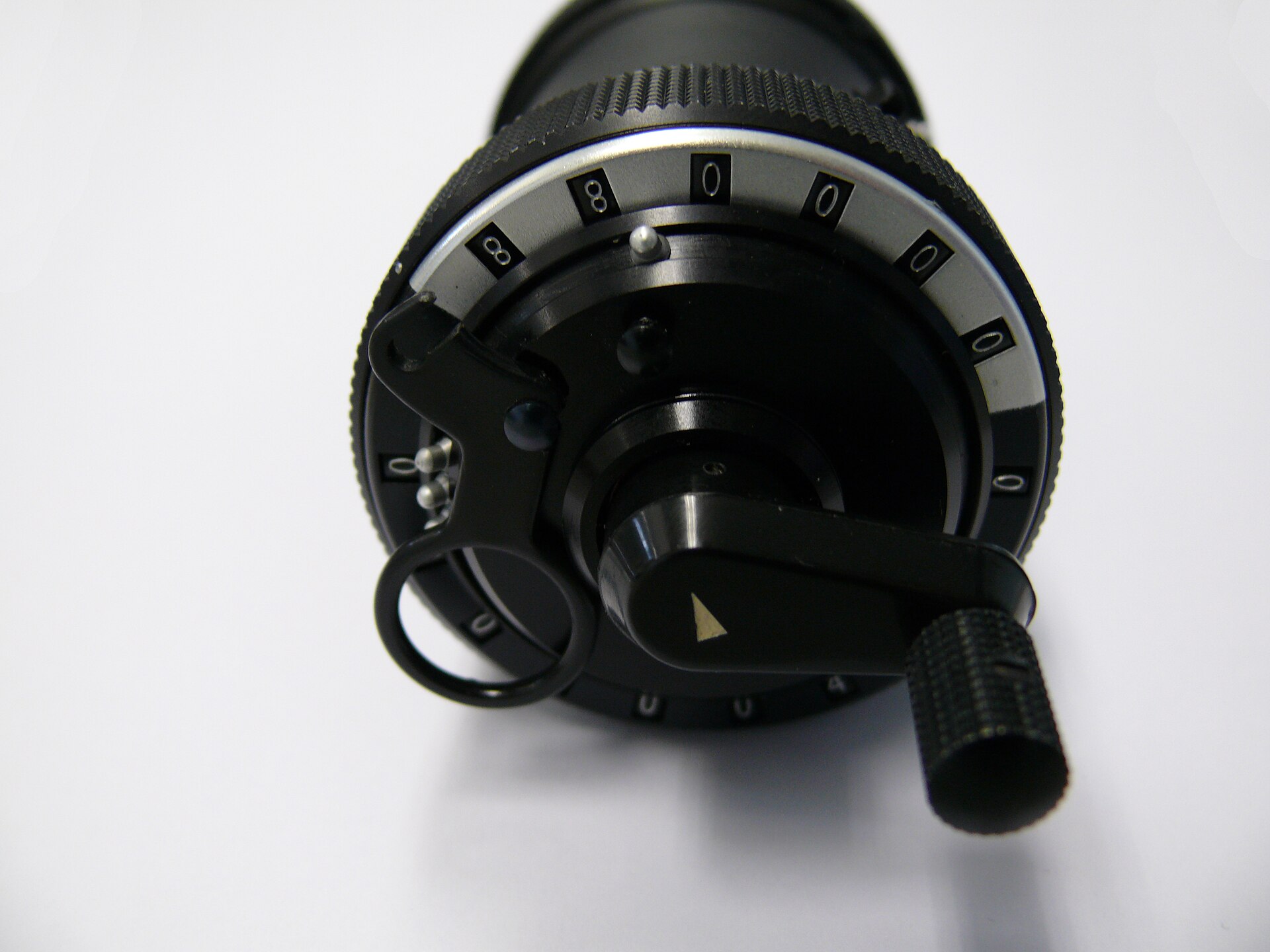
54 × 3. Set 54 on the slides. Three plus turns of the crank. The black dial reads 162; the white dial reads 3, confirming the multiplier; the setting dial still reads 54, confirming the multiplicand. The machine checks its own work — a habit the factory literature enforces by printing the check line under every answer.
647 × 125. Set 647. Five plus turns in carriage position 1 develops the units digit of the multiplier, and the white dial shows 5. Move the carriage to position 2, where each turn adds the set number ten times; two plus turns develop the tens digit, and the white dial now shows 25. Carriage to position 3; one plus turn. Black dial: 80,875. White dial: 125.
Eight turns and two carriage moves, rather than a hundred and twenty-five turns. The carriage is the machine’s multiplier, and the crank only ever counts a single digit at a time.
Decimals. Small white markers clip into the base between the setting columns and between the dial slots to mark decimal points. The rule for multiplication is stated once and used everywhere: the number of decimal places in the black dial equals the sum of the decimal places in the setting dial and in the white dial. Working 13.6 × 1.15, there is one decimal place in the setting register and two in the counter, so the black dial is read with three: 15.640.
6.3 The short cut
This is the technique that separates someone who owns a Curta from someone who uses one.
457 × 89. Done directly, that is nine turns in position 1 and eight in position 2 — seventeen turns. But 89 = 100 − 11, so 457 × 89 = 457 × (−1 − 10 + 100), and the machine can do that in three turns because subtraction costs no more than addition:
- one minus turn in carriage position 1 (crank lifted): −1
- carriage to position 2, one minus turn: −10
- carriage to position 3, one plus turn: +100
Black dial: 40,673. White dial: 89 — the counter arrives at the right multiplier on its own, because the minus turns decrement it.
Seventeen turns become three. The factory booklet recommends the method whenever a digit of the multiplier is 6, 7, 8 or 9, and the saving is roughly a factor of five on a bad multiplier. This is only possible because of the complemented drum: on a machine that had to be cranked backwards to subtract, nobody would use a technique that alternates plus and minus turns freely.
6.4 Addition and subtraction
Addition is the base case: set the first number, one plus turn; set the second number, one plus turn. There is no need to return the slides to zero between entries — the operator simply adjusts each slide until the new number reads correctly in the setting window. 237 + 419 gives 656, and the white dial reads 2, counting the items added.
Subtraction is one plus turn for the first number and one minus turn, crank lifted, for the second. 139 − 78 gives 61. If a count of the number of items is wanted across a mixed run of additions and subtractions, the reversing lever must be moved down before each minus turn and back up for plus turns, so that the counter decrements rather than increments.
6.5 Division
Division is where the Curta stops resembling anything modern.
The divisor is set on the slides, and plus turns are made until the dividend is built up in the black dial. The counter records every turn, so it ends up holding the number of times the divisor went in — the quotient. Division, on this machine, is a search.
42 ÷ 7. Set 7. Make plus turns while watching the black dial until it reads 42. The white dial reads 6. If a turn too many overshoots — the black dial showing 49 — the instruction is to make a minus turn immediately.
For multi-digit quotients the carriage does the work again, and the factory rule is deliberately mechanical so that the operator does not have to think: start every division with the carriage in its highest position, 6 on a Type I and 8 on a Type II, and work down. The number of quotient digits then takes care of itself.
1728 ÷ 12. Set 12, carriage to the top position. Two plus turns overshoot the leading digits, so one minus turn. Carriage down one; five plus turns overshoot, one minus turn. Carriage down one; four plus turns reach the dividend exactly, and the calculation is broken off. The quotient reads 144 in the white dial.
The decimal rule for division is the mirror of the multiplication rule: decimal places in the black dial minus decimal places in the setting dial gives the decimal places in the white dial.
17.29 ÷ 1.2, a division that does not terminate, shows the procedure at its most characteristic. Decimals are ignored at first; the operator simply builds the black dial as close to the dividend as possible, moving the carriage down a place each time the dividend is overstepped and correcting with one minus turn. On a Type I the six digits of the counter fill up and the calculation is over. On a Type II two further carriage positions remain, so two more digits are developed. The quotient is 14.4083…, and the remainder is read as the difference between the true dividend and what stands in the black dial: 0.00004 on a Type I, 0.0000004 on a Type II.
There is also a subtractive division method, for which the reversing lever goes down, and the factory booklet is candid that it is only worth using when the dividend is already sitting in the black dial from a previous operation.
6.6 The dealer’s manual: notation, and everything past the four rules
The London technique manual is a different kind of document from the factory sheet, and considerably more ambitious. It assumes the instruction sheet has been read, and sets out “the most suitable method or ‘programme’ by which common commercial and scientific calculations can best be adapted for solution by the Curta.” It was distributed free, updated by instruction sheets issued periodically, and its publisher invited customers to send in methods of their own so that “a really comprehensive ‘Library’ can be built up.”
It opens by inventing a notation, because, as it observes, “calculations which take only a few seconds to perform are liable to take as many minutes to describe.” The three registers are SR (setting), CR (counter) and PR (product). A carriage position is written C3. An R after the carriage position means the reversing lever is down. An oblique stroke stands for a run of zeros to the left or right of a figure, and 9/ for a run of nines. An asterisk marks the result. So a complete multiplication becomes one line:
C6 /1.53400 37.2/ 57.0648/*
— start in carriage position 6, reversing lever up, set 1.534, multiply by 37.2 from the left, read 57.0648 at the left-hand end of the product register.
The manual’s index is the best single answer to the question of what these machines were actually for. Under commercial: sterling currency, wages, percentages, amortisation of debts by annuities. Under engineering: gear ratios, the sides of a triangle, heat insulation. Under mathematical: square roots, cube roots, fractional powers, quadratic equations, cubic equations, summation of squares, accumulation of products, evaluation of a polynomial or power series, evaluation of series, construction of an n-th order polynomial from n differences, and interpolation. And then, on its own, cotton cloth calculations — a reminder of who was buying these in Britain in the 1950s.
6.7 Square roots
The Curta has no square-root key, no square-root lever, and no square-root mechanism. It extracts square roots because methods exist, and the London manual gives several, noting that “each method has merits according to circumstances.”
Töpler’s method uses the fact that the sum of the first n odd numbers is n². The radicand is divided into two-digit groups from the decimal point; 1 and then 3 are set on the slides with a turn for each, building up to the first group; then the slide setting is increased by 2 and the carriage moved down a place, and the series continues. Working √457.315 this way, the counter climbs 2, 4, 21, 21.1, 21.2, 21.3, 21.31 … and the answer to six significant figures is 21.3849.
The elegance is in the check. The manual notes that if one further increment is added, the setting register is exactly twice the counter register — “this proves that we have made the calculation correctly, and should always be checked.” The method carries its own proof.
The manual also observes that once about half the required significant figures plus one have been developed, the series can be abandoned: the setting register is by then accurate enough that the operator can simply build the product register up to the radicand directly.
Herrmann’s method is Newton’s iteration, done by hand. If R is an approximate root of N², then writing N = R + d and discarding d² gives N = (N² + R²) / 2R, which doubles the number of correct figures at each pass. In practice: take a rough root off a slide rule — 21.4 for √457.315 — set it, square it, then set 2R and build the product register to the radicand. The counter ends holding 21.3849. The manual notes that a further pass, squaring 21.3849 and setting 42.7698, yields twelve significant figures.
Two further approaches are indexed: Sabielny’s method, recommended when the approximate value of the root is already known, and a table method using the manual’s own Curta Table 101.
Pythagoras, worked the manual’s way, shows how these combine. To find the third side of a right triangle, square a, square b with plus or minus turns as required, leaving the radicand in the product register, and then extract the root by whichever method suits. The manual adds a practical touch for a British drawing office of the period: when the measurements are in sixty-fourths of an inch, multiply the whole inches by 64 mentally, set that, add the fraction by moving the slides, and work entirely in sixty-fourths — then divide by 64 at the end.
6.8 How Contina sold all this
The Contina handbook’s own marketing copy is worth quoting, because it is a precise period record of what the machine was claimed to do. It is “A dwarf in size… A giant in calculating efficiency”. It “adds, subtracts, multiplies, divides, squares, cubes, extracts square roots”. It is “fool-proof”, with “automatic devices” preventing errors from wrong handling and “special stops” preventing overspeeding of the axles. “All parts are interchangeable and can easily be replaced.” Tests “have shown that the whole mechanism of the CURTA will stand up to millions of rotations.” And it is “rust-proof and tropic-proof”.
Two of those claims deserve a note. The square-root claim is true only in the sense described above — by method, not by mechanism. And the interchangeability claim reflects the Austauschbau precision-manufacturing tradition Herzstark trained in, but it should not be read as an invitation: as the collecting volume discusses, many Curta parts look identical while differing slightly in dimension, which is precisely why amateur reassembly so often fails.
Comments (0)