Curta · Volume 7
Cutaways, Teaching Models, and the Multiple Curta
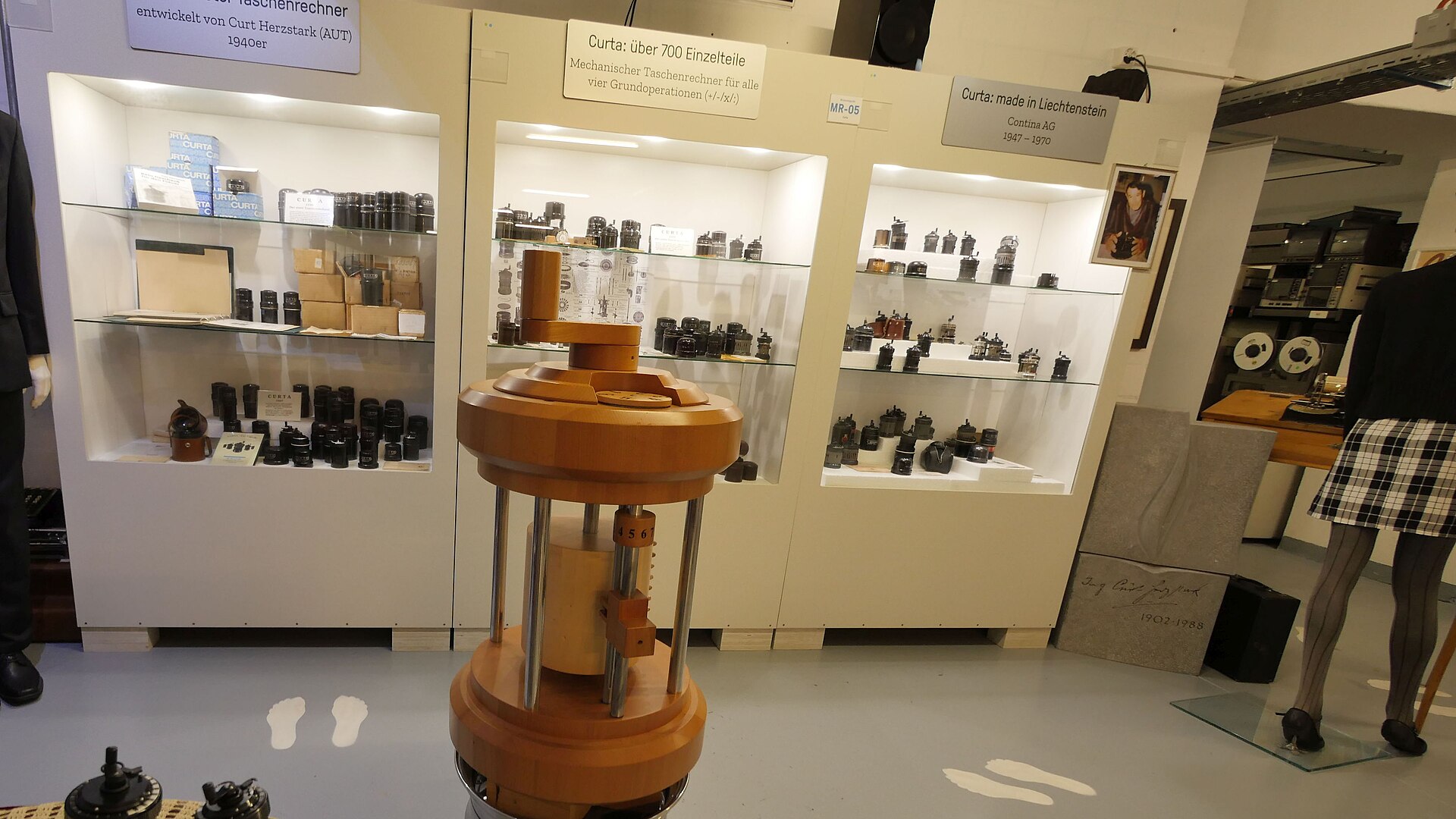
Not every Curta was built to be used. A small number were built to be looked into — factory cutaway kits for dealers, sample boards of loose components, oversized wooden models for exhibitions. And a smaller number still were built to be multiplied: Herzstark patented machines that gang several Curtas to a single crank, and one such machine, with twelve of them, was actually built in an English university chemistry department to invert matrices.
These are the Curtas that almost nobody has handled, and they are the ones that say most about how the machine was sold and what it was thought to be good for.
7.1 The demonstration kit
The problem with selling a Curta is that its argument is on the inside. A closed cylinder does not explain why it costs four hundred and fifty Swiss francs. Contina’s answer was a demonstration kit: a see-through, fully operational Type I together with a set of sample components and sub-assemblies, all fitted into a lined case.
Collector documentation describes kits of eleven parts — the working cutaway machine plus ten sample components and sub-assemblies — housed in a fabric-lined case covered in simulated leather with silver lettering identifying Contina and Mauren, Liechtenstein. The sample components are the ones an owner would never otherwise see: removable gears on transmission shafts, indexing balls, spider springs, bearing sleeves. Some cases carry the lettering “CONTINA MAUREN/Liechtenstein (Zollunion Schweiz)” — the customs-union wording that appears throughout the company’s literature. A different format is also recorded: a briefcase set holding thirty-three original Curta parts laid out on blue velvet with multilingual manuals, intended for salesmen and exhibitions.
The numbers usually quoted are small. Roughly twenty-five kits of the principal style are thought to have been made, of which around twenty-one are documented, with serials recorded from 942 — the earliest known — up to 37262, implying they were produced over a long span rather than in one batch.
Those figures need a clear caveat. They come from collector-compiled registers rather than from factory records, and a census of surviving examples is not a production record. The kits are genuine, well documented as a type, and rare; the specific counts should be read as the best available estimate from the collecting community, not as a Contina number.
7.2 Wooden models and exhibition pieces
A second kind of non-working Curta exists: the oversized model.
The Museum Enter in Solothurn holds a wooden model of the Curta, on permanent loan from the Swiss collector Peter Regenass. It stands far larger than the real machine and reproduces the external form — body, setting slides, carriage, crank — at a size a room full of people can see.
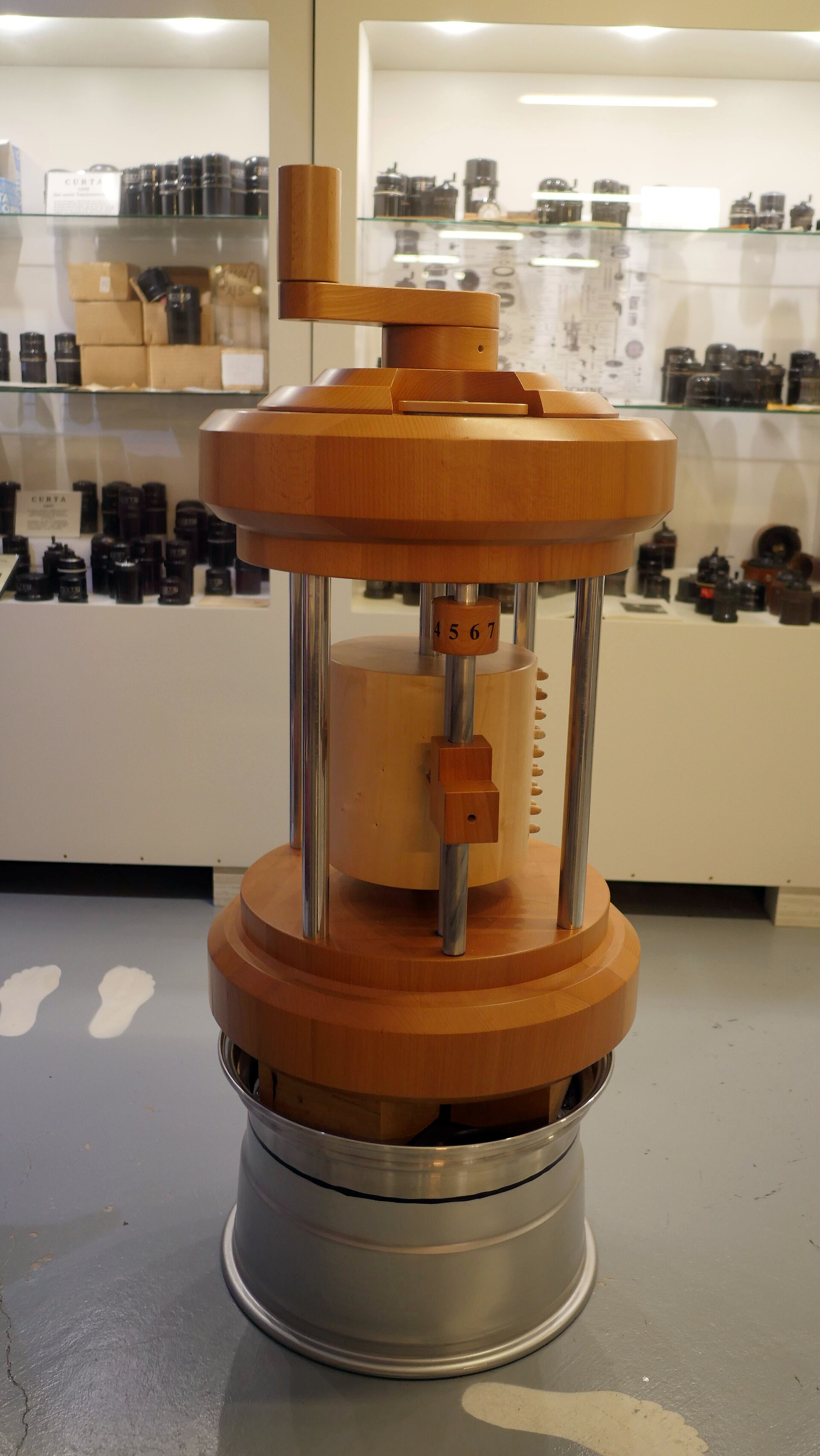
It is worth noticing what this object implies. The impulse to build a Curta several times life size, so that its arrangement can be understood by looking rather than by reading a sectional drawing, is not a modern one. It predates 3D printing by decades. The oversized 3D-printed working Curta covered in a separate dive is the same impulse carried to its conclusion — the difference being that the printed one calculates.
7.3 The Multiple Curta
In 2015, papers from Herzstark’s estate held at the Schreibmaschinenmuseum Beck in Pfäffikon came to light containing design drawings and patent documents for a machine that had been entirely unknown: a multiple calculator built from coupled Curtas. Bruderer, who published them, calls it the world’s smallest mechanical parallel calculator.
The patents describe several configurations — two Curtas standing side by side, three stacked one above another, four side by side, and five arranged in a circle — and state that in principle any number of machines can be coupled. The distinguishing features are what make it more than a novelty:
- all the machines are driven simultaneously by a single hand crank;
- all of them can be switched, jointly or individually, to a different arithmetic operation by shifting the drive shafts axially — and this works even when the individual machines are set to different operations;
- all the counting mechanisms can be shifted decade-wise, together or individually, in either direction;
- all the result registers, or all the revolution counters, can be zeroed together or individually.
Herzstark added in the patent specification that the multiple machine could also be driven electrically.
The mechanical arrangement is described in the drawings: the crank drives the main shafts through bevel and spur gears, with a chain drive given as an alternative; in the four-machine version the Curtas are removably attached to a socket carrying the coupling, drive and control elements. A variant of the double machine with a base plate, covered by an additional patent, was designed specifically to make operation easier.
The Austrian patents are: specification 195 147, the basic patent, submitted 19 October 1954 and granted 15 May 1957; and specification 205 775, the additional patent, submitted 15 December 1954 and granted 15 March 1959. The first Austrian application for a multiple calculating machine, however, was submitted much earlier — on 20 December 1949 — and efforts were also made to patent the device in America.
The use cases Bruderer lists are exactly the ones where the same operation is applied to a column of different numbers: converting a price list to several currencies at once, computing piece prices across a range of goods, or determining x and y coordinates simultaneously in surveying. With a quadruple machine an operator sets four multiplicands, turns the crank seven times, and has four products.
7.4 The Twelve-fold Curta at Birmingham
The remarkable thing about the Multiple Curta is that somebody built one, independently, without any apparent knowledge of Herzstark’s patents.
James Christie Robb (1924–1999) of the Chemistry Department at the University of Birmingham submitted a paper to the Transactions of the Faraday Society on 20 July 1953 describing a calculator for aiding matrix calculations. It was published as Trans. Faraday Soc. 50 (1954), 8–12, and was flagged to the wider computing community by A. Opler in Mathematical Tables and Other Aids to Computation 8:47 (1954), 181 — at the time the leading international journal in the field.
The machine comprised twelve Curta Model I calculators mounted in a circle on an octagonal base of Dural aluminium alloy fitted with two handles. Robb designed it; it was built by S. Traver with the support of J. Harcourt. Three levers on the base plate controlled, from left to right, carriage shift over six decimal places, reset to zero, and multiplication; the left-hand lever raised the carriages and rotated them to any of the six positions. Its purpose was the calculation of inverse matrices and the solution of simultaneous linear equations: twelve arbitrary values of one to eight places could be multiplied by the same positive or negative factor at once. The description notes that in principle there is no limit to the number of Curtas that can be combined — the same conclusion Herzstark had reached in his patents.
The twelve machines were donated by Contina AG of Liechtenstein.
Two details in this story are worth keeping. The first is that the paper refers to the Curta and to Contina but does not mention Curt Herzstark at all — and by 1953 Herzstark had already left the company, so the machine’s inventor had no connection to the donation that put twelve of his machines on an aluminium plate in Birmingham. The second is that the article cites a British patent application, number 10993/53. Whether a patent was ever granted is not known; Bruderer reports that there is no corresponding entry in the European patent database.
7.5 What the multiples show
There is a temptation to file the Multiple Curta as a curiosity. It is better read as evidence about the design.
Ganging calculating machines to one crank was not new — double and triple Brunsviga, Marchant, Millionaire, Monroe, Thales and Triumphator machines existed and were used for survey and liquidation work. What was new was doing it with a machine small enough that twelve of them fit on a base a person can pick up with two handles. The Curta’s miniaturisation was not merely a convenience for the pocket; it changed what could be built out of calculating machines. A twelve-fold desktop machine of conventional units would have been furniture.
Comments (0)