Curta · Volume 1
The Machine in the Hand
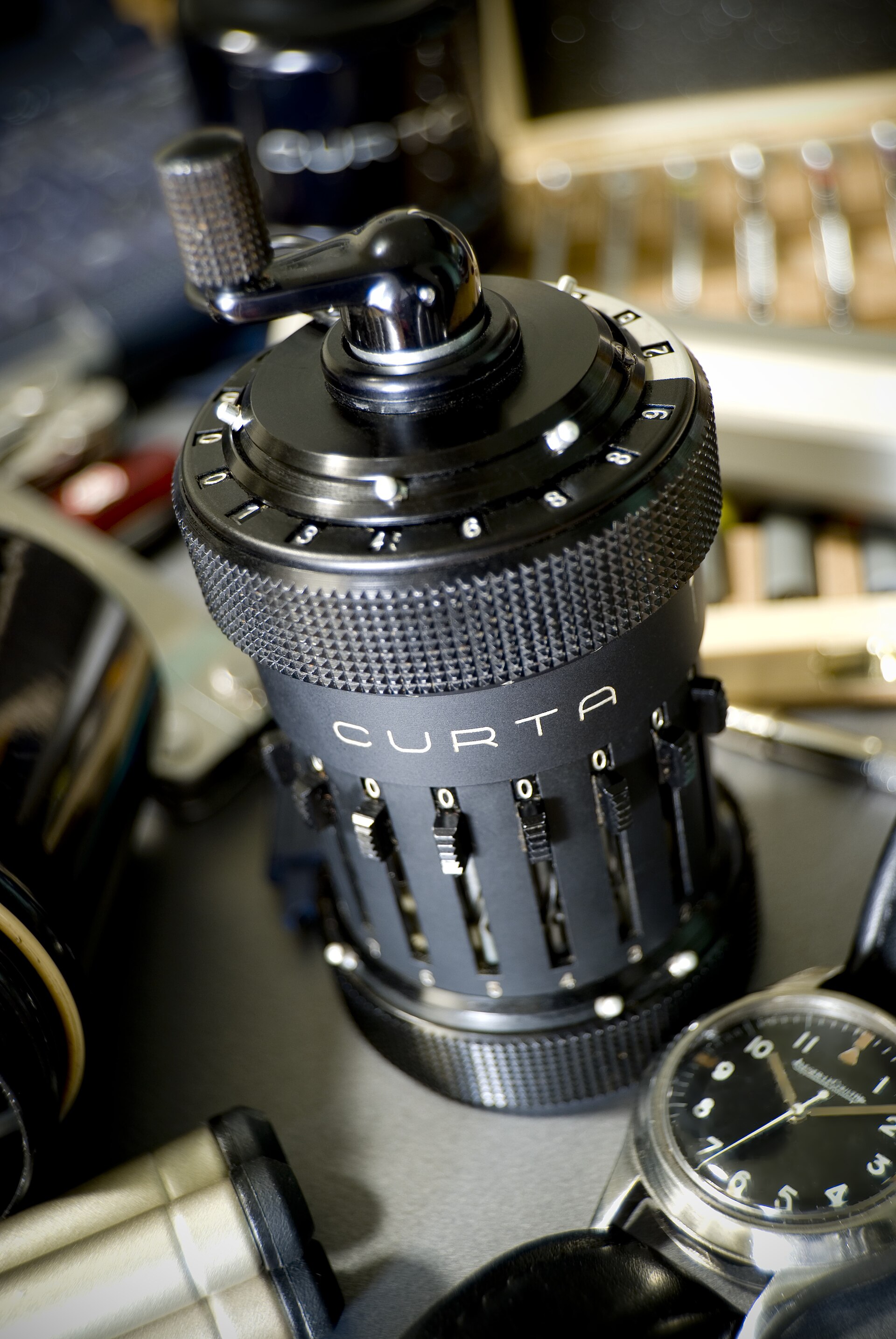
There is a particular moment that recurs in almost every written account of the Curta, and it is always the same moment: someone picks one up for the first time and is surprised by the weight. The object is about the size of a pepper mill — a black anodised cylinder roughly two inches across and three and a half inches tall — and the hand expects something hollow. What it gets instead is a dense, cold, machined mass, because the inside is solid mechanism almost all the way through. That first surprise is the whole machine in miniature. The Curta is not a novelty that happens to calculate. It is a full four-function calculating machine, with automatic tens carry and an eleven- or fifteen-place result, that was miniaturised until it fit in a coat pocket, and the miniaturisation cost something: almost six hundred parts, hand assembly, and a manufacturing programme that took most of a decade to become profitable.
1.1 What the object actually is
A Curta is a stepped-drum calculating machine built as a cylinder rather than a box. Numbers are set on sliders that run vertically up the outside of the body — one slider per digit column — and each slider’s position is repeated in a small window at the top so the operator can read back what was entered. The whole top of the machine is a rotating carriage carrying two rings of numbered dials: a black ring, which is the result, and a white ring, which counts crank turns. A crank on the top drives everything.
One clockwise turn of the crank adds the number standing on the sliders into the black dials and advances the white dials by one. Lift the crank before turning it, and the same turn subtracts. Lift the carriage, rotate it one position, and drop it, and each subsequent turn now adds ten times the set number instead — which is how multiplication is done, and why the operator’s thumb and forefinger spend as much time on the carriage as on the crank. A clearing lever swept around the dial ring zeros the registers.
That is the entire user interface. There is no keyboard, no display in the modern sense, and no power of any kind. Everything the machine does, it does because a hand turned a crank.
1.2 Why it mattered
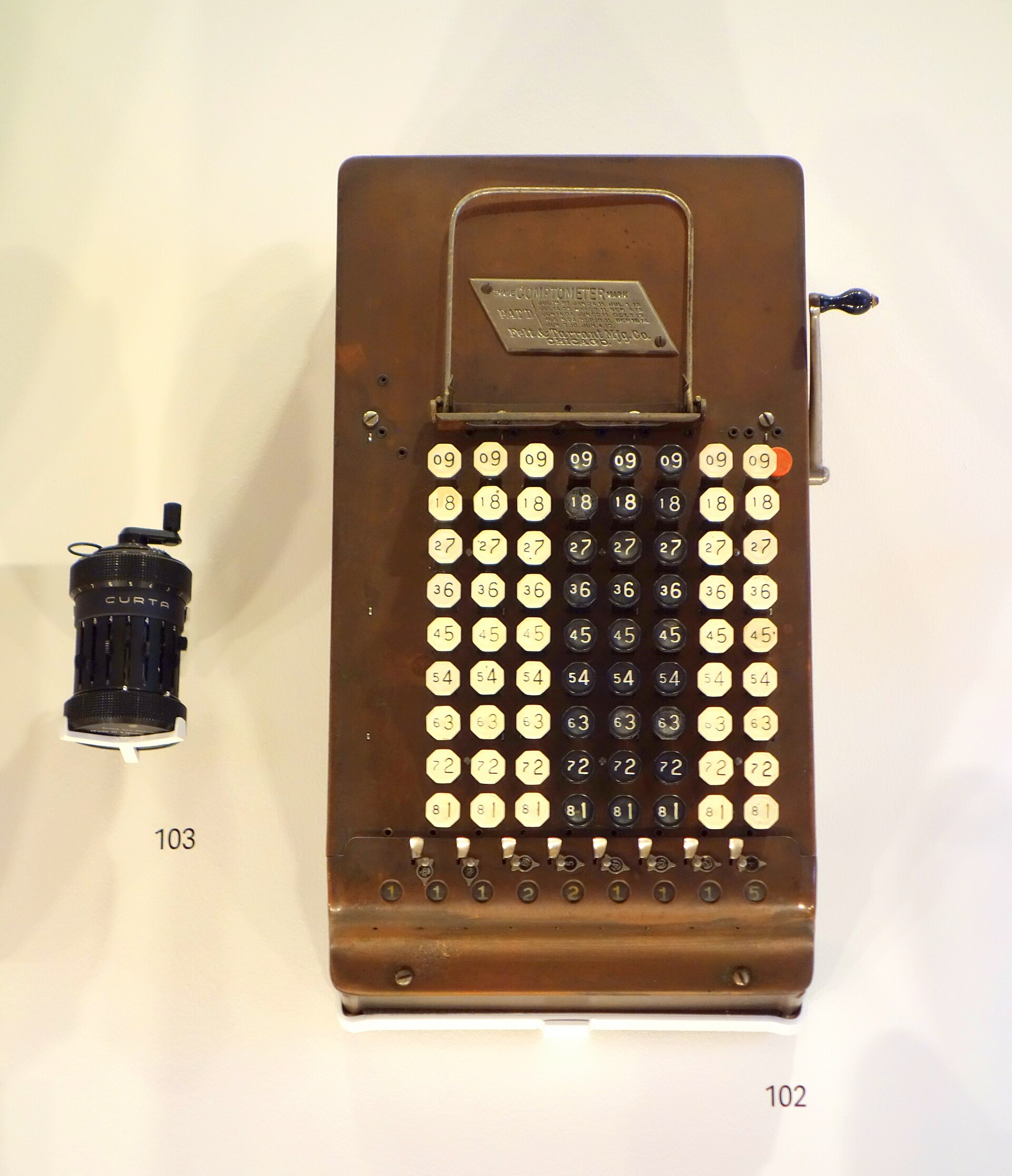
Before the 1970s, anyone who needed to do arithmetic away from a desk had a bad set of options, and the Liechtenstein National Museum’s exhibition on the machine lays them out plainly. A bead frame does all four operations but has no automatic tens carry, so the operator does the carrying. A slide rule is light and fast but cannot add or subtract at all, and reads to perhaps three significant figures. Small mechanical pocket adders such as sliding-bar calculators cannot multiply or divide and carry only semi-automatically. Desktop calculating machines do everything correctly, with full automatic carry — and weigh several kilograms.
The Curta closed that gap and did not merely close it: an eleven-place result on the Type I and fifteen on the Type II gave a precision that most of the electronic pocket calculators which eventually displaced it did not match. A device that could be carried in a jacket and produced exact answers to eleven places was, for a surveyor or an engineer or a rally navigator, a genuinely new instrument rather than a smaller old one.
The rally case is the one most often cited, and it is worth stating carefully because it is usually stated loosely. Time-speed-distance rallying requires a navigator to compute, repeatedly and quickly, what average speed will hit a checkpoint at the correct time. The Curta was well suited to this because it adds repeatedly and reliably and because it survived being bounced around a car. Contemporary and collector accounts agree that crews went on using them into the 1980s — after electronic calculators were cheap and common — on the grounds that the early electronics did not survive the vibration and the cold as well as the mechanism did. The nickname that attached to these crews, “Curta-crankers”, comes from that community rather than from the manufacturer.
1.3 Two models, and one number that is constantly misquoted
Contina made two models. The Type I appeared in 1948, the Type II in 1954. They are mechanically the same machine at two capacities.
Table 1 — Two models, and one number that is constantly misquoted
| Type I | Type II | |
|---|---|---|
| Setting slides (digits entered) | 8 | 11 |
| Revolution counter (white dials) | 6 | 8 |
| Result register (black dials) | 11 | 15 |
| Carriage positions | 6 | 8 |
| Diameter | 53 mm | 65 mm |
| Height | 85 mm | 90 mm |
| Mass | c. 230 g bare, c. 330 g with its case | c. 360 g |
The capacity is conventionally written as a triple: the Type I is an 8 × 6 × 11 machine and the Type II an 11 × 8 × 15 machine. This notation is used in the factory literature, and it is worth learning, because the Type I is very frequently described in secondary sources as a “six-digit” machine. It is not. Six is the revolution counter — the register that counts crank turns and holds the multiplier or quotient. Eight digits can be set. Eleven come out. Any description that gives the Type I as “six in, eleven out” has confused the counter with the setting register.
1.4 What this series covers
The volumes that follow take the machine apart in a deliberate order.
The next two deal with history, and they deal with it at length, because the Curta’s history is not decoration attached to a technical object — the design decisions and the biography are the same story. Curt Herzstark worked out the central mechanical idea in 1938, was imprisoned in Buchenwald in 1943, drew the machine there, walked out with the drawings, and then lost the company to a share restructuring that left his stake worth nothing. Contina AG’s twenty-three years of production are covered separately, because the manufacturing story explains why a machine with almost no competition never became a mass product.
After that comes the technical material: what actually distinguishes a Type I from a Type II; how the complemented stepped drum works and why it is the thing that made a pocket-sized four-function machine possible at all; and how the machine was operated in practice, drawn from the factory instruction booklet and from a dealer’s technique manual that goes a long way past the four rules into square roots, polynomials and interpolation.
The last two volumes cover the machines that were never sold to be used — the factory cutaway kits, the oversized teaching models, and Herzstark’s remarkable patents for coupling several Curtas to one crank — and then collecting: serial ranges, what the bottom plate tells you, what examples change hands for, and which of the collecting hazards are real.
Where sources disagree, the disagreement is stated rather than resolved by picking the more confident source. There are more such disagreements than a reader might expect for a machine that went out of production within living memory, and several of them — the year production stopped, the year Hilti took over, the total number built — are not small.
1.5 A note on the sources used here
Five period documents sit behind the technical volumes: the Contina instruction sheet Your CURTA Calculator, the Contina booklet Computing Examples for the CURTA Calculating Machine, a Contina-issued mathematical handbook with five-place logarithm tables, and a technique manual issued free to customers by Automatic Business Machines Limited of 15 Cromwell Road, London S.W.7. To these is added Herbert Bruderer’s 2022 article The Curta, a Technical Marvel, which is the source for the Multiple Curta material, and the exhibition panels prepared by Hansjörg Nipp for the Liechtenstein National Museum’s 2021 exhibition Curta — made in Liechtenstein, which are the closest thing to a documented institutional account of the company.
Where a claim rests on collector-compiled material rather than a factory record or a museum catalogue, that is said in the text.
Comments (0)