Curta · Volume 3
Contina AG: A Factory in a Farming Principality, 1946–1972
Liechtenstein in 1946 was an agricultural country of about thirteen thousand people with almost no industry. The Princely House and the government wanted industrial enterprises and the jobs that came with them. A Viennese engineer arrived with a pocket calculating machine, three working prototypes and no capital. The result was one of the strangest industrial episodes in twentieth-century precision manufacturing: a machine of watchmaking tolerances, made in six-figure quantities, in a principality with no tradition of making anything of the kind — and an inventor who ended up with none of it.
3.1 The telegram from Vaduz
A telegram dated 26 March 1946 invited Curt Herzstark to Vaduz Castle. It followed a demonstration he had given at the Palais Liechtenstein in Vienna, which had gone well enough to be escalated.
At the beginning of May 1946 he presented the machine to Prince Franz Josef II (1906–1989). The Prince, who was interested in mathematics, ran a number of calculations on it himself, and agreed with the experts present that the product should be manufactured in Liechtenstein on a monopoly basis. He declared himself willing to provide four million Swiss francs. Herzstark was to receive thirty-five per cent of the share capital in exchange for his patents and applications.
Two things then happened, in an order that mattered enormously. In mid-July 1946 Herzstark fell seriously ill with pneumonia and pleurisy and spent months under treatment at the hospital in Vaduz. In August 1946, while he was still in hospital, the Prince’s representatives explained that only one million Swiss francs had actually been earmarked as share capital, and that the figure was in any case merely a formality adopted for tax reasons.
The museum panel’s judgement on this is unambiguous, and it is the hinge of the entire story: “This undercapitalisation would later prove to have far-reaching consequences for Curt Herzstark and the company.” Ill, with direct negotiations with the Prince suspended, and with the prospect of part-ownership in front of him, Herzstark agreed.
On 14 September 1946 the company Contina Bureaux und Rechenmaschinenfabrik Aktiengesellschaft was founded. On 19 September 1946 Herzstark received an employment contract appointing him Technical Director and a member of the executive board for ten years.
3.2 Building a precision works from nothing
In March 1947 rooms were rented at the Hirschen Inn in Mauren. One room was the design office; the room opposite was the development workshop. Every individual component of the machine could, at that stage, be made on one universal milling machine and one versatile lathe.
Development for series production began on 1 April 1947, with Herzstark working alongside the Swiss precision mechanic Hans Künzli and two draughtsmen. The staffing was tiny — collector accounts name a founding group of about four.
Finding people was the persistent problem. Series production needed a large number of specialists, and they were not to be had in Liechtenstein; they had to be recruited from neighbouring countries. Herzstark wanted to hire specialists from the old Vienna works and, for reasons the museum panel describes as inexplicable, this was refused by the company’s management. There was resistance even to procuring machinery and operating equipment.
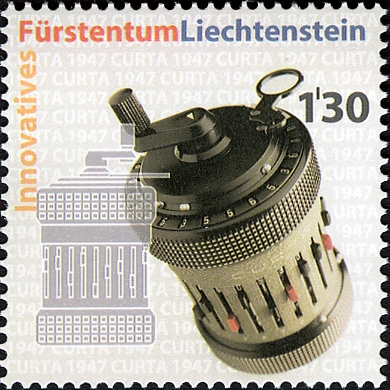
By the beginning of 1948 a complete drawing set existed and the first prototypes were available for testing. The machine was originally called Liliput; at the beginning of 1948 this was provisionally changed to Contina. The name it eventually kept was settled at the Basel trade fair in 1948, and the story attached to it — recorded by collectors rather than by the company — is that a Contina trade correspondent proposed it on the grounds that the machine was Herzstark’s daughter: if the father is Curt, the daughter must be Curta.
The factory building in Mauren was sufficiently finished by the end of May 1948 for the design department and production to move in. Assembly had originally been planned for Eschen.
3.3 The gauge decision
In 1948 the board decided to add gauges — measuring equipment — to the production programme. The decision consumed design and manufacturing capacity that the calculating machine needed, and the museum panel’s verdict is blunt: it “would ultimately prove to be a big failure.”
The consequence was that essentially no calculating machines were produced under series conditions in 1948. Perhaps a hundred machines were built that year and not delivered, because they still required so much additional hand work to reach the required quality. Many drawings had to be amended. Gauge construction was soon discontinued altogether.
The precision of the machine placed demands on the production equipment that had been badly underestimated. Workshops had to be set up for milling, turning, engraving, grinding, anodising, heat treatment and inspection. Outsourced components needed lead time. Staff had to be recruited and trained for manufacture, assembly, inspection, warehousing and auxiliary work. Delivery in large numbers only became possible at the beginning of 1950 — nearly four years after the company was founded. Production was properly ramped up in 1950–51 after design improvements and a reorganisation of the assembly line in Mauren.
Bruderer records that manufacturing and assembling a single Curta I took nine to ten hours. That figure, more than any other, explains the economics of what follows.
3.4 1950: the shares
The modest share capital, the over-indebtedness and the delay together meant that the existing share capital had to be written off in 1950. Ownership of Contina AG passed to a bank in Liechtenstein.
For Herzstark the effect was total. His shareholding of CHF 350,000 — which he had received in exchange for his patents — became worthless. When he was informed, a member of the Contina board, Johannes Tschopp, told him it was “just bad luck”. The remark survives because Herzstark’s lawyer quoted it in a letter.
One thing saved him from losing everything. The people responsible had never actually signed the patents over to the company. A Zurich patent attorney established that the patents remained in Herzstark’s name, and after tough negotiations he received a settlement for them in 1952.
The sequence of his departure is reported slightly differently in different places. Furr’s account describes a rupture around Easter 1951: the postmaster instructed not to deliver mail to his house, Herzstark denied access to the factory, and his resignation as technical director that year. The museum panel describes him stepping down disappointed, and notes that Contina did not want to lose his expertise entirely — so after the patent settlement in 1952 he was given a consultancy contract, which he fulfilled until 1955. Both can be true; they differ in emphasis rather than in substance.
He then withdrew into private life. In the 1950s his wife moved back to Vienna with their two children; Herzstark remained in Liechtenstein and had only sporadic contact with his family. Recognition came late. From the early 1980s articles appeared in the trade press about the little mechanical miracle, and he attended gatherings of admirers and collectors and meetings of inventors and received his due as an inventor. He died at Nendeln on 27 October 1988.
3.5 Hilti, and the end
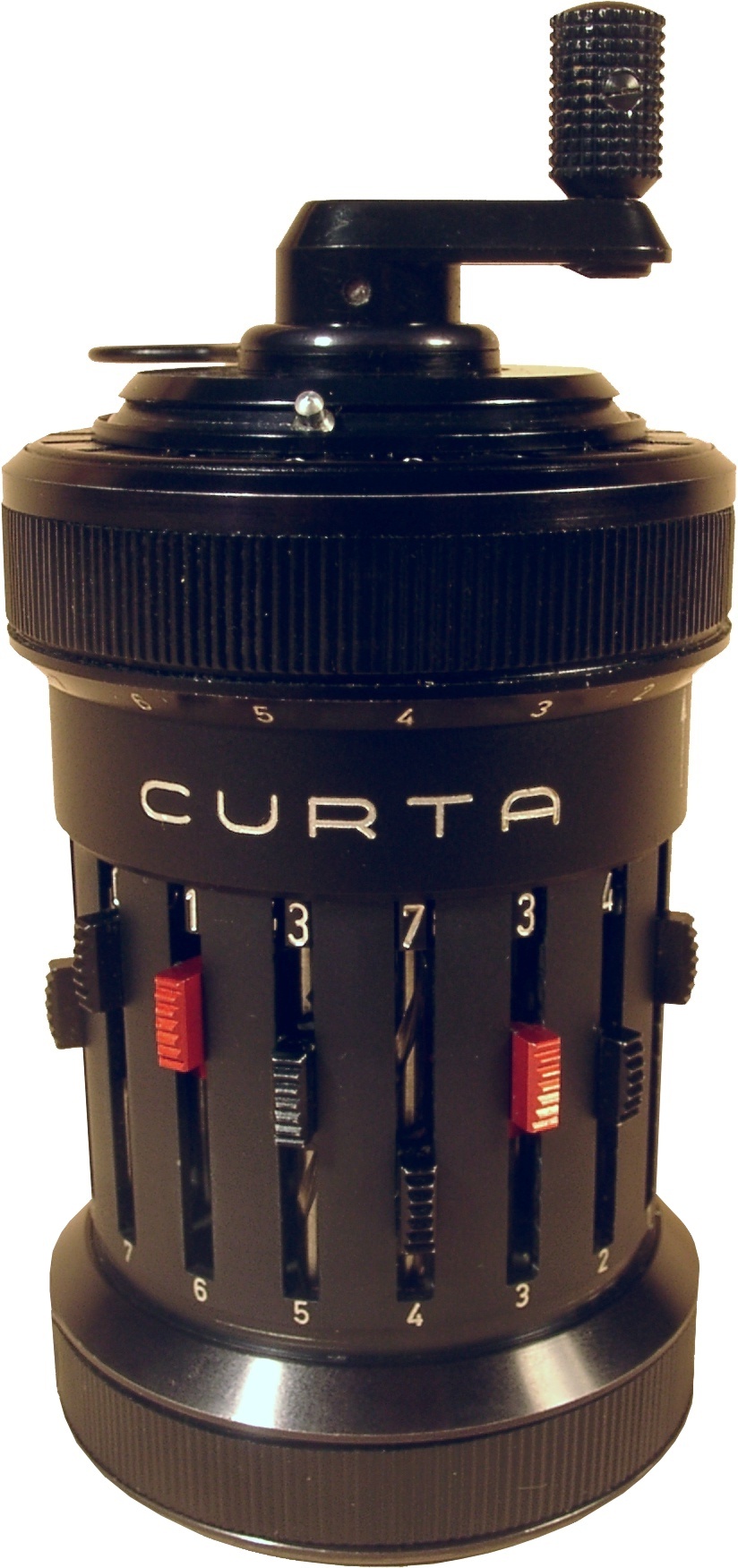
Contina was taken over by Hilti AG. The date is reported inconsistently: the Liechtenstein National Museum panel gives 1965, while Furr’s account and several secondary sources give 1966. This could not be resolved from the sources consulted here, and the one-year discrepancy should be treated as open.
Production continued under the new owner, and the panel’s figures show it continuing well: optimising the work processes reduced manufacturing costs, output per year rose after the takeover with the same number of employees, and then held roughly constant. But no further major investment was made, because it was already visible on the horizon that mechanical calculating machines would be replaced by electronics.
The production totals, from the museum’s exhibition:
Table 1 — The production totals, from the museum's exhibition
| Units | |
|---|---|
| Curta I, 1948–1971 | approx. 79,000 |
| Curta II, 1948–1971 | approx. 62,000 |
| Total | approx. 141,000 |
| Of which built 1950–1965 under Contina management | 95,000 |
| Of which built 1966–1971 under Hilti management | 46,000 |
Other sources give slightly different splits — Wikipedia gives about 140,000 total as 80,000 Type I and 60,000 Type II; a serial-number study by Hansjörg Nipp, circulated through collector channels, gives about 78,700 Type I and between roughly 61,700 and 69,900 Type II. All of these agree on the order of magnitude and on the rough two-to-one ratio between the models, and none of them should be quoted to the nearest unit.
The end date is genuinely contested, and the contest is not trivial:
- The Liechtenstein National Museum panel: production ceased at the beginning of 1971.
- Furr’s collected account: production continued until November 1970, with sales continuing into early 1973.
- Herzstark himself, quoted second-hand: the last Curta was produced in 1972.
- Jaap Scherphuis’s reference page: Type I 1948–1970, Type II 1954–1970.
- Wikipedia and a great many popular accounts: the last Curta was made in 1972.
The most likely reconciliation is that assembly of machines stopped around 1970–71 and that stock continued to be sold, and possibly finished, for a year or two afterwards — which is exactly the kind of gap that produces three plausible “end dates”. It is stated here as unresolved.
3.6 Why it never became a mass product
The most interesting fact in the museum’s account is not the production total but the forecast. The market potential for the Curta was initially estimated at around three million units, and there was no real competition for the whole life of the product. Roughly 141,000 were made — under five per cent of the estimate — against no competitor at all.
The panel gives the reasons directly. The machine was not developed further and the facilities were not expanded for mass production. Patents and ideas existed for increasing the number of places and for reducing cost and weight through the use of plastics; they were not implemented. And there were organisational and financing problems from the outset, marketing errors, and diversification into questionable products during Contina’s later history.
That is a failure of the company, not of the design. The design was so nearly unimprovable that the same drawings, scaled up three times, are still being built today — which is the subject of a separate dive.
Comments (0)