Calculator Watches · Volume 8
Collecting and the Exam Room
Calculator watches span the whole range of collecting, from a Casio still on sale for the price of a meal to a gold Pulsar that fetches thousands at auction. This volume covers what they cost, which ones collectors seek, how to identify a Data Bank, and the one place a calculator watch is never welcome: the examination hall.
8.1 What a DBC-32 costs
The DBC-32 is a current Casio, so a new one is easy to find. Prices seen:
Table 1 — The DBC-32 is a current Casio, so a new one is easy to find. Prices seen
| Where and when | Model | Price |
|---|---|---|
| Britain, about 2017 | DBC-32, resin / steel | about £26 / £35 |
| Britain, July 2020 | DBC-32-1ADF | £21 delivered, discounted |
| Amazon (US), March and November 2025 | DBC-32-1A, resin | $25.90, then $25 (list $74.95) |
| New York Watch Store, October 2026 | DBC-32D-1A, steel | $60.26 (list $89.95) |
| Casio India, 2026 | DBC-32-1A | ₹2,195 |
| eBay (US), asking, October 2026 | used DBC-32 | $44 to $135 |
Used examples are offered for more than new ones, but those are asking prices; eBay’s records of what actually sold are not public. A new DBC-32 is the cheapest way to own one, and a used one is mainly worth having as a source of spare parts (volume 7).
8.2 The collectable ones
Table 2 — The collectable ones
| Watch | Introduced | Price then | Recent prices |
|---|---|---|---|
| Pulsar Time Computer Calculator | Christmas 1975 | $3,950 gold; about $500 steel by spring 1976 | few reliable records; auction listings conflict, and gold examples have been offered for many thousands of dollars |
| HP-01 | 1977 | $650 steel, $750 gold-filled | $1,216 to $1,388 at three auctions in late 2024; a steel example $5,803 at Sotheby’s in October–November 2024 |
| Casio C-80 | February 1980 | not found: $49.95 in one dealer’s advertisement, $75 in a later article | no reliable records |
| Casio CFX-400 | mid-1980s | $59.95 chrome (July 1986) | asking prices of $755 and £799.99 for new old stock |
| Seiko UC-2000 | 1984 | about $300 | ¥30,000 to ¥39,800 on Yahoo! Auctions Japan, December 2023 |
| Timex Data Link | 1994 | about $130 (1996) | $50 to $70 asking on eBay, 2026 |
| Casio CA-53W | 1988 | still sold new, about $40 |
The two that matter most to collectors are the first and the most ambitious. The gold Pulsar calculator, made in a run of about a hundred, according to collectors’ sources, is the first calculator watch that certainly reached customers. The HP-01 is Hewlett-Packard’s only watch and its first algebraic calculator, and a working one with its stylus, pen and case is a prize. Both used LED displays, and both are now around fifty years old; a dead display driver or a leaking cell can make an otherwise fine example worth far less. HP sold a battery kit so that owners could change the HP-01’s cells themselves.
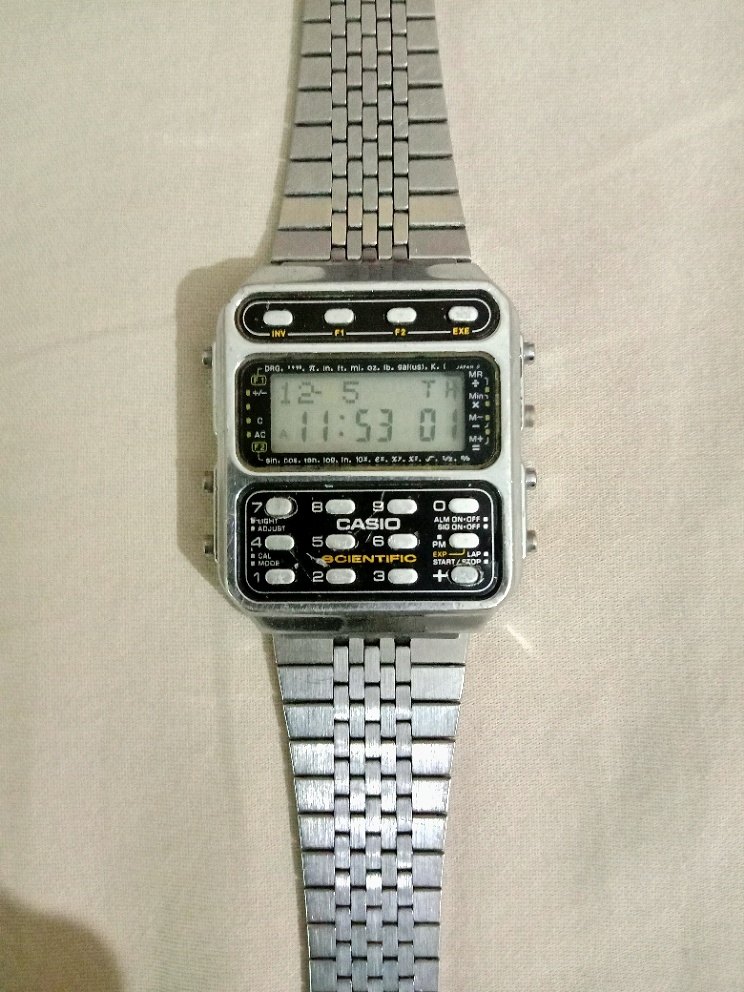
The Casios of the 1980s, the scientific CFX-400 above all, have climbed from mail-order prices to hundreds of dollars for good examples; Elektor wrote in 2009 that “even broken ones can fetch many hundreds of dollars”. The museums hold the milestones: the Smithsonian’s National Museum of American History has a Pulsar calculator and an HP-01, both given by John Bergey, the former head of Time Computer, and the Computer History Museum has a C-80 and two HP-01s.
8.3 Identifying a Data Bank
- The module number is the number in a box on the case back: 2888 on mine. It identifies the movement, its features and its operation guide (Casio’s PDF for it is qw2888.pdf). The same module is used in several models, so the model number beside it, DBC-32 here, and the case, strap and colour together identify the variant.
- The DBC-32 family, all on module 2888, according to lookatwrist’s history: the DBC-32-1A, -9A, DBC-32C-1B and -8B of 2004; the steel-bracelet DBC-32D-1A of 2005; and six more DBC-32C colours in 2007–08. Suffixes such as -1AES, -1AEF and -1ADF on retailers’ listings mark regional packaging, not different watches. No source records a gold DBC-32; the gold calculator Data Bank is the DBC-611G of 2011.
- Origin and codes. My watch says MADE IN CHINA, and Casios made in China are genuine Casios. The letters DH on its back also appear on other Chinese-made Casios; nobody has published what they mean, and Casio’s backs carry no date code that collectors have decoded.
- Fakes. No documented counterfeit of the DBC-32 or any Data Bank was found; the cheapness of the real thing leaves little to gain. One blogger, buying a heavily discounted DBC-32 in 2020, suspected a fake from its plain box and its warm-white light, but Casio’s own specification gives the light as amber. The best test is behaviour: a genuine module 2888 does everything in volume 6, including showing the remaining records when [=PM] is held in the Data Bank Mode, and its auto light switch gives “a very faint clicking sound” when the watch is shaken.
8.4 Where to look
New DBC-32s are sold by Casio and by watch retailers, and are often discounted on Amazon. Used Data Banks turn up on eBay, where searching for the module number (“2888”) as well as the model helps, and older Japanese models on Yahoo! Auctions Japan. The collectors’ communities are the Casio forum on WatchUSeek, where lookatwrist’s history of the Data Bank line is the best single account; Reddit’s r/casio; casiofanmag.com, with model pages and manuals; raredigitalwatches.com, with module numbers, dates and prices; and the Calcuseum, with period advertisements and documents.
8.5 The exam room
Calculator watches have been unwelcome in examinations for as long as they have existed: a Data Bank is a crib sheet with a clock. Today’s rules are blunt.
- The SAT (College Board) bans “phones, smartwatches, fitness trackers, smart glasses, or other wearable technology”, but says “simple digital non-smartwatches or analog watches are acceptable”. Other College Board pages ban “watches that beep, make a noise, or have an alarm”, which rules out a Data Bank on its alarms alone.
- The ACT: “You may bring a watch to pace yourself, but do not bring a smartwatch or a watch with an alarm.” It must lie face up on the desk during the test.
- The Texas Board of Professional Engineers and Land Surveyors names them: its list of devices barred from the surveyors’ examination includes “calculator watches” and “databanks”.
- In Britain, the exam boards’ Joint Council for Qualifications (JCQ) lists “a watch (e.g. analogue, digital, smartwatch)” among items candidates may not have, and its instructions for 2025–26 bar any calculator that gives “access to any information stored prior to that examination”, naming “databanks” among the examples. A commission set up by JCQ recommended in 2019 that all watches be banned from exam rooms, because invigilators could not tell smartwatches from ordinary ones.
- The International Baccalaureate bans “wearable technology”, giving smart watches as the example.
So a DBC-32 fails twice over: it is a watch with alarms, and its calculator stores data. It stays in the bag.
8.6 The documents in the Library
Everything in the Reference Library for this series:
- My watch: Casio’s Operation Guide 2888 (2004); the guide to its successor, module 3228 (DBC-611, 2011); Casio’s general Watch Operation Guide 3563 (2024), for its precautions on water, batteries and the LCD.
- The HP-01: the Hewlett-Packard Journal of December 1977; the owner’s guide and quick reference guide (1977); HP’s patents US 4,158,285, US 4,109,315 and US 4,106,677.
- Early calculator watches: Time Computer’s (Pulsar) US 3,803,834 and US 3,928,960; Seiko’s US 4,019,037 and US 4,041,295; Hughes’s US 4,062,181.
- How they work: Epson’s S1C60N05 datasheet, S1C6200 core reference and FC-135 crystal datasheet; patents on watch displays (US 4,129,983, US 4,110,967), timekeeping (US 4,282,595, US 4,516,862), lamps and buzzers (US 4,529,322, US 4,527,096, US 4,526,477).
8.7 Gaps
Casio publishes no specifications in the 2888 guide and no circuit; the module’s chip, its display drive and its accuracy trimming are unknown, and no teardown has been published. Whether the Data Bank survives a battery change has not been tested. The C-80’s launch price, the Pulsar calculator’s manual and Casio’s C-80 patent were not found. The HP-01’s production figures rest on unsourced stories. Most prices for collectable watches are asking prices or single auction results.
Sources
- Prices: NY Watch Store, Casio India, Slickdeals (Amazon), eBay listings, all 2025–26; Armchair Anarchism (2017) and Casiotribe (2020) on the DBC-32; Sotheby’s, Kaplans, Alexandre Landre and Dannenberg (2024) via everywatch; aucfan (Yahoo! Auctions Japan, 2023); Elektor, January 2009; Popular Science, July 1986.
- lookatwrist, Data Bank history, WatchUSeek, August 2020; Casio parts lists (casiopart.com); Casio India product page for the DBC-32-1A.
- Smithsonian National Museum of American History (1994.0354.07, 1994.0354.14); Computer History Museum (102618810, X1300.97, X1416.97); Wikipedia, “HP-01”.
- College Board, “Prohibited devices” (SAT); ACT, “Test day”; Texas Board of Professional Engineers and Land Surveyors, “Surveyor exam day items”; JCQ, Instructions for Conducting Examinations 2025–26; Tes, “Malpractice report calls for all watches to be banned” (10 September 2019); IB, “Conduct of the examinations” (2016).
Comments (0)