Calculator Watches · Volume 2
Calculators on the Wrist, 1970–1984
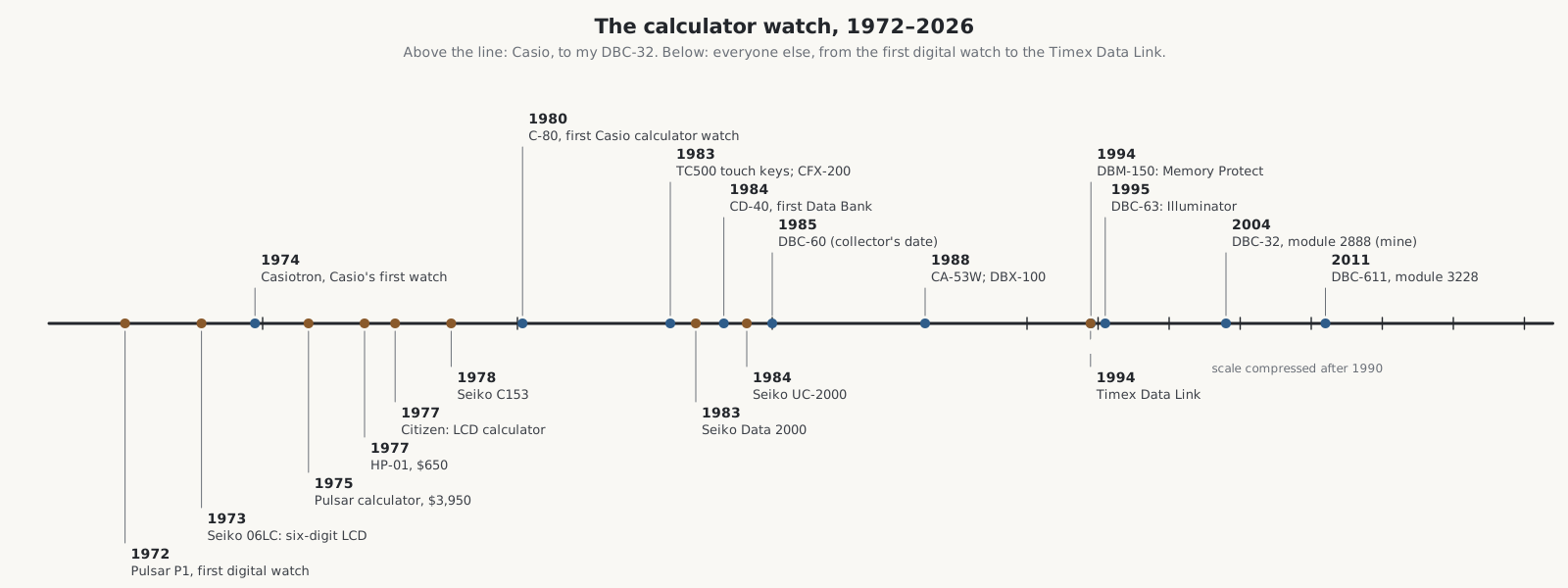
The calculator watch was born of two booms that peaked together in the mid-1970s: the electronic calculator, which had shrunk from a desk machine to a pocket one in five years, and the digital watch, which went from a $2,100 novelty to a $9.95 one in five. Putting the two together was the obvious next step, and several companies took it at once. The result, at first, was a gold-cased status symbol worked with a stylus; within a decade it was a cheap plastic watch that anyone could buy.
2.1 The digital watch
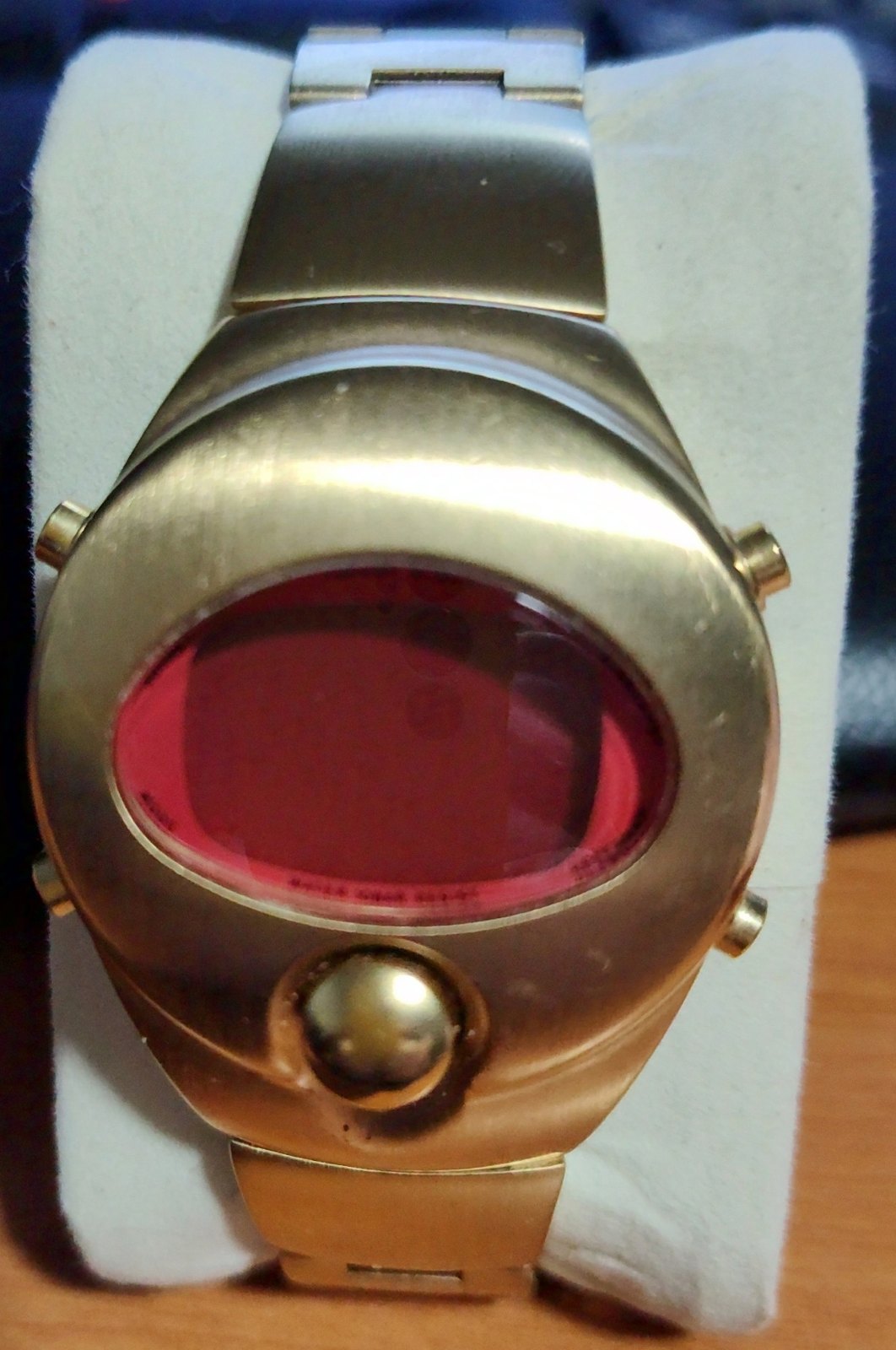
The first electronic digital watch was the Hamilton Pulsar. Hamilton and the Texas firm Electro/Data announced it at a press conference in New York on 6 May 1970, and it went on sale on 4 April 1972, which Guinness World Records takes as the date of the first digital watch, at $2,100 in a gold case. Its red light-emitting diode (LED) display lit only when a button was pressed, because an LED display drew far too much current to stay on. Inside were a 32,768 Hz quartz crystal and, according to one history, 44 integrated circuits joined by 4,000 bonding wires. The Science Museum in London calls it “the first watch without any moving parts”.
The liquid-crystal display, which shows its digits all the time on a tiny current, followed almost at once. Seiko’s 06LC, made by its Suwa Seikosha company and first sold in October 1973, was, Seiko says, the first watch with a six-digit LCD. Casio, a calculator maker, entered watches in November 1974 with the Casiotron, “the world’s first electronic watch equipped with an automatic calendar”, priced at ¥58,000, “nearly a whole month’s starting salary for a university graduate in Japan”. The insight behind it, Casio’s history says, was that “watches simply add up seconds”: a watch was a counting machine, and Casio knew how to make those.
Then prices fell as calculator prices had. TIME reported in December 1975 that digital watches would be about five per cent of American watch sales that year, some 2.5 million, at prices from $30 to over $3,000. Texas Instruments showed a plastic LED watch for $20 at the 1976 Consumer Electronics Show and sold one for $9.95 in May 1977. Pulsar, which had refused to cut its prices, lost $5.9 million by the end of 1976 and was sold, ending up with Seiko in 1978.
2.2 The first calculator watches
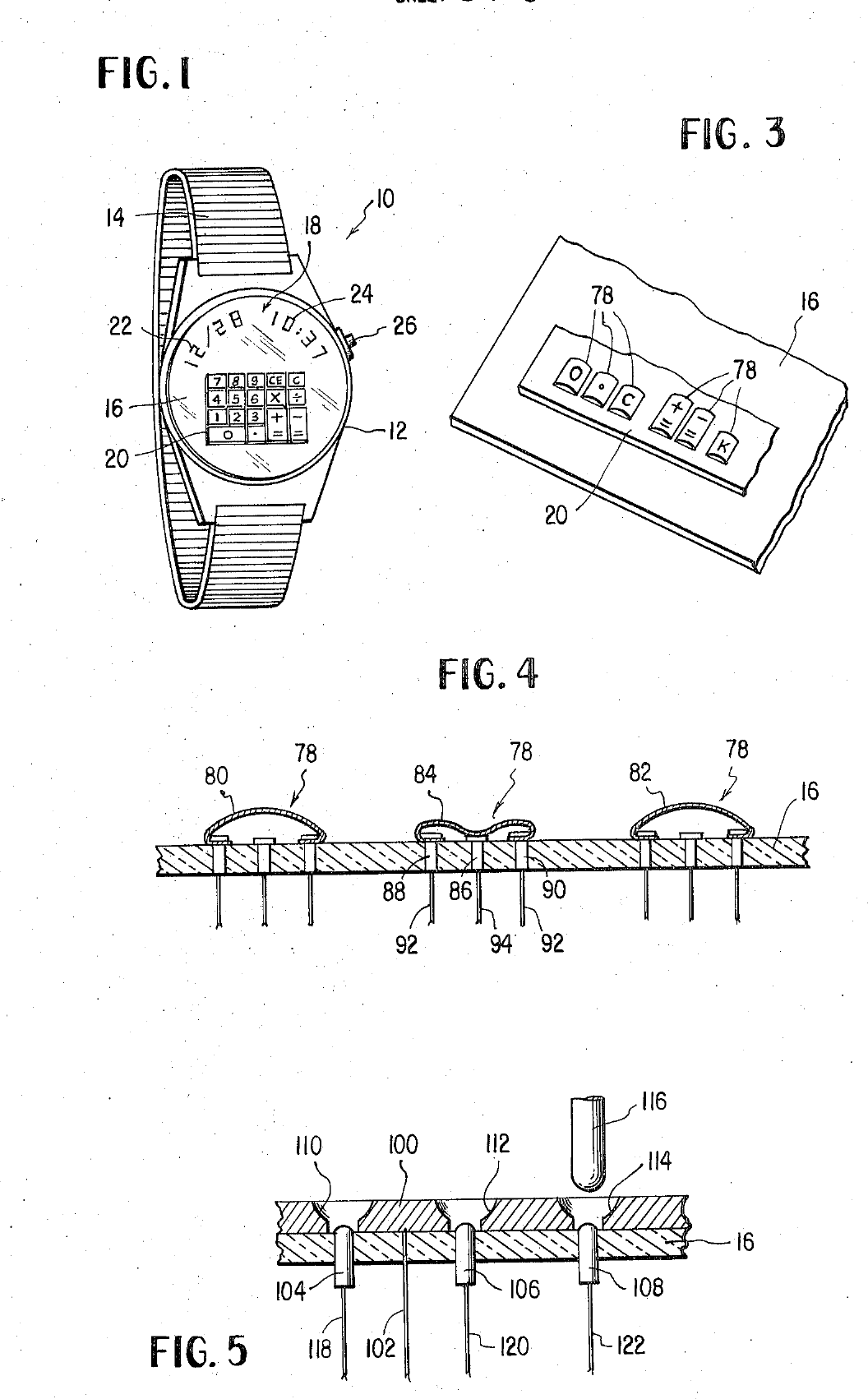
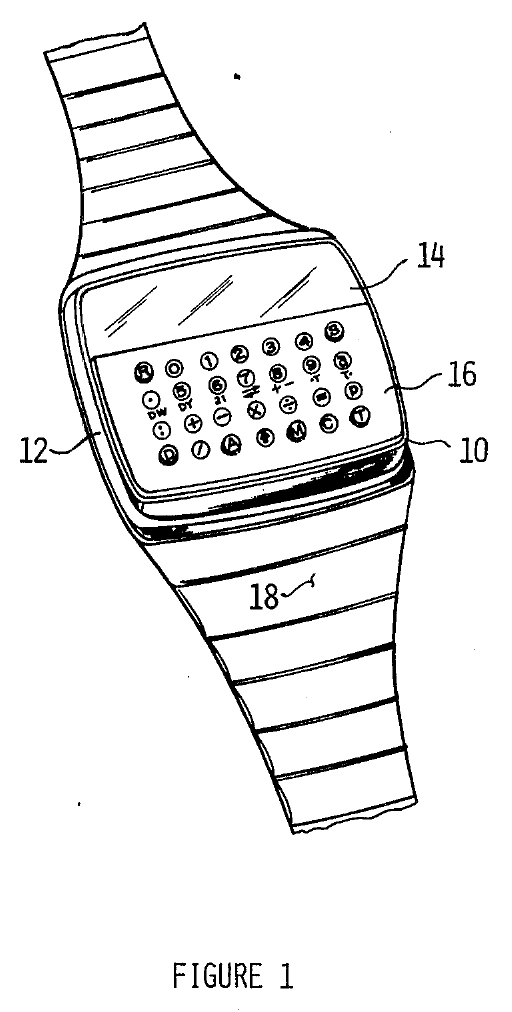
Who was first is not simple. On paper, Seiko was: its American patent US 4,019,037, “Electronic wristwatch incorporating calculator”, claims a Japanese priority of 27 December 1971, for a watch whose numbers were entered by turning a ring rather than pressing keys. Time Computer Inc., the Hamilton company that made the Pulsar, filed US 3,803,834, “Wristwatch calculator”, in February 1973: an eight-digit display shared between time and calculation, with a miniature keyboard on the face, its keys either “snap-acting” buttons of conductive plastic or holes to be touched with a conductive stylus. A Calcron LED Wrist Calculator was advertised in Playboy in June 1975, which may make it the first offered for sale; little else is known of it.
The first that certainly reached customers was the Pulsar calculator watch, which Time Computer “put … on the market in time for Christmas sales in 1975”, as the Smithsonian’s record puts it. TIME described it that December as a “personal information center”, a limited run of solid-gold, 22-key watches at $3,950, adding, subtracting, multiplying and dividing figures up to 999 billion, with a memory. By spring 1976 a stainless-steel model was about $500; other sources give $400, $550 or “under $600”. It had a six-digit LED display, ran on four silver-oxide cells, and came with a pen whose retractable tip pressed the tiny keys; an ordinary ballpoint would not do. Time Computer’s patent of 1975, US 3,928,960, shows how such a watch was built: a CMOS clock chip running from a 32,768 Hz crystal, a separate P-MOS calculator chip, and twenty keys of conductive plastic.
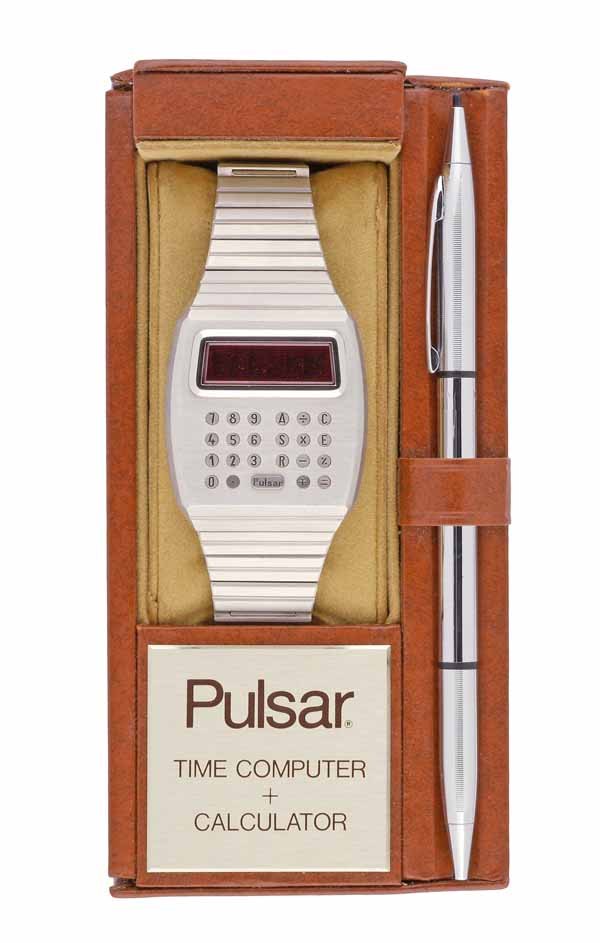
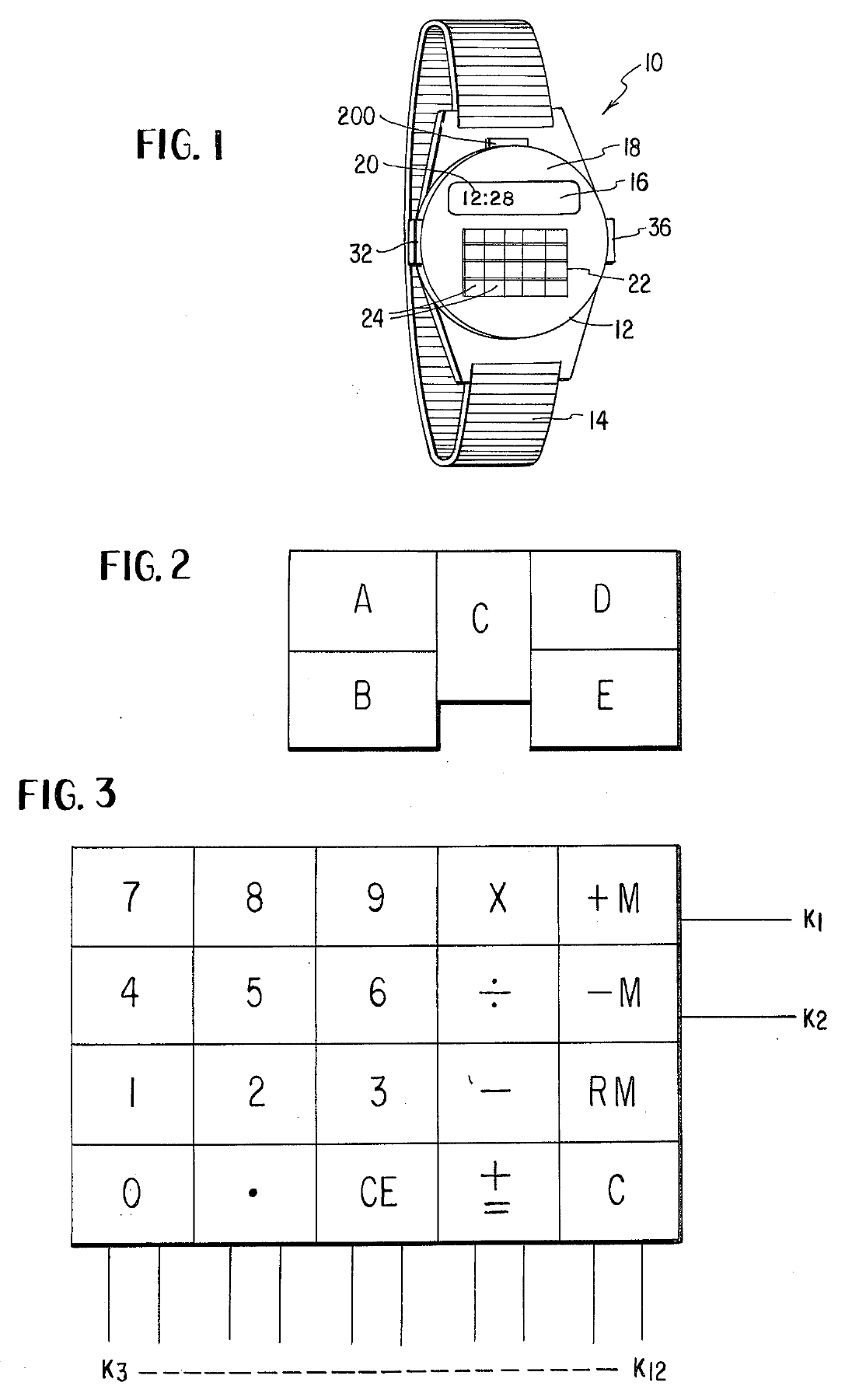
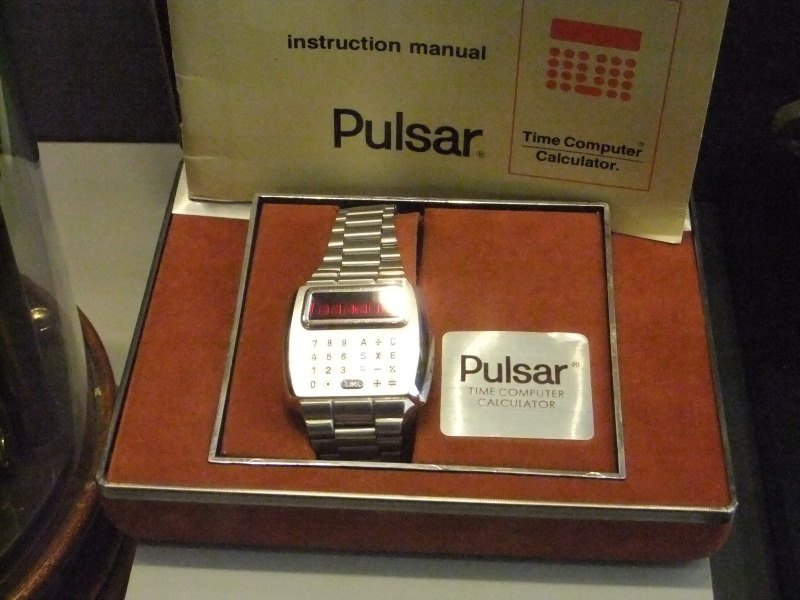
Others followed with LED calculator watches in 1975–77. Uranus Electronics filed a design patent for a “Combined watch and calculator” in July 1975 and showed a solar-powered model. Hughes Aircraft made one sold as the Compuchron, among other names, for about $150 in 1977, later worn by the cast of Battlestar Galactica. National Semiconductor made a scientific calculator watch, the CW-01. Timex patented a “Combination wristwatch/chronograph/wrist calculator/measuring device” in 1975. Sinclair sold a wrist calculator kit with no clock at all.
2.3 The HP-01
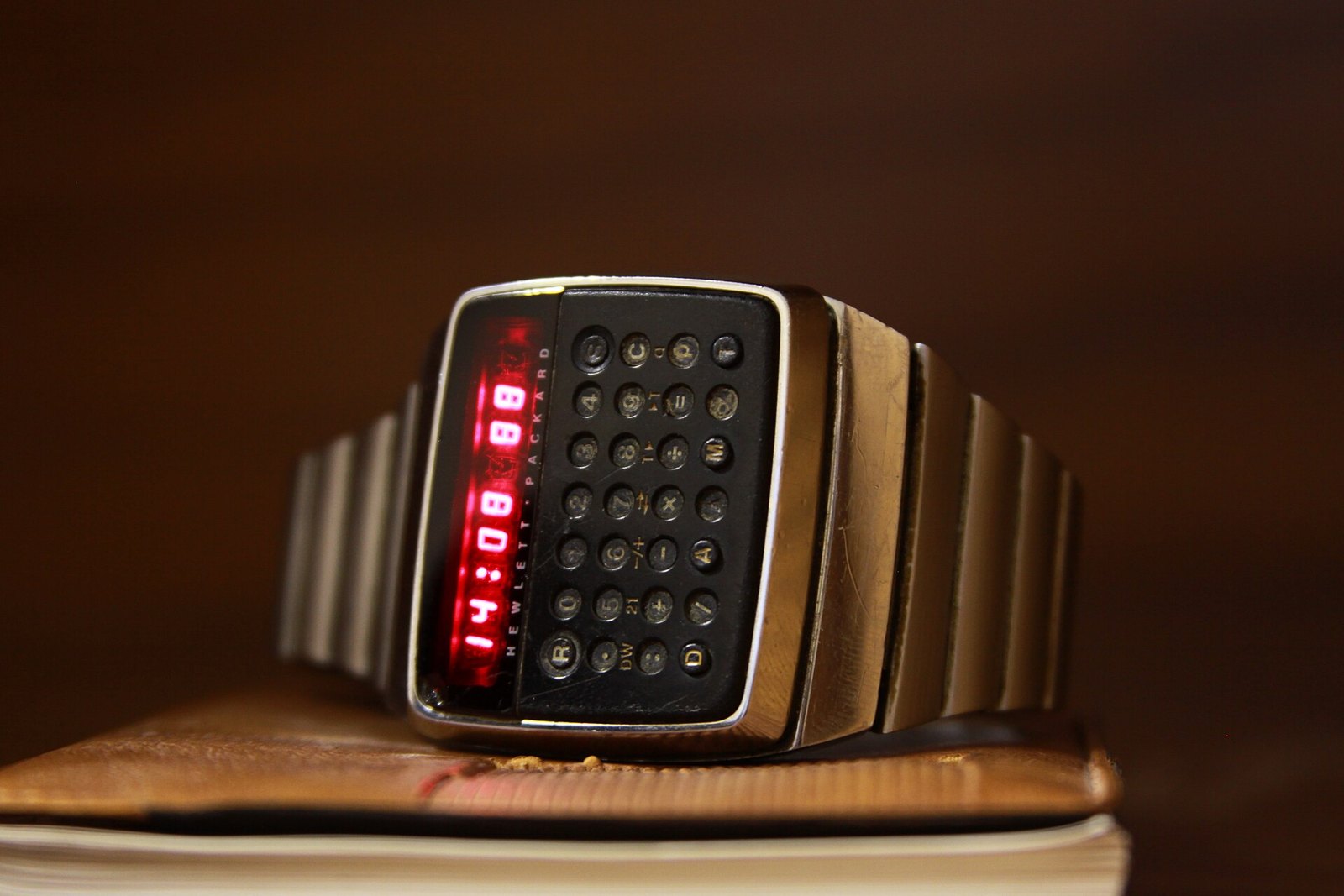
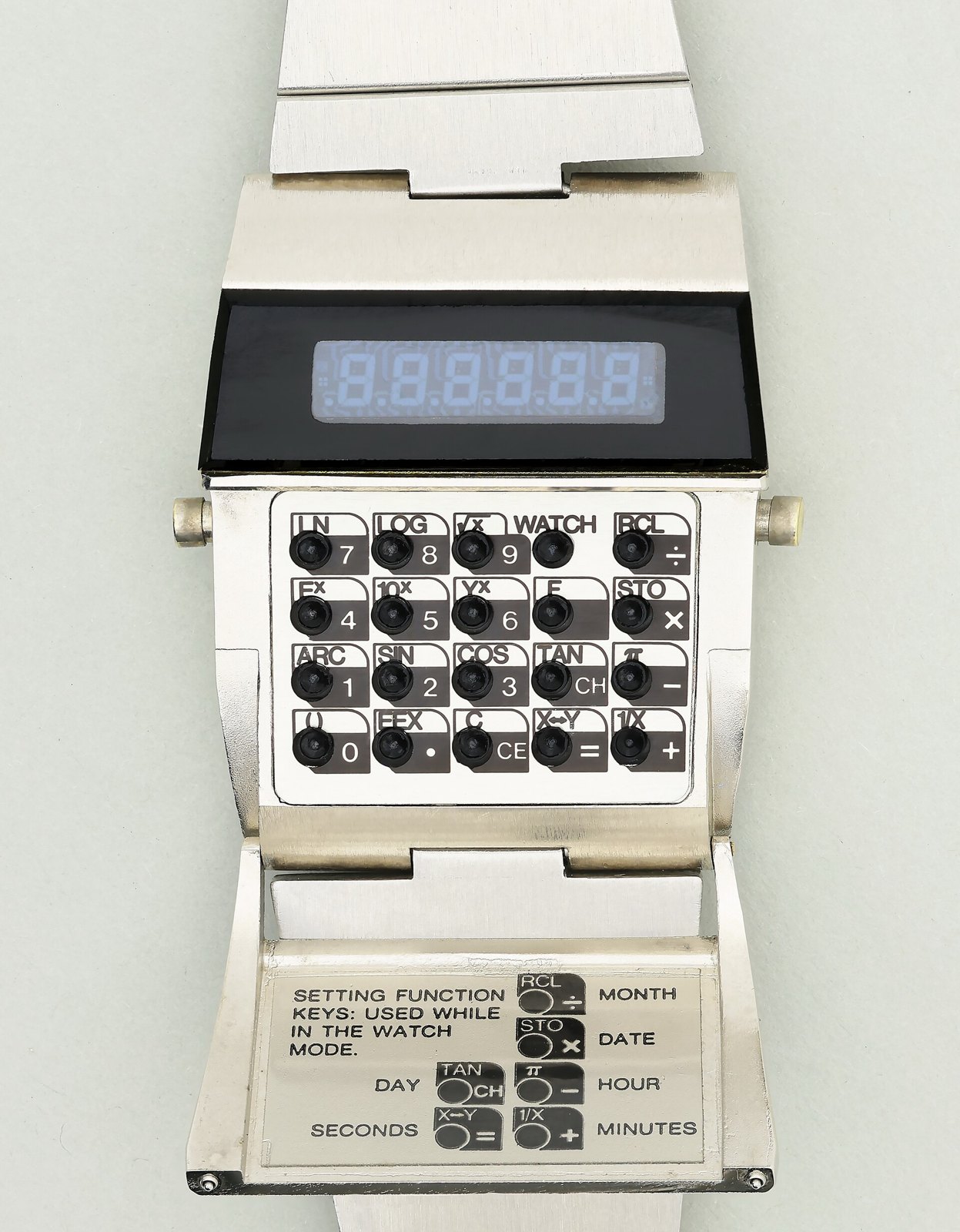
The most ambitious of them came from the company that had made the first scientific pocket calculator. Hewlett-Packard announced the HP-01 in 1977 with a full-page advertisement in Scientific American that September, and described it in the Hewlett-Packard Journal that December as a “Wrist Instrument” that “Opens New Dimension in Personal Information”: “a digital electronic wristwatch, a personal calculator, an alarm clock, a stopwatch, a timer, and a 200-year calendar, and its functions can interact to produce previously unavailable results”. The stopwatch could be multiplied by a constant while it ran, to show, for example, the cost of a telephone call as it went on.
The engineering was remarkable. The HP-01 had six chips, five CMOS and one bipolar display driver, with about 38,000 transistors between them, mounted with the crystal parts on a five-layer ceramic substrate, and it worked like a miniature HP-35, through its numbers one digit and one bit at a time. It drew 20 microwatts with its display dark, “four orders of magnitude smaller than that of the HP-35”, and 36 milliwatts lit. It had 28 keys: six worked with a finger and twenty-two, recessed, with a stylus kept in the clasp of the band. HP set its clock at the factory “within 30 seconds per year”. The cases were machined from cold-forged stainless steel; it weighed six ounces; and it cost $650 in steel and $750 gold-filled, “available only at fine jewelry stores”. It was made at HP’s Corvallis Division in Oregon.
It did not last. The Smithsonian, which holds one given by John Bergey, the former head of Time Computer, says “the HP-01 did not sell well, and Hewlett-Packard scrapped plans for a follow-up HP-02”; Wikipedia says production stopped by the end of 1979. It was heavy, expensive and sold through jewellers rather than HP’s usual outlets, and its LED display could be read only for a few seconds at a time. Stories that 50,000 were made, half of them bought by a Saudi prince, have no source behind them.
2.4 LCD calculator watches
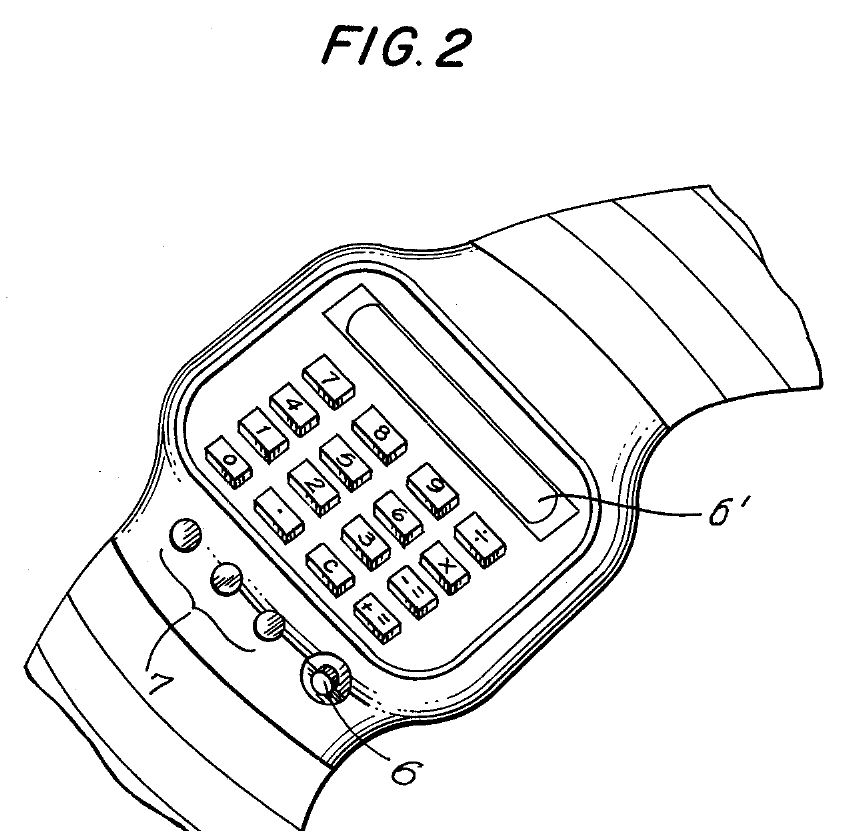
The LED calculator watch could only ever be an occasional instrument: its display ate the battery. The liquid crystal changed that, and the Japanese makers moved first. Citizen’s archive records a “Digital Calculator” of 1977, model NA-0038, “the first domestically produced wristwatch to combine watch and calculator functions” and, Citizen claims, the first to show the time and the calculator together on one LCD; its 23 keys were set round the rim. Seiko lists a calculator watch of 1977, and the Science Museum holds a Seiko C153 made in September 1978 with its stainless stylus; Seiko’s patent US 4,041,295, of 1973 priority, shows its approach to the keyboard problem, cutting the calculator’s keys to as few as seven by making the time-setting buttons serve as calculator keys.
Casio’s first, the C-80, came in February 1980. Casio calls it the “First calculator-style Casio watch”, not the first of all, and stresses that its four-function, eight-digit calculator could be worked “with a fingertip”: its Finger Touch System “could electronically determine the likely intended key when the user pressed two or more at once”. Casio patented its way of getting keys through a watch case, an elastic sheet carrying conductive bodies through holes in the case onto the circuit board, sealing the case as it did so, in GB 2,062,304, with a Japanese priority of October 1979. The Computer History Museum holds a C-80. Its launch price is not recorded in any source found.
2.5 Into the 1980s
By 1983 Casio had a range: the J-100 jogging watch of 1981; the CFX-200, which a collectors’ museum calls Casio’s first scientific calculator watch; and the TC500 of 1983, with touch-sensitive keys on the glass itself. In January 1984 came the watch that set the course of the next forty years, the first Data Bank. Volume 3 takes up the story from there.
Sources
- Guinness World Records, “First electronic digital watch”; Science Museum Group, Pulsar watch (1984-35) and Seiko C153-5011 (2015-501); Coronet, “The Hamilton Pulsar”; grail-watch wiki, “Pulsar”.
- Seiko, “100 Stories: Innovation”; Epson, 06LC milestone page; Casio company history, 1970s and 1980s; Casio heritage pages, 1970s and 1980s.
- TIME, “Modern Living: Going Digital”, 22 December 1975; facele.eu on Texas Instruments’ watches; Technologizer, “Before PCs there were digital watches” (2012).
- Smithsonian National Museum of American History: Pulsar Calculator Watch (1994.0354.07) and HP-01 (1994.0354.14); Computer History Museum, Casio C-80 (102618810) and HP-01 (X1300.97).
- Hewlett-Packard Journal, December 1977, pp. 2–10; HP-01 owner’s guide (1977); Joe Horn on HP’s 1977 advertisement (hpcalc.org); Wikipedia, “HP-01” and “Calculator watch”.
- Citizen design archive, “Digital Calculator 1977” (NA-0038); Watchismo, “Calculating history of the LED calculator watch” (2006); Digital-Watch.com on the Hughes calculator watch; Hackaday, “A brief history of calculator watches” (2024).
- Patents: Seiko US 4,019,037 and US 4,041,295; Time Computer US 3,803,834 and US 3,928,960; HP US 4,158,285, US 4,109,315 and US 4,106,677; Uranus USD 244,012; Hughes US 4,062,181; Timex US 4,022,014; Casio GB 2,062,304.
Comments (0)