Calculator Watches · Volume 5
How It Keeps Time and Counts
A calculator watch is a very small, very slow computer that spends almost all its life asleep. It wakes for a few thousandths of a second each second to move the clock on, checks the alarms, and goes back to sleep; when a key is pressed it wakes, works out what to do, and sleeps again. This volume follows the clock from the crystal to the seconds, and the calculator and the Data Bank into the chip, and ends with the arithmetic that lets one coin cell run it all for ten years.
5.1 Why 32,768
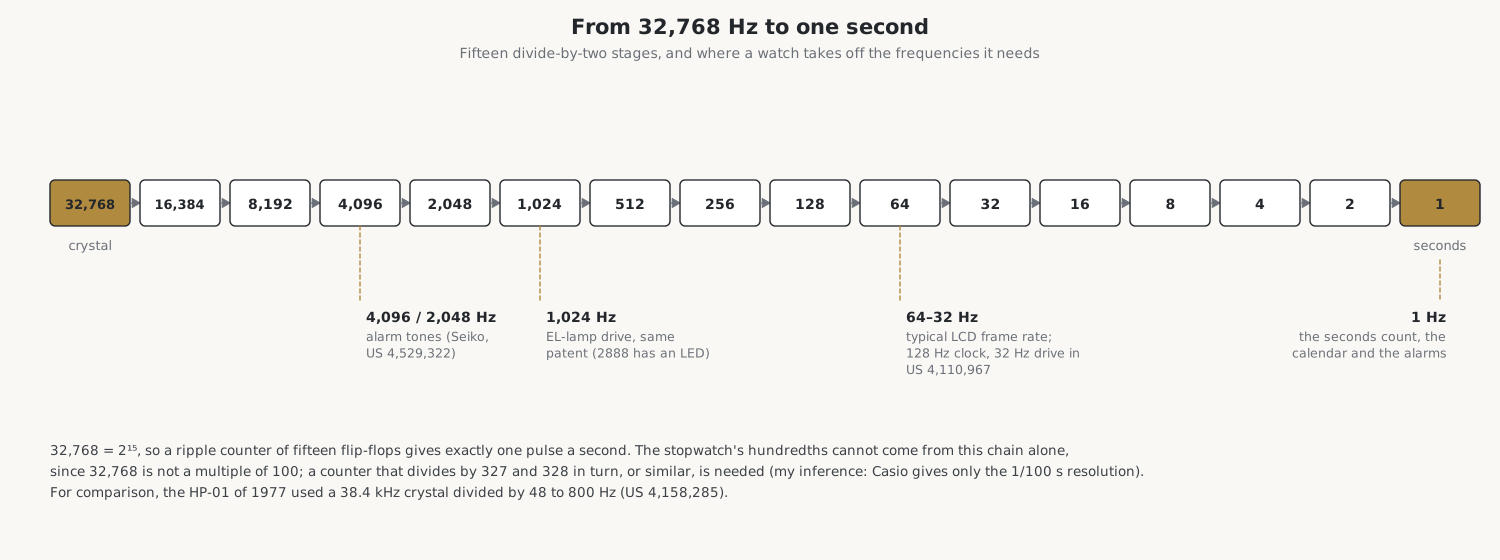
The crystal in a quartz watch vibrates at 32,768 Hz. The number is a power of two, 2¹⁵, so a chain of fifteen flip-flops, each halving the frequency, turns it into exactly one pulse a second. A higher frequency would need a smaller fork but more current, because a CMOS circuit’s power rises with the rate at which it switches; a lower one would need a longer fork. The first quartz wristwatch on sale, Seiko’s Astron of December 1969, ran at 8,192 Hz, 2¹³; 32,768 became the standard. Its quartz tuning forks are made photolithographically, etched from a wafer, a process Juergen Staudte invented in 1968.
The crystal sits in a Pierce oscillator, the simplest circuit there is for the job: a single CMOS inverter in the chip, the crystal connected from its output back to its input, a small capacitor from each end to ground and a resistor of several megohms to bias it. Epson’s datasheet for its S1C60 watch chip, for example, specifies a 25 pF trimmer capacitor on one side and a 20 pF capacitor built into the chip on the other.
The divider chain also supplies the watch’s other frequencies. Seiko’s watch patents take the alarm tones from 4,096 or 2,048 Hz; a patent on LCD drive uses a 128 Hz clock and 32 Hz for the display. The stopwatch’s hundredths of a second cannot come straight from a chain of halvings, because 32,768 is not a multiple of 100; the chip must count unevenly, by 327 and 328 in turn or something like it. Casio gives only the result, a stopwatch reading to 1/100 second (Operation Guide 2888, p. 3).
The HP-01 of 1977 took a different path. Its patent describes “a free-running oscillator using a crystal … having a frequency of 38.4 KHz”, divided by 48 to 800 Hz for its clock circuits, a frequency chosen to suit a calculator that worked through its numbers one digit at a time, 48 bits to a word.
5.2 Accuracy and temperature
A quartz watch is accurate because quartz is stable, but not perfectly so. A tuning-fork crystal runs fastest at its turnover temperature, about 25 °C, and slows as it gets warmer or colder, along a parabola: Δf/f = B (T − 25)², where B is about −0.034 to −0.04 parts per million per degree squared, according to the datasheets of crystal makers such as Epson and Geyer. Wikipedia puts the effect as about two minutes a year at 10 °C from the turnover and eight minutes at 20 °C.
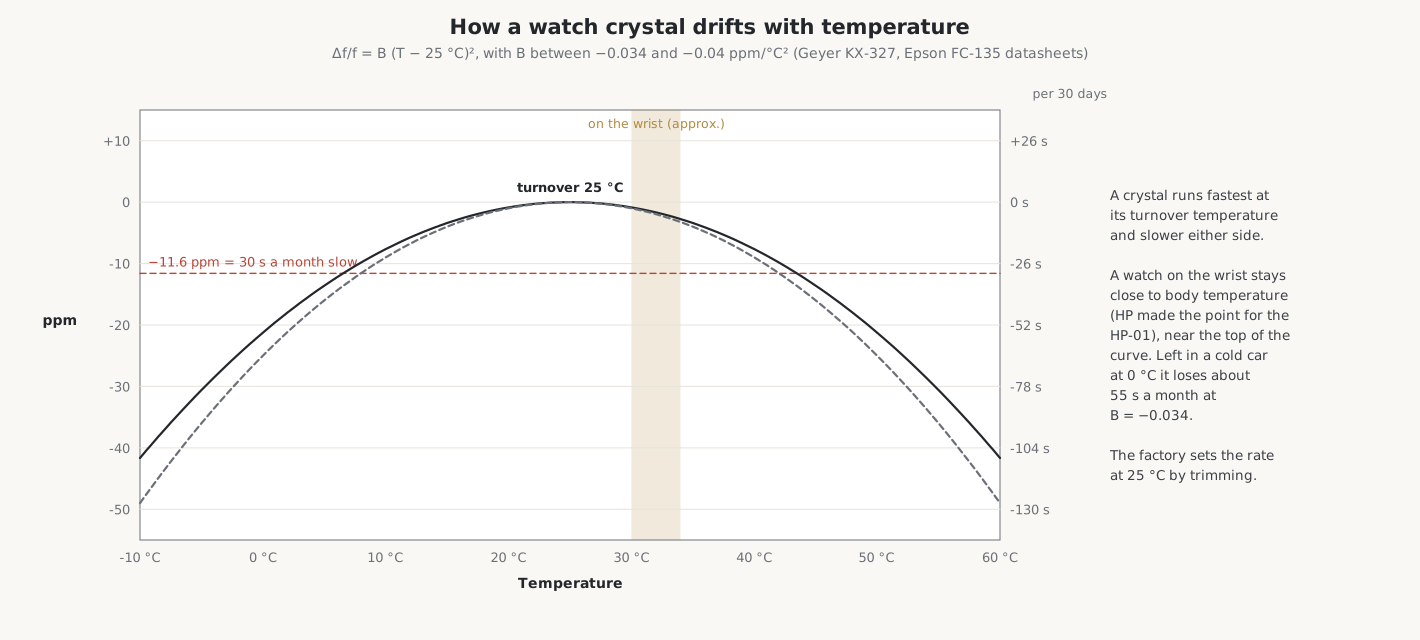
Casio’s product page gives the DBC-32’s accuracy as ±30 seconds a month; the operation guide for module 2888 has no specification section. Thirty seconds a month is 11.6 parts per million. An Epson FC-135 watch crystal is specified to ±20 parts per million at 25 °C, which alone could make a watch 52 seconds a month fast or slow, and it ages by up to 3 parts per million in its first year. So every watch has to be adjusted at the factory. There are two ways:
- A trimmer capacitor on one side of the oscillator pulls the frequency. On Epson’s S1C60, varying it from 5 to 25 pF shifts the rate by at least 40 parts per million.
- Digital trimming, patented by Timex in 1981 (US 4,282,595): the crystal is cut to run slightly fast, the factory measures it, and a correction stored in the chip deletes a set number of the crystal’s pulses in every 32-second period before they reach the divider. A crystal running at 32,771 Hz, three cycles a second fast, has 96 pulses deleted in each 32 seconds. Each deleted pulse per 32 seconds is worth about one part per million, or 2.5 seconds a month.
Casio’s F-91W has trimming links on its board for the same purpose, and a Casio DBX-100 Data Bank board has six such links on its edge. How module 2888 is trimmed is not known.
Worn on the wrist, a watch stays near body temperature and close to the top of the curve. HP’s engineers made the same point about the HP-01: its “battery operating temperature will remain relatively close to body temperature”. A watch left in a cold car is another matter: at 0 °C, 25 °C below the turnover, the curve above loses about 55 seconds a month.
5.3 The chip
The chip in a calculator watch is a microcontroller: a processor, its program in read-only memory (ROM) made with the chip, a little working memory (RAM), and the special circuits a watch needs, oscillator, divider, display driver, key inputs and buzzer outputs, all on one piece of silicon, built in CMOS for minimal current. Casio does not publish what is in module 2888, but watch microcontrollers that are documented show what such a chip is like. Epson’s S1C60N05 is one:
Table 1 — The chip in a calculator watch is a microcontroller: a processor, its program in read-only memory (ROM) made with the chip, a little working memory (RAM), and the special circuits a watch needs, oscillator, divider, display driver, key inputs and buzzer outputs, all on one piece of silicon, built in CMOS for minimal current. Casio does not publish what is in module 2888, but watch microcontrollers that are documented show what such a chip is like. Epson's S1C60N05 is one
| Epson S1C60N05 (a documented 4-bit watch chip) | |
|---|---|
| Processor | 4-bit S1C6200 core, 100 instructions |
| Program memory | 1,536 words of 12 bits (mask ROM) |
| Working memory | 80 words of 4 bits |
| Display driver | 20 segments × 4 commons, voltage booster on chip |
| Supply | 3.0 V (1.8–3.5 V), or 1.5 V in the S1C60L05 |
| Current, typical | 0.8 µA halted, 1.5 µA running, at 32,768 Hz |
| Instruction time | 5, 7 or 12 clock cycles: 153 to 366 µs at 32,768 Hz |
A 4-bit processor handles one decimal digit at a time, which suits a calculator: the S1C6200 has a decimal flag that makes its add and subtract instructions work in binary-coded decimal (BCD), one digit to each 4-bit word, the way pocket calculators had worked since the HP-35. It also has two instructions that make a watch possible: HALT, which stops the processor while the oscillator and the clock run on, and SLP, which stops everything. A watch chip spends nearly all its time halted, woken by the divider once a second, by an alarm or by a key.
Run from the crystal, the processor manages only a few thousand instructions a second. That is plenty for a clock, and enough for a calculator: an eight-digit multiplication or division, done digit by digit with repeated addition or subtraction, takes a fraction of a second. Seiko’s watch-processor patent of 1985 (US 4,516,862) describes the same kind of machine, with a 32 kHz crystal, clocks up to 4 kHz derived from the divider, a machine cycle of about 240 µs, and a 128 × 4-bit RAM.
5.4 The calculator
Module 2888’s calculator works on numbers of up to eight digits, or seven when negative, the minus sign taking a digit’s place (p. 2). A result too long shows E; pressing C clears the E and leaves an approximate result to go on with. The constant, set by pressing an operator twice (volume 6), is a stored operand that the chip applies to each new number. Like most four-function calculators, it works from left to right, without brackets or precedence.
The calculator watches of the 1970s did their arithmetic quite differently. The HP-01’s arithmetic chip worked on words of twelve BCD digits, 48 bits, passed through it one bit at a time, exactly like HP’s pocket calculators. Time Computer’s patents for its Pulsar calculator watch describe a separate calculator chip, a P-MOS Cal-Tex CT-5007 (US 3,928,960), beside a CMOS clock chip running from a 32,768 Hz crystal, with the calculator powered only while it is in use (US 3,803,834).
5.5 The Data Bank in memory
The Data Bank holds 25 records, each a name of up to eight characters and a number of up to fifteen (p. 1–2). Its storage can be estimated, though not read off any document. The number field needs only twelve symbols, the digits, the hyphen and the space, so each fits in one 4-bit word. The name field has to hold any of 121 characters, so each needs at least seven bits, in practice two 4-bit words. A record therefore needs about 8 × 2 + 15 = 31 words of four bits, and 25 records about 775, before the clock, the alarms, the stopwatch and the program’s own variables. On the order of a thousand 4-bit words of RAM, ten times what Epson’s small S1C60N05 offers, is needed: a larger chip of the same family, or Casio’s own.
That RAM keeps its contents only while it has power. Data Banks from the DBM-150 of 1994 onward that carried the words “Memory Protect” stored their records in EEPROM, which survives without power; module 2888 does not claim it, so a battery change should be expected to clear the records (volume 7).
When a record is stored, the name and number “flash for about one second as Data Bank records are sorted” (p. 2). A second is a long time for a computer, but a short one for a processor managing a few thousand instructions a second that must compare names character by character, through Casio’s 121-place sort table, and shift the list to make room.
The thirteen languages cost nothing in RAM. The day names, seven three-letter abbreviations in each language, and the 121 characters with their sort order, are tables in the chip’s ROM, fixed when the chip was made.
5.6 Ten years on one cell
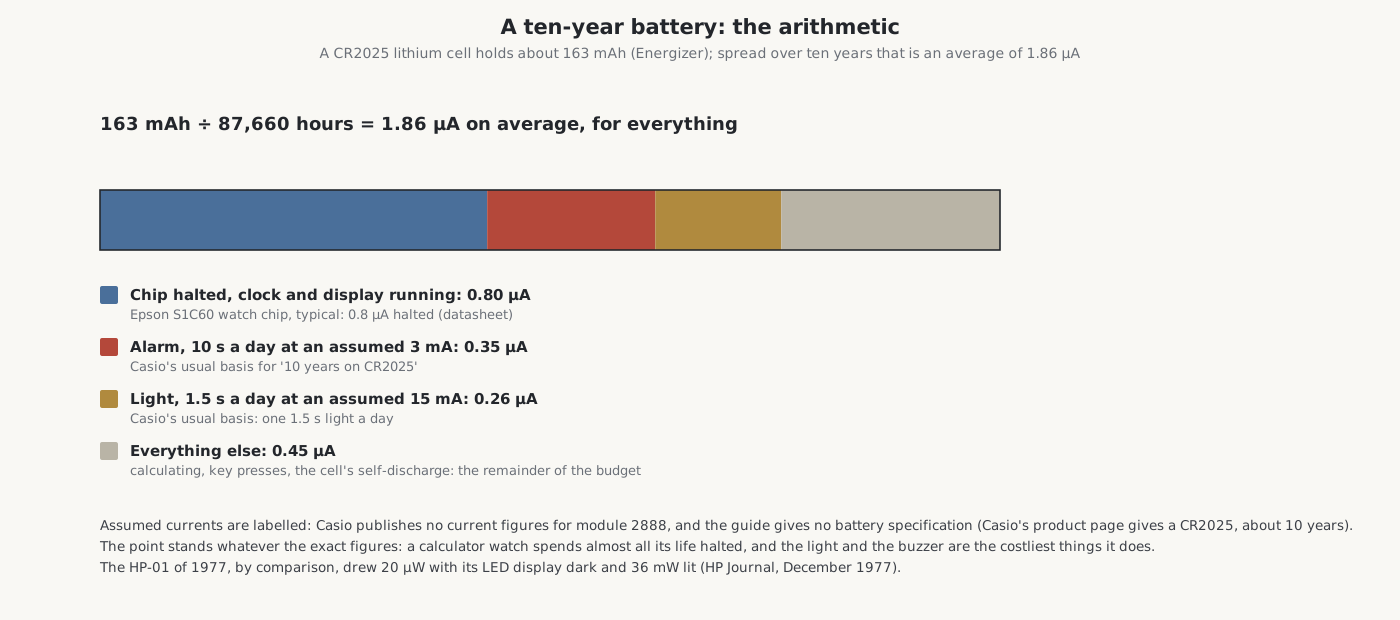
The arithmetic is simple and strict. A CR2025 holds about 163 mAh. Ten years is 87,660 hours. So the watch may draw, on average, 1.86 µA, about five and a half millionths of a watt at 3 V, with its display on all the time. A documented watch chip such as Epson’s draws 0.8 µA halted, so the budget leaves only about a microampere for the display, the light, the buzzer and every calculation. Casio’s guides for its other ten-year modules state what they assume: one 10-second alarm and one 1.5-second light a day. The light and the buzzer each draw thousands of times more than the halted chip while they run, which is why Casio’s guide warns that “frequent use of illumination shortens the battery life”, and why the auto light switch turns itself off after six hours (p. 4).
The contrast with the first calculator watches is the whole story of the technology. The HP-01 drew about 20 µW with its LED display dark and 36 mW with it lit, from three silver-oxide cells, two of them for the display alone; HP’s engineers were proud that this was “four orders of magnitude smaller than that of the HP-35”. Module 2888 does more, with its display on all the time, for under a third of the HP-01’s power with its display off.
Table 2 — Ten years on one cell
| HP-01 (1977) | Casio DBC-32, module 2888 (2004) | |
|---|---|---|
| Chips | 6 (5 CMOS, 1 bipolar), about 38,000 transistors | 1, under epoxy |
| Display | 9-digit LED, lit on demand | LCD, always on |
| Crystal | 38.4 kHz | 32,768 Hz |
| Power | 20 µW dark, 36 mW lit | about 6 µW average (from 1.86 µA at 3 V) |
| Cells | three 1.5 V silver-oxide | one 3 V lithium CR2025 |
| Keys | 28, most pressed with a stylus | 16 keys and 4 buttons |
| Accuracy | set “within 30 seconds per year” | ±30 seconds a month (Casio) |
Sources
- Casio, Operation Guide 2888 (MO0407-EA, 2004), pp. 1–4; Casio India, DBC-32-1A product page (battery, accuracy).
- Epson, S1C60N05 datasheet and S1C6200 core quick reference; FC-135 crystal datasheet; Geyer KX-327 crystal datasheet.
- Patents: Timex US 4,282,595 (digital trimming); Daini Seikosha US 4,516,862 (watch processor); HP US 4,158,285 (HP-01); Time Computer US 3,803,834 and US 3,928,960 (Pulsar calculator); US 4,110,967; Seiko US 4,529,322.
- Hewlett-Packard Journal, December 1977, pp. 2–10.
- Seiko, “Quartz knowledge” (the Astron’s 8,192 Hz); Wikipedia, “Crystal oscillator”; Zeptobars on the F-91W; Core Electronics forum on the DBX-100; Energizer CR2025 datasheet; lookatwrist’s Data Bank history (WatchUSeek, 2020) on Memory Protect.
- The storage estimate and the battery arithmetic are my own, from the figures above.
Comments (0)