Calculator Watches · Volume 1
Calculator Watches: My Casio Data Bank
A calculator watch is a whole pocket calculator, and then some, squeezed onto a wrist: a keypad of sixteen tiny keys, an eight-digit arithmetic unit, a clock, a calendar, alarms and a stopwatch, all run by one chip from one coin cell for years at a time. In 1975 the first one, the Pulsar, cost $3,950 in solid gold. In 1977 Hewlett-Packard’s HP-01 cost $650 and came with a stylus to press its keys. By the 1980s Casio was selling calculator watches by the million, and they had become a badge of the bookish: Marty McFly wore one in Back to the Future. Fifty years on, Casio still makes them.
Mine is a Casio Multi-Lingual DATA BANK, model DBC-32, built on Casio’s module 2888.
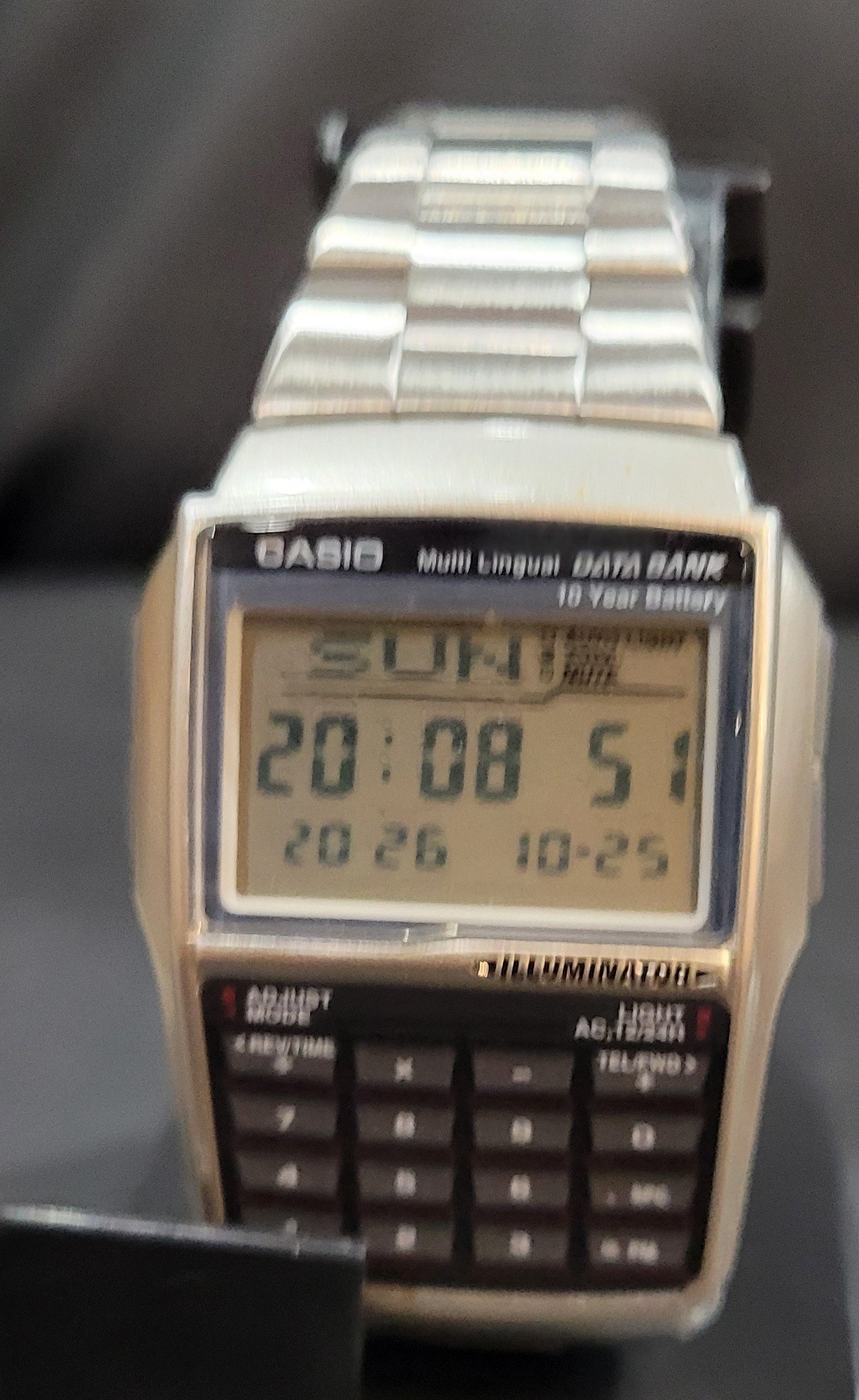
1.1 My DBC-32
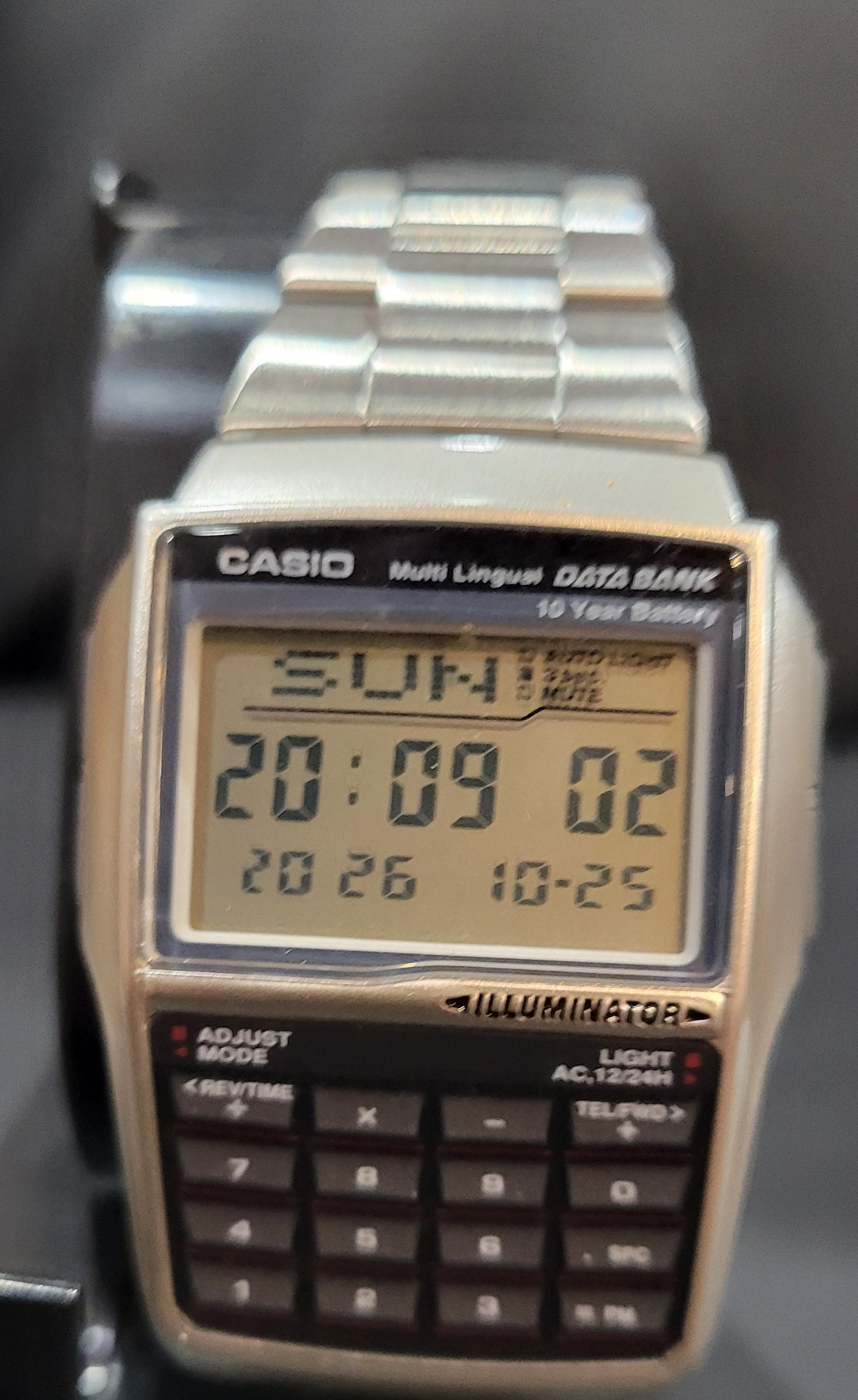
The face says it all in small print: CASIO, Multi Lingual DATA BANK, 10 Year Battery and ILLUMINATOR. The case back adds the rest. The number in a box, 2888, is the module, Casio’s name for the movement and its electronics; DBC-32 is the model. Above them is the list of features, TELEMEMO 25 · 5 MULTI-FUNCTION ALARM · CALCULATOR · DUAL TIME, and below them STAINLESS STEEL BACK, MADE IN CHINA, and the thirteen languages the watch can speak: ENG/POR/ESP/FRA/NED/DAN/DEU/ITA/SVE/POL/ROM/TÜR/RUS.
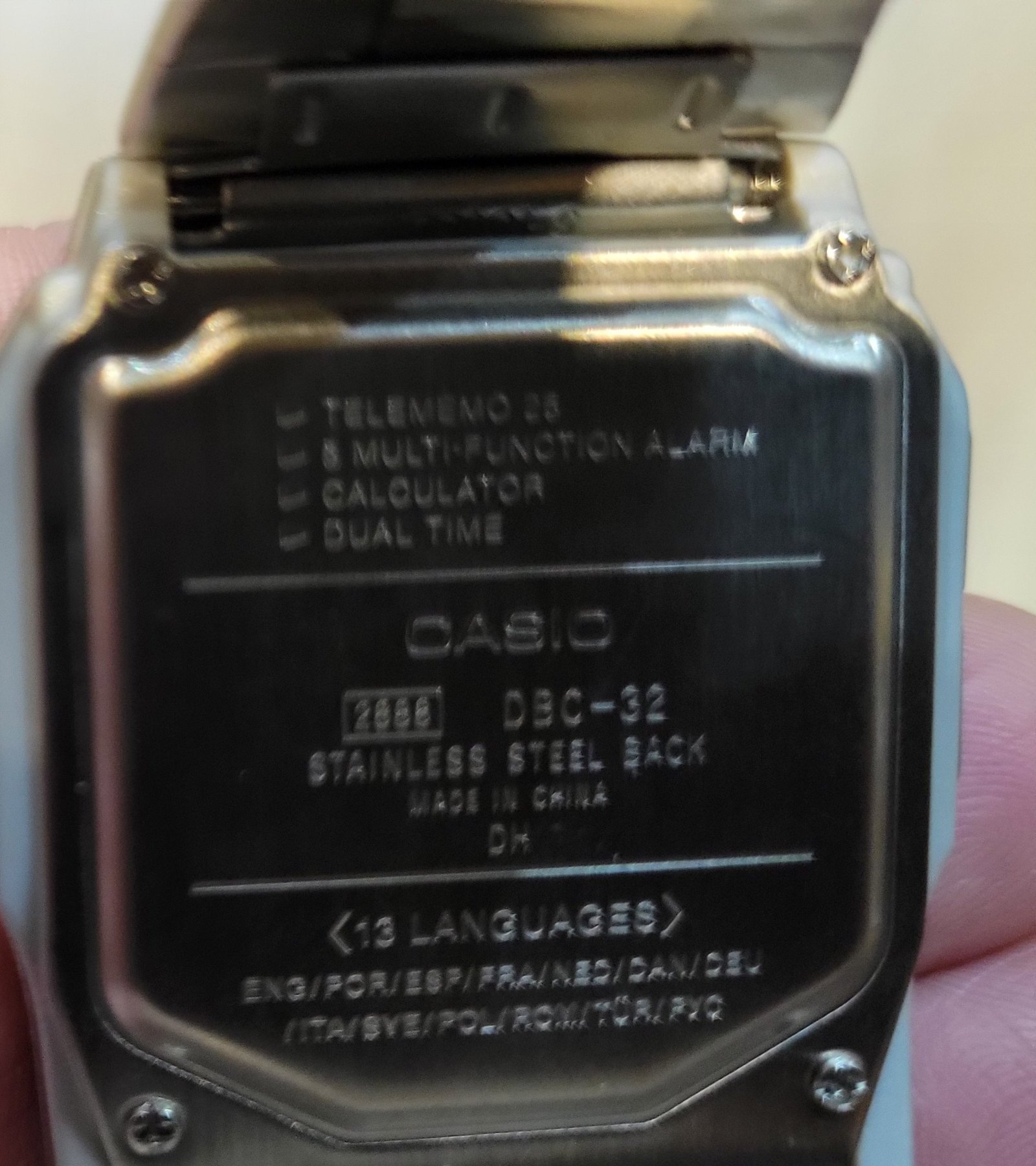
The DBC-32 dates from 2004. A collector’s history of the Data Bank line, compiled from his own watches, lists the first DBC-32s on module 2888 in that year, in black resin and in colours, and the DBC-32D-1A, the silver version on a stainless-steel bracelet, in 2005; Casio’s parts list for that model also gives 2005. Casio’s operation guide for module 2888 carries the document code MO0407-EA and was made in July 2004. Mine is on a steel bracelet, so it is very probably a DBC-32D-1A, though the case back gives only “DBC-32”. Six more colour versions followed in 2007 and 2008, and the DBC-32 is still on sale in 2026.
What it does, according to Casio’s guide and its product page:
Table 1 — What it does, according to Casio's guide and its product page
| Feature | Module 2888 |
|---|---|
| Data Bank (“Telememo”) | 25 records, each a name of 8 characters and a number of 15 digits, sorted automatically |
| Calculator | add, subtract, multiply, divide, constants, powers; 8 digits; one currency rate |
| Languages | day of the week and name characters in 13 languages, Cyrillic included |
| Alarms | 5 (one can snooze), and an hourly time signal |
| Stopwatch | to 1/100 s, up to 23:59′59.99″, with split and two-finish timing |
| Dual Time | a second time zone, with its own daylight saving setting |
| Calendar | automatic to 2099 |
| Light | amber LED and light guide, with an auto light switch |
| Accuracy | ±30 seconds a month |
| Battery | CR2025 lithium, about 10 years |
“Multi-Lingual” does not mean the watch translates anything. The language setting chooses the language of the day of the week, SUN, DOM, DIM or ВС for Sunday, and the set of letters available for typing names into the Data Bank, so that a Pole can store ŁUKASZ and a Russian НАТАША. The Data Bank itself is the watch’s real purpose: twenty-five telephone numbers, carried on the wrist, from the days before every number lived in a phone.
1.2 A family of five decades
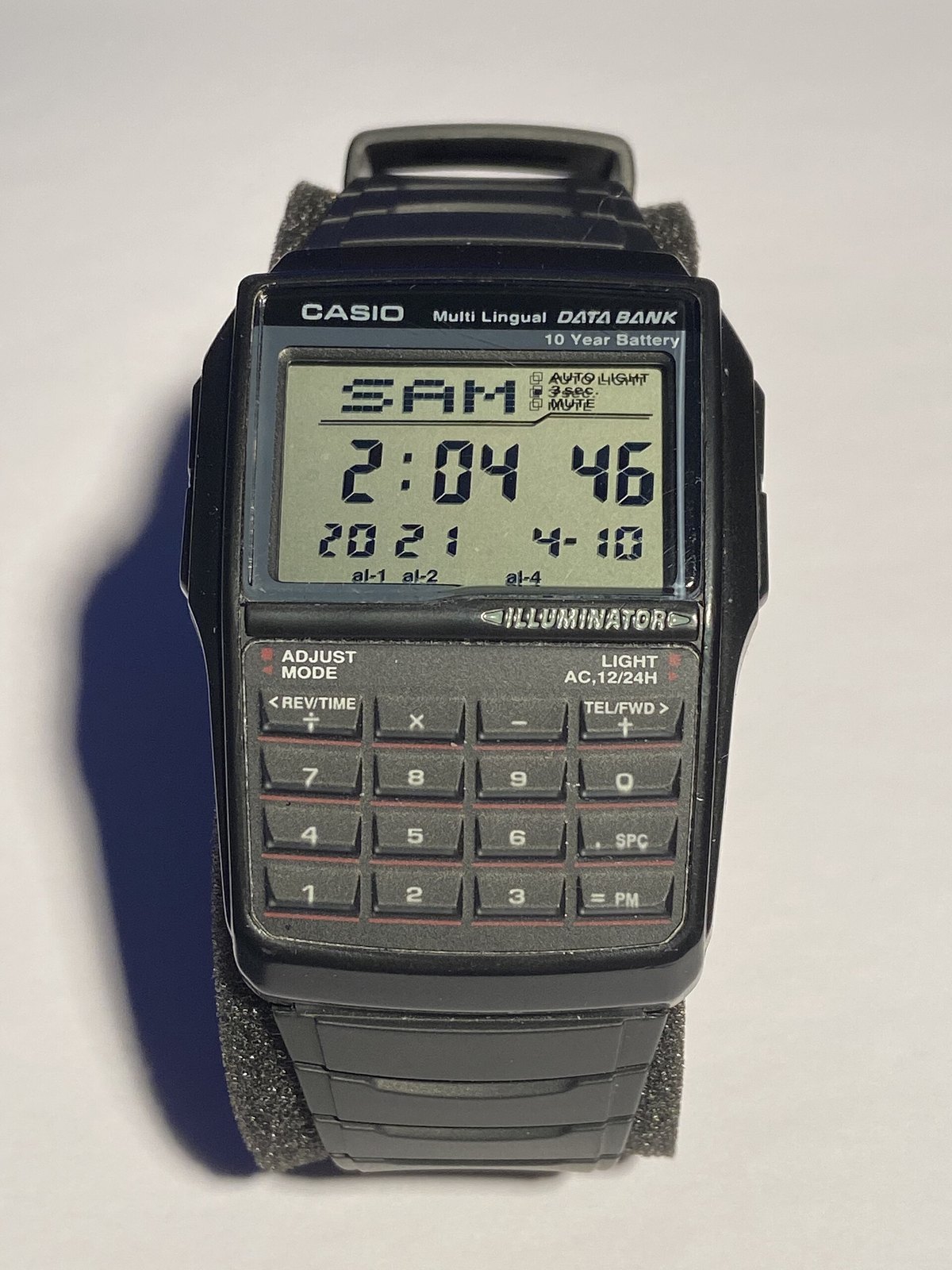
The DBC-32 is the latest of a long line. The first calculator watch went on sale for Christmas 1975; the first Casio calculator watch, the C-80, in February 1980; the first Casio Data Bank, the CD-40, in January 1984, of which Casio says it sold six million in five years. Through the 1980s and 1990s the Data Bank grew from ten telephone numbers to three hundred, gained a backlight, a memory that survived a battery change, voice recording and radio-set time, and then, as mobile phones took over the job, shrank back to the simple watch that Casio still sells. The DBC-32 sits at the end of that line, with one successor, the DBC-611 of 2011, which uses module 3228 to do the same things in a case styled after the Data Banks of the 1980s.
1.3 What is in this series
- My Casio Data Bank: this introduction.
- Calculators on the Wrist, 1970–1984: the first digital watches, the Pulsar calculator, the HP-01, the LED watches of the 1970s, the first LCD calculator watches from Citizen and Seiko, and Casio’s C-80.
- The Data Bank Years, 1984–2026: Casio’s calculator and Data Bank watches, Seiko’s wrist computers, the Timex Data Link, Back to the Future, the decline and the revival.
- Inside a Calculator Watch: the module, the liquid-crystal display and its drive, the keypad, the light, the auto light switch, the buzzer and the cell.
- How It Keeps Time and Counts: the 32,768 Hz crystal, temperature and trimming, the watch chip, the calculator, the Data Bank in memory, and ten years on one cell.
- Operating the DBC-32: every mode, from Casio’s operation guide, with Casio’s worked examples.
- Care and Repair: the case back, water, the battery and the Data Bank, the display, the keys, the crystal and the bracelet.
- Collecting and the Exam Room: what calculator watches cost then and now, the collectable ones, identifying a Data Bank, and why exam boards ban them.
1.4 A note on the sources
The operating volume is drawn entirely from Casio’s Operation Guide 2888, which is in the Reference Library with the guide to its successor, module 3228, the HP-01’s owner’s guide and the Hewlett-Packard Journal article that describes its design, and patents on calculator watches from Hewlett-Packard, Seiko, Time Computer (Pulsar), Timex and others. Casio publishes no technical description of module 2888, and nobody has published a teardown, so the hardware volumes describe what Casio’s guide shows and fill in the rest from documented watch chips and from a teardown of an older Data Bank; where they do, they say so. The history draws on Casio’s own company histories, the Smithsonian’s and the Computer History Museum’s records, TIME, and a collector’s history of the Data Bank line on WatchUSeek. Where sources disagree, on dates, prices and firsts, the text says so.
The other electronic dives on this site cover the scientific calculators whose arithmetic the calculator watch borrowed, and the pocket computers of the same years.
Sources
- Casio, Operation Guide 2888 (MO0407-EA, 2004); Casio India, DBC-32-1A product page (specifications, 2026); Casio parts lists for the DBC-32-1A and DBC-32D-1A (casiopart.com).
- Casio corporate history, chapter 2 (the CD-40 and its sales); Casio company history, 1980 (the C-80 and CD-40).
- lookatwrist, “History of Casio DBC, DBX, and DBM Data Bank Calculator Watches”, WatchUSeek, 11 August 2020.
- Smithsonian National Museum of American History, Pulsar Calculator Watch (1994.0354.07); Hewlett-Packard Journal, December 1977.
- The markings and the photographs are of my own watch.
Comments (0)