Calculator Watches · Volume 3
The Data Bank Years, 1984–2026
In January 1984 Casio put a telephone book on the wrist. The Data Bank turned the calculator watch from an engineer’s gadget into a mass-market one, and for fifteen years it grew more capable every year, while Seiko and Timex tried to go further and make the watch a terminal for a computer. Then the mobile phone took over its job, and the calculator watch settled into the role it has now: a cheap, durable, slightly ironic classic.
3.1 The first Data Bank
Casio’s corporate history records that “the Databank Telememo 10 (CD-40) was released in January 1984”. It stored ten entries of up to sixteen letters or numerals, telephone numbers with a name, and it “sold six million units in the five years after release”. Wikipedia dates the CD-40 and its companion CD-401 to 1983; Casio’s own pages say 1984. Its heritage page adds that the name Data Bank “came to be synonymous with the multifunction digital watch”.
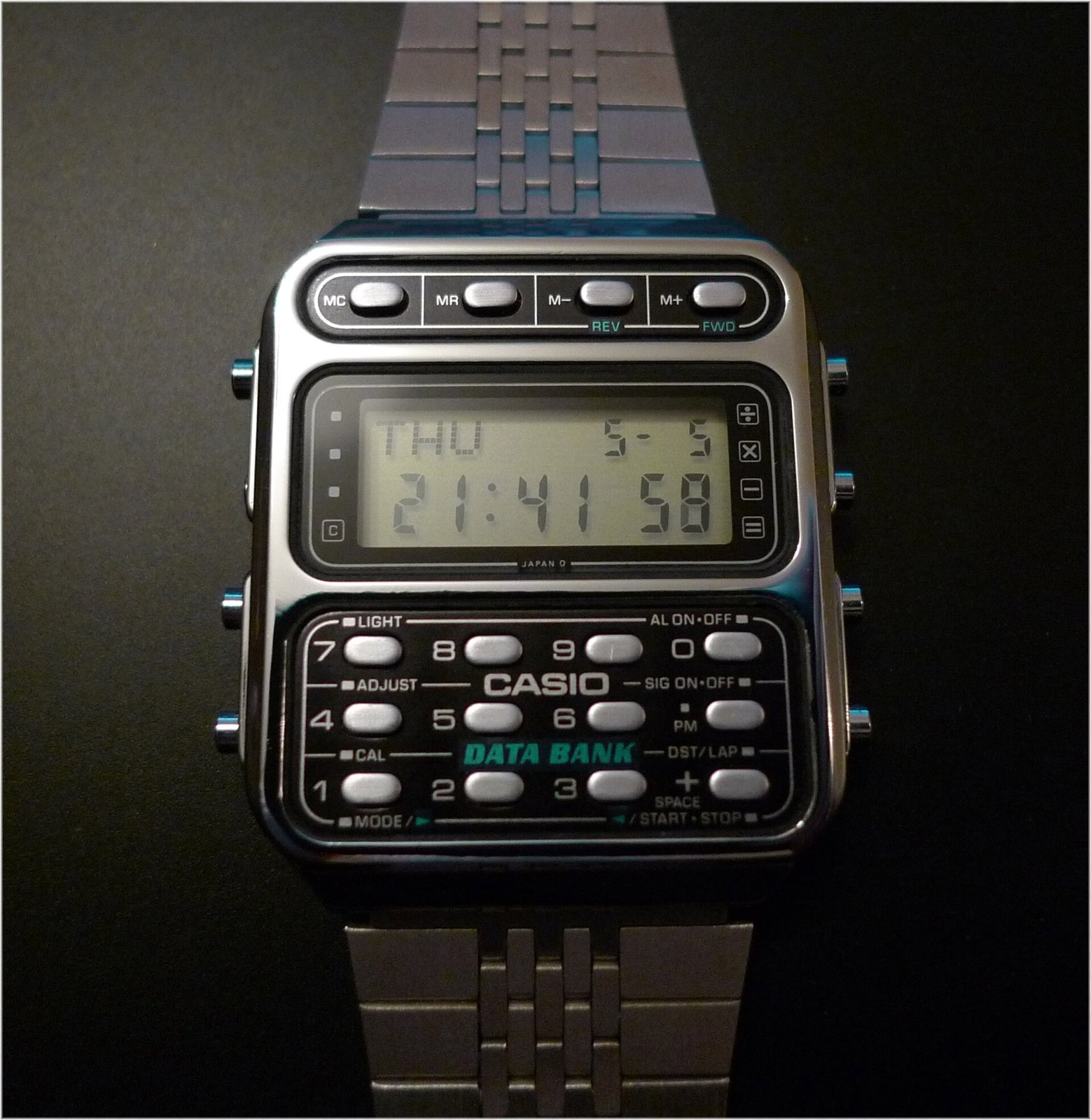
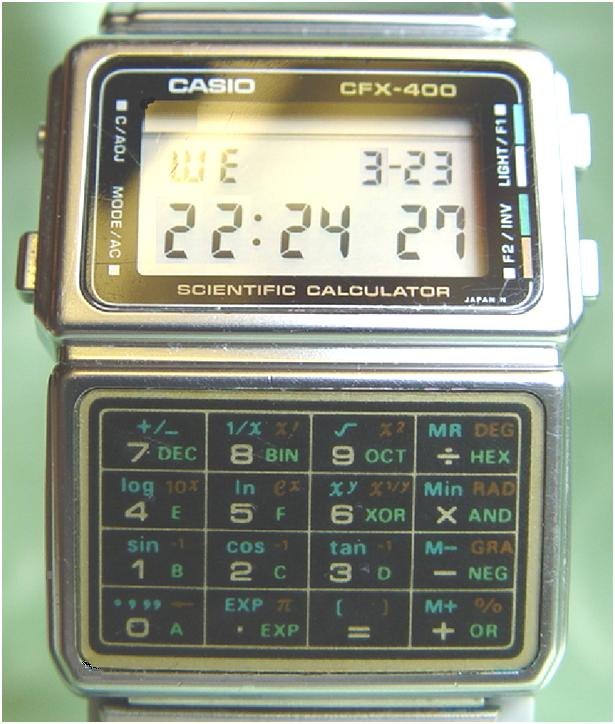
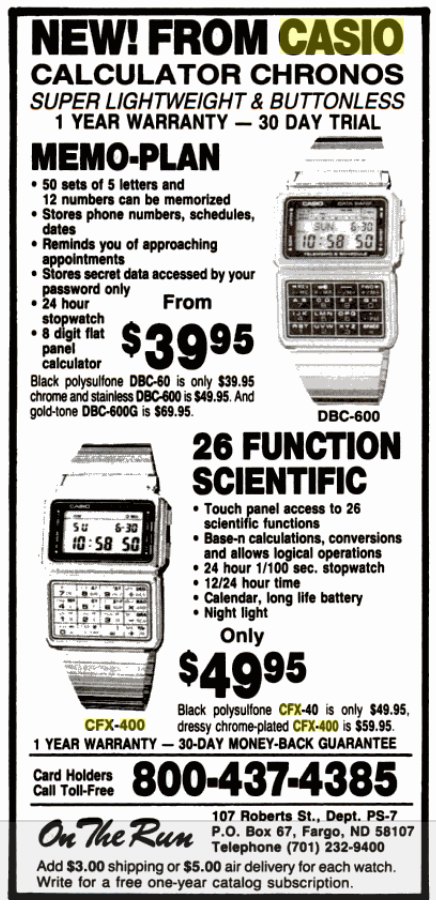
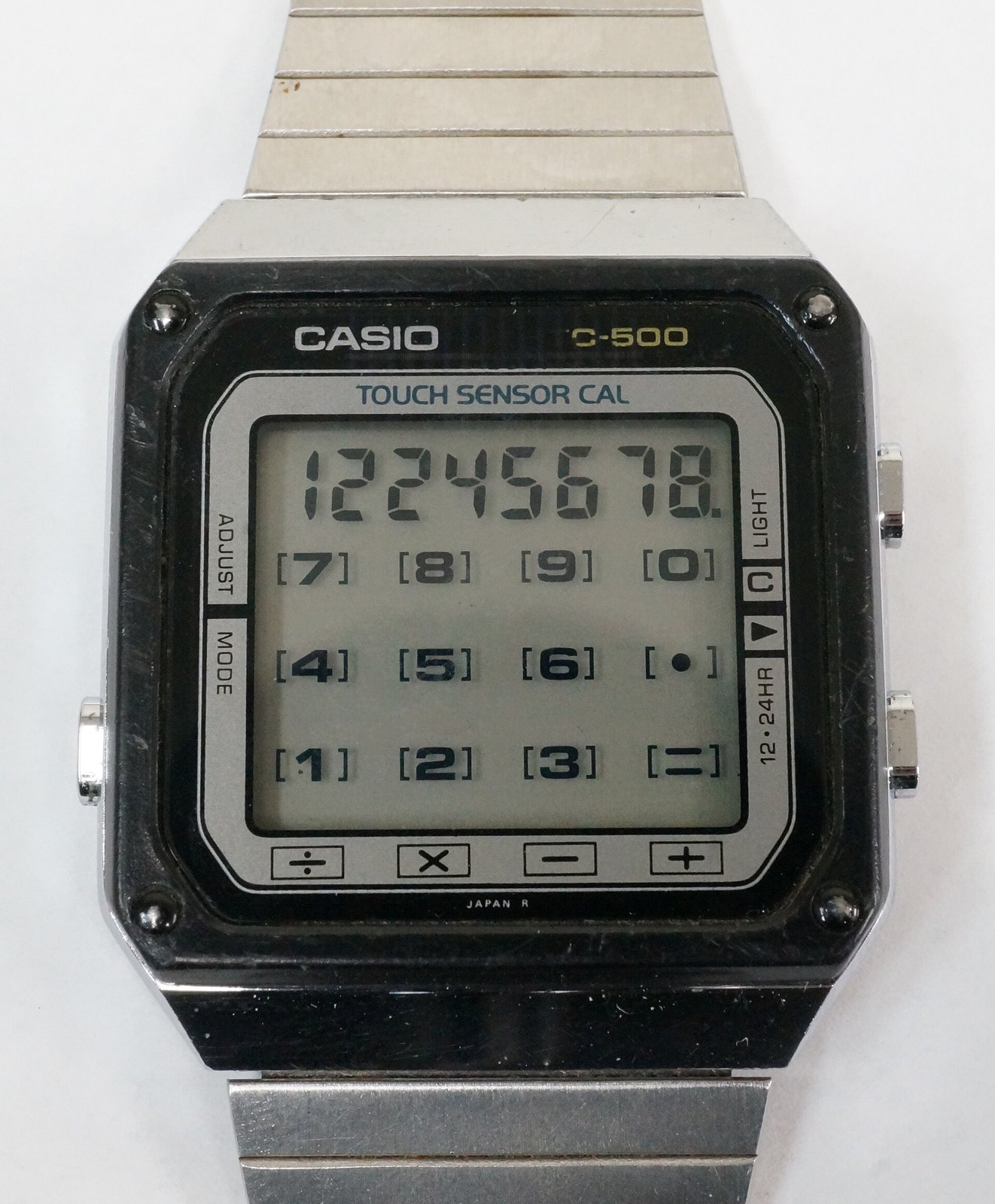
Casio pushed in every direction at once. The DB-1000 of August 1984 recognized characters written on the glass with a fingertip. The CFX-200 and CFX-400 were scientific calculator watches, with logarithms and trigonometry on the wrist. The TC500 of 1983 had touch-sensitive keys printed on the crystal. A mail-order advertisement in Popular Science in July 1986 offered the “Memo-Plan” Data Bank calculator watch, storing “50 sets of 5 letters and 12 numbers”, at $39.95 in black plastic as the DBC-60, $49.95 in chrome and steel as the DBC-600 and $69.95 gold-toned, and the “26 function scientific” at $49.95 as the CFX-40 or $59.95 as the chrome-plated CFX-400: a calculator watch now cost what a cheap pocket calculator did.
3.2 The DBC line
The Data Banks with a calculator, the DBC series, run from the 1980s to my DBC-32. A collector posting as lookatwrist on the WatchUSeek forum has pieced the line together from his own watches and their case backs; the dates are his, but the module numbers can be checked against the backs.
Table 1 — The DBC line
| Year | Models | Module | Records | What was new |
|---|---|---|---|---|
| 1985 | DBC-60, DBC-600 | 563 | 50 | a password-protected “secret” area |
| 1988 | DBX-100 | 261 | 100 | a full dot-matrix display |
| 1989 | DBC-61, DBC-610 | 676 | 50 | countdown timer, world time |
| 1991 | DBC-62 | 676 | separate rubber keys instead of a membrane | |
| 1994–95 | DBM-150, DBM-151 | 1079 | 150 | Memory Protect: records survive a battery change |
| 1995 | DBC-63 (Telememo 50) | 1276 | 50 | Illuminator electroluminescent backlight |
| 1995 | DBC-30 (Telememo 30) | 1253 | 30 | five alarms |
| 1996 | DBC-80, -81, -150, -310 | 1476–1486 | 80–300 | Telememo 80, 150 and 300 |
| 1999 | DBC-V50 | 1591 | voice memo | |
| 2001 | DBC-W150 | 2296 | Waveceptor radio-set time | |
| 2004–08 | DBC-32 family | 2888 | 25 | multi-lingual, LED auto light |
| 2011 | DBC-611 | 3228 | 25 | the 2888’s features in a 1980s-style case |
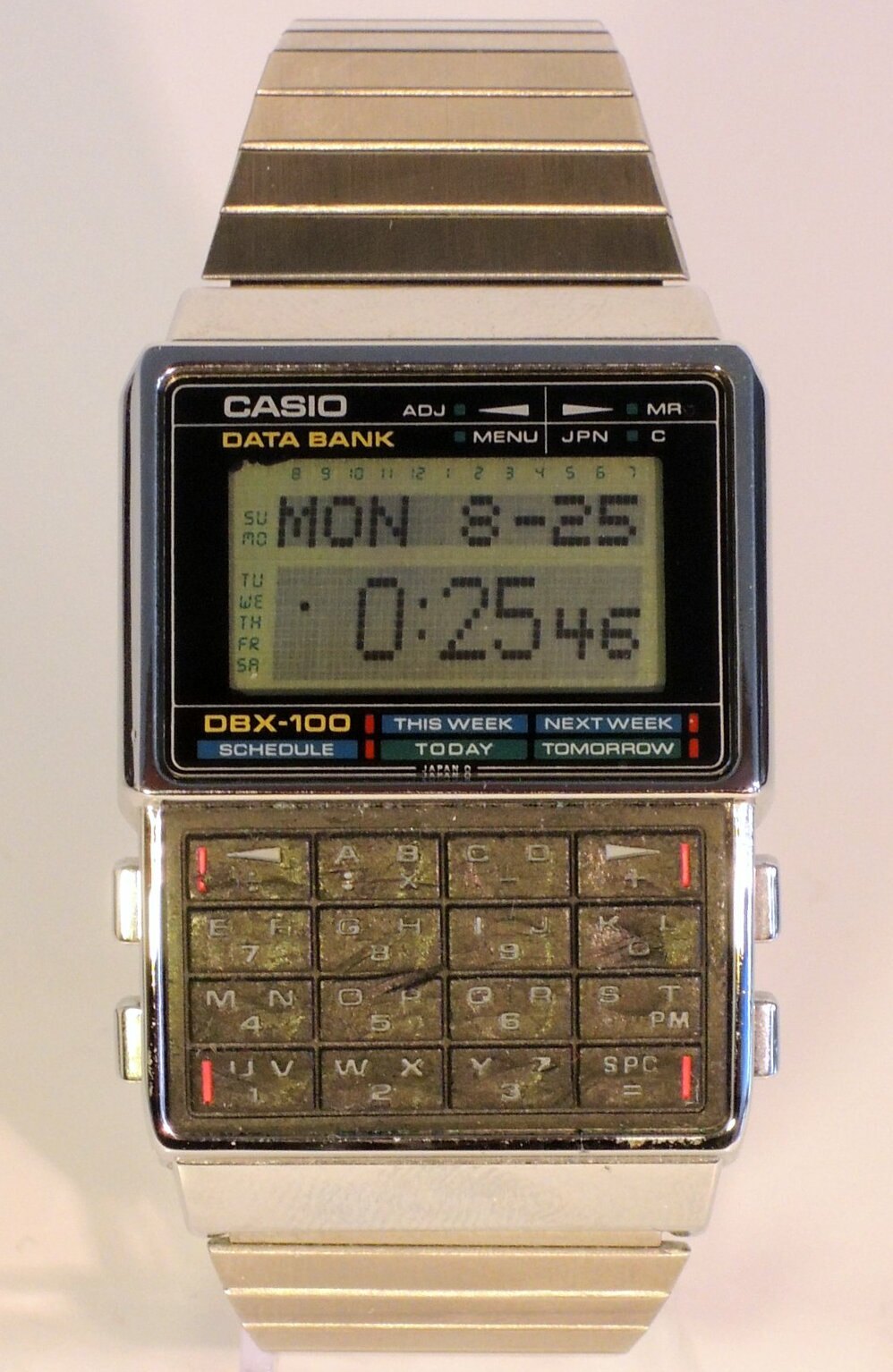
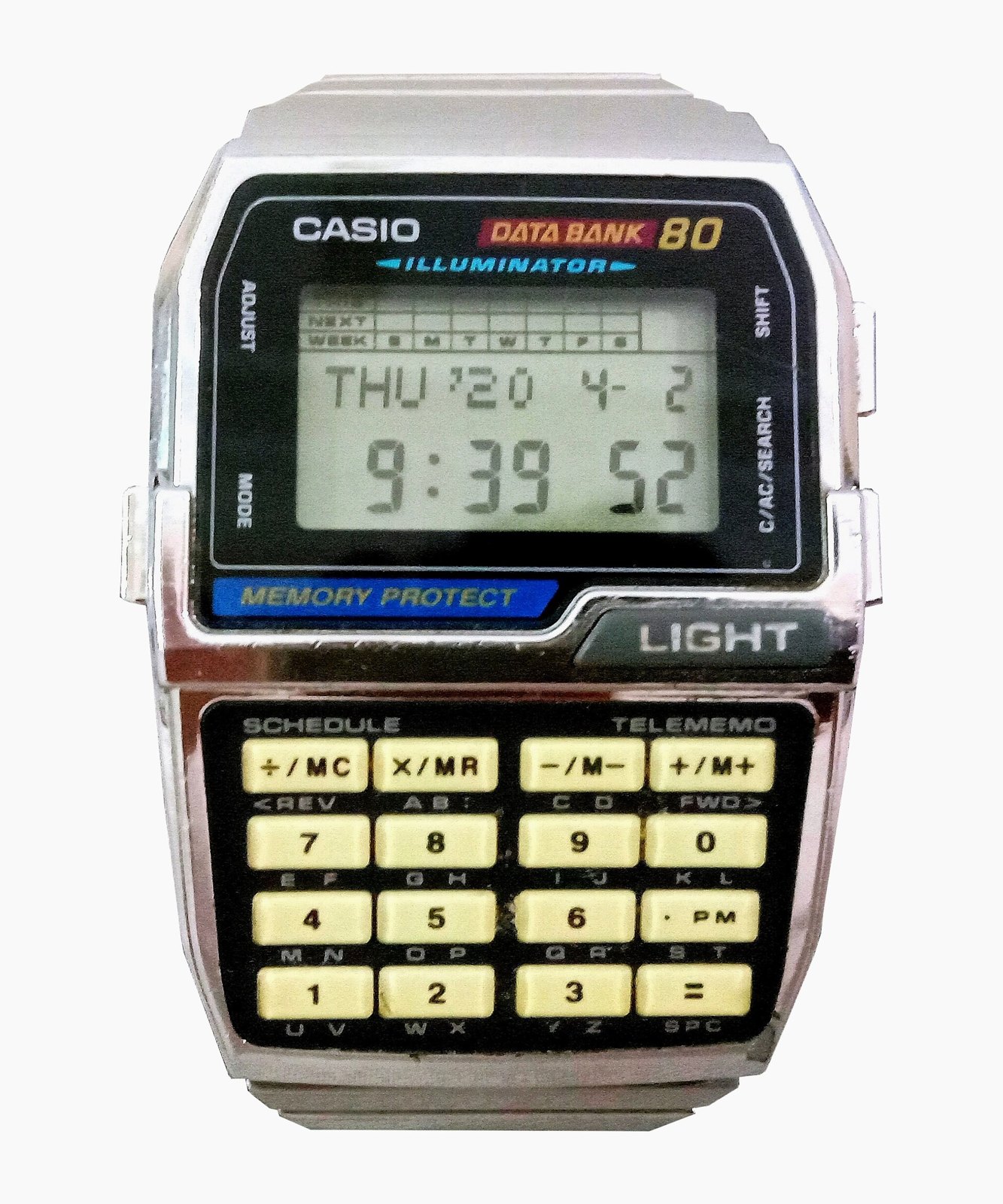
Two of those changes matter for anyone who owns one. Before Memory Protect, which arrived with the DBM-150, a Data Bank kept its records in memory that needed power; the earlier models carried two cells, so that changing one at a time kept the records alive. The DBM and the “Memory Protect” models that followed stored them in EEPROM, which keeps its contents without power. And the Illuminator of 1995 lit the display with an electroluminescent panel, before LEDs took over in later modules, mine among them.
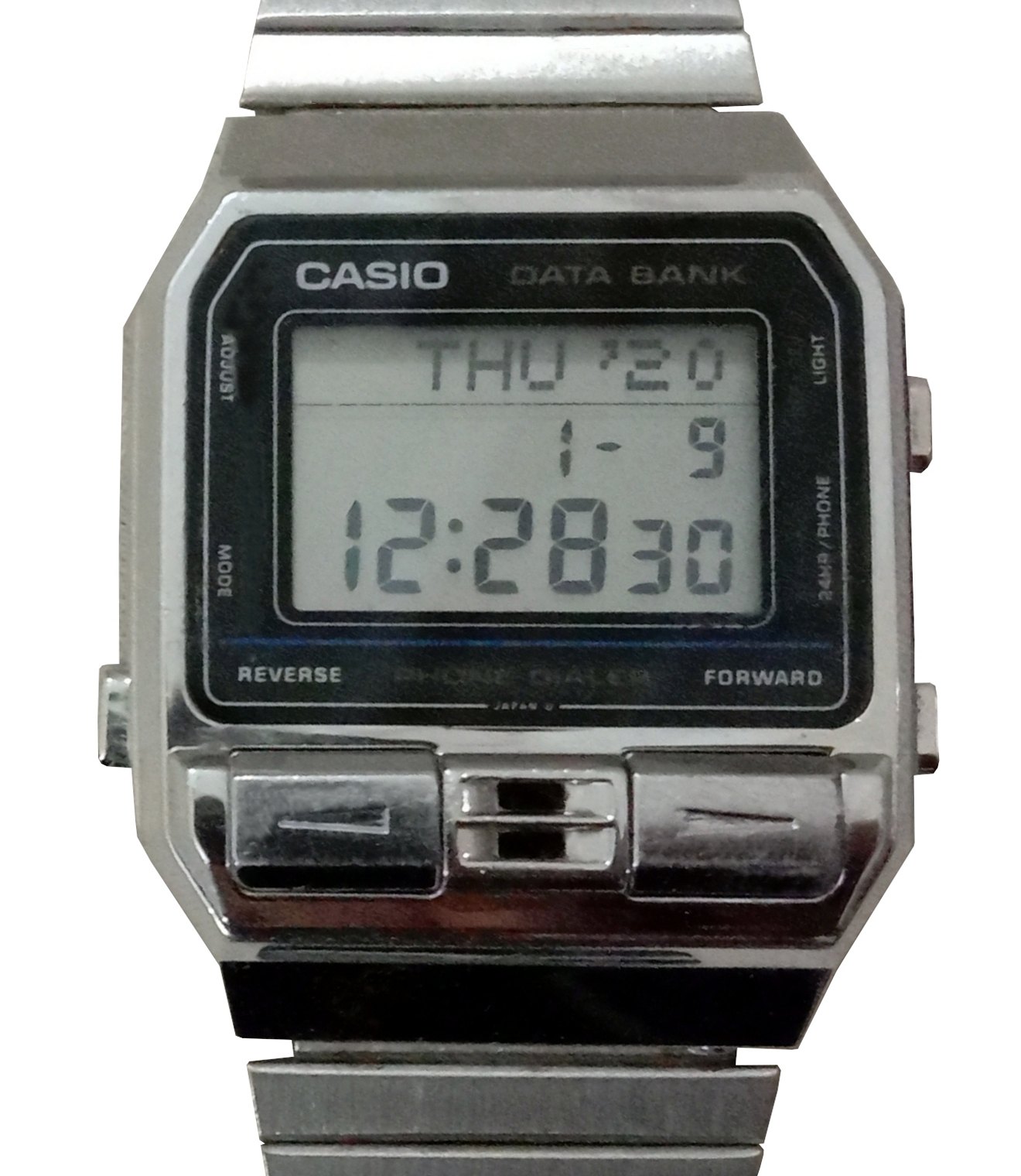
Casio also made Data Banks that dialled. The DBA watches played the touch tones of a stored number into a telephone handset; Wikipedia calls the DBA-800 “the world’s first phone dialler watch”.
3.3 Back to the Future
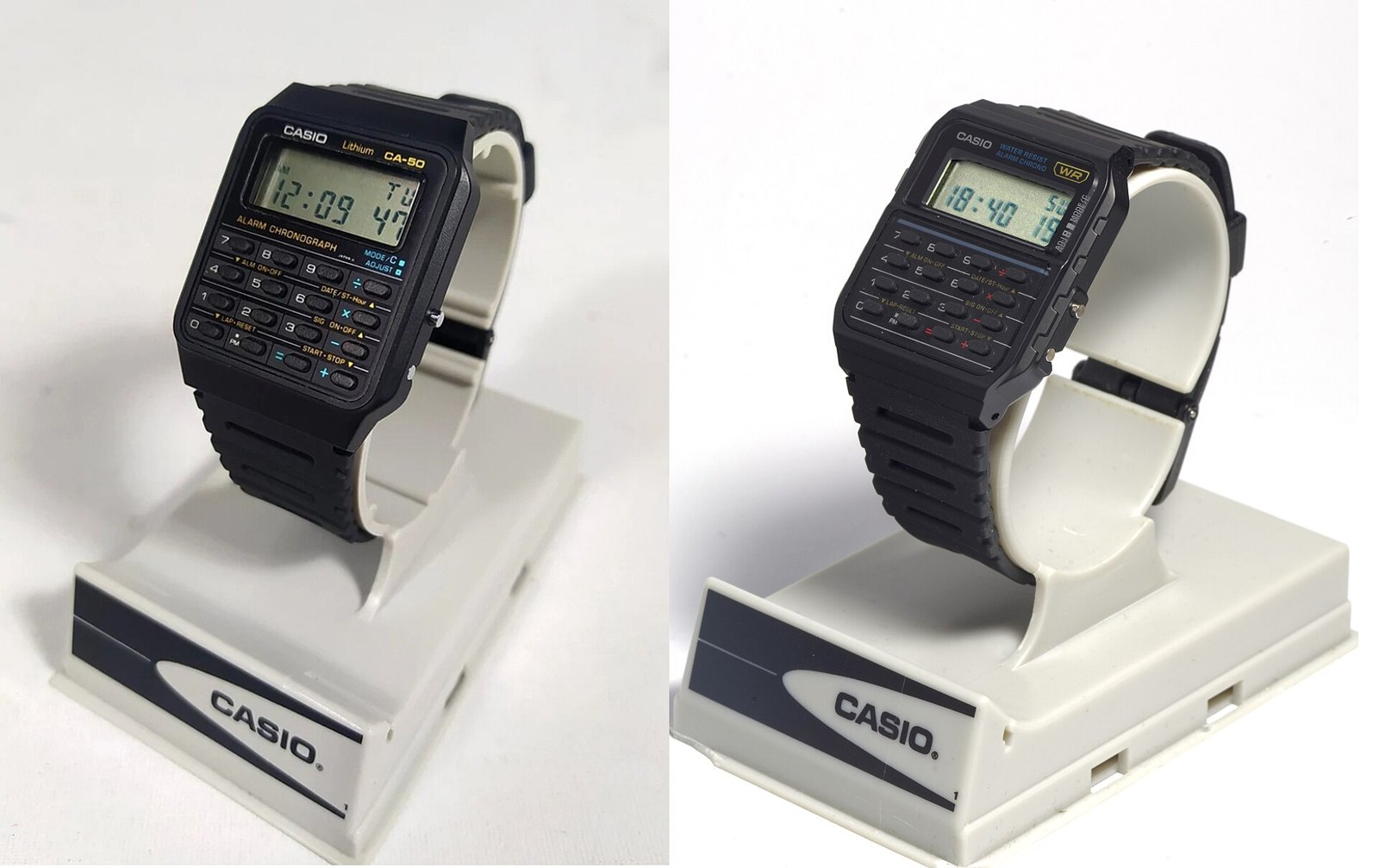
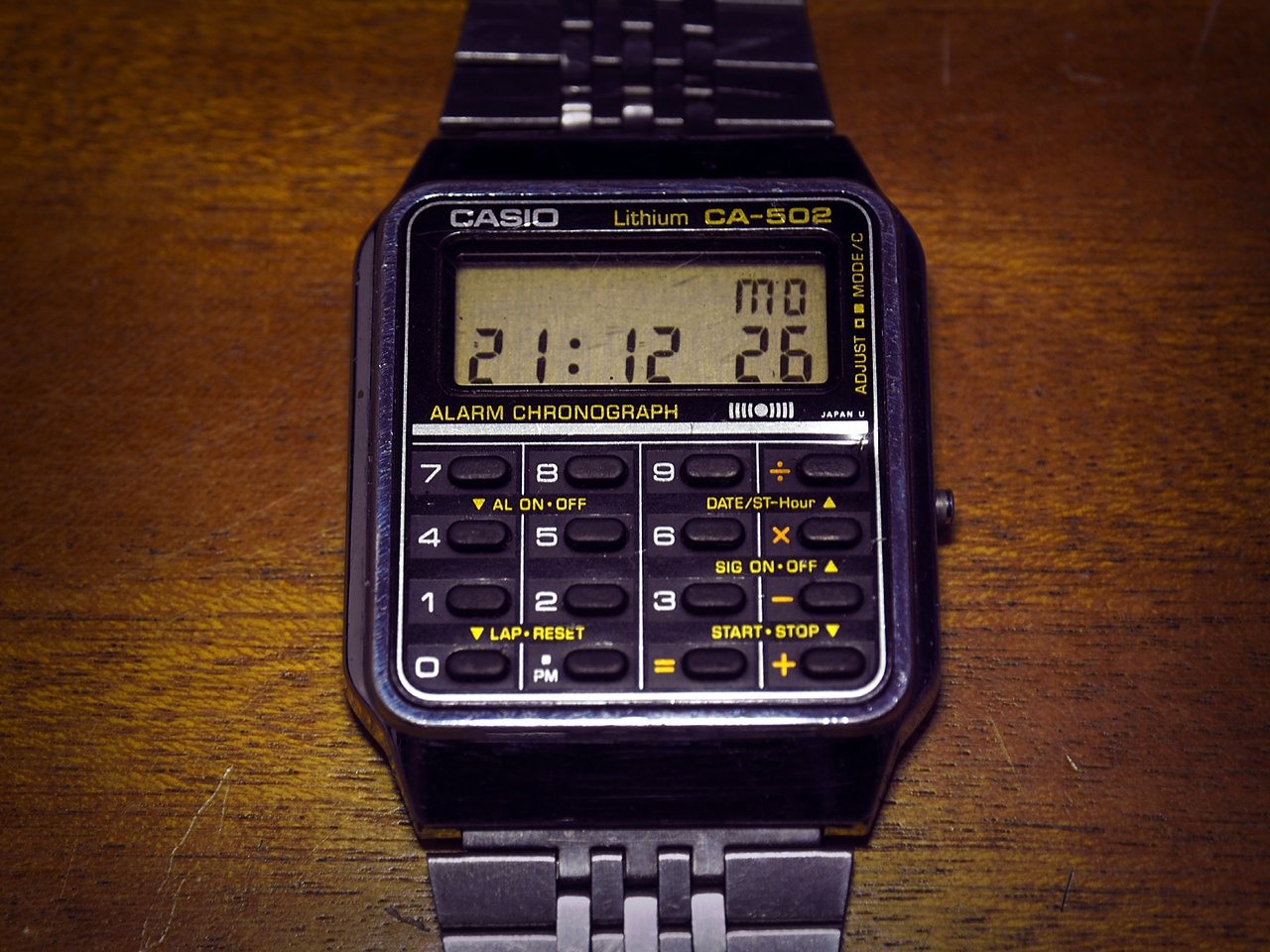
In 1988 Casio introduced the CA-53W, a small, light calculator watch that is still on sale. It is the most famous calculator watch of all, because of a film. In Back to the Future (1985) Marty McFly, played by Michael J. Fox, wears a Casio calculator watch; since the CA-53W did not yet exist, it was its predecessor, the CA-50. In Part II (1989) and Part III (1990) he wears the CA-53W. Many accounts give the CA-53W for the first film too, which its 1988 introduction rules out. The CA-53W turned up again on Walter White’s wrist in Breaking Bad, and for the first film’s fortieth anniversary, on 27 October 2025, Casio issued a tribute model, the CA-500WEBF-1A, at $120.
3.4 Wrist computers
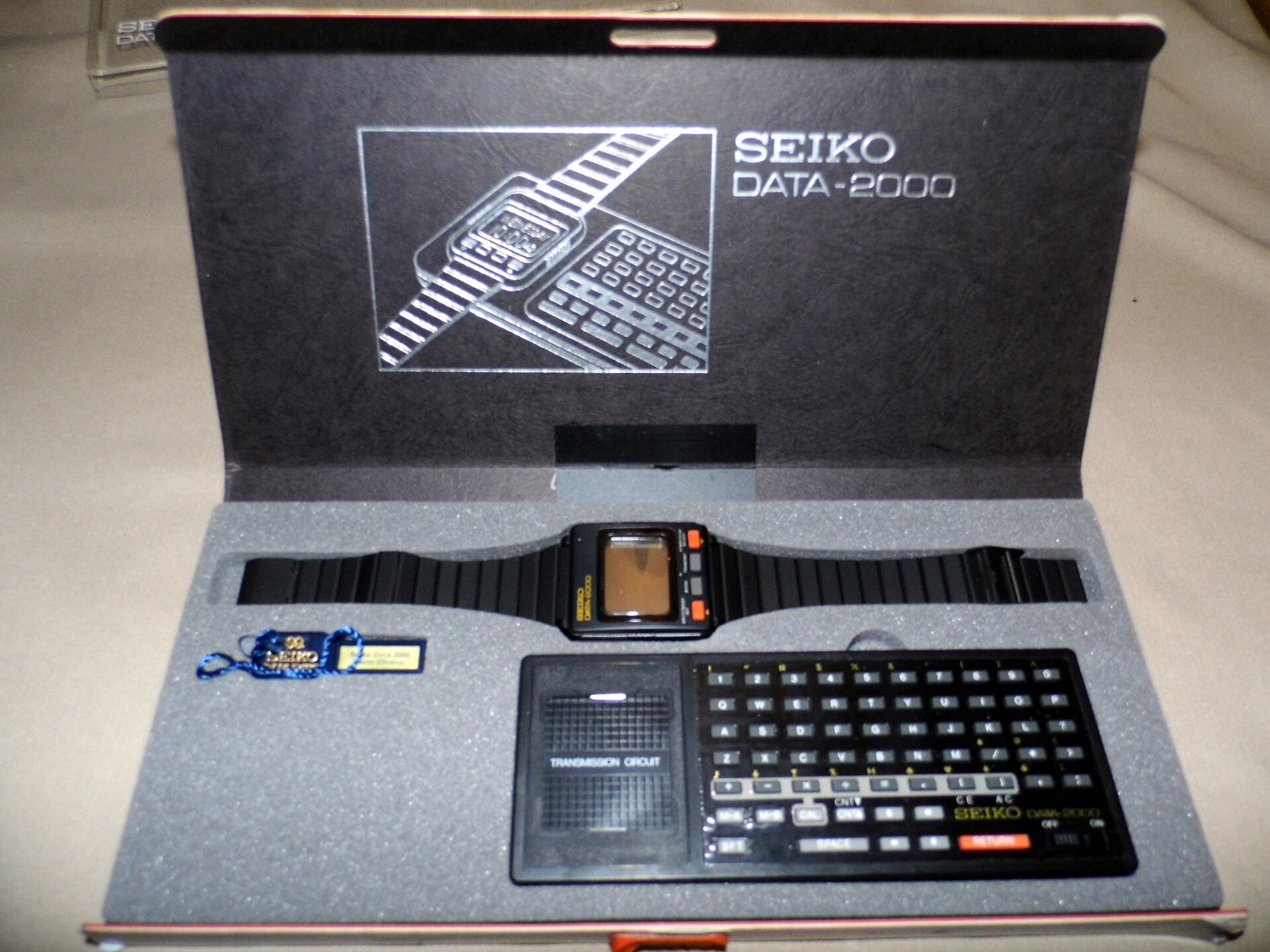
Seiko took the opposite course from Casio and tried to make the watch a computer. The Data 2000 of 1983 came with a pocket keyboard that transferred notes to the watch by magnetic coupling; it sold for $295. The UC-2000 “Wrist Information System” of 1984, which Seiko calls “the world’s first wristwatch with computer functions”, docked onto a keyboard unit, the UC-2100, and onto a terminal with a printer and Microsoft BASIC, the UC-2200; the watch held 2,000 characters. The RC-1000 “Wrist Terminal” of the same year had no keyboard at all and loaded its data from a personal computer through a serial cable; a British review priced it at £119.
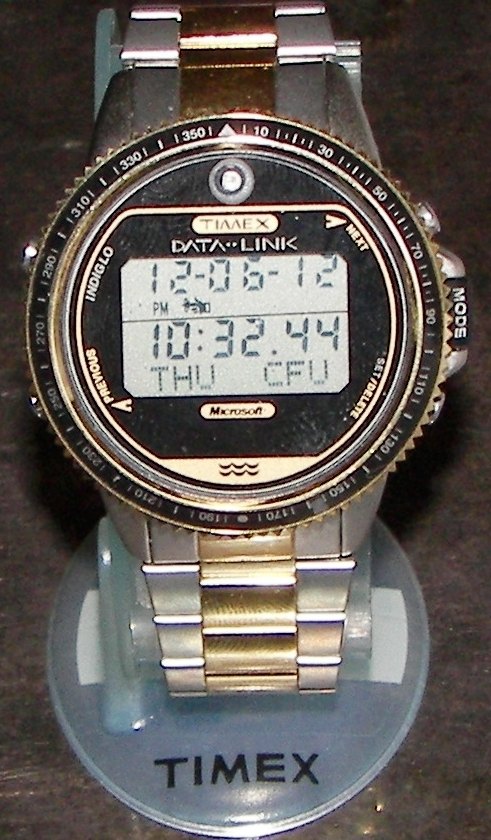
A decade later, Timex and Microsoft made the idea simple. Bill Gates demonstrated the Timex Data Link on 21 June 1994: the watch read appointments and telephone numbers from flashing bars on a computer’s screen, through an optical sensor in its face, without a cable at all. It cost about $130 in 1996, and NASA qualified it for space flight. Casio’s data watches of the time, by one 1995 review, sold for a third to a half of its price.

3.5 Decline and revival
The calculator watch’s fortunes followed the gadgets that replaced it. Wikipedia dates its fading to the mid-1990s, as cheap mobile telephones and personal digital assistants spread; lookatwrist puts the peak of the Data Bank in 1996, the year of the Telememo 300. Once every telephone number lived in a telephone, twenty-five on a wrist had little point, and the Data Banks shrank back from hundreds of records to the 25 of my DBC-32.
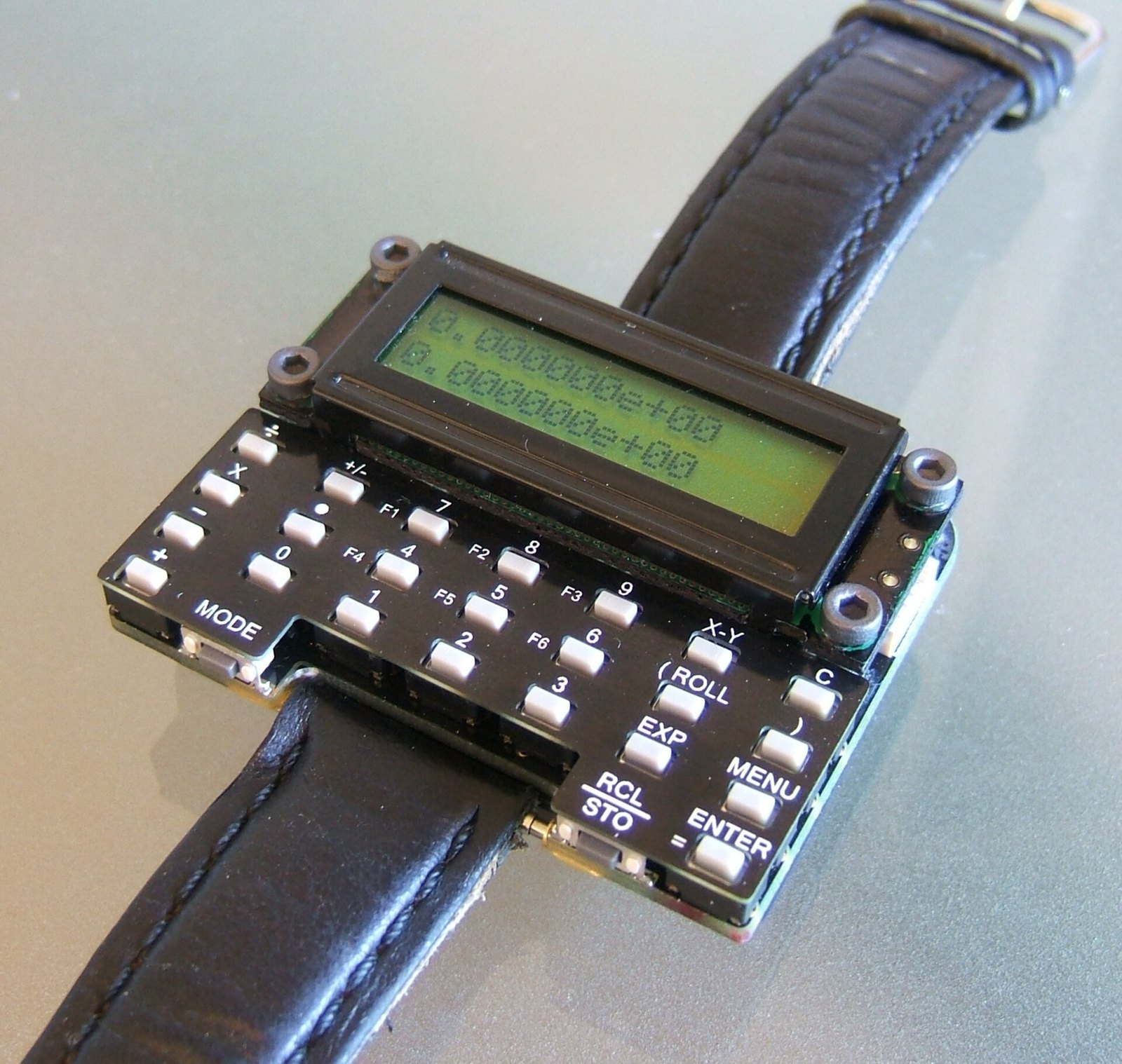
What kept the line alive was affection. In 2018 Casio founded its VINTAGE sub-brand around its 1970s-to-1990s designs; the CA-53W, the A168 and the Data Banks sell new as retro classics, and the smartwatch, which does everything a Data Bank did and much more, has made the calculator watch a deliberate choice rather than a necessity. Enthusiasts have even built their own: the μWatch is an open-source scientific calculator watch designed for the electronics hobbyist to build.
Sources
- Casio corporate history, chapter 2 (CD-40, sales); Casio company history, 1980s and 1990s; Casio heritage pages, 1980s; Casio Germany on the VINTAGE brand.
- lookatwrist, “History of Casio DBC, DBX, and DBM Data Bank Calculator Watches”, WatchUSeek, 11 August 2020.
- Popular Science, July 1986, p. 78 (advertisement, via Wikimedia Commons).
- Wikipedia, “Casio Databank”, “Casio CA-53W”, “Calculator watch” and “Timex Datalink”; G-Central on the CA-53W and the CA-500WEBF; Pocket Calculator Show, “Nerd Watch Museum” (2002).
- Seiko, “100 Stories: Innovation”; raredigitalwatches.com on the Seiko Data 2000, UC-2000 and RC-1000; Gizmodo, “The gadget we miss: the calculator watch” (2013).
- Casio, Operation Guide 3228 (MO1106-EA, 2011), for the DBC-611.
Comments (0)