CRT Calculators · Volume 2
The Machines, Model by Model
Every CRT calculator known to collectors is here, roughly in order of introduction. For each the essentials are given: who made it, when, what it cost, what was inside, how many survive, and how to tell its versions apart. Where the sources disagree, both readings are given. Most of the detail comes from the Old Calculator Web Museum of Rick Bensene, which owns or has documented almost every one of these machines.
2.1 Friden EC-130 (1964)
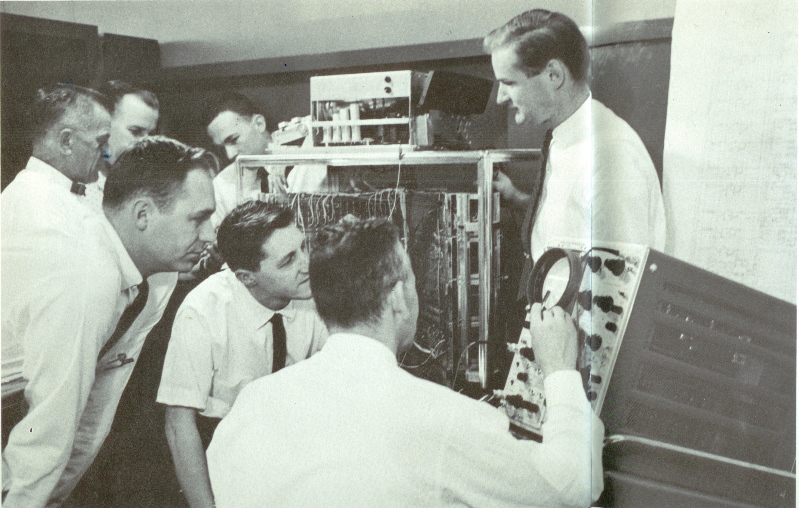
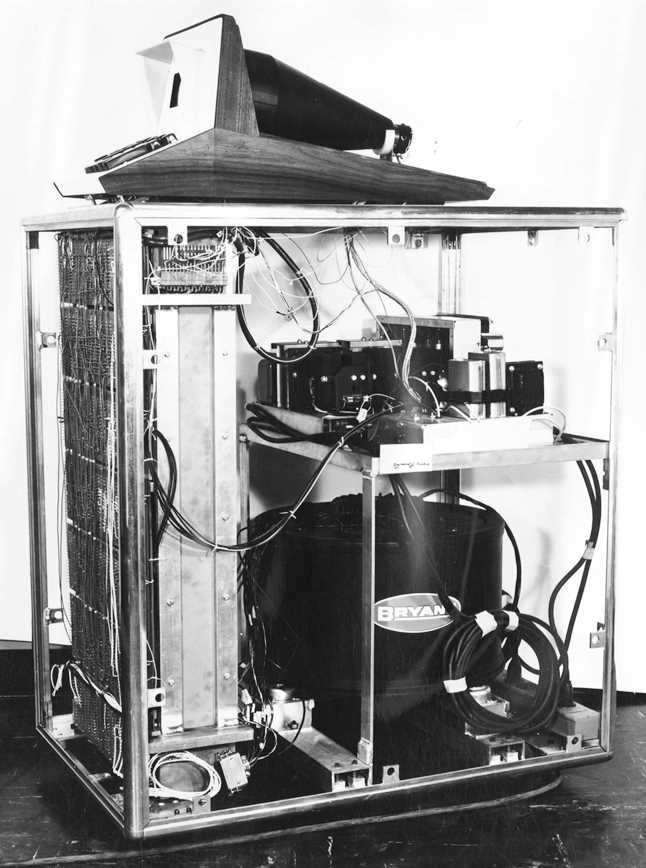
Friden, Inc. of San Leandro, California, was one of the big three American makers of mechanical calculators, with Marchant and Monroe. In July 1961 it started project 516 under its research vice-president Larry Robison, a former Burroughs man, with Robert “Bob” Ragen leading the calculator design. The first prototypes of 1961–62 stored their numbers on a Bryant magnetic drum turning at 3,600 rpm, which proved too big, noisy and sensitive to movement. A delay-line prototype, EDTC-3, ran in June 1962, and the display was developed under contract at the Stanford Research Institute by a team under Jack Bialik.
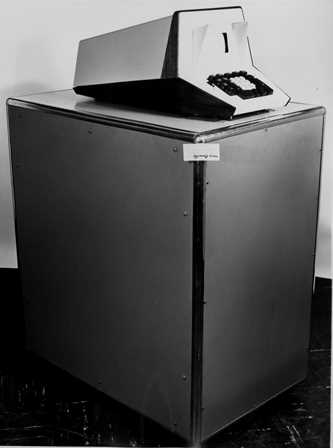
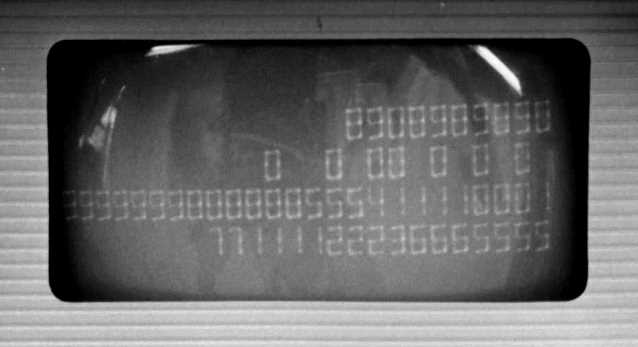
Friden showed the machine privately in June 1963 and introduced it publicly in 1964. The sources give May and August 1964 for the launch, which took place at the Waldorf-Astoria in New York; Wikipedia’s “June 1963” is probably the private showing. The price was $2,150, about three times a good electromechanical calculator, cut to $1,695 in July 1965. By August 1970 Friden had built 18,168 EC-130s. Friden had been bought by the Singer sewing-machine company, in 1963 or 1965 according to different accounts, and later machines carry the Singer name.

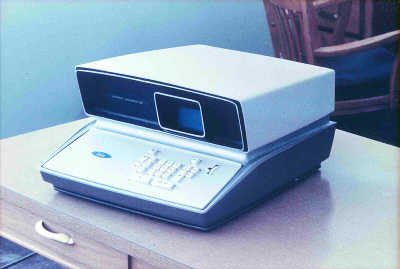
What is inside. Discrete germanium transistors (mostly 2N1305) and silicon diodes in diode-resistor logic, on seven boards of about 12 × 5 inches; a magnetostrictive delay line of Ni-Span C wire; and a Westinghouse 5DEP1 five-inch round CRT. The machine weighs about 42 pounds (Friden’s brochure said 50) and draws 70 W. It is 18 inches wide, 21½ deep and 18 high.
What it does. Add, subtract, multiply and divide on 13-digit numbers with a fixed decimal point set by a thumbwheel, using a four-register stack that is shown on the screen. There is one storage register. Division of 13 nines by 1 takes about two seconds.
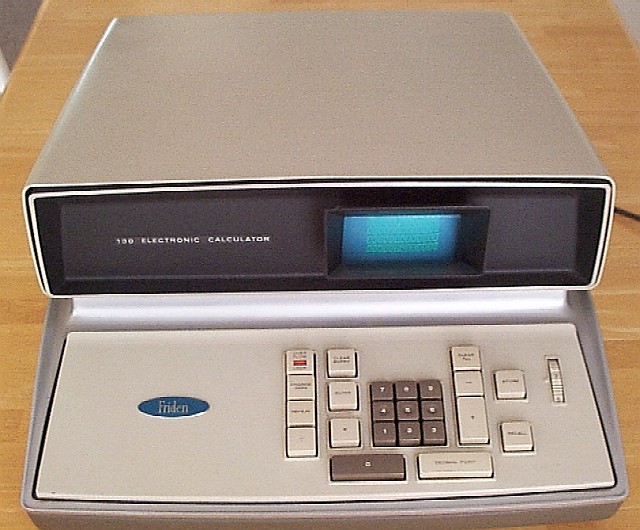
Versions. The important change came at serial number 8501: earlier machines have four single-digit counters (A, B, C and D) and are called “four-counter” machines; from 8501 the B counter was removed (Friden Service Letter 18 of April 1965). Four-counter machines run on a 666 kHz clock and draw the bottom register brighter than the rest; three-counter machines run at 333 kHz and do not. The decimal thumbwheel’s settings changed from 0/2/5/9/13 to 0/2/5/7/13 places in November 1964. An entry-counter option cost $75.
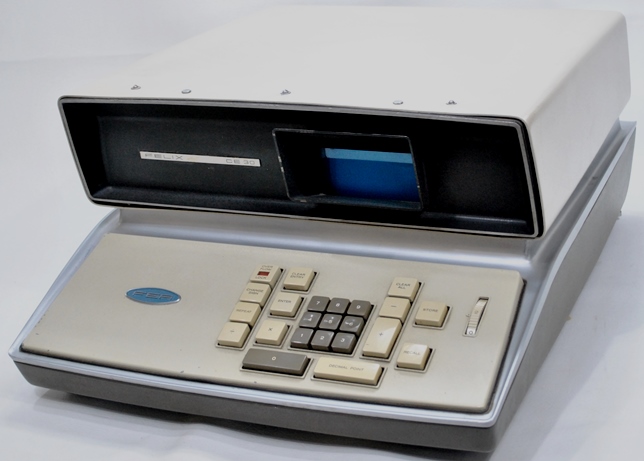
The licensed copy. In Romania, ICE Felix of Bucharest built the Felix CE 30 under licence from Friden Holland, with a Friden-supplied keyboard and delay line, from about 1970 to 1972–73. It carries an “FEA” badge in place of Friden’s. Fewer than ten are thought to survive.
2.2 Friden EC-132 (1965)
Shown to Friden’s sales force on 7 April 1965 at about $1,950–2,000, the 132 added a one-key square root, using the method of Friden’s mechanical SRQ calculator (Ragen’s US patent 3,526,760). The top register copies down when the stack drops, which gives a repeating constant, a power lamp was added, and the decimal thumbwheel has every setting from 0 to 13. Inside are eight boards in pairs with 324 transistors, mostly Texas Instruments 2N1304 and 2N1305, and the same 5DEP1 tube and delay line. About 15,824 were made. A 132 changes to the three-counter design at serial 3902 (or 3092; the Old Calculator Web Museum’s pages give both).
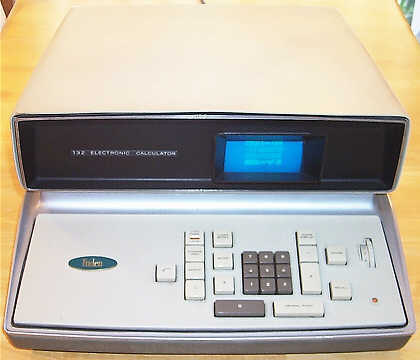
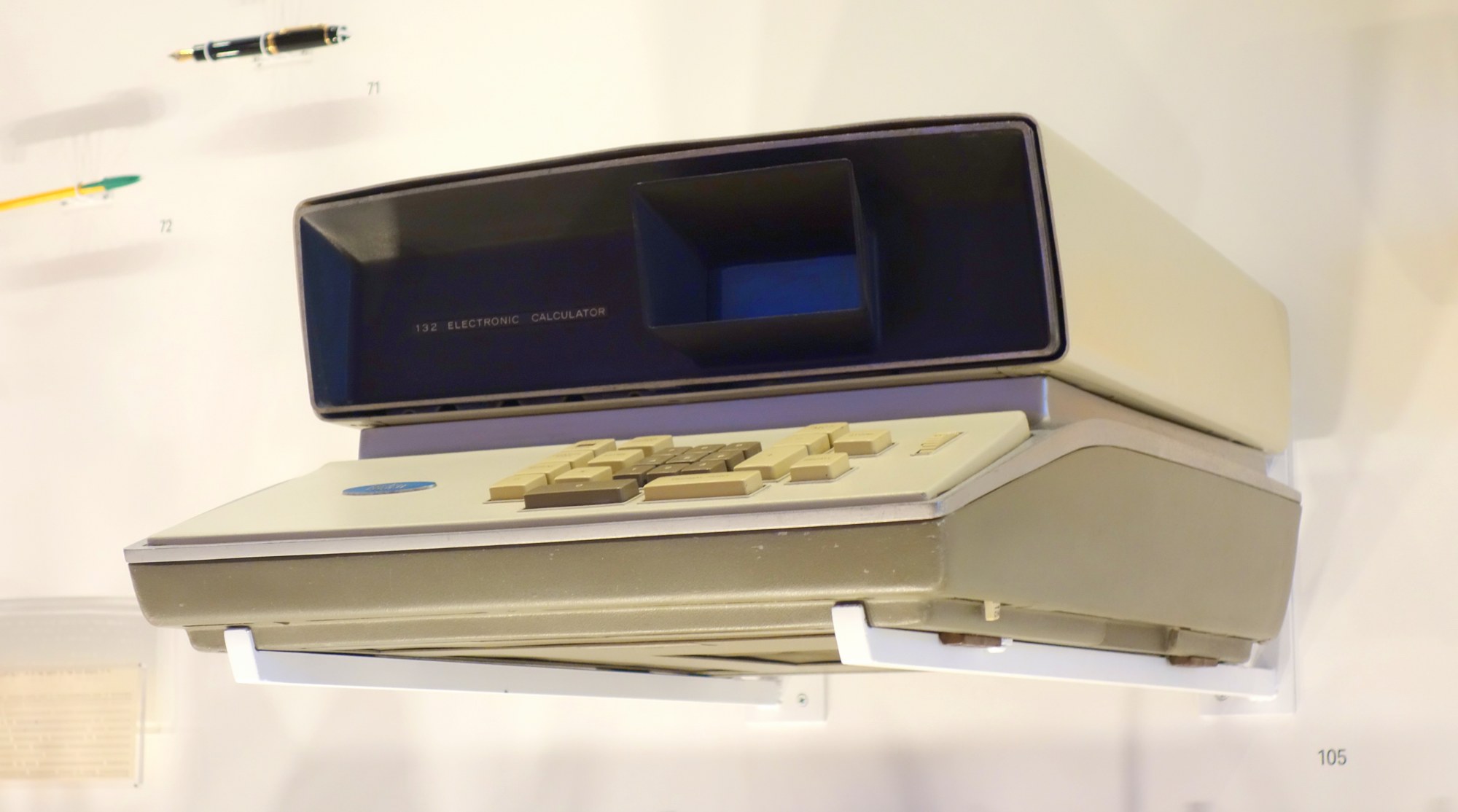
From January 1967 Friden tested finished 132s with automatic test robots nicknamed “Granny Goose”, which pressed the keys and checked the results.
2.3 Singer/Friden 1160, 1162 and 1166 (1969–1972)
Friden began redesigning the 130 with integrated circuits in March 1966, and the result appeared in May 1969 as a family of smaller, lighter machines. They kept the delay line, now about 40 feet of beryllium-copper wire with a 4 ms delay, because storing the stack in early bipolar integrated circuits would have cost too much. They use a smaller Westinghouse 3WP1 three-inch tube that shows only the bottom two of the four stack registers.
- 1160 (May 1969): the IC version of the 130, with 83 integrated circuits, among them three custom Texas Instruments counter chips (SN1286, SN1287, SN1288) standing for the A, C and D counters.
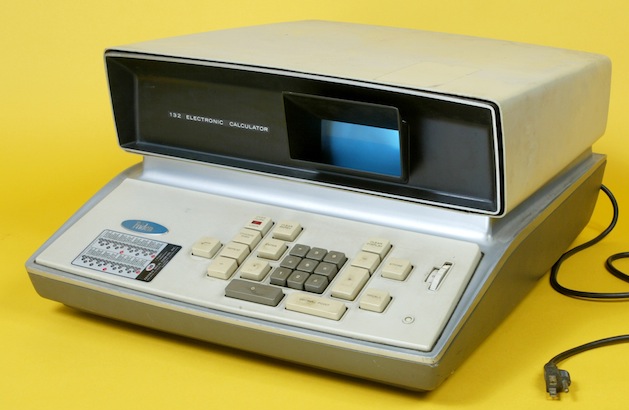
- 1162 (May 1969, $1,195): the IC version of the 132, with square root, 93 ICs on six boards, and a 700 kHz master clock. It does not suppress leading zeros, so the rows of zeros often leave burn marks on the tube.
- 1166 (about 1970, $895): built only at Friden’s Albuquerque plant, with leading-zero suppression, a floating decimal point and 105 ICs. It was the last CRT calculator Friden made and, at an estimated 35,000–45,000, the commonest CRT calculator of all. The Romanian Felix CE 33 copies it.
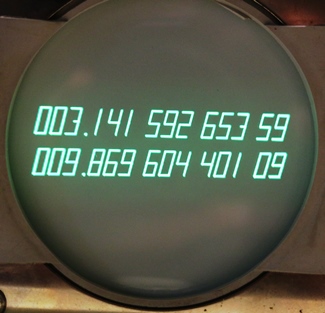
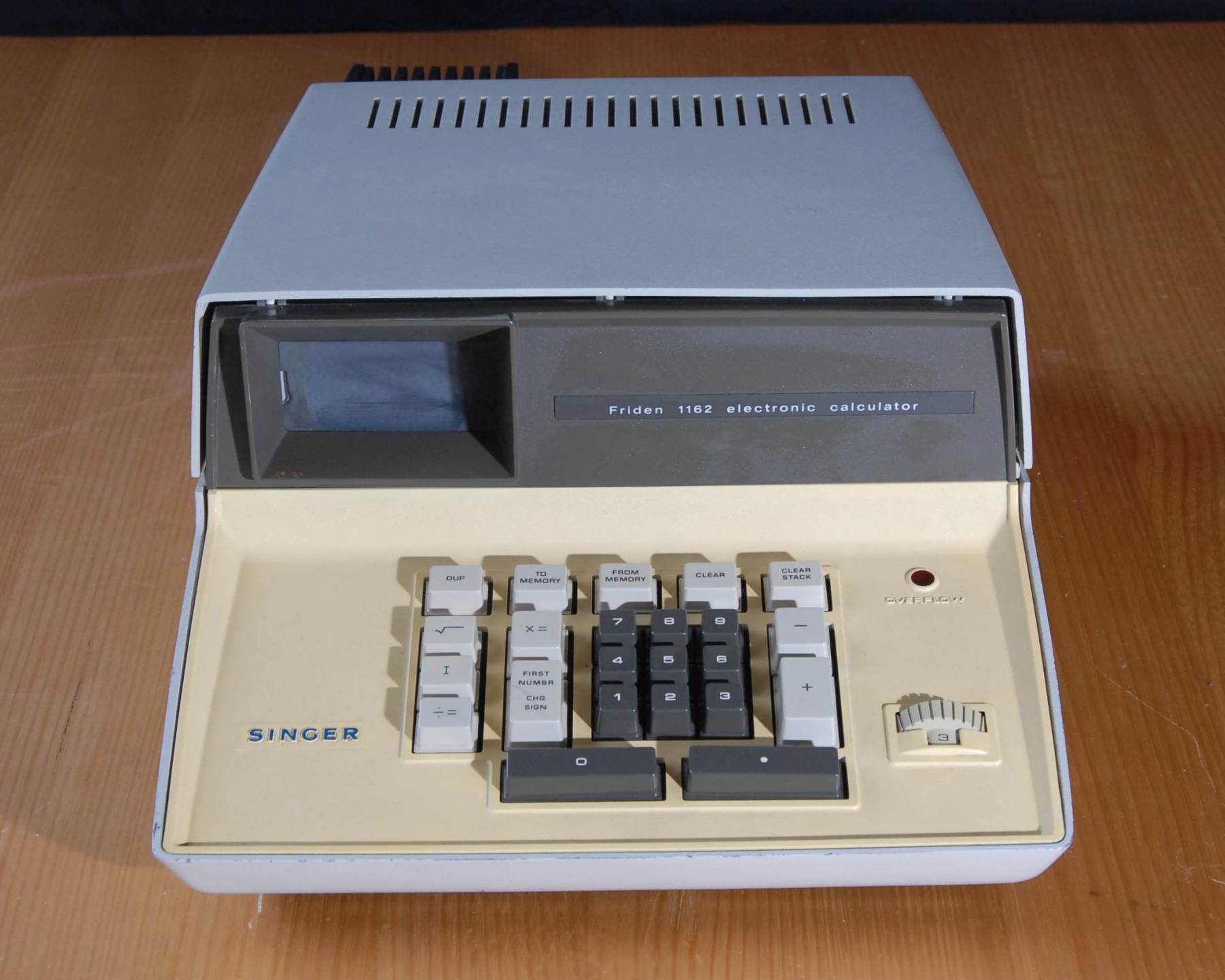
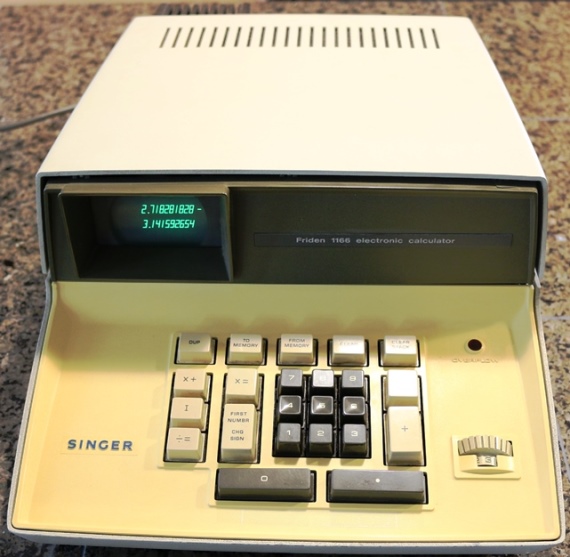
The 116x machines weigh about 24 pounds and measure 12¾ × 12½ × 6¾ inches. Production ended in late 1971 or early 1972, after which Friden sold machines made by Hitachi.
2.4 Wyle Laboratories WS-01 and WS-02 Scientific (1964)
Wyle Laboratories of El Segundo, California, was an aerospace testing company. In 1961 it bought Ransom Research, which had a calculator project half built, and its founder Frank Wyle put nearly a million dollars into finishing it. The WS-01 “Scientific” was announced in April 1964 at $3,950, or $4,350 with its punched-card reader. It was built of discrete germanium transistors (mostly 2N404) and stored its numbers on a home-built rotating magnetic disk, which proved temperamental. The WS-02 of late 1964 replaced the disk with a magnetostrictive delay line made by Digital Devices Inc. of Syosset, New York; Wyle upgraded WS-01s free.
The display is unlike any other: an eight-inch tube with orange-yellow phosphor showing six lines of 24 digits (the entry register, accumulator, multiplier-quotient register and three memories), with the digits drawn as curves from sine and cosine waves, which gives them a handwritten look (US patent 3,305,843 by Thomas Scuitto). It squares and takes square roots, and the PC-01 card reader runs programs of 12 steps per card; the card is punched with a pen point. The machine weighs about 50 pounds.
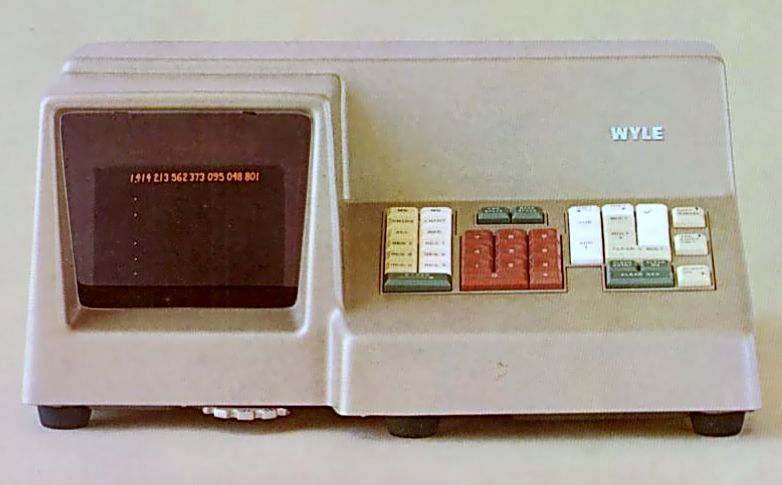
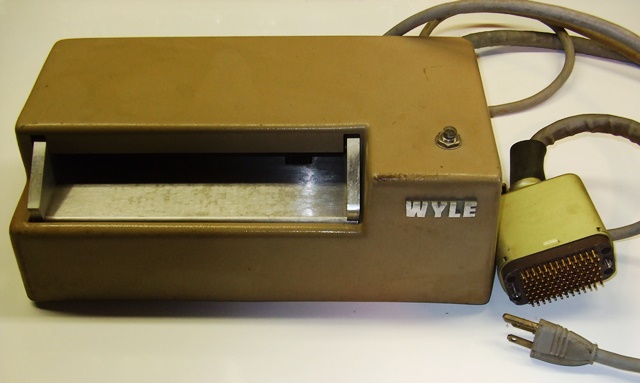
Wyle sold the Scientific until about 1967–68 and designed calculators for the Japanese Busicom company before leaving the business in mid-1968; its calculator staff went on to found Computer Design Corporation, later Compucorp. No production figures are known, and the museum has none on display.
2.5 SCM Cogito 240 and 240SR (1965)
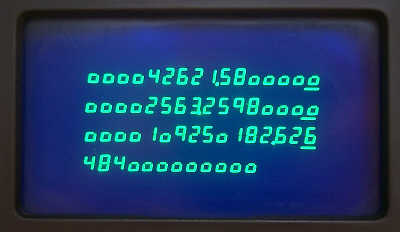
The Cogito came from Stanley P. Frankel (1919–1981), a Manhattan Project physicist and designer of the LGP-30 computer, through his firm Computron, which Smith-Corona Marchant bought in 1962. The 240 and 240SR (with semi-automatic square root) appeared in June 1965 at about $2,195 and $2,395. They are built of discrete transistors around a 480-bit Digital Devices delay line, with a CRT showing four rows for three registers (12, 12 and 24 digits) in blue-green figure-8 digits. The 240SR’s square root works by Newton’s method from a guess the operator supplies, and can take 25 seconds. The machine weighs 39 pounds and opens like a clamshell; its boards are joined by “harmonica” connectors with no backplane, so a board low in the stack can only be reached by removing all the boards above it. One seller’s claim of “about 40 known” is unverified.
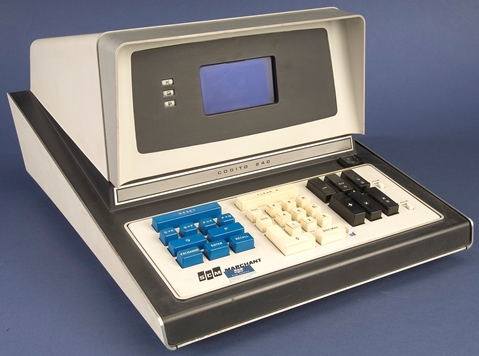
Tom Osborne, who would design the HP 9100, worked at SCM in 1962–63 and left believing the project was doomed.
2.6 Victor 3900 (1965–1968)
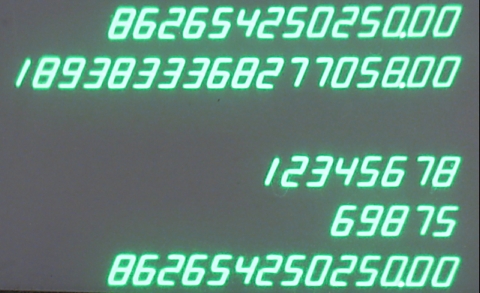
Victor Comptometer of Chicago contracted General Micro-electronics, a company founded in 1963 by former Fairchild engineers, to build a calculator entirely of MOS integrated circuits, at $50,000 a month from October 1964. The Victor 3900, announced in October 1965 at $1,825, was the first calculator made wholly of integrated circuits: 29 p-channel MOS chips of 23 types on the main board, with about 250–300 transistors each, holding seven 22-digit registers in dynamic shift registers. Among the designers was Jay Miner, later the father of the Atari 2600’s graphics and the Amiga. The CRT, about four inches across, shows five lines of 20 digits. The story that its tube came from a Sony portable television is half true: an engineer did take a Sony micro-TV apart to try its tube, but its magnetic deflection did not suit, and an electrostatic tube was bought instead.
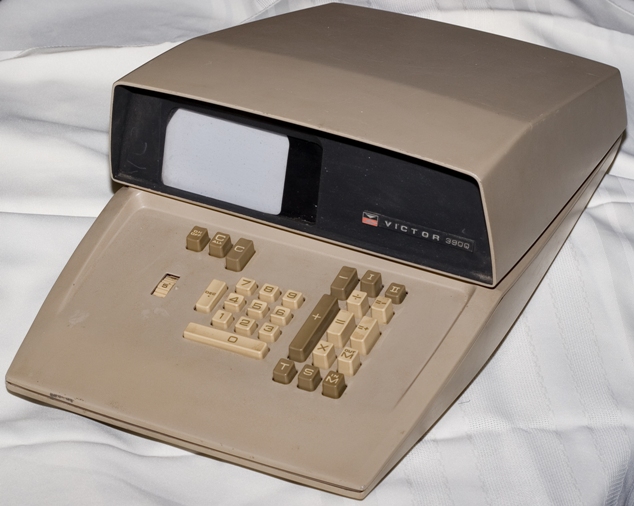
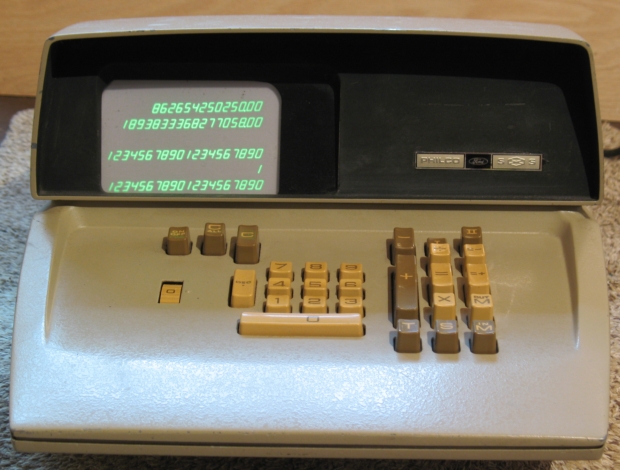
Deliveries began in 1967; the machine was unreliable, and Victor abandoned it in June 1968. Philco-Ford, which had bought General Micro-electronics, sold the returned stock as the Philco or Philco-Ford 3900. A little over a thousand were made, and at least two working survivors are known.
2.7 Busicom 202, 207 and 2017 (1967–1969)
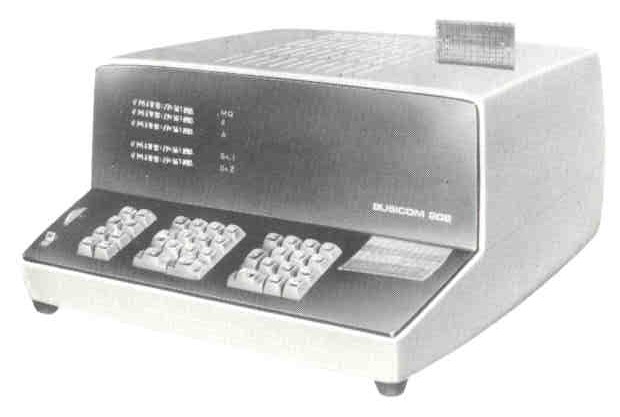
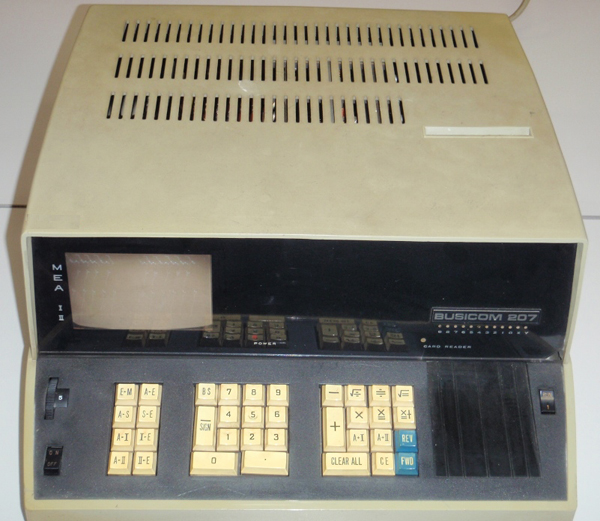
The Nippon Calculating Machine Company of Japan, which took the name Busicom in 1967, had Wyle design its electronic calculators. The 202 of November 1967 shows five registers of 20 digits in seven-segment vector digits on a CRT, uses small-scale integrated circuits and a delay line, and reads 36-step programs from cards. The 207 and 2017 of February 1969 have a six-inch tube; the 2017 has 17 memories. Busicom went on to commission the Intel 4004 microprocessor in 1969 and went bankrupt in 1974. The machines were sold only through Busicom’s own distributors and are very rarely seen outside Japan.
2.8 Hewlett-Packard 9100A and 9100B (1968–1970)
Tom Osborne built a calculator on his own in 1964, in a balsa-wood case painted Cadillac green metallic, and offered it to some thirty companies before Hewlett-Packard took it up. HP rebuilt it as the 9100A, introduced on 11 March 1968 at $4,900. It is a programmable scientific calculator with logarithms, trigonometry and coordinate conversion, built without a single digital integrated circuit: diode-resistor logic, 40 J-K flip-flops, a 32,768-bit read-only memory printed into a 16-layer circuit board, and a magnetic-core memory. A flat, rectangular HP tube about 11 inches long shows three registers (X, Y and Z) with ten-digit mantissas and exponents. Programs of up to 196 steps are stored on magnetic cards. The 9100B of October 1969 doubled the memory and added subroutines. The machine weighs about 40 pounds and measures 8¼ × 16 × 19 inches.
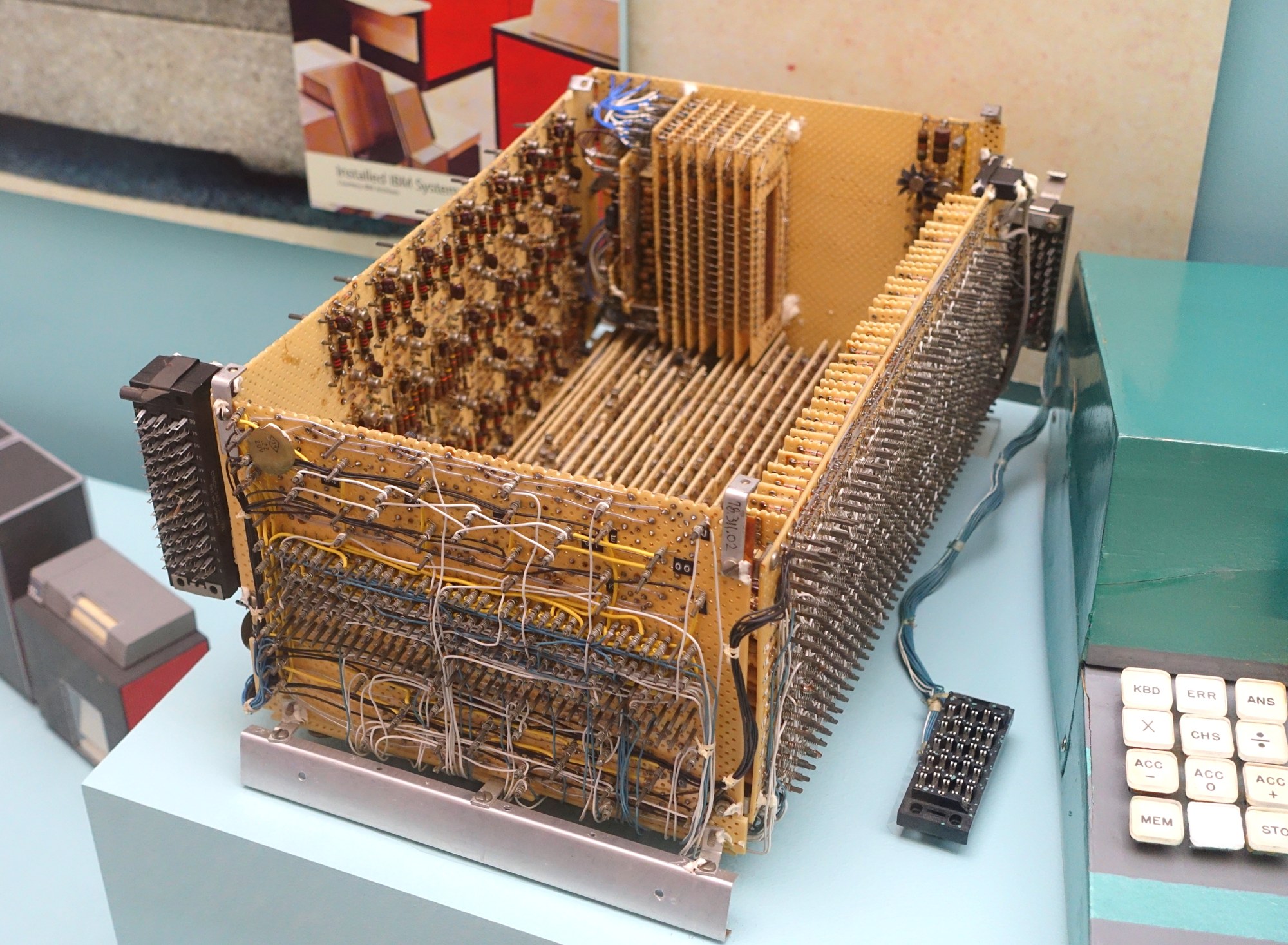
No production figures are published. Collectors’ forums suggest the 9100B is several times rarer than the 9100A. The CRT, HP part 5083-1551, is the same in both and is now essentially unobtainable except from another machine.
2.9 Victor 14-321 and 14-322 (1969–1971)
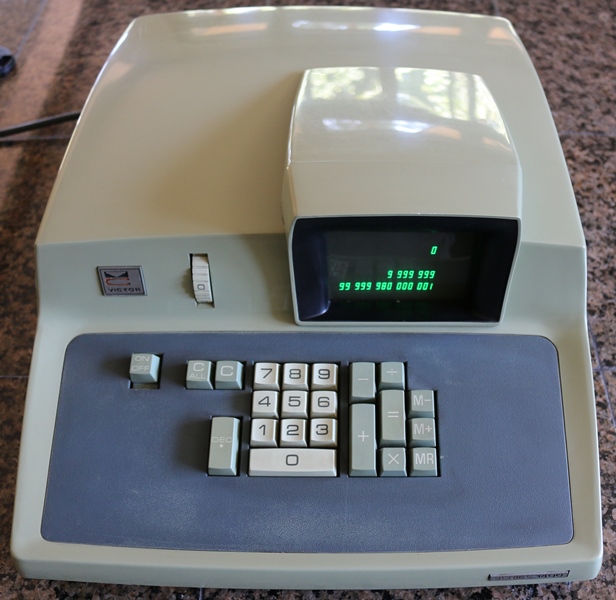
Victor’s own design, introduced in early 1969 (one source says March 1970) at $795: about 114 DTL integrated circuits and a five-inch RCA 4499 tube with green phosphor, showing three lines of 14 digits, grouped in threes, with leading zeros suppressed. Early machines store their registers in a magnetostrictive delay line; from late 1969 two 200-bit MOS shift-register chips replaced it, which is the way to tell the versions apart. The 14-322 has a second memory. Victor declared the series obsolete on 20 January 1971.
2.10 Monroe 820 and 820A (1969)
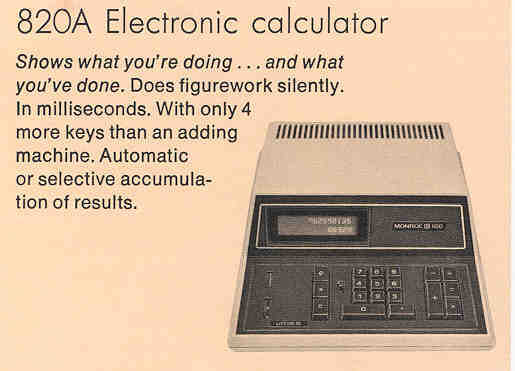
Monroe advertised its 820 of August 1969 as the smallest CRT-display desktop calculator in the world: 14 pounds, two registers of 14 digits, small-scale integrated circuits, built at Lexington, South Carolina. The 820A adds an accumulation switch; its panel still reads “Monroe 820”, so the tag underneath is the way to tell them apart.
2.11 Descal ASI-500 (about 1969–70)
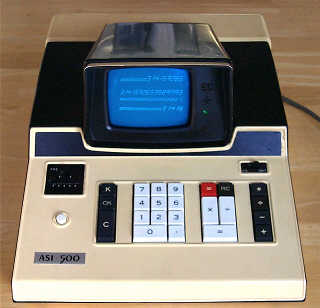
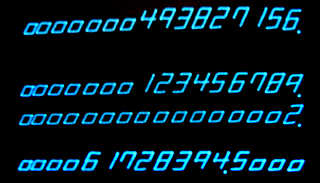
A Japanese machine from Takachiho Koheki, sold under the name Descal: 89 Hitachi PMOS integrated circuits, logic believed to derive from Sharp designs, and a Toshiba tube with long-persistence blue-white phosphor showing four rows of 16 digits that seem to melt into place. Its display patent, US 3,654,612, draws digits with slope and step sweeps blanked by a diode ROM.
2.12 Others
- Hungary: the EMG 666 of 1972, a programmable desktop with a 95 × 120 mm CRT showing four rows of 16 characters and a cassette drive.
- Soviet Union: the Calcuseum catalogue lists the Elektronika 1122 (1974) and the Elektronika T3-16 (1975, resembling the HP 9100B) as CRT machines, but no other source confirms it, and no Soviet CRT calculator of the 1960s has been found. The Soviet machines are covered in their own series.
- Logicon built a programmable CRT calculator that was never sold; between two and six were made.
- Some later machines with CRTs, such as the Wang 2200 and the HP 9830, are small computers rather than calculators and are outside this series.
2.13 Telling a CRT calculator from a Nixie one
Many desk calculators of 1965–72 have a dark window with glowing green or orange figures. A CRT machine shows its digits on one curved or flat glass face, the digits are drawn with lines (often slanted “pieces of eight”), several registers are shown at once, and there is a deep bulge or neck behind the screen inside the cabinet. A Nixie machine has a row of separate round tubes, each digit a glowing wire numeral sitting inside the one in front. A vacuum-fluorescent machine has flat blue-green segmented digits in one or more glass envelopes.
Comments (0)