CRT Calculators · Volume 1
CRT Calculators: Numbers on a Television Screen
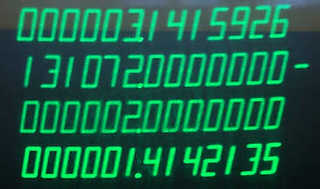
For about eight years, from 1963 to the early 1970s, some of the first electronic calculators showed their numbers on a cathode-ray tube, the same kind of glass tube as a television or an oscilloscope. They were desk machines the size of a typewriter and the weight of a small suitcase, they cost as much as a car, and they glowed green. Several rows of figures sat on the screen at once, drawn by an electron beam that traced each digit stroke by stroke many times a second. They are among the most interesting and the rarest calculators a collector can look for.
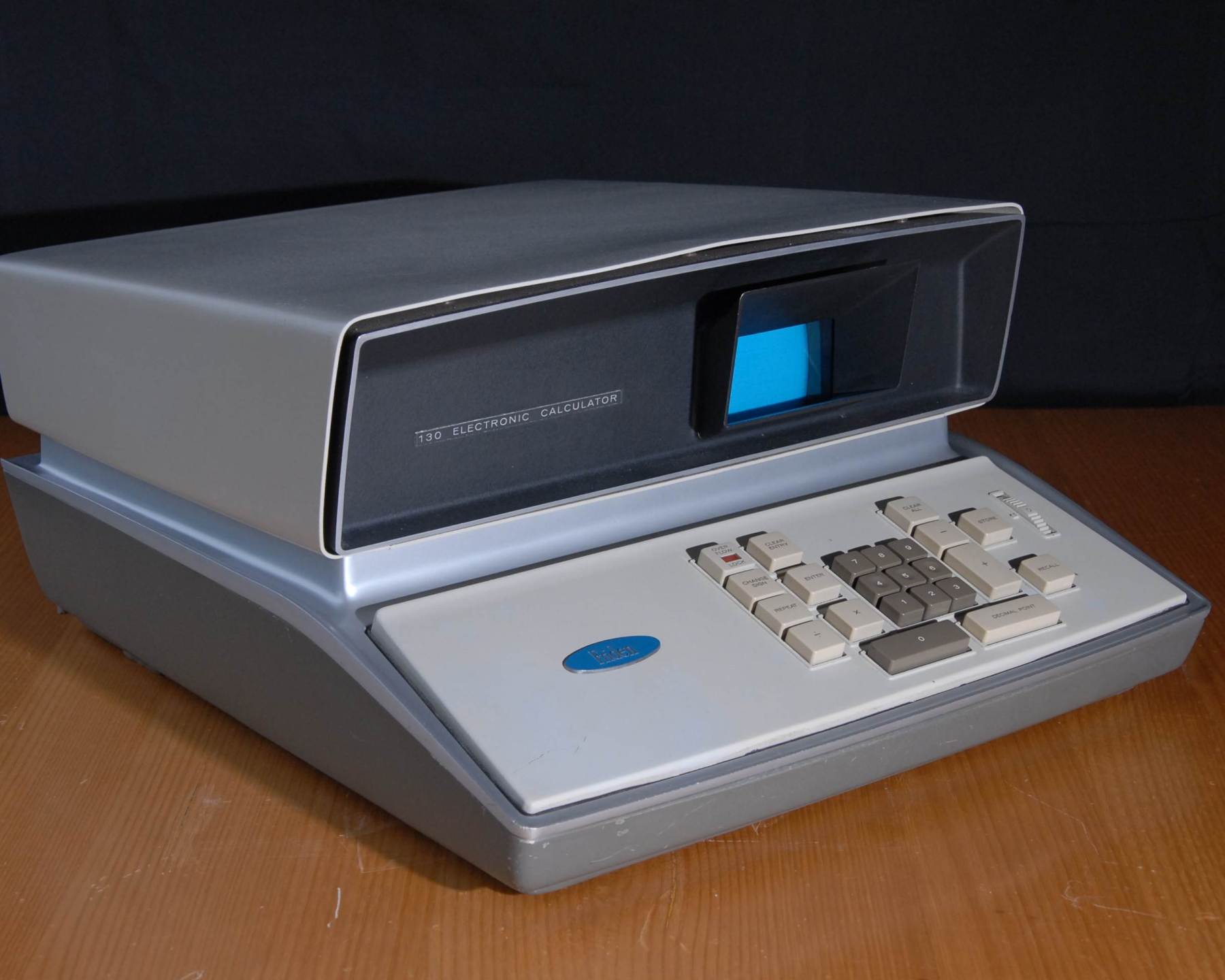
Many years ago I had one of these machines: big, heavy, with its numbers on a small CRT. I have been looking for one ever since, and that search is the reason for this series.
1.1 What they are called
There is no single trade name for them. Collectors call them CRT calculators or CRT-display calculators, and the museums describe them as early solid-state or transistorised desktop electronic calculators with a cathode-ray-tube display. Sellers rarely use any of these words. A machine on an auction site is far more likely to be listed by its model number alone (“Friden 130”, “HP 9100A”) or as a “vintage calculator” or “adding machine”, which is one reason they are hard to find. The collecting volume gives the search terms that work.
1.2 Why a cathode-ray tube?
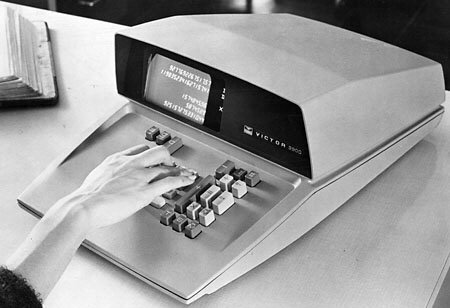
In 1961, when Friden began its electronic calculator, the obvious way to show a number was a row of Nixie tubes, one glass tube per digit, each holding ten stacked neon-lit cathodes shaped like the numerals. The British ANITA of the same year used them. But Friden wanted to show the four registers of its new stack, thirteen digits each, all at once, so that the operator could see the numbers being worked on. That would have taken 56 Nixies or more, with their high-voltage drivers. A single small CRT could show all four rows for less. Victor reached the same conclusion for its 3900: its five lines of 20 digits would have needed 105 Nixies.
A CRT also suited the electronics of the day. The first of these calculators kept their numbers not in transistor flip-flops, which were costly, but in a delay line: a coil of wire in which the digits circulate as pulses of sound, coming round every few thousandths of a second. The numbers pass by serially, one digit at a time, and a CRT can draw each digit as it goes past. Memory and display were both serial, both recirculating, and they fitted together naturally. The theory volumes explain how.
1.3 The machines
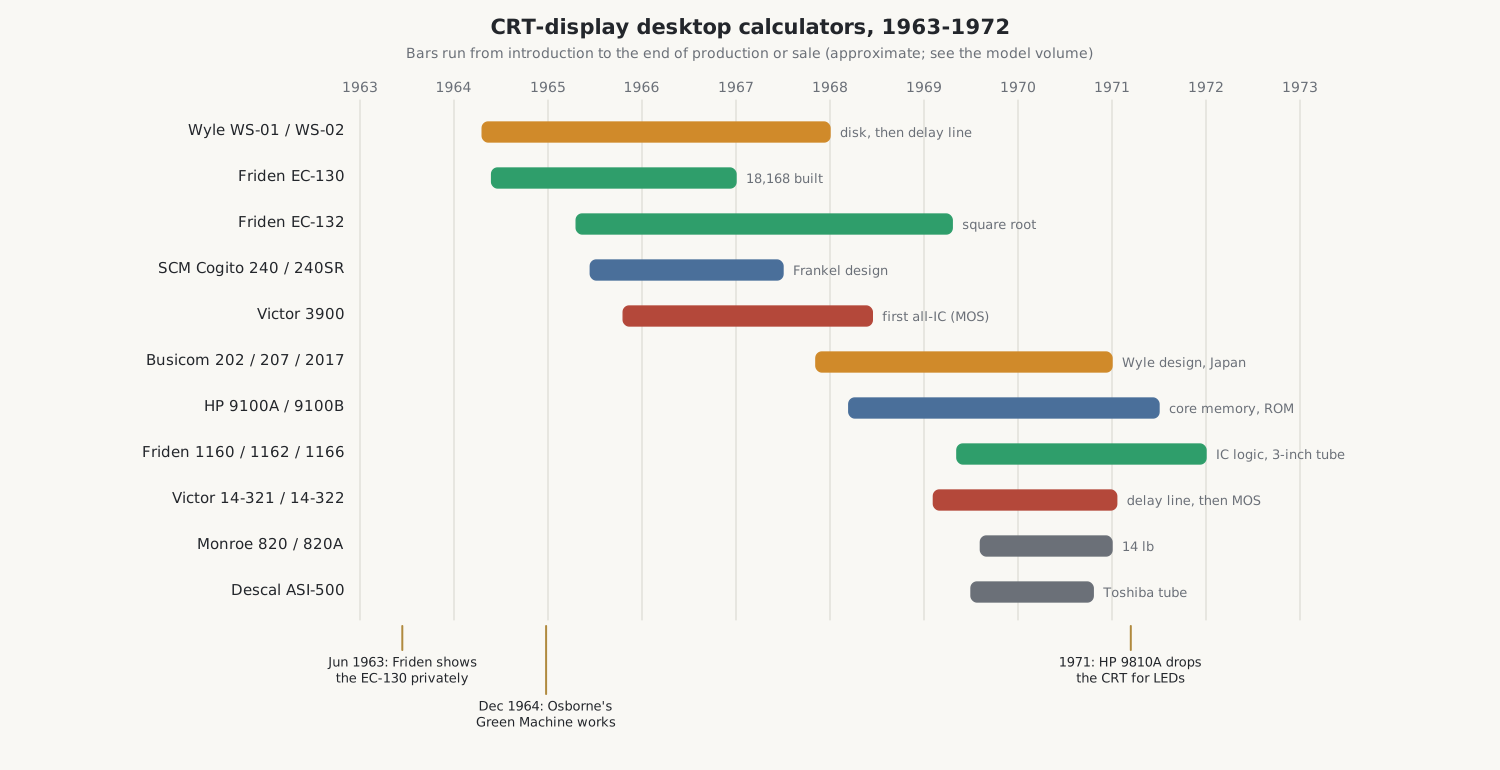
About a dozen makers built CRT calculators. The model volume covers each one; in brief:
- Friden EC-130 (1964) and EC-132 (1965), from San Leandro, California: germanium transistors, a nickel-alloy delay line, a round 5-inch tube showing a four-level stack. The first all-transistor calculators sold in the United States, and the first commercial calculators to work in what became known as Reverse Polish Notation. About 18,000 EC-130s and 15,800 EC-132s were made.
- Singer/Friden 1160, 1162 and 1166 (1969–72): the same design rebuilt with integrated circuits, smaller, cheaper, showing two of the four stack registers on a 3-inch tube. The 1166 was the commonest CRT calculator of all, at an estimated 35,000–45,000.
- Wyle Laboratories WS-01 and WS-02 Scientific (1964): an aerospace test lab’s calculator with six lines of 24 digits, drawn in curves from sine and cosine waves.
- SCM (Smith-Corona Marchant) Cogito 240 and 240SR (1965), designed by the physicist Stanley Frankel.
- Victor 3900 (1965–68): the first calculator built entirely of integrated circuits, MOS chips from General Micro-electronics, with five lines of 20 digits.
- Busicom 202, 207 and 2017 (1967–69): Wyle designs built in Japan for the company that later commissioned Intel’s first microprocessor.
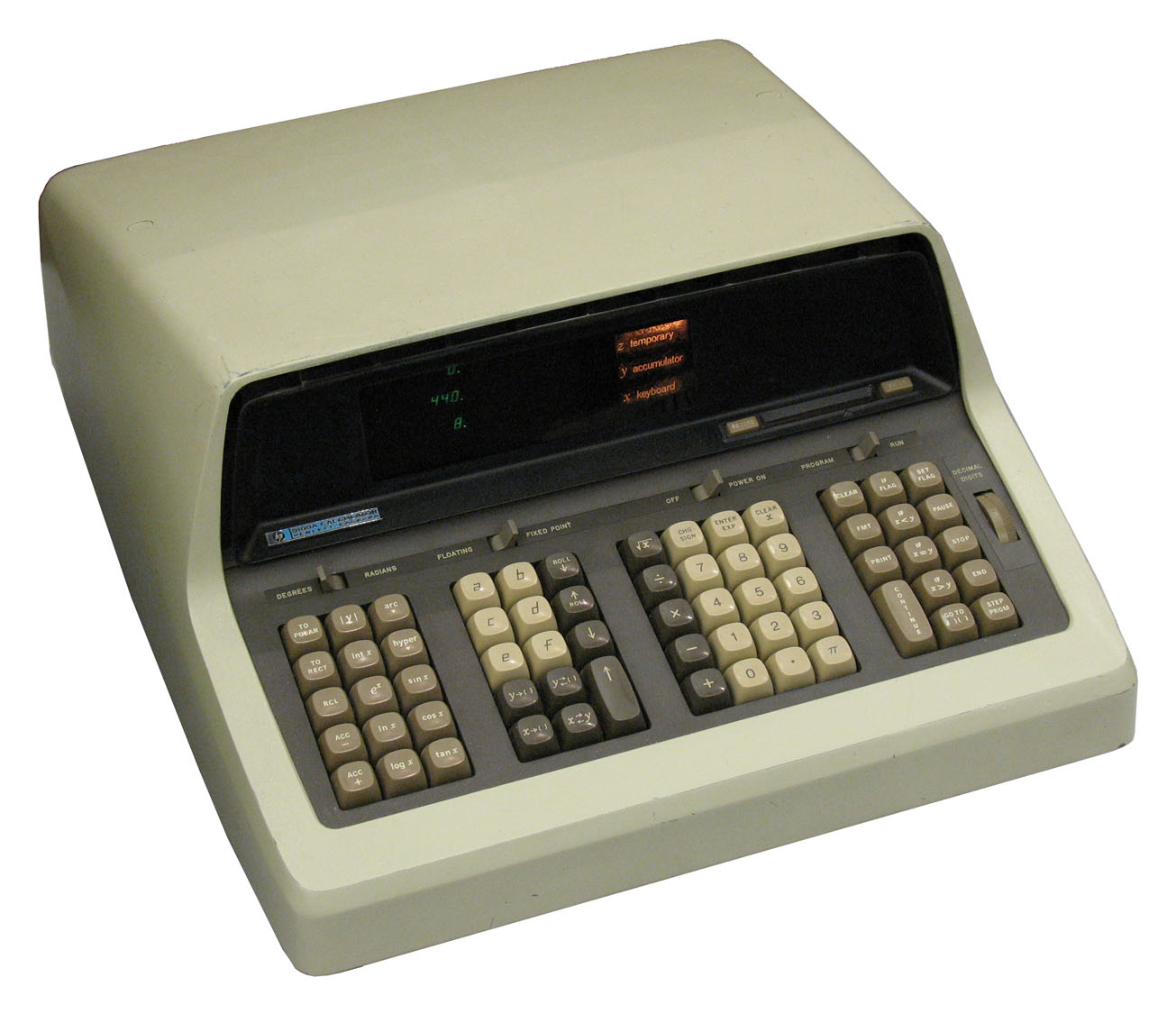
- Hewlett-Packard 9100A and 9100B (1968–69): HP’s first calculator, a programmable machine with core memory and a ROM printed into a circuit board, that did trigonometry and logarithms. HP itself called it a “personal computer” in an advertisement.
- Victor 14-321 and 14-322, Monroe 820, the Japanese Descal ASI-500, and licensed copies of the Friden built in Romania as the Felix CE-30 and CE-33.
1.4 Why they disappeared
The CRT calculator was a solution to a problem that solved itself. By the late 1960s, MOS integrated circuits could hold a calculator’s registers on a chip, so the delay line was no longer needed, and with it went the reason to draw digits serially. Nixie tubes, then gas-discharge panels, vacuum-fluorescent tubes and light-emitting diodes became cheaper than a CRT with its 2,000–3,000 V supply. A CRT also had to warm up, could burn a permanent image into its phosphor, and was heavy. Friden built its last CRT machine, the 1166, until about 1972. HP replaced the 9100’s tube with LEDs in the 9810A of 1971.
1.5 How rare are they?
They are rare. The Friden 130 and 132 sold in their tens of thousands, but many were scrapped when they were replaced, and radio amateurs broke up a great many for their tubes. The HP 9100 is keenly collected and seldom offered. The Wyle, Cogito, Victor 3900 and Busicom machines are so scarce that the Old Calculator Web Museum, the leading collection of early electronic calculators, still lists most of them as wanted. A complete working CRT calculator is a find.
1.6 What this series covers
- The machines, model by model: every CRT calculator, with dates, prices, production, and how to identify each version.
- Theory of operation: the Friden EC-130 in depth: the counters that did all the arithmetic, the magnetostrictive delay line, how a number is laid out in it, and how the machine adds, subtracts, multiplies, divides and finds square roots.
- Theory of operation: the CRT and its drive circuits: the tube itself, how a digit is drawn stroke by stroke, the deflection amplifiers, the 2,400 V supply, with the original Friden schematics and the competing methods of HP, Wyle and Descal.
- Theory of operation: the HP 9100 and the others: a calculator with a ROM, core memory and microcode, and the MOS Victor 3900, the Wyle, the Cogito and the integrated-circuit Fridens.
- Operating them: how to use the Friden’s stack, the 116x, the HP 9100 and the rest.
- Care, repair and restoration: high-voltage safety, first power-up after decades, the known faults, and where documents and parts can be found.
- Building a reproduction: a design for a CRT calculator that can be built today.
- Collecting: what to search for, where they turn up, what they cost, and what to check.
The factory manuals, service manuals, schematics and patents behind this series are in the site’s Reference Library.
Comments (0)