Flight Computers · Volume 4
How the Mechanical E6B Works
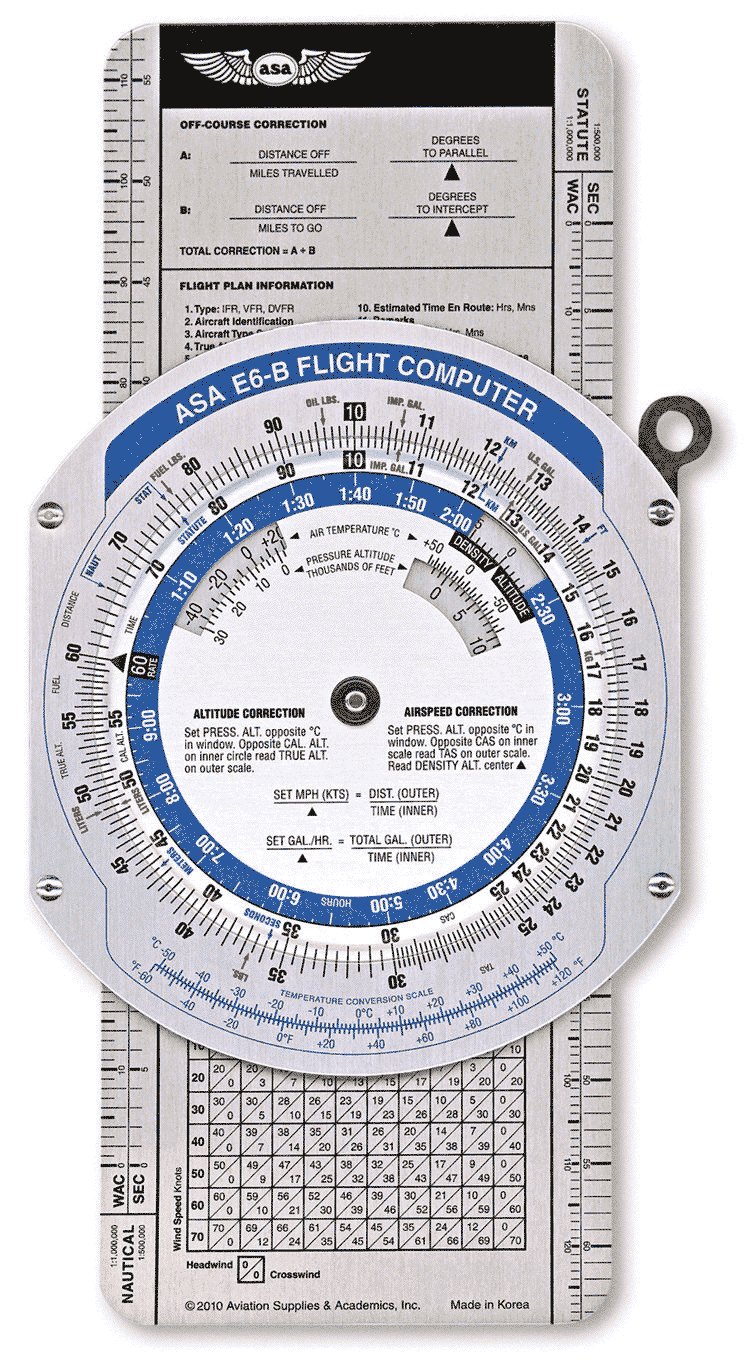
A mechanical E6B has two faces, and each is a calculating machine with no moving parts but the ones the pilot turns. The calculator side is a circular slide rule, which multiplies and divides by adding and subtracting distances on logarithmic scales. The wind side is a drawing board on which the pilot plots the wind with a pencil, and on which a printed grid of curves turns the wind triangle of volume 5 into a matter of sliding and reading. Both are worth understanding even for a pilot who, like me now, uses an electronic one: the electronic E6B gives the same answers, and the slide rule shows why they are what they are.
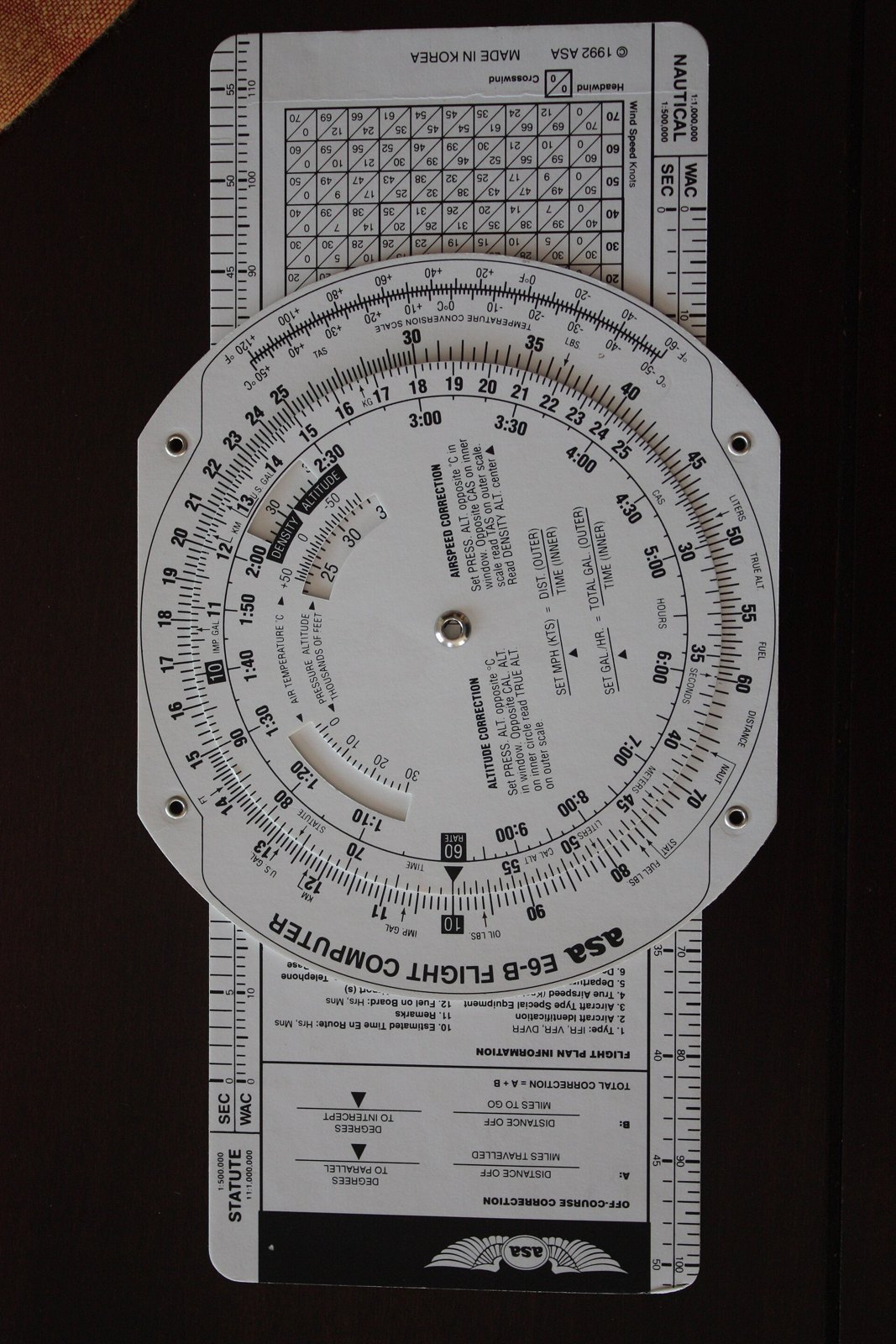
4.1 The calculator side
4.1.1 Two logarithmic scales
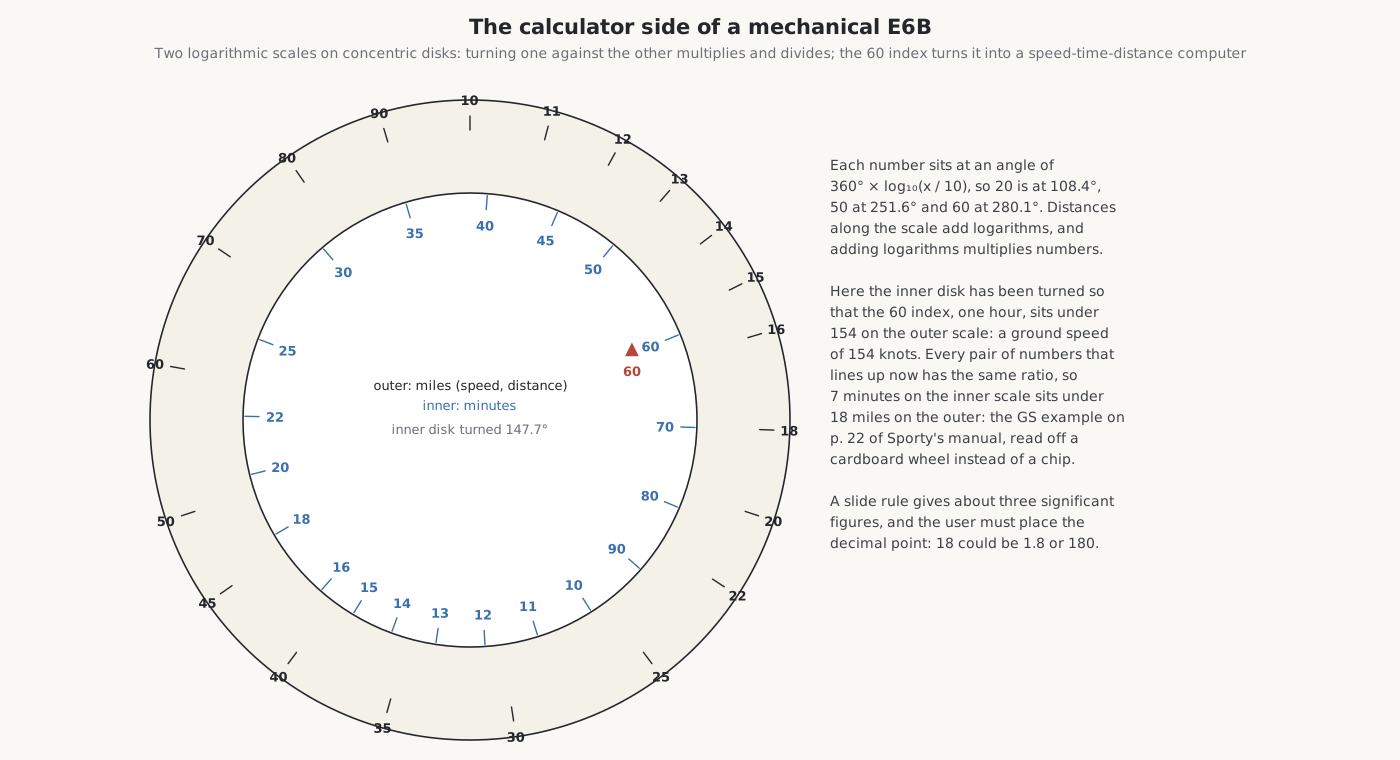
The calculator side has two scales running round concentric disks, each covering one decade, 10 to 100, round the whole circle. A number x sits at an angle of 360° × log₁₀(x/10) from the 10 mark: 20 at 108°, 50 at 252°, 60 at 280°. Because the angles are logarithms, turning the inner disk so that a number on it lies under a number on the outer disk sets a fixed ratio between the two scales all the way round: every pair of numbers that line up is then in the same proportion. ASA’s manual gives the plainest example: set 10 on the inner scale under 20 on the outer, and “all of the numbers on the outer disk are exactly twice the value of the numbers on the inner disk”.
The scale does not know where the decimal point goes. “That number ‘10’,” ASA’s manual says, “may be read as ‘.1,’ ‘1,’ ‘100,’ or ‘1,000’ depending upon the context.” The pilot supplies the magnitude, which is both the slide rule’s discipline and its commonest source of error.
4.1.2 The indexes
Three marks on the inner scale do the work of a pilot’s arithmetic:
- The 60 index, often a black triangle marked “rate” or “1 hour”. Placing 60 minutes under a speed on the outer scale sets the ratio of miles to minutes for that speed, so every time on the inner scale then lies under the distance flown in that time. At 154 knots, 7 minutes lies under 18 miles: the same problem my electronic E6B works in its GS function (volume 6). The same setting, with gallons on the outer scale, gives fuel burned over time.
- The 10 index, for plain multiplication and division: 10 under 12, and 7 lies under 84.
- The seconds index, at 36: an hour is 3,600 seconds, so a rate set against 36 instead of 60 gives a rate per second.
Pairs of arrows printed on the scales convert units, each pair placed so that the ratio of their positions is the conversion factor: nautical miles at 66 and statute miles at 76 on the outer scale (66 × 1.151 = 76), with kilometres near 122; pounds and kilograms; US gallons, Imperial gallons and litres. A straight Fahrenheit-Celsius scale is printed beside them.
4.1.3 The windows
Two small windows cut into the inner disk handle the effects of temperature and pressure. In the airspeed window, the pilot sets the pressure altitude against the outside air temperature; the disk is then turned by exactly the ratio between true and calibrated airspeed for that air, and the true airspeed can be read on the outer scale over the calibrated airspeed on the inner. A neighbouring window shows the density altitude at the same setting. The altitude window works the same way for the ratio between true and indicated altitude. Each works because, for a given pressure altitude and temperature, the ratio is a single number, and a single number on a slide rule is a single angle; the curved scales in each window are drawn so that lining up the two settings gives that angle.
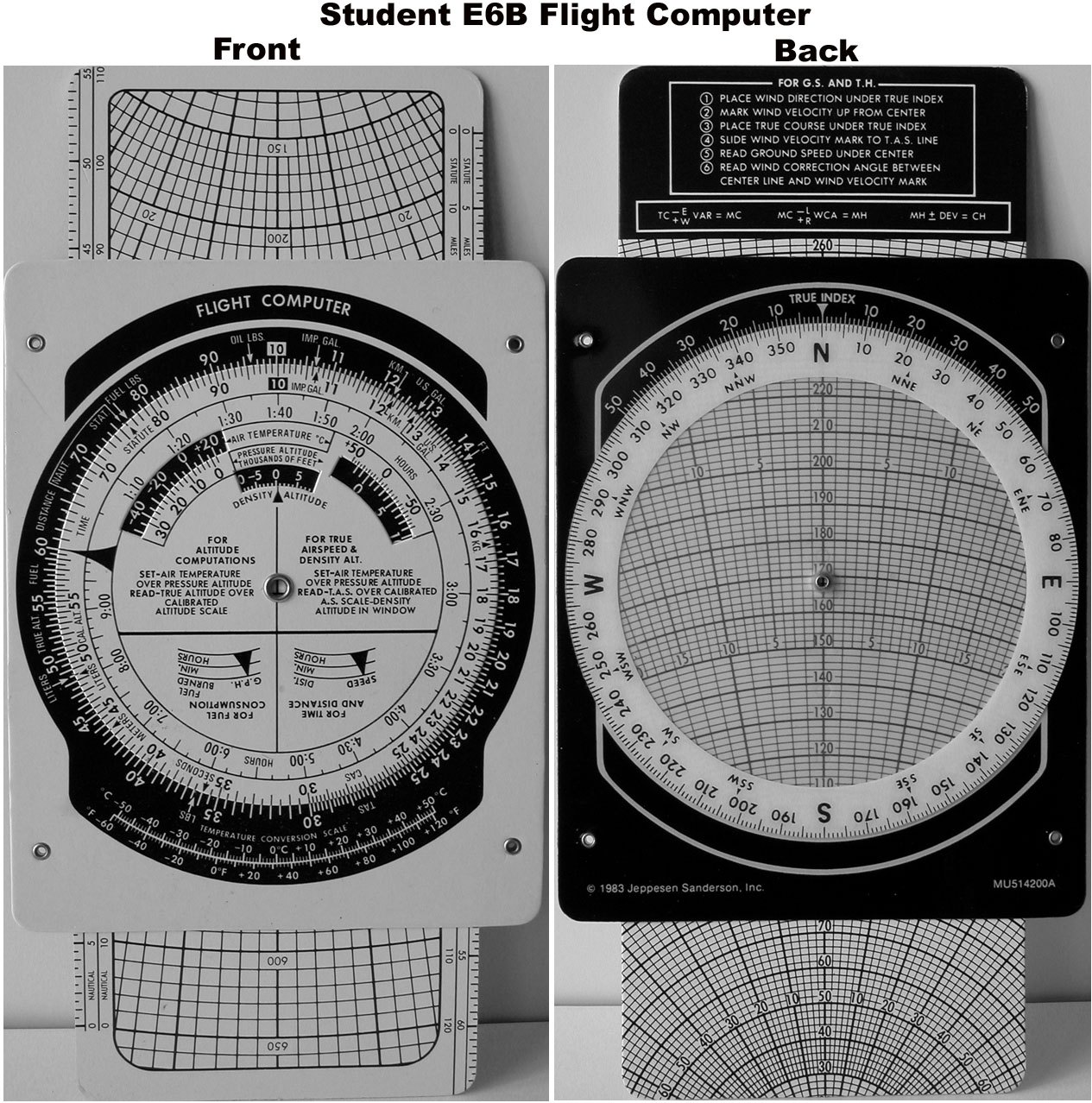
4.2 The wind side
The classic E6B’s wind side is a transparent compass ring, with a true index at the top and a small hole, the grommet, at its centre, over a sliding card. The card is printed with speed arcs, circles about a centre far off the bottom of the card, and drift lines fanning out from that centre. Most cards have low speeds on one side and high speeds on the other.
To find the heading and ground speed:
- Turn the ring to put the wind direction under the true index.
- Slide the card so that the grommet sits on any convenient arc, and pencil a wind dot straight up from the grommet, as many units as the wind’s speed.
- Turn the ring to put the true course under the index.
- Slide the card until the wind dot sits on the arc of the true airspeed.
- Read the wind correction angle from the drift line under the dot, right or left of centre, and the ground speed under the grommet.
The construction is exact, not an approximation. The grommet is the tip of the ground-speed vector and the arcs’ centre its tail; the dot lies the wind’s speed from the grommet and the true airspeed from the arcs’ centre. Once the course is under the index, the figure on the card is the wind triangle, and the drift lines measure its angle. Dalton’s patent of 1937 described exactly this: a transparent rotating member over “polar coordinate lines or drift lines”, moved to set the airspeed.
The circular computers, Jeppesen’s CR series among them, do without the slide: the wind is broken into crosswind and headwind components on a fixed grid, and the angle is found from the crosswind on a sine scale.
4.3 Accuracy, and mistakes
A slide rule gives about three significant figures. The longer the scale, the better: an E6B’s outer scale, on a circle about 10 cm across, is about a third of a metre long, longer than a 25 cm slide rule’s main scale, and a careful user can expect answers within about half a per cent, which is as good as the inputs: no pilot knows the wind to better than a few knots. The FAA’s Weight and Balance Handbook says of it simply: “Its accuracy is limited, but it is sufficiently accurate for most weight and balance problems.”
The mistakes are not in the instrument but in the user, and the manuals list them:
- the decimal point, 25 read as 250;
- a wind given as magnetic used as true, or “from” plotted as “to”;
- adding the correction angle when it should be subtracted;
- indicated temperature used where true is wanted, or indicated airspeed where calibrated is wanted;
- nautical and statute miles, or gallons and litres, mixed;
- reading the wrong one of two speed scales.
The electronic E6B removes most of them by asking for each value by name, in its own units, and placing the decimal point itself. It cannot stop a pilot entering the wrong wind; as Barry Schiff put it, the electronic computers are slightly more accurate but just as prone to “garbage in, garbage out”. In my experience, mistakes are not as common with the electronic one, and it is much quicker. Rod Machado, the flight instructor and author, argues the other side in AOPA’s Flight Training: the mechanical E6B “makes you smart in that it keeps your head in the game”, and “after you’ve developed some fidelity with it, then move up to whatever electronic version tickles your fancy”. That is the order I learned in.
Sources
- ASA, E6-B Flight Computer instructions; Gleim, Pilot Handbook, flight-computer chapter; Jeppesen, E6B Flight Computer Manual (1966) and undated edition; A. C. Zweng, Practical Manual of the E-6B Computer (1944); Kane Mark 6 Dead Reckoning Computer instructions (1958).
- FAA, Weight and Balance Handbook (FAA-H-8083-1B), p. 10-2.
- Patent US 2,097,116, Philip Dalton (1937).
- Barry Schiff, “Wind triangle computers”, AOPA Pilot, April 2000; Rod Machado, “Since you asked”, AOPA Flight Training, October 2009; Slide Rule Museum on slide-rule accuracy; Bill Vorkoetter, on the E6-B and CR computers.
- The scale angles and accuracy figures are my own arithmetic.
Comments (0)