Flight Computers · Volume 2
Dalton's Computer, 1933–1970
Before radio beacons and satellites, a pilot out of sight of land found the way by dead reckoning: from a known starting point, the course, the speed and the time flown give the present position, if the wind is allowed for. Navigators at sea had done it for centuries with charts, dividers and tables. In an open cockpit, with one hand on the stick, it was nearly impossible, until a young Navy pilot put the whole calculation on a disc that could be worked with the other hand.
2.1 Navigating with a pencil
Around 1930, Keith Smith writes in his biography of Dalton, most flying was pilotage, following landmarks, “much of the flying was done with automobile road maps”. A careful navigator drew the course on a chart and solved the wind with a drawing, the wind triangle of volume 5; but “airplanes of the day did not have room to layout a chart”, and the arithmetic was done from printed dead-reckoning tables. P. V. H. Weems, who taught navigation at the US Naval Academy and taught Charles Lindbergh, wrote in 1931 that the methods of the sea, “while correct in principle, are too slow and cumbersome for use in the air”. Others tried devices: Barry Schiff, writing in AOPA Pilot, calls the French Le Prieur Navigraph “the most elaborate 1920s mechanical computer”.
2.2 Philip Dalton
Philip Dalton was born on 1 April 1903 in Scotia, New York. He studied physics at Cornell and Princeton, began a doctorate at Harvard, served as a reserve artillery officer, and in 1930 enlisted in the Naval Reserve to learn to fly, gaining his wings as Naval Aviator number 4654 in June 1931. Posted to a scouting squadron, he was told by his commander, as he wrote to his family, to “rig up a plotting board in the front seat and learn to fly with one hand on the stick and with a pencil in the other”.
He did better than that. His aircraft plotting board, with a small circular slide rule in its corner for time, speed and distance, was issued by the Navy Hydrographic Office in June 1933 as the VC-2 and made standard in Navy aircraft. “For the first time in the history of naval aviation,” he wrote in February 1934, “single seater fighters have been able to do accurate navigation at sea using my plotting boards.”
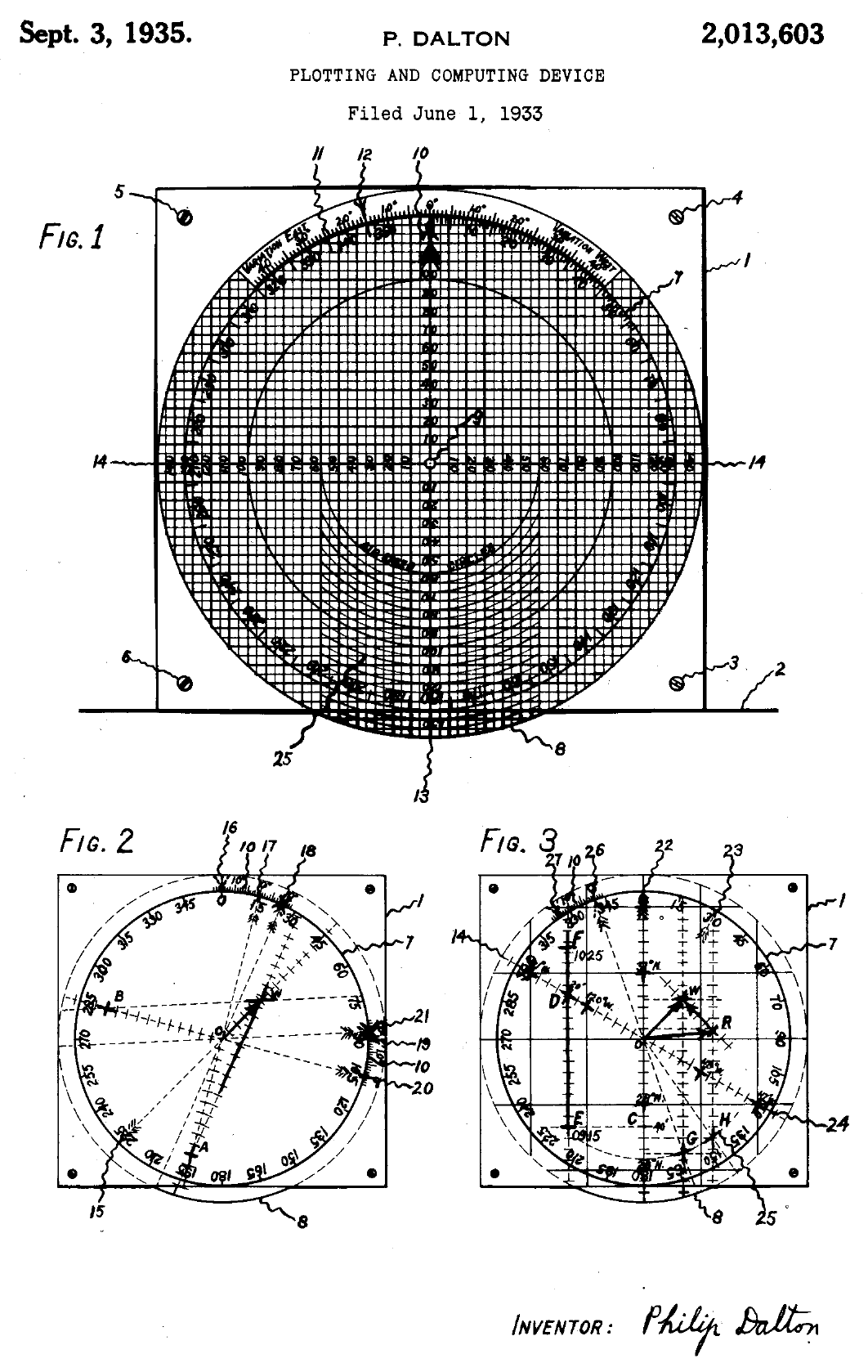
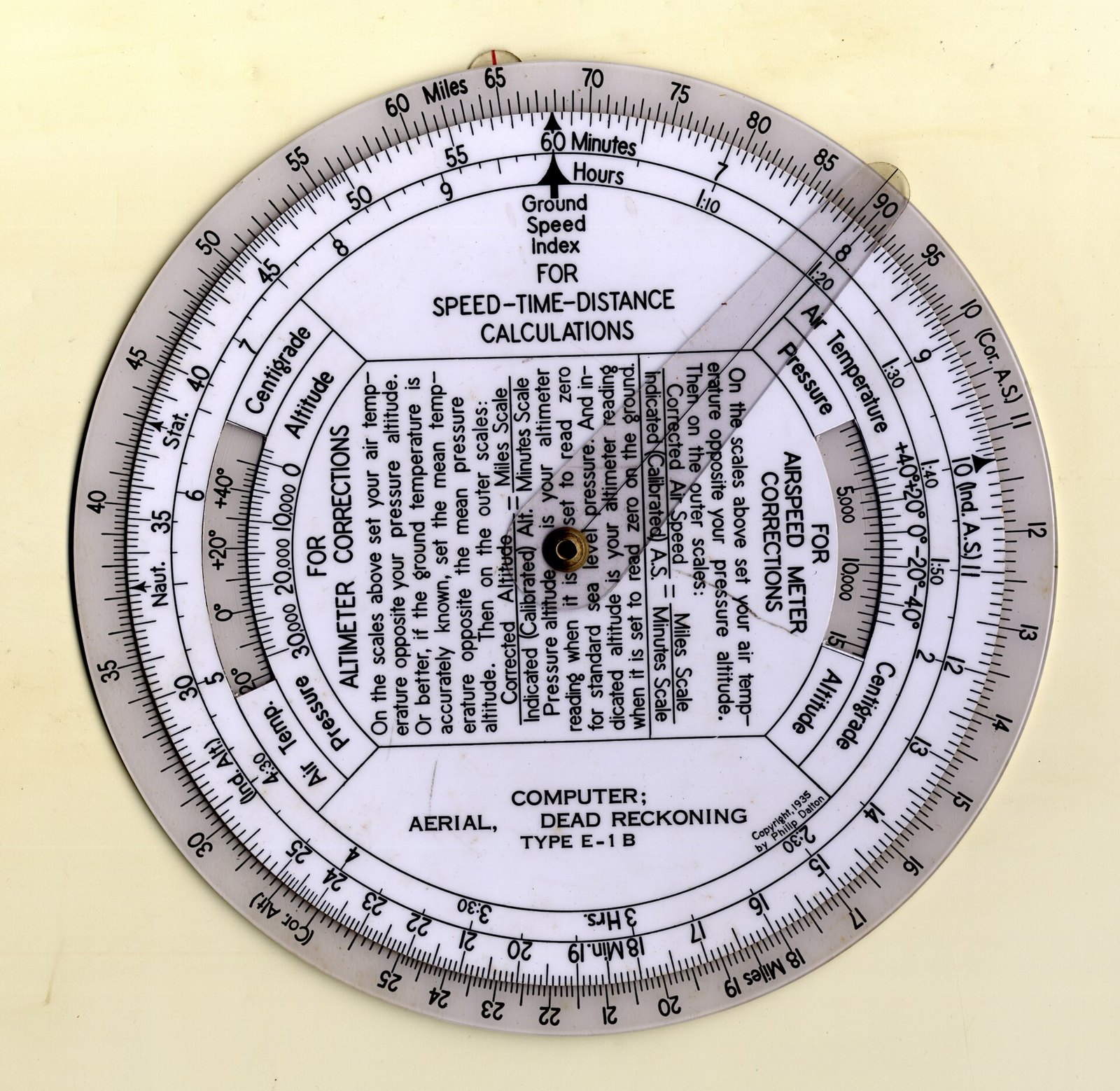
His first computer, the circular slide rule now called the Model B, followed in 1933, and in 1934 he combined it with a wind-plotting face as the Dalton Aircraft Navigational Computer, Mark VII, made by Bastian Brothers of Rochester and marked with his patent, US 2,013,603, and “Copyright 1934”. Weems marketed his inventions. The order and dates of the models that followed are confused in the sources; the Smithsonian, a Slide Rule Museum biography and Wikipedia disagree on whether the Army’s E-1B came before or after the Mark VII. According to Wikipedia, Fred Noonan carried a Mark VII on Amelia Earhart’s last flight in 1937.
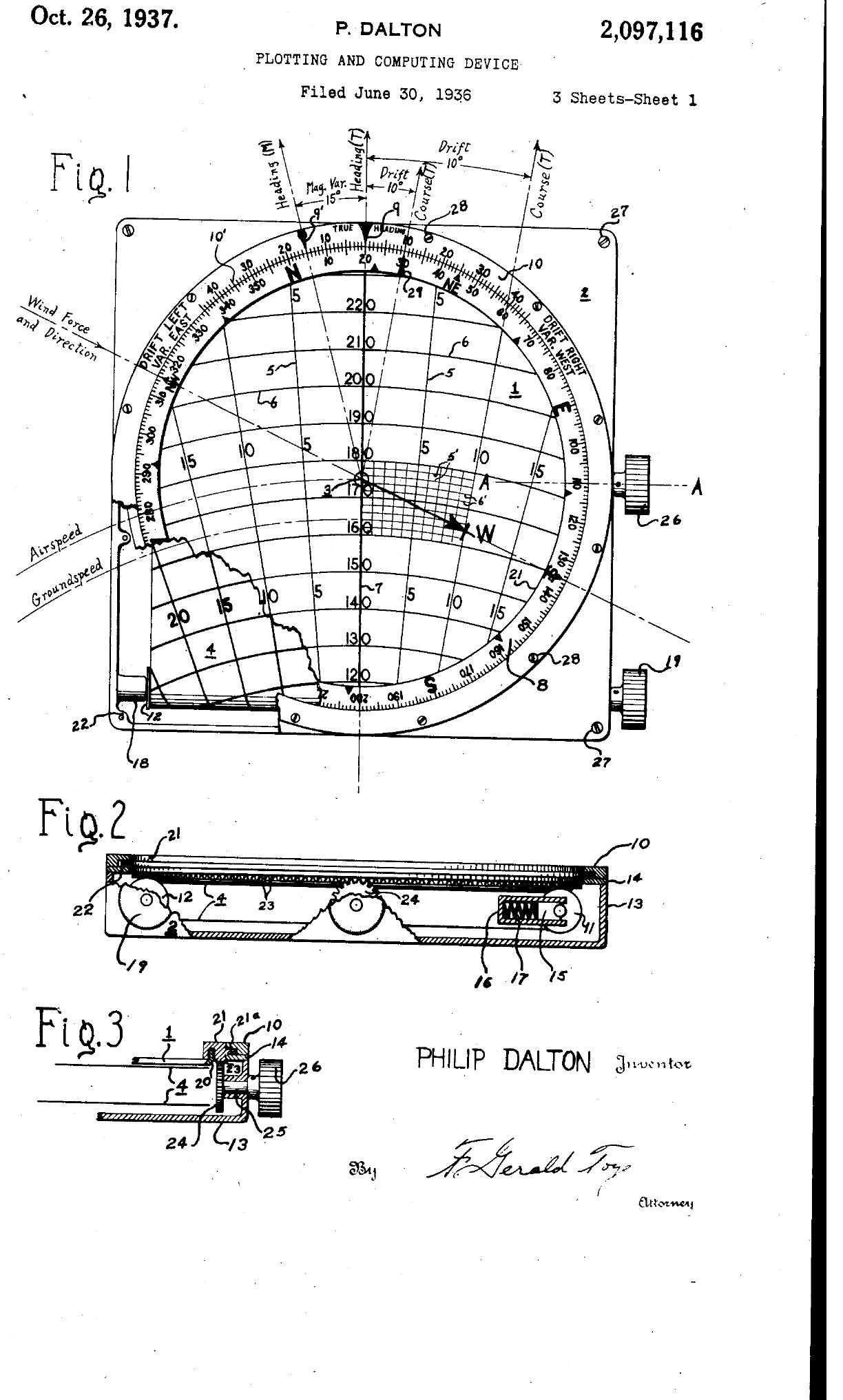
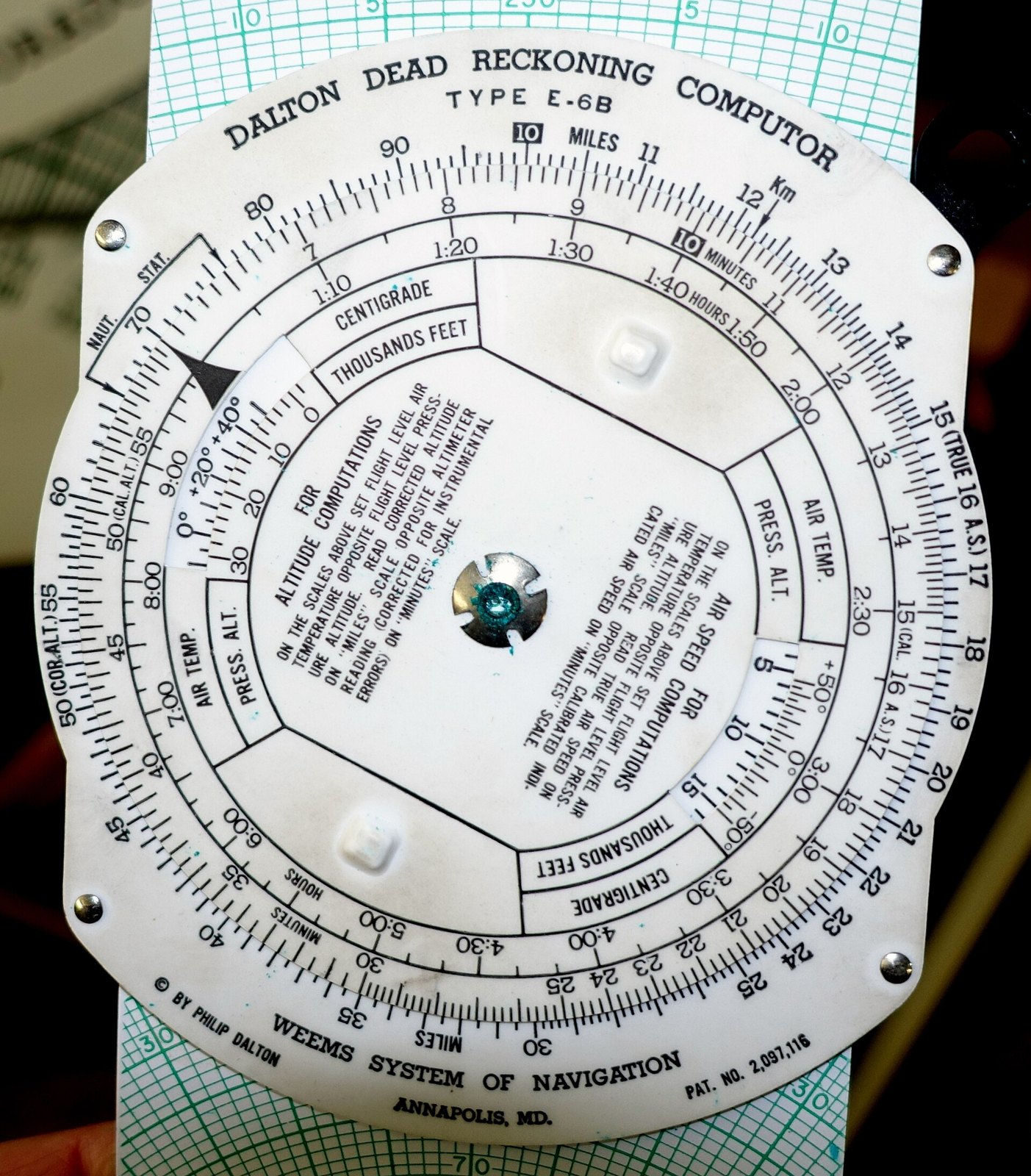
Dalton then patented the design that became famous: US 2,097,116, filed in June 1936 and granted in October 1937, a transparent rotating plotting disc over a chart on a strip “forming an endless belt” on two rollers, moved by a knob, printed with speed arcs. The endless belt solved the wind triangle for any speed, but it was expensive to make. For the Army he made a version with a flat sliding card instead, with his slide rule on the back. The Army’s specification of 1938 moved the “10” index to the top of the slide rule in place of the “60”; the result was his Model J, which the Army adopted in 1940 as the E-6B.
Recalled to active duty in October 1940, Dalton was instructing at Naval Air Station Anacostia when, on 24 July 1941, his training aircraft crashed near Hybla Valley, Virginia, killing him and his student. He was 38. “Not only Naval Aviation but all of Aeronautics; commercial, civil and military throughout the World, have benefited by Lieutenant Dalton’s genius,” his commanding officer wrote to his widow. Wikipedia gives the date as 25 July in one place and 24 July in another; the commanding officer’s letter says the crash happened “today”, the 24th.
2.3 The E-6B at war
The E-6B was introduced in 1940, but, as Wikipedia puts it, “it took Pearl Harbor” for the Army to order it in quantity. It was issued to virtually every Army pilot, navigator and bombardier, and made by Keuffel & Esser, G. Felsenthal & Sons and others; Weems marketed the Dalton name. Early E-6Bs were aluminium; wartime shortages brought plastic, which allowed markings that glowed under the ultraviolet lamps of a darkened cockpit. Wikipedia gives more than 400,000 made in the war; Schiff, more than a million made in the United States by 2000. Navigation cadets marched to class singing “My eyes are dim, I cannot see. I have not brought my E-6B.” And a navigator wrote to one of the makers: “I have just returned from a mission in a badly battered B-17, and it was only with the aid of my hack watch and your E-6B Computer that we were able to reach the furthermost emergency landing spot on the coast of England.”
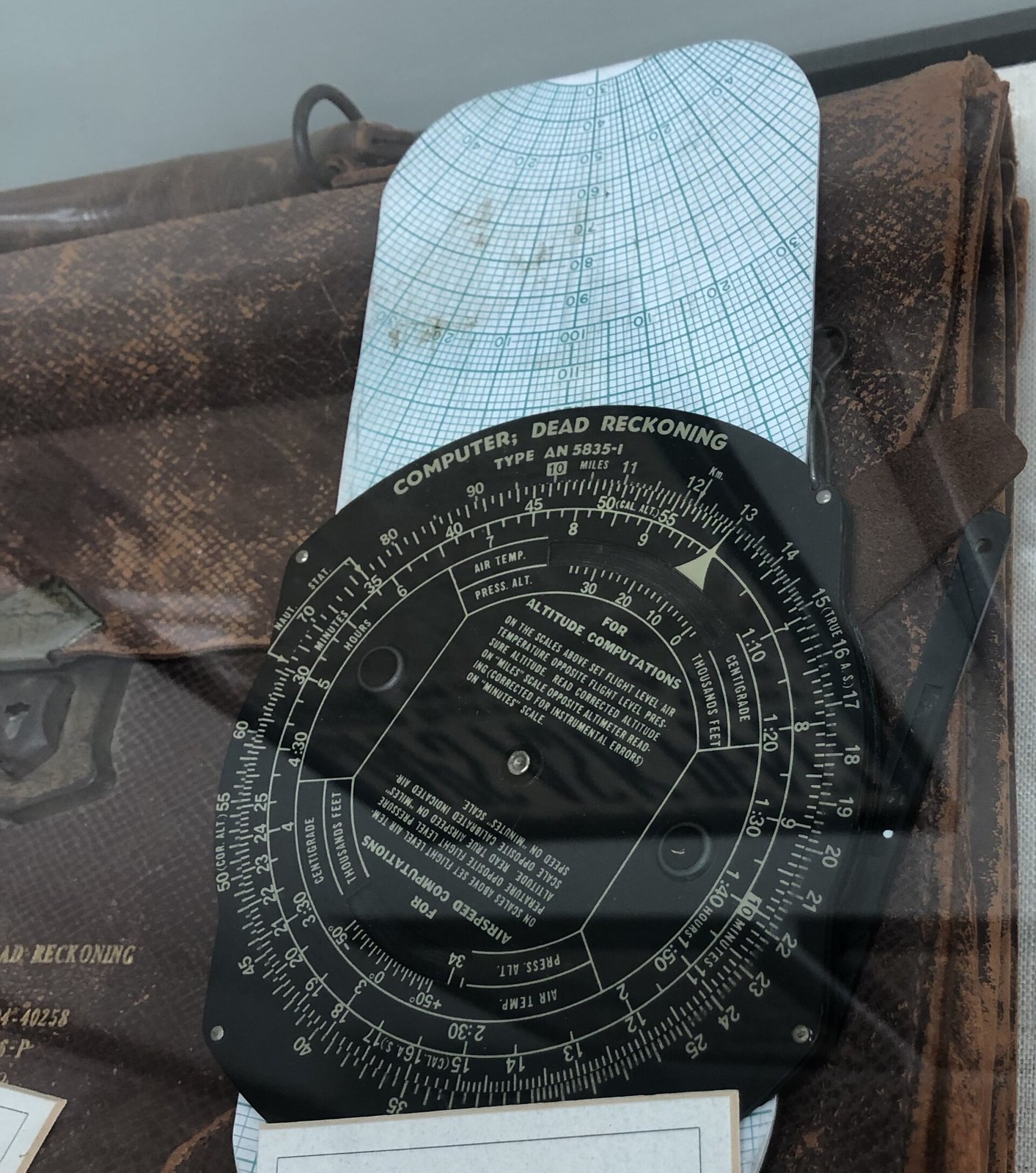
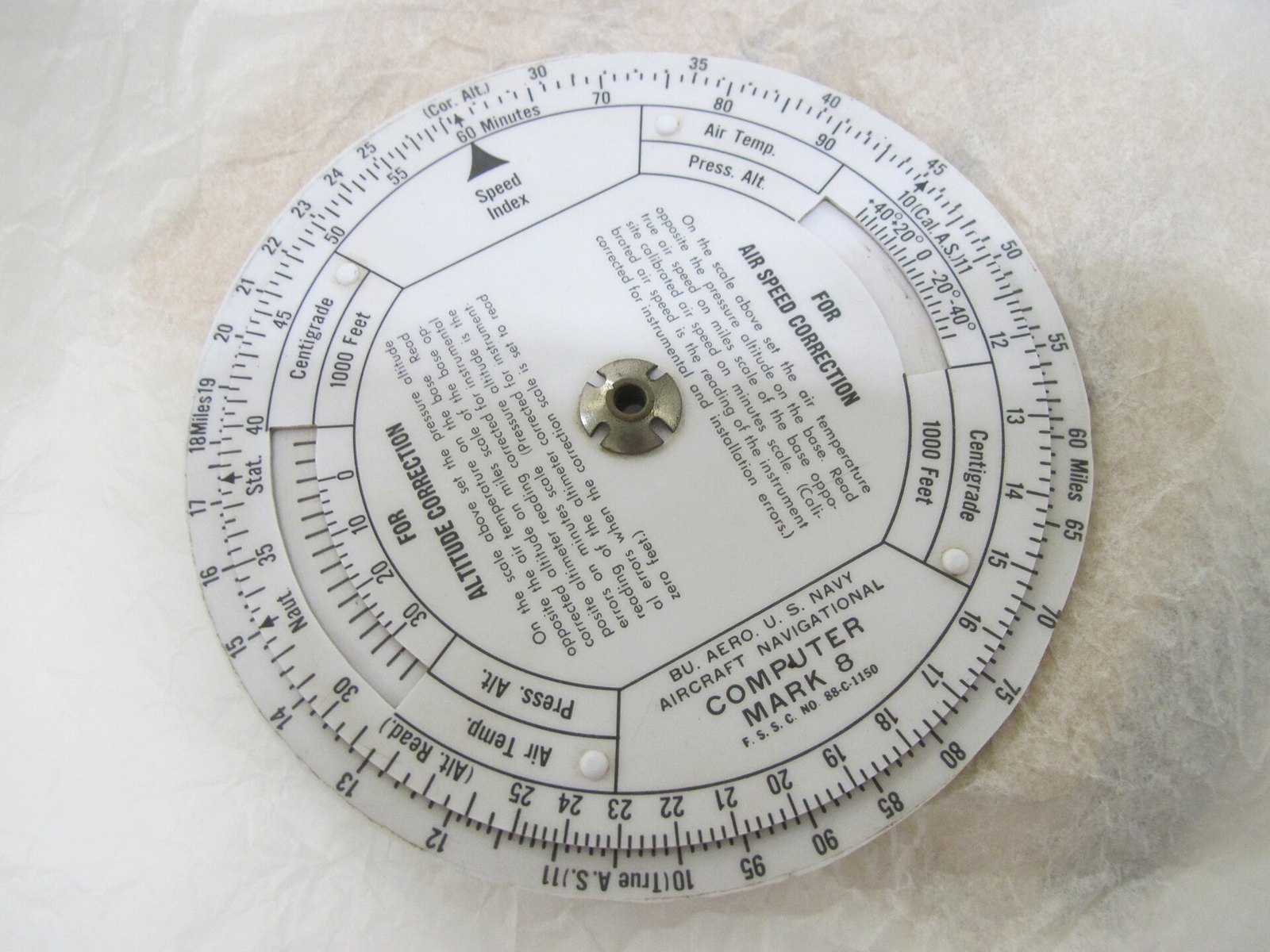
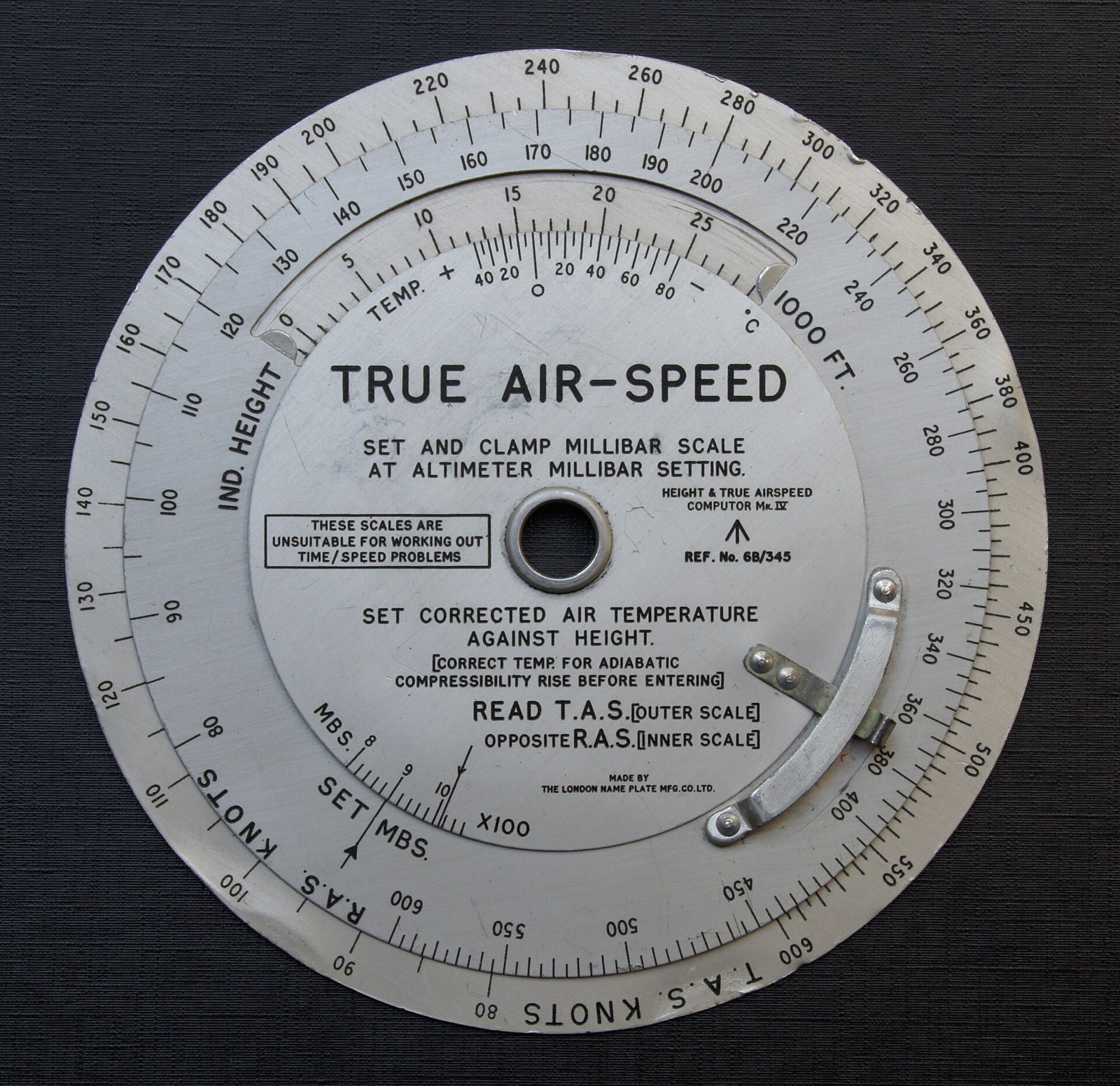
Britain and Germany had their own. The Royal Air Force and the Commonwealth air forces used Dalton’s endless-belt computers, some made in Toronto for the Royal Canadian Air Force, and its own instruments such as the Mark IV height and true airspeed computer; the Luftwaffe used Siegfried Knemeyer’s triangle calculator. The US Navy used Weems’s plotting computers such as the Mark 8.
2.4 After the war
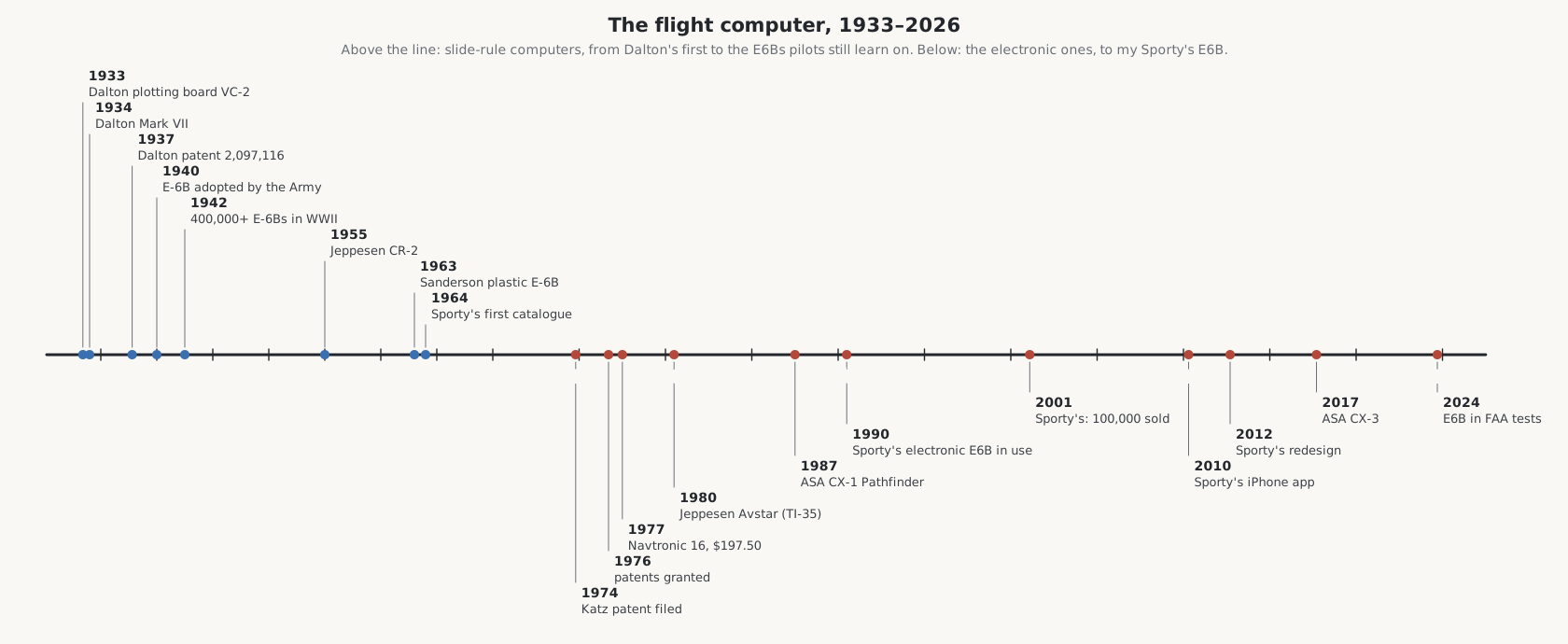
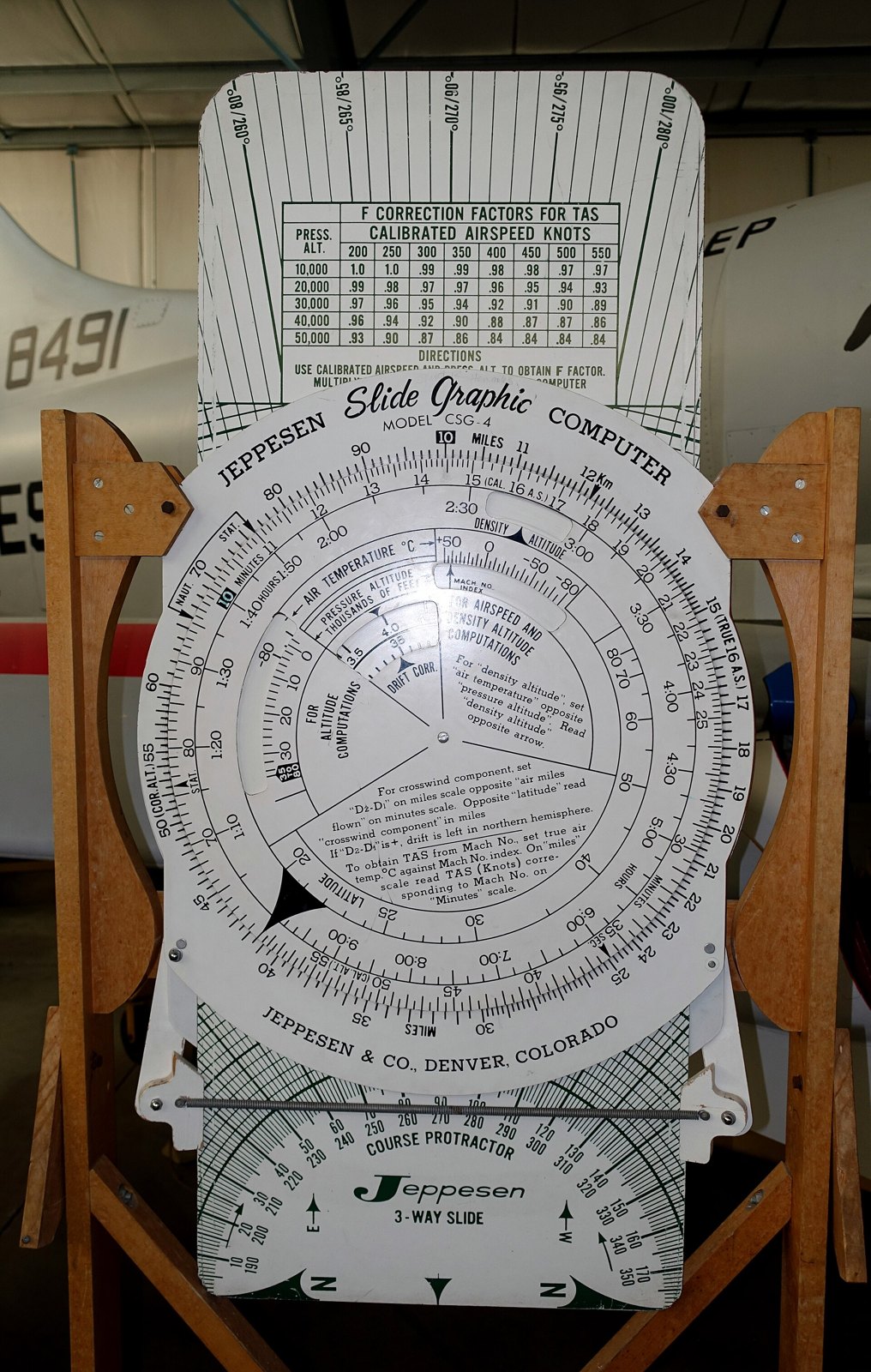
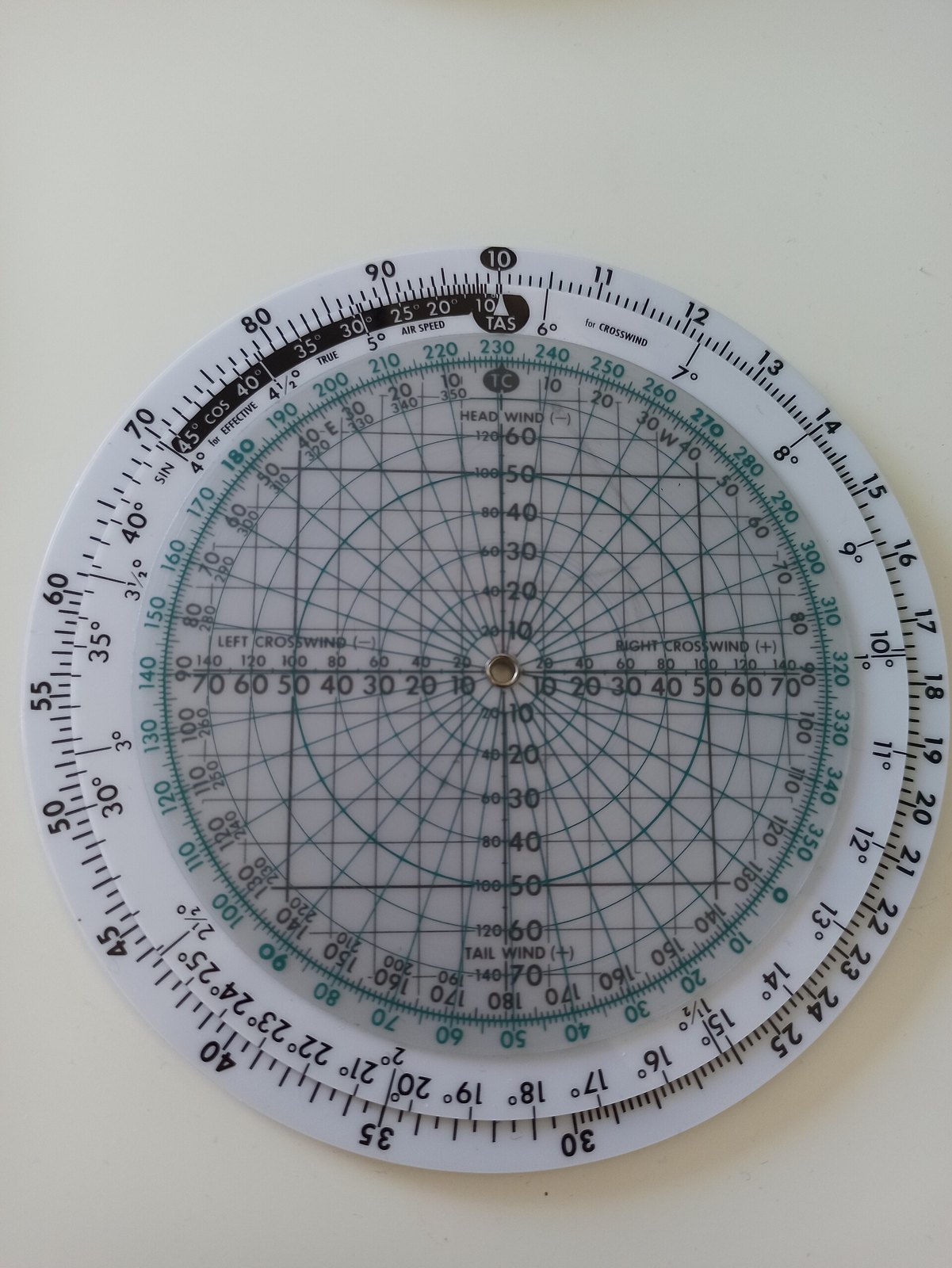
The E-6B went into civil flying with the veterans. Weems’s company became part of Jeppesen, which made E-6Bs, its own Slide Graphic Computer, and from the 1950s the circular CR series, which solve the wind triangle with sine and cosine scales instead of a sliding grid. Plastic E-6Bs from Sanderson Films and others followed in the 1960s; after Dalton’s patent expired in 1954, other makers sold copies under the name, often spelled E6-B or E6B. Sporty’s Pilot Shop, founded by Hal Shevers in Cincinnati in 1961, sold its first catalogue in 1964 and has sold E6Bs since; its Classic Aluminum E6B costs $29.95 in 2026. The FAA’s own handbook still teaches the wind triangle that it solves.
Sources
- Keith Smith, “Philip Dalton: The Lost Navigator” (code7700.com), quoting Dalton’s letters and his commanding officer’s letter.
- Barry Schiff, “Wind triangle computers”, AOPA Pilot, April 2000; Paul Sanik, “U.S. Army Air Corps Aerial Dead Reckoning Computer Type E-6B”, Journal of the Oughtred Society 6:2 (1997).
- Patents US 2,013,603 (1935) and US 2,097,116 (1937), Philip Dalton; US 2,775,404, Harold Lahr, United Air Lines (1956), marked on Jeppesen’s CR-2.
- Wikipedia, “E6B flight computer” and “Philip Dalton”; Slide Rule Museum, Dalton biography; Smithsonian National Air and Space Museum records A19750227000 and A20120155000; University of Toronto Scientific Instruments Collection, Dalton Model G; Ingenium, E-6B 1987.2620.001.
- Weems & Plath, company history; Sporty’s, “Our history”.
- A. C. Zweng, Practical Manual of the E-6B Computer (Pan American Navigation Service, 1944).
Comments (0)