Flight Computers · Volume 1
Flight Computers: My Sporty's E6B
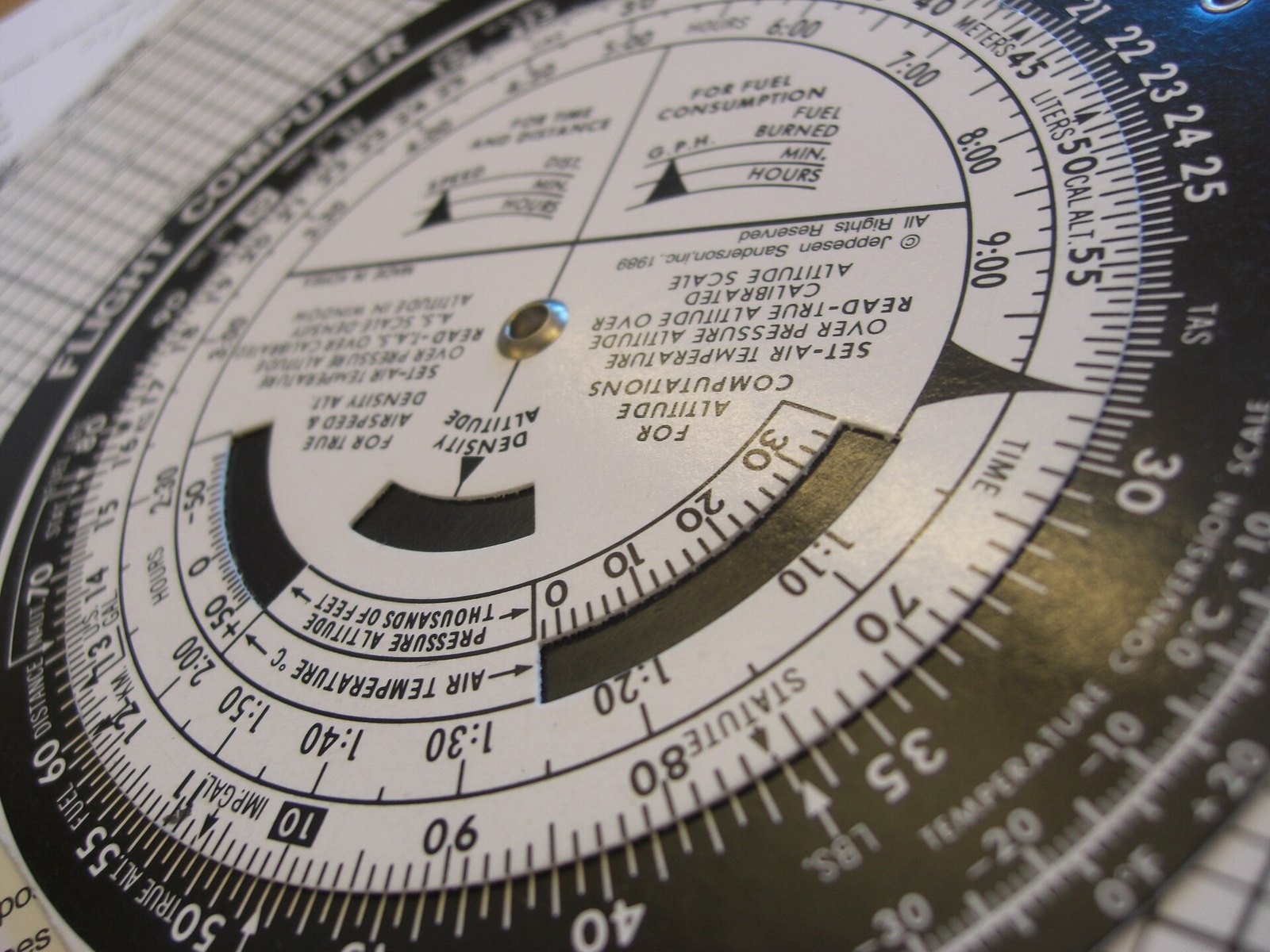
Every pilot who plans a cross-country flight has to answer the same handful of questions. Which way must the aircraft point so that the wind does not blow it off course? How fast will it cover the ground? How long will the leg take, and how much fuel will it burn? How high does the aircraft “think” it is on a hot day? Is it loaded within its limits? Since the 1930s pilots have answered them with a flight computer, and for most of that time the flight computer has been a circular slide rule with a wind grid on the back: the E-6B, designed by a United States Navy lieutenant, Philip Dalton, and adopted by the Army Air Forces in 1940. Electronic versions followed in the 1970s, and they kept the name.
I fly. When I started flying I used a cardboard E6B and then an aluminium one. Now I use the electronic one: it is so much quicker, and mistakes are not as common.
Mine is a Sporty’s E6B Electronic Flight Computer.
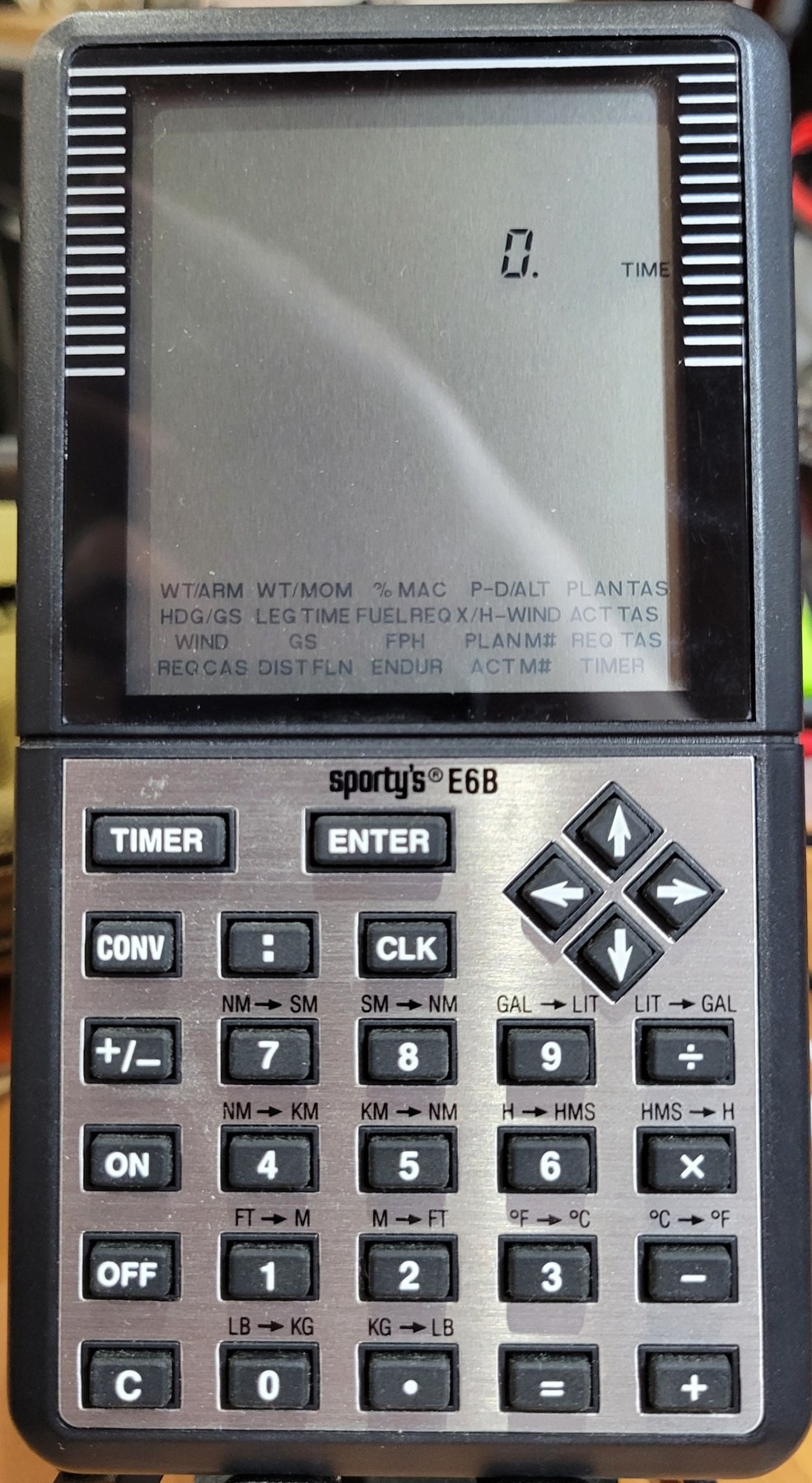
1.1 My E6B
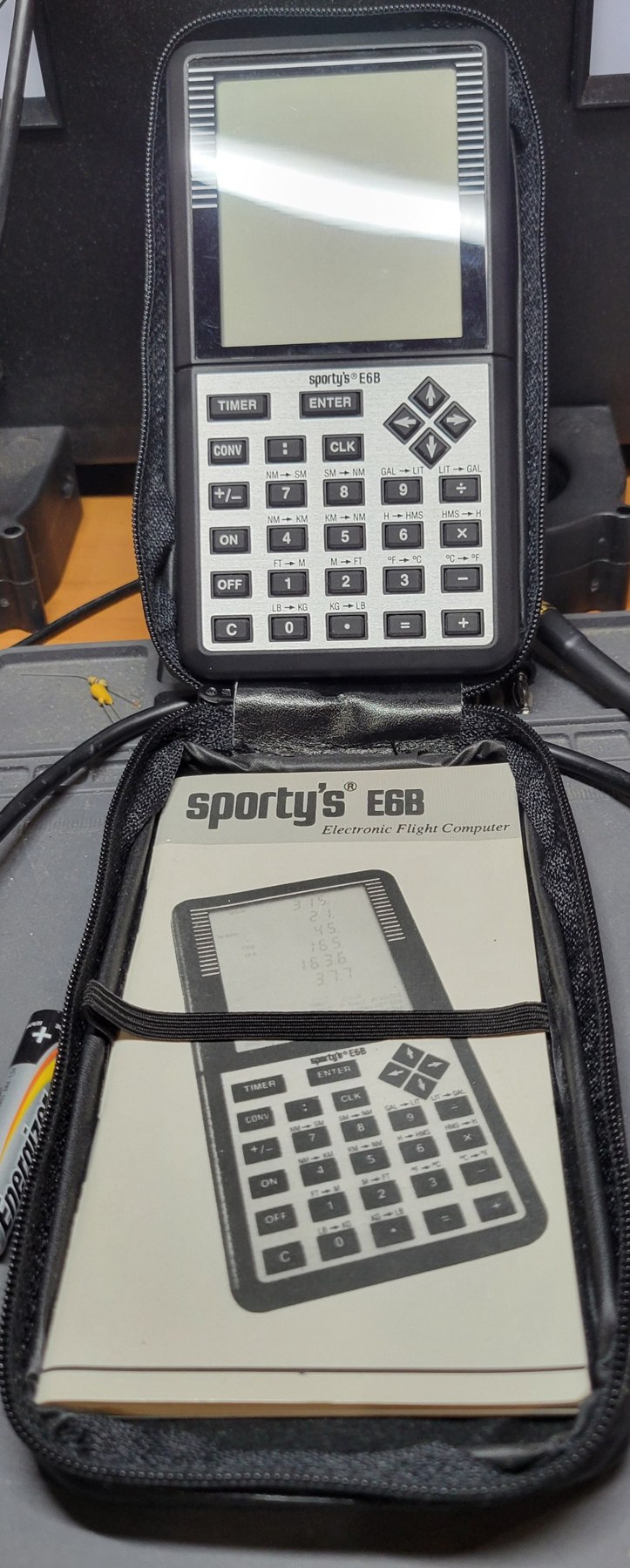
The face of my E6B reads sporty’s® E6B. The display has a menu of twenty functions printed along its foot in four rows: weight and balance (WT/ARM, WT/MOM, %MAC), altitudes (P-D/ALT), airspeeds (PLAN TAS, ACT TAS, REQ TAS, REQ CAS), the wind triangle (HDG/GS, WIND, X/H-WIND), time, speed, distance and fuel (LEG TIME, GS, DIST FLN, FUEL REQ, FPH, ENDUR), Mach number (PLAN M#, ACT M#) and a TIMER. Above the number keys are fourteen conversions, between nautical and statute miles, nautical miles and kilometres, feet and metres, pounds and kilograms, US gallons and litres, decimal hours and hours-minutes-seconds, and Fahrenheit and Celsius. It runs on three AAA cells, and it lives in a black zip case with “sporty’s” on the front, with its printed manual held in by an elastic strap and a spare cell in the pocket.
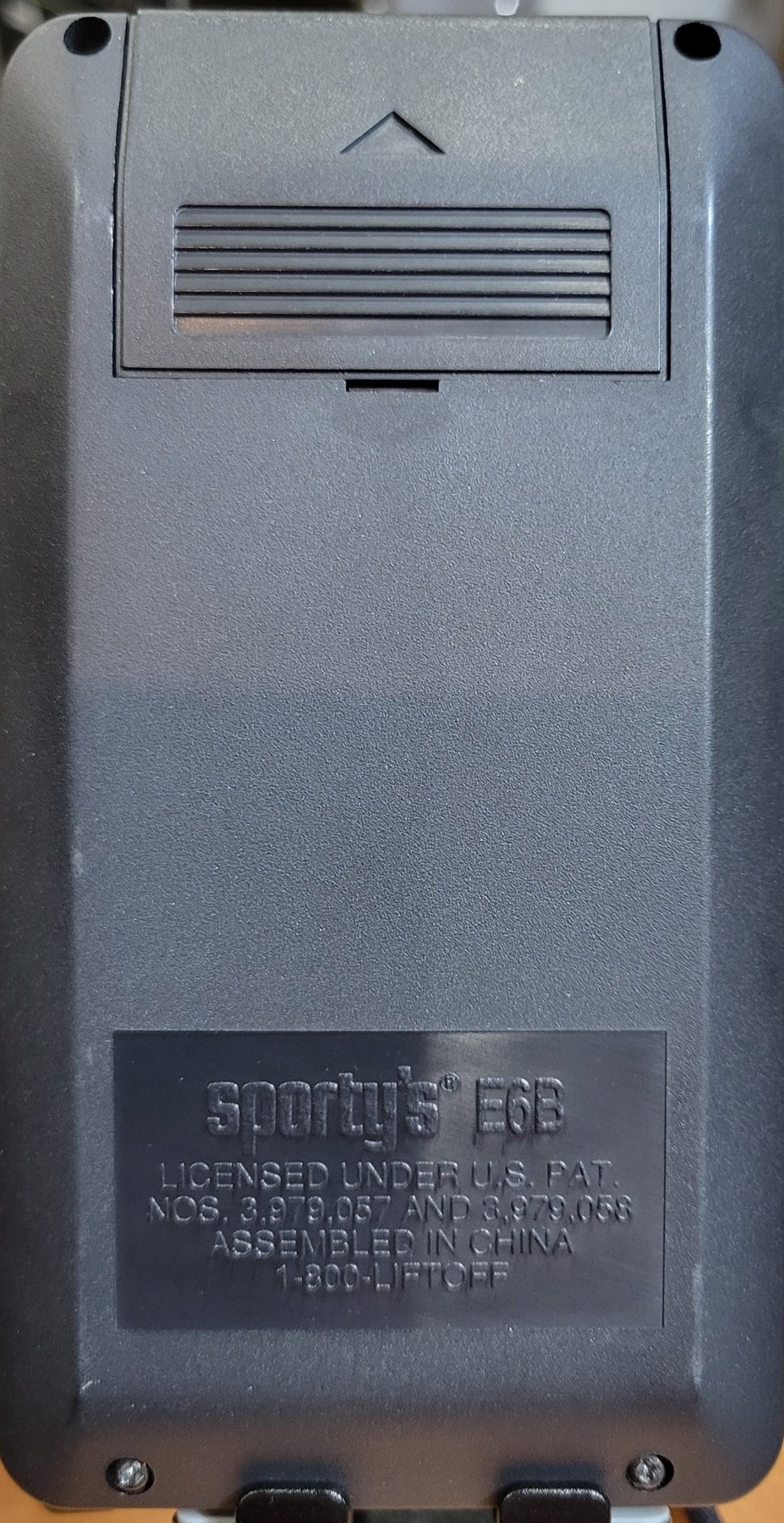
The plate on the back reads sporty’s® E6B · LICENSED UNDER U.S. PAT. NOS. 3,979,057 AND 3,979,058 · ASSEMBLED IN CHINA · 1-800-LIFTOFF. The two patents, granted on 7 September 1976 to Specialized Electronics Corporation, are the patents on the first electronic navigation computers, and the idea in them, a computer that prompts the pilot for each value in turn, is exactly how my E6B works (volume 3). The telephone number is an older one; Sporty’s now gives 1-800-SPORTYS.
Which version it is can be read from the menu. Sporty’s manual of 2005 describes the same body and keys with 20 aviation functions and 14 standard conversions, but the last cell of its menu is REQCLIMB, required rate of climb, which Sporty’s added in May 2005. On mine the last cell is TIMER. So my E6B is the original Sporty’s electronic model, made before that change; in 2012 Sporty’s replaced it with a redesigned computer with a backlit screen, 24 functions and a built-in cover. Sporty’s said in 2001 that it had sold 100,000 of the original model, “about one in six U.S. certificated pilots”. The cover of my manual is an earlier edition than any I have found online: it shows the computer working a wind of 315° at 21 knots on a course of 045° at 165 knots, with the answers 163.6 and 37.7.
1.2 From cardboard to chip
The E6B on paper and the E6B on a chip solve the same problems by entirely different means. The cardboard or aluminium E6B is a slide rule: two logarithmic scales on concentric disks for multiplying and dividing, and a sliding grid under a transparent window on which the pilot draws the wind with a pencil and reads the answer off printed curves. Its accuracy is about three significant figures, and it relies on the pilot to place the decimal point and remember which scale is which. The electronic computer works the same formulas in a chip, asks for each input by name, and gives the answer to six digits.
1.3 What is in this series
- My Sporty’s E6B: this introduction.
- Dalton’s Computer, 1933–1970: dead reckoning before computers, Philip Dalton and his plotting boards and computers, the E-6B in the Second World War, and the slide-rule computers that followed.
- Electronic Flight Computers, 1974–2026: the patents on my E6B’s back, the Navtronic, the Avstar, ASA’s Pathfinders, Sporty’s E6Bs, the apps, and the E6B built into the FAA’s own tests.
- How the Mechanical E6B Works: the circular slide rule and its indexes, and the wind side.
- The Mathematics of Flight: the wind triangle, airspeeds, pressure and density altitude, time, distance and fuel, and weight and balance, with every formula and example checked.
- Operating My E6B: every function, with Sporty’s worked examples.
- The E6B in Training and Testing: what the FAA allows in the knowledge test, checkrides, and the case for learning the slide rule first.
- Care, Collecting and the Library: batteries and faults, prices, and the documents in the Library.
1.4 A note on the sources
The operating volume is worked from Sporty’s manual of 2005, the edition closest to my E6B, and every printed answer has been recomputed from the standard formulas. The theory follows the FAA’s Pilot’s Handbook of Aeronautical Knowledge and Weight and Balance Handbook. The history draws on Philip Dalton’s patents and a biography by Keith Smith, Barry Schiff’s history of wind-triangle computers in AOPA Pilot, Paul Sanik’s study of the Army E-6B in the Journal of the Oughtred Society, the Smithsonian’s records, and the patents of the first electronic computers. All of these are in the Reference Library with the 1944 Practical Manual of the E-6B Computer, Jeppesen’s E6B manual and the FAA’s rules on calculators in tests. Where sources disagree, the text says so.
The mechanical E6B is a slide rule; the Slide Rules site covers the family it belongs to.
Sources
- Sporty’s, Sporty’s E6B Electronic Flight Computer manual, Version 05A (2005); 2016 manual (Version 13.16A).
- Patents US 3,979,057 and US 3,979,058 (1976).
- Aviation Consumer, “Electronic E6Bs”, 9 February 2001; General Aviation News, 20 May 2005 and 5 September 2012.
- My own E6B, its case and the cover of its manual.
Comments (0)