Flight Computers · Volume 3
Electronic Flight Computers, 1974–2026
The pocket calculator reached the cockpit almost as soon as it existed. By 1974 Hewlett-Packard sold navigation and aviation programs on magnetic cards for its HP-65, and inventors were filing patents for calculators built for nothing but flying. Two of those patents are printed on the back of my E6B, and the idea at their heart, a computer that tells the pilot what to enter next, is the idea every electronic flight computer since has followed.
3.1 Programmable calculators
Hewlett-Packard’s Navigation Pac 1 for the HP-65, copyright 1974, ran dead-reckoning and speed-time-distance problems from magnetic cards; an Aviation Pac covered flight planning, weight and balance, wind and conversions. The Navigation Pac recommends carrying conventional tables as a backup. These were general calculators running aviation programs; a pilot still had to remember which number went where.
3.2 The patents on my E6B
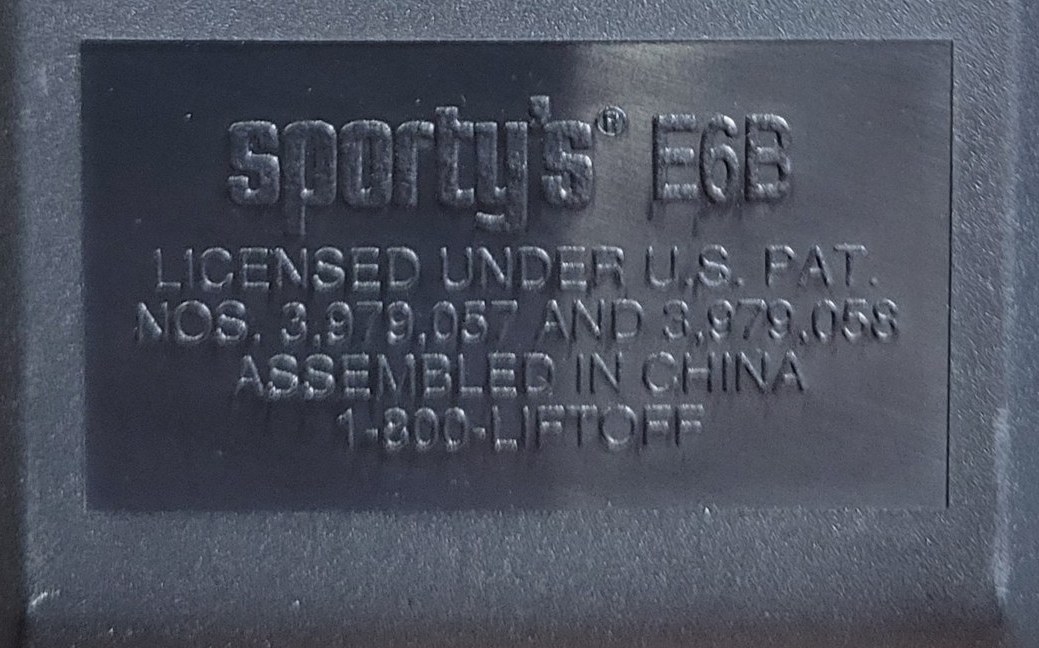
In October 1974 three Illinois inventors, Ronald C. Katz, Aaron Aronson and Clarence Turek, filed a patent for Specialized Electronics Corporation on an “Electronic navigational computer”. Granted on 7 September 1976 as US 3,979,057, it describes a hand-held, battery-powered computer for pilots: an ordinary scientific calculator chip, MOS Technology’s MPS 2525 and 2526, driven by a read-only memory and a sequencer that “press the keys” for it in the right order. Eight program keys select the problem: the wind triangle, finding the wind, true altitude, density altitude, the airspeed needed for a given true airspeed, and time, rate and distance. As each value is needed, a lamp lights to ask for it.
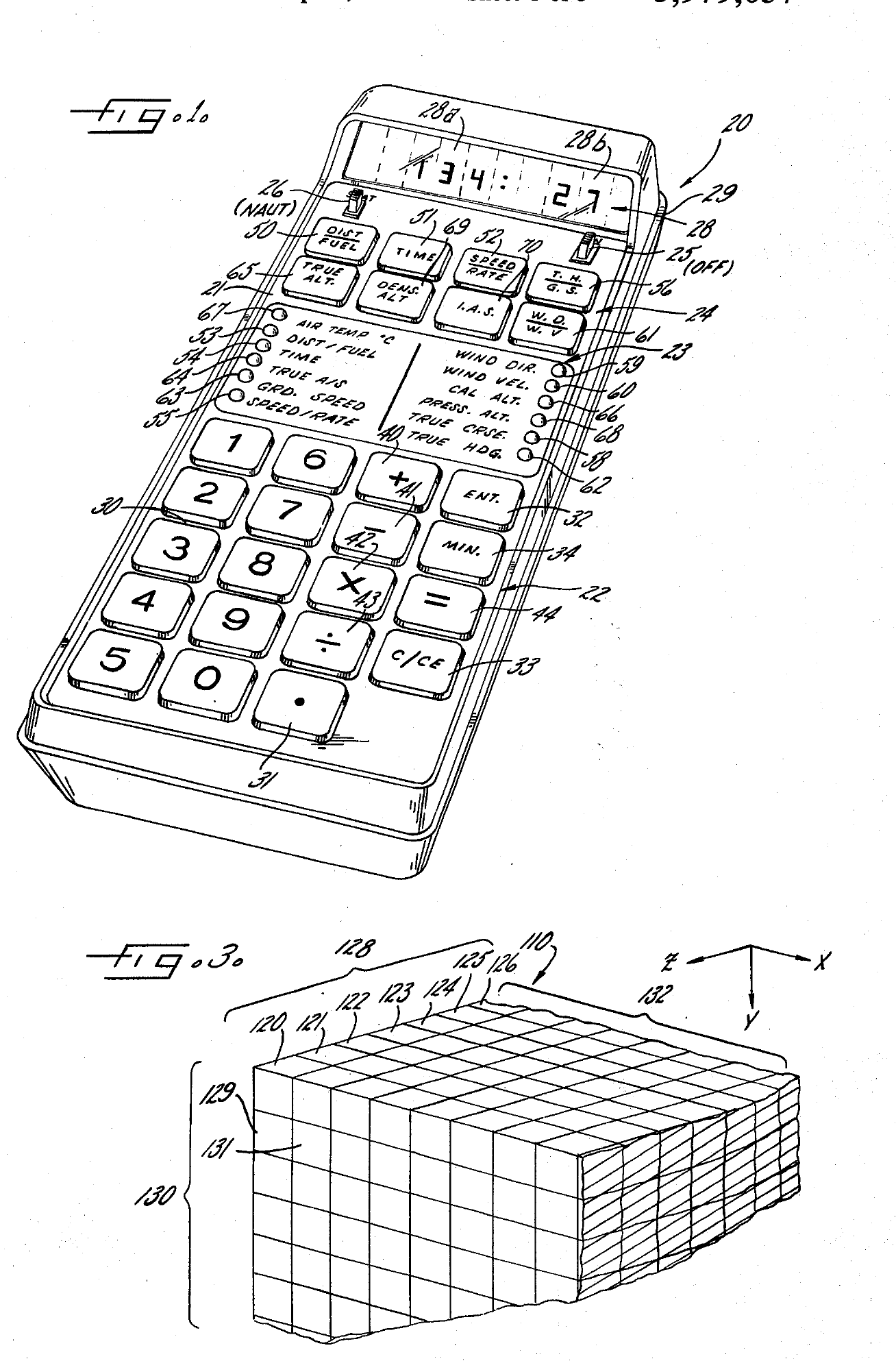
The second patent, US 3,979,058, filed in March 1975 and granted the same day, generalized that last idea as an “Operator prompting system for stored program calculator”: at each step the stored program shows what to enter, “in conversational language”, by lamps with printed legends, a separate display of words, or a display that alternates names and numbers. It applies, the patent says, to programs “navigational, financial, scientific, or engineering”.
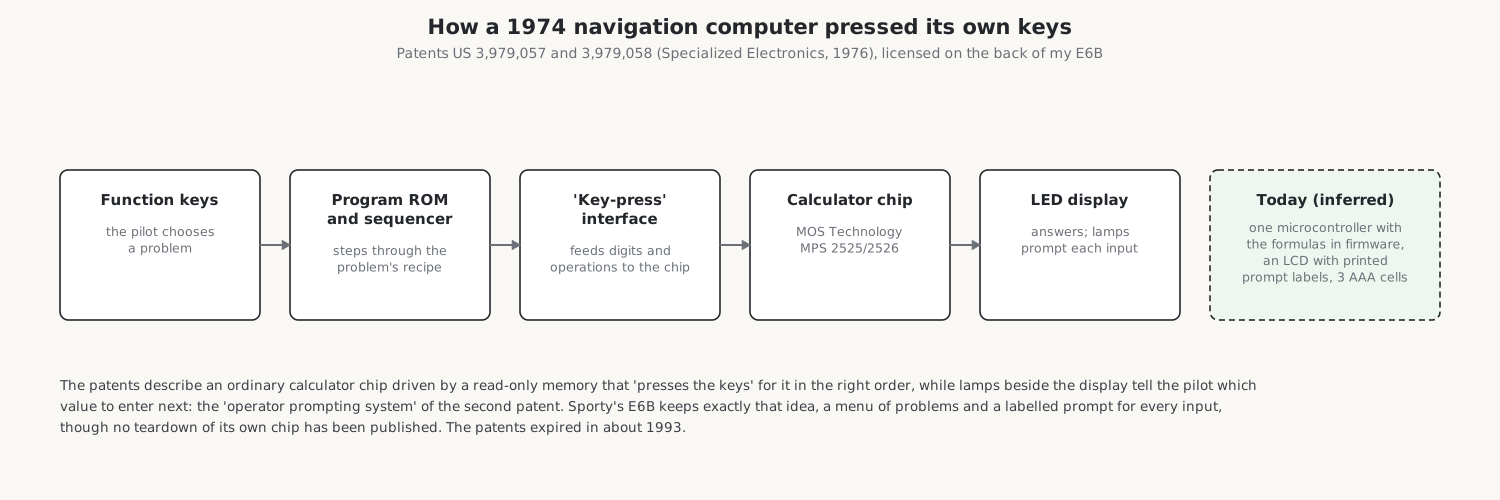
Specialized Electronics sold the result as the Navtronic 16, introduced in 1977 at $197.50, with a red LED display and fourteen LED lamps beside the keys to prompt each entry; the Smithsonian’s National Air and Space Museum holds one. Joerg Woerner’s Datamath Calculator Museum, which has taken one apart, found a National Semiconductor calculator chipset inside a 1979 example, not the MOS Technology chips of the patent. It was followed by the Navtronic 1701 and, in the 1980s, the liquid-crystal Navigator and Explorer. The Navtronic had rivals from the start: the Commodore N60 of 1976 and the Heathkit OCW-1401 also date from 1976 to 1978.
The two patents expired in 1993. Sporty’s licensed them, as the plate on my E6B says, and the menu of my E6B, with a label lighting beside each value it asks for, is the 1975 “operator prompting system” in liquid crystal. The patents’ Ronald C. Katz is not to be confused with Ronald A. Katz of the telephone-patent licensing company; nothing links the two.
3.3 Avstar, Pathfinder and the menu
Jeppesen Sanderson, the chart publisher, brought out the Avstar in 1980, built for it by Texas Instruments on the TI-35 scientific calculator, and sold also as the Cessna Sky/Comp and the Beechcraft and Piper Avstars; the ProStar followed on the TI-55-II. These kept the calculator layout, with aviation functions on extra keys.
ASA, Aviation Supplies & Academics of Seattle, took the next step. Its patent US 4,831,538, filed in December 1986, describes a “hand-held navigation and flight performance computer” with a display divided into a menu of function names, prompts for each input and a data area; arrow keys choose the function; and each answer is kept as the default input for the next problem. The patent criticizes the older designs that needed a key for every program, “43 keys” for its set of functions. The result was the CX-1 Pathfinder, on sale by 1988.
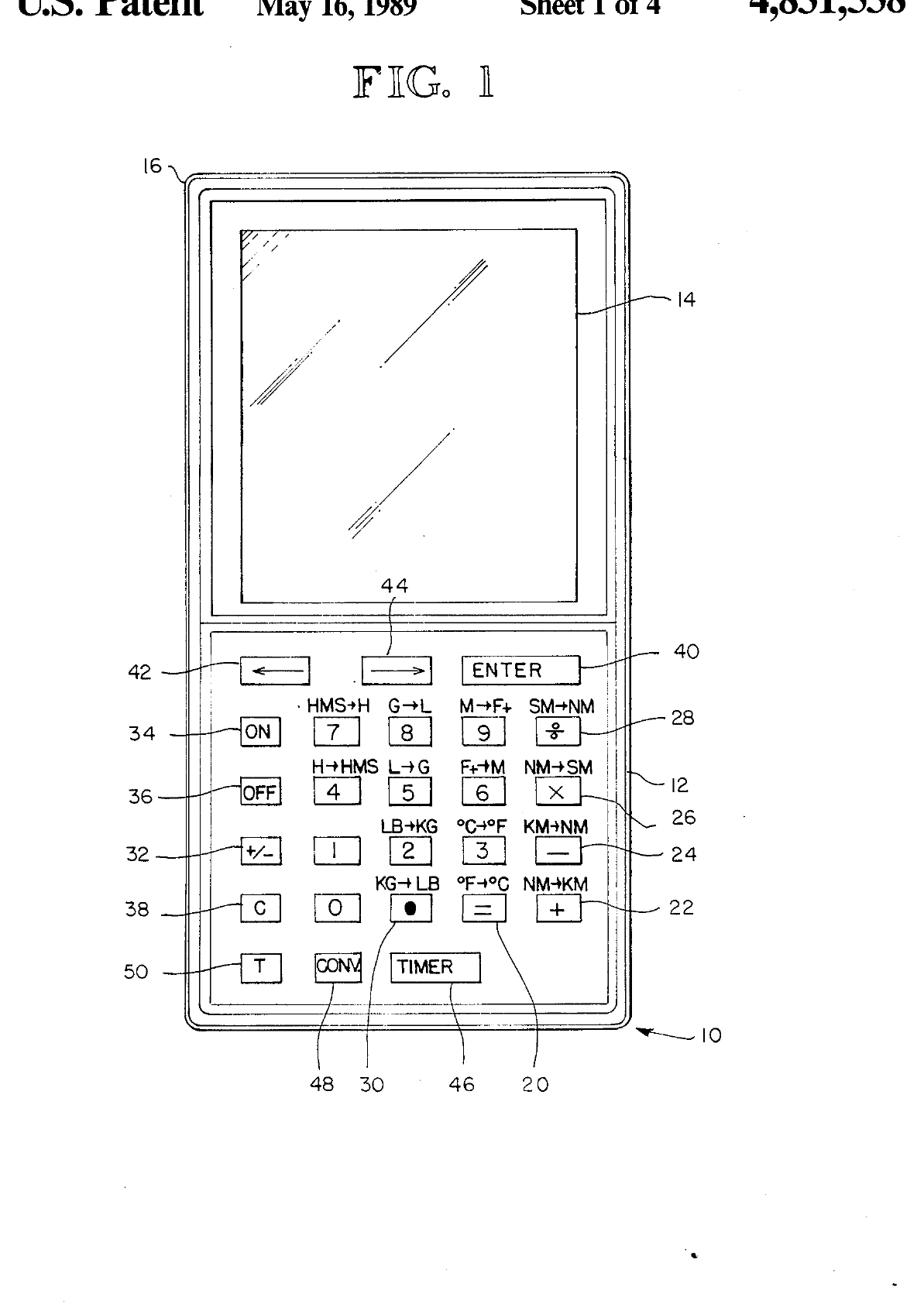
That is the design of my E6B: a menu of twenty functions printed across the foot of the display, a cursor moved with the arrow pad, ENTER to choose, a labelled prompt for every input, and answers carried forward from one problem to the next.
3.4 Sporty’s E6Bs
Sporty’s says its mechanical E6B “evolved into an electronic version in the 1980s”; a pilot recalls buying one for his instrument rating’s written test around 1990. In February 2001 Aviation Consumer tested it against ASA’s CX-1a and Jeppesen’s TechStar and called it the “clear winner”, with a “superior display”, a zip case that opens from the top and a four-way arrow pad; it cost $69.95, and Sporty’s said it had sold 100,000. In November 2001 Sporty’s added a thin “flat” E6B-F with lithium cells, and in May 2005 a required-rate-of-climb function for the original model, which appears as REQCLIMB in the last cell of the menu, where mine has TIMER. In September 2012 Sporty’s redesigned it with a backlit screen, a larger keypad, a built-in cover, 24 functions and 20 conversions; it cost $79.95 in 2022 and $89.95 in 2026, when Sporty’s said that “over 250,000 pilots have trusted Sporty’s Electronic E6Bs”. ASA’s current CX-3 came out in 2017 at $99.95.
Hal Shevers, who founded Sporty’s in 1961 selling radio receivers from the trunk of his car and moved it to Clermont County Airport near Batavia, Ohio, in 1971, retired in 2024 after 63 years and died in May 2026, aged 90.
3.5 The E6B becomes software
In April 2010 Sporty’s announced an E6B app for the iPhone at $4.99; by 2017 it ran on the Apple Watch, and in 2026 it has 27 functions and costs $9.99. And on 23 September 2024 the FAA’s knowledge-test platform began offering, in every test, “an enhanced aviation-oriented calculator, including an E6-B flight computer”. Ninety years after Dalton’s first computer, the E6B is built into the examination itself.
Sources
- Patents US 3,979,057 and US 3,979,058, Katz, Aronson and Turek, Specialized Electronics Corp. (1976); US 4,831,538, ASA (1989); US 3,924,111, Farris (1975).
- Hewlett-Packard, HP-65 Navigation Pac 1 (1974) and Aviation Pac 1.
- Datamath Calculator Museum, “Navtronic 16”; Smithsonian National Air and Space Museum, Navtronic 16 (A19790181000); Calcuseum on the Commodore N60, Avstar and ProStar; Albion College’s aviation calculator page.
- Aviation Consumer, “Electronic E6Bs”, 9 February 2001; AOPA Flight Training, November 2001; General Aviation News, 20 May 2005, 5 September 2012 and 29 September 2017; Plane & Pilot, 26 September 2022; Sporty’s product page and history; iPad Pilot News, 6 February 2017; AvWeb, April 2010; Flying and AOPA on Hal Shevers (May 2026).
- FAA, Airman Testing Community Advisory, August 2024.
Comments (0)