Scientific Calculators · Volume 1
Scientific Calculators: My Casio and My TI
A scientific calculator does what a slide rule did, and a good deal more, to ten significant figures, for the price of a meal. In 1972 the first one in a pocket, Hewlett-Packard’s HP-35, cost $395. Four years later Texas Instruments sold the TI-30 for $24.95, and within a year the American slide-rule makers had stopped production. Fifty years on, the scientific calculator is still on every student’s desk, because exam rooms ban phones, and it still works much as its makers designed it in the 1970s, with decimal arithmetic and digit-by-digit algorithms inside a single chip.
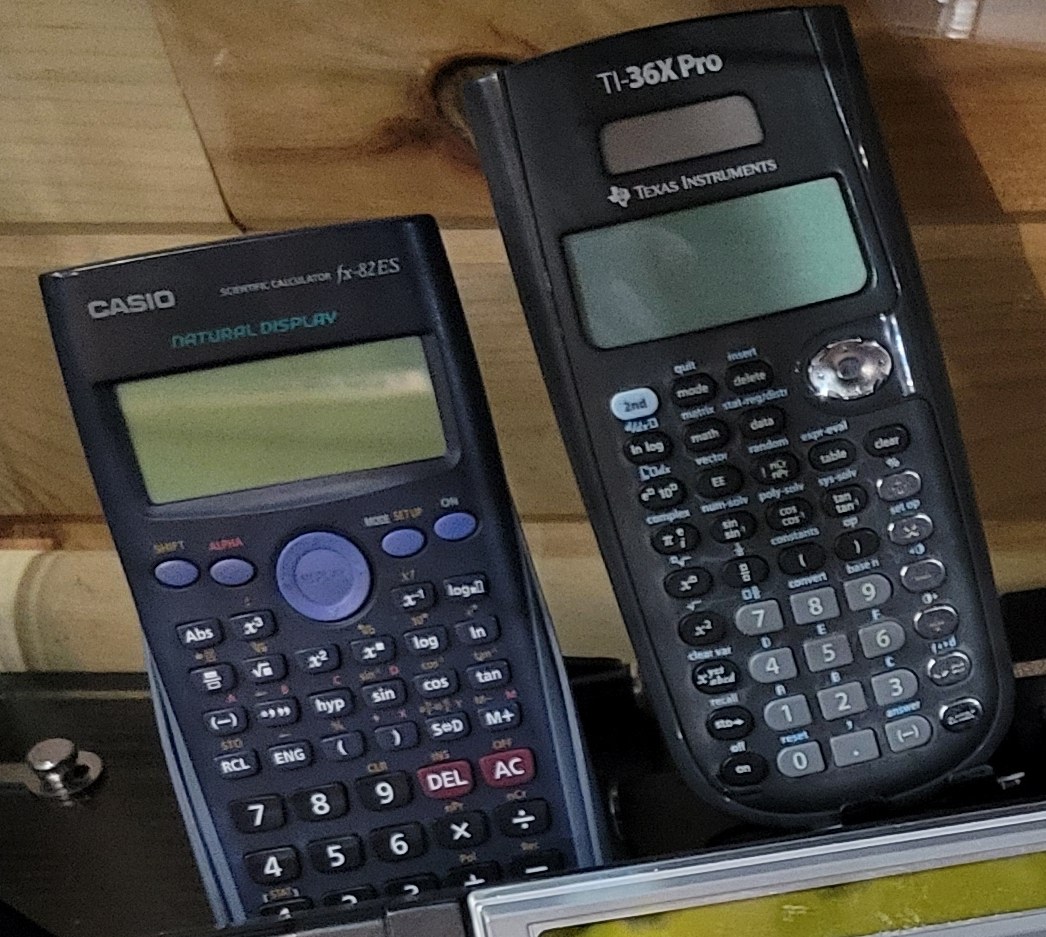
I have two: a Casio fx-82ES and a Texas Instruments TI-36X Pro. They come from the two best-known families of the last twenty years, made by two of the companies that lead the field, and they show two answers to the same question: how to make a calculator show mathematics the way it is written on paper.
1.1 My Casio fx-82ES
The fx-82ES of 2004 was the first calculator with Casio’s Natural Display: fractions, roots, powers and logarithms typed and shown the way a textbook prints them, on a 96 × 31 dot liquid-crystal screen. It belongs to a family, the fx-82, that Casio has made under one number since 1982 and sold to schools around the world. Mine is the original ES, not the ES PLUS of 2008, and it has no solar cell: it runs on a single AAA battery, which Casio rates at about 17,000 hours with the cursor flashing.
It has three modes, COMP for calculation, STAT for statistics and regression, and TABLE for tabulating a function, and 252 functions. Inside it is the same calculator as the larger fx-991ES, with features switched off, which is why hobbyists have found ways to switch them back on.
1.2 My TI-36X Pro
The TI-36X Pro was announced on 16 May 2011 at a suggested price of $25. It is Texas Instruments’ most capable non-graphing calculator: a four-line display of 16 characters a line, TI’s MathPrint textbook format, numerical derivatives and integrals, an equation solver and polynomial and linear-system solvers, matrices, vectors, complex numbers, number bases, statistics with six regressions, physical constants and unit conversions. It runs on a CR2032 lithium cell helped by a five-cell solar panel. It is the American name for a European model, the TI-30X Pro MultiView, which was launched in September 2010, withdrawn a month later for giving wrong answers, and relaunched in 2011. It is approved for the SAT, the ACT, AP exams and the American engineering licensing exams, the FE and PE.
1.3 Two answers to the same problem
Both machines solve the problem the first scientifics never could: showing a whole expression, and showing it as mathematics. The HP-35 and its rivals showed one number at a time in red light-emitting digits. My fx-82ES draws √(1/2) + 3 with the fraction stacked under a root sign, and gives fractions as fractions until asked for a decimal. The TI-36X Pro does the same in MathPrint, on more lines, with more mathematics behind it. Underneath, both still compute in decimal, with more digits than they show, by methods that go back to Henry Briggs’s tables of logarithms of 1624.
1.4 What is in this series
- My Casio and My TI: this introduction.
- The Electronic Slide Rule, 1968–1978: the HP 9100A and HP-35, Texas Instruments’ SR series, the Sinclair Scientific, Casio’s fx-10, and the TI-30 that finished the slide rule.
- The LCD Generations, 1978 to Today: the fx-82 line from 1982 to the ClassWiz, the TI-30 line to the TI-36X Pro, Natural Display and MathPrint, HP, Sharp, solar power.
- Inside a Scientific Calculator: one chip, a display, a keyboard and a battery, from the HP-35’s five chips to the fx-82ES’s one.
- How They Calculate: decimal numbers, CORDIC, Briggs’s logarithms, guard digits, the calculator forensics test, and how a textbook fraction is stored.
- Operating the Casio fx-82ES: modes, setup, fractions, percentages, memories, statistics and tables, from Casio’s guide.
- Operating the TI-36X Pro: MathPrint, calculus, solvers, matrices, statistics and conversions, from TI’s guidebook.
- Repair, Hacks and Fakes: batteries, keys and displays; turning an fx-82ES into an fx-991ES; spotting a counterfeit Casio.
- Exams and Collecting: which exams allow which calculators, what the classics are worth, and the documents in the Library.
1.5 A note on the sources
The worked examples in the operating volumes are taken from Casio’s fx-82ES User’s Guide and its appendix and from TI’s TI-36X Pro Guidebook, and every printed result has been checked against those documents, which are in the Reference Library with the HP-35, SR-50, SR-51, TI-30 and Sinclair Scientific manuals, the HP Journal article on the HP-35 and two Texas Instruments patents. The history draws on Dave Cochran’s case study of the HP-35’s design for the Computer History Museum, Ken Shirriff’s reverse engineering of the Sinclair Scientific, Mike Sebastian’s calculator-forensics tables, and Casio’s and TI’s own chronologies and press releases. Where sources disagree, on dates, prices and even what is inside the calculators, the text says so.
Comments (0)