Pocket Computers · Volume 2
From Calculator to Computer
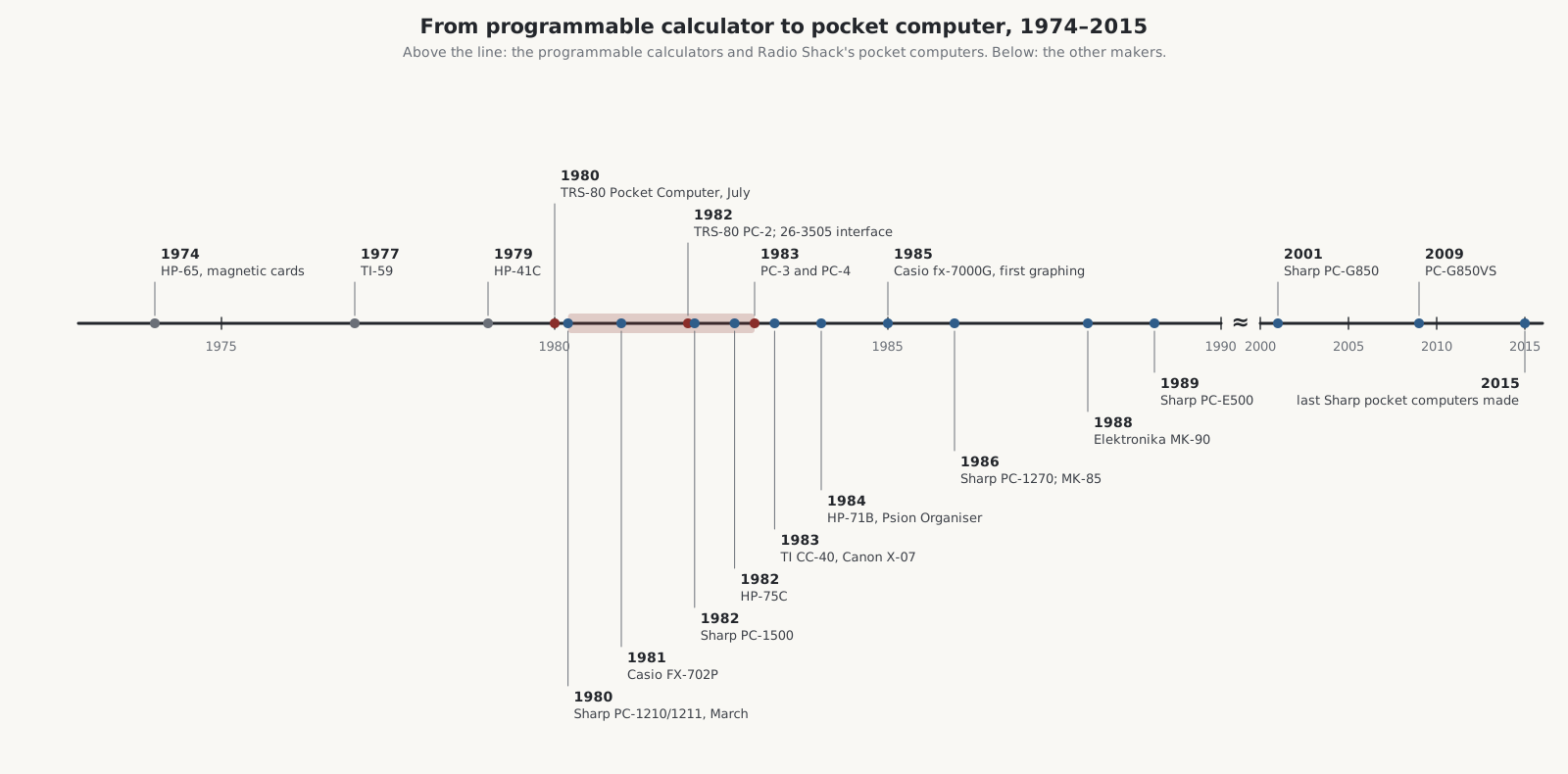
The pocket computer grew out of the programmable calculator. Through the 1970s calculators learned to store sequences of keystrokes, to branch and loop, to save their programs on magnetic cards and to show letters as well as numbers. By the end of the decade the best of them were small computers in everything but name, programmed in their makers’ own keystroke languages. In 1980 Sharp took the last step and gave one a real programming language, BASIC, the language of the home computers then appearing on desks.
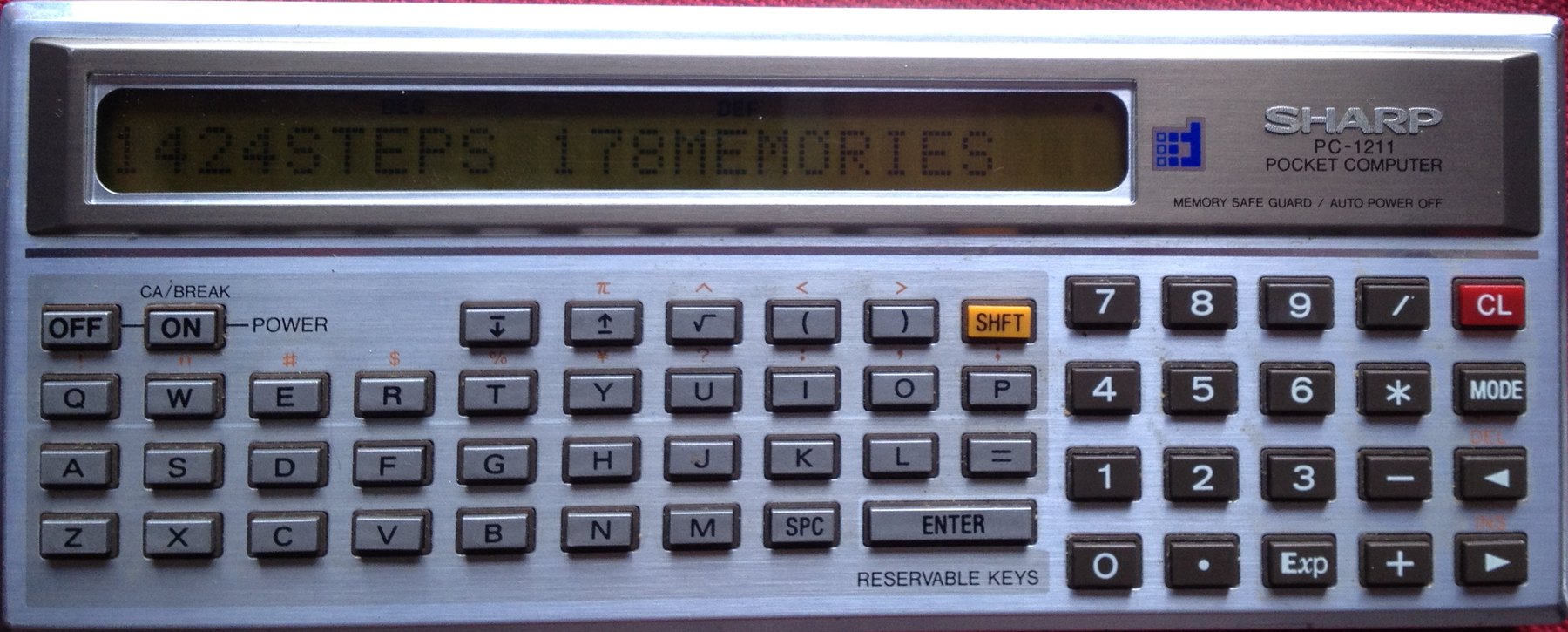
2.1 The programmable calculators
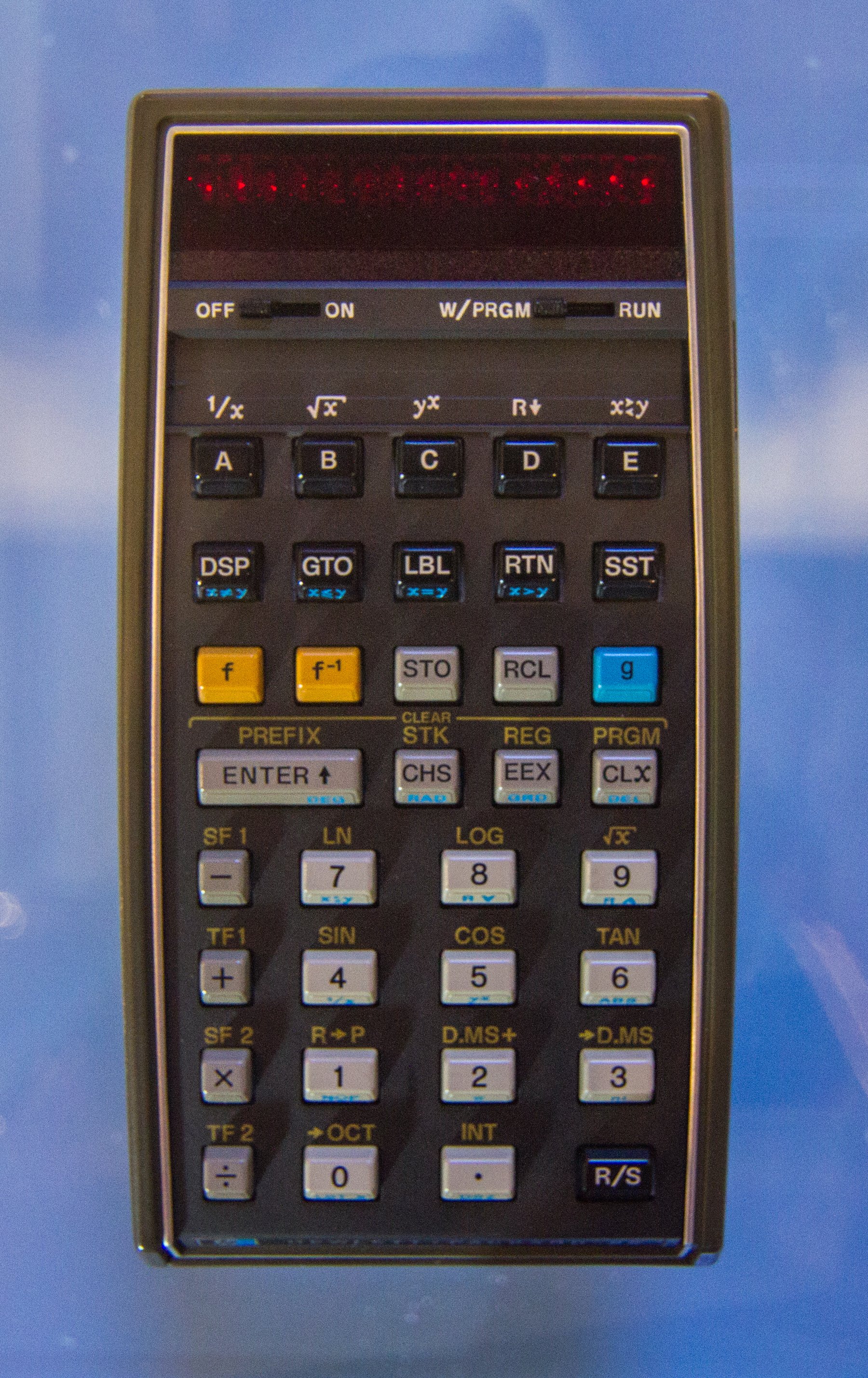
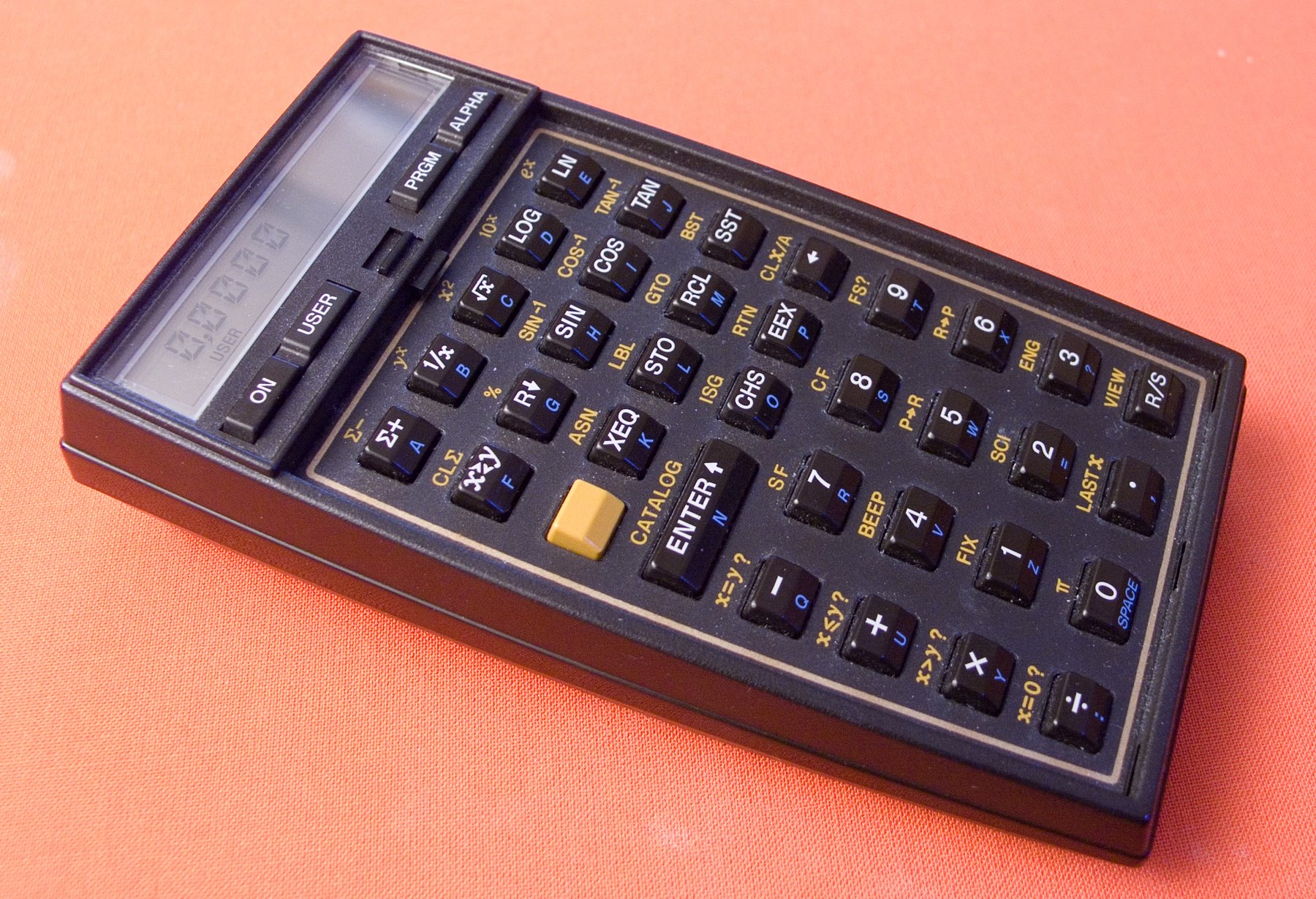
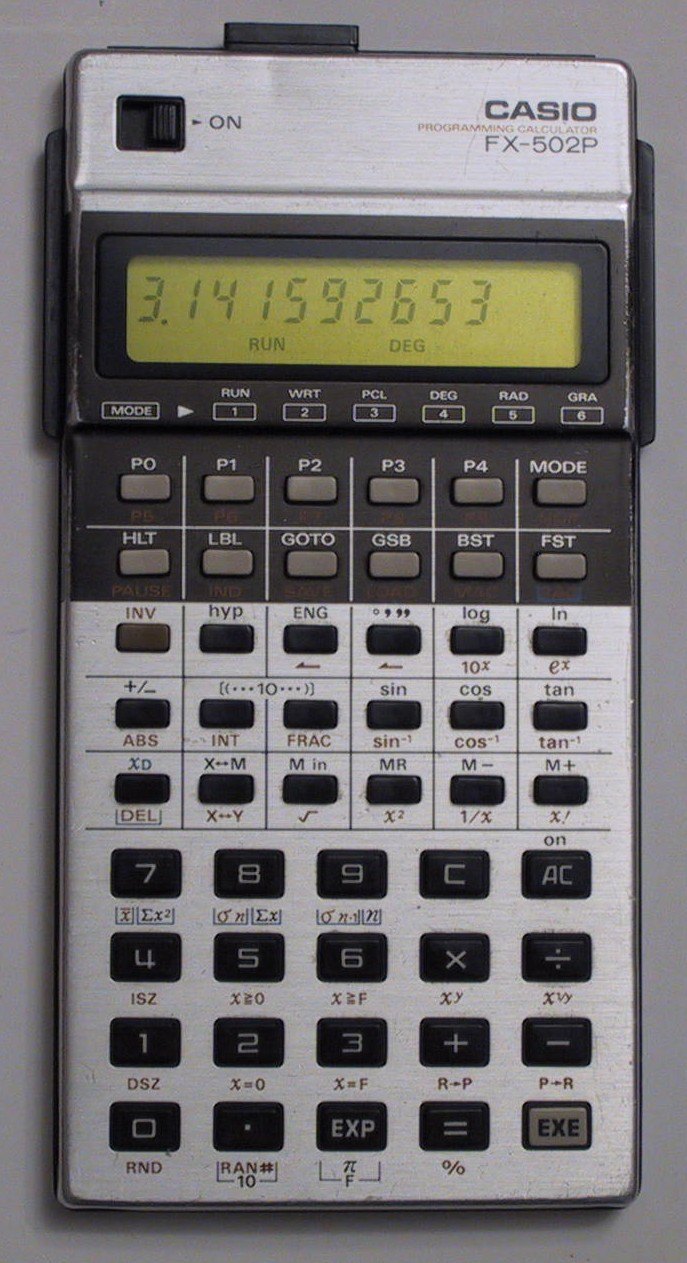
Table 1 — The programmable calculators
| Machine | Year | Launch price | What it added |
|---|---|---|---|
| HP-65 | January 1974 | $795 | the first handheld programmable with magnetic cards to save programs; 100 steps |
| TI-59 | May 1977 | $299.95 | magnetic cards and plug-in ROM modules of ready-made programs; a printer cradle for $199.95 |
| Casio FX-502P | 1978 or 1979 | about ¥20,000–25,000 | 256 steps, and a cassette interface, the FA-1, that saved programs on ordinary audio tape |
| HP-41C | July 1979 | $295 | an alphanumeric liquid-crystal display, plug-in memory and application modules, a card reader and printer |
Each was programmed by recording keystrokes. A program on an HP-41C is a list of the keys the owner would have pressed, with labels and tests added; it is powerful, but it is not a language anyone outside the calculator world could read. The HP-35 of 1972, the first scientific pocket calculator, had cost $395, “fifty times as much as the slide rule”, as Roland Saam puts it; by 1979 the best programmables cost less than that and did far more.
2.2 Sharp’s PC-1210 and PC-1211
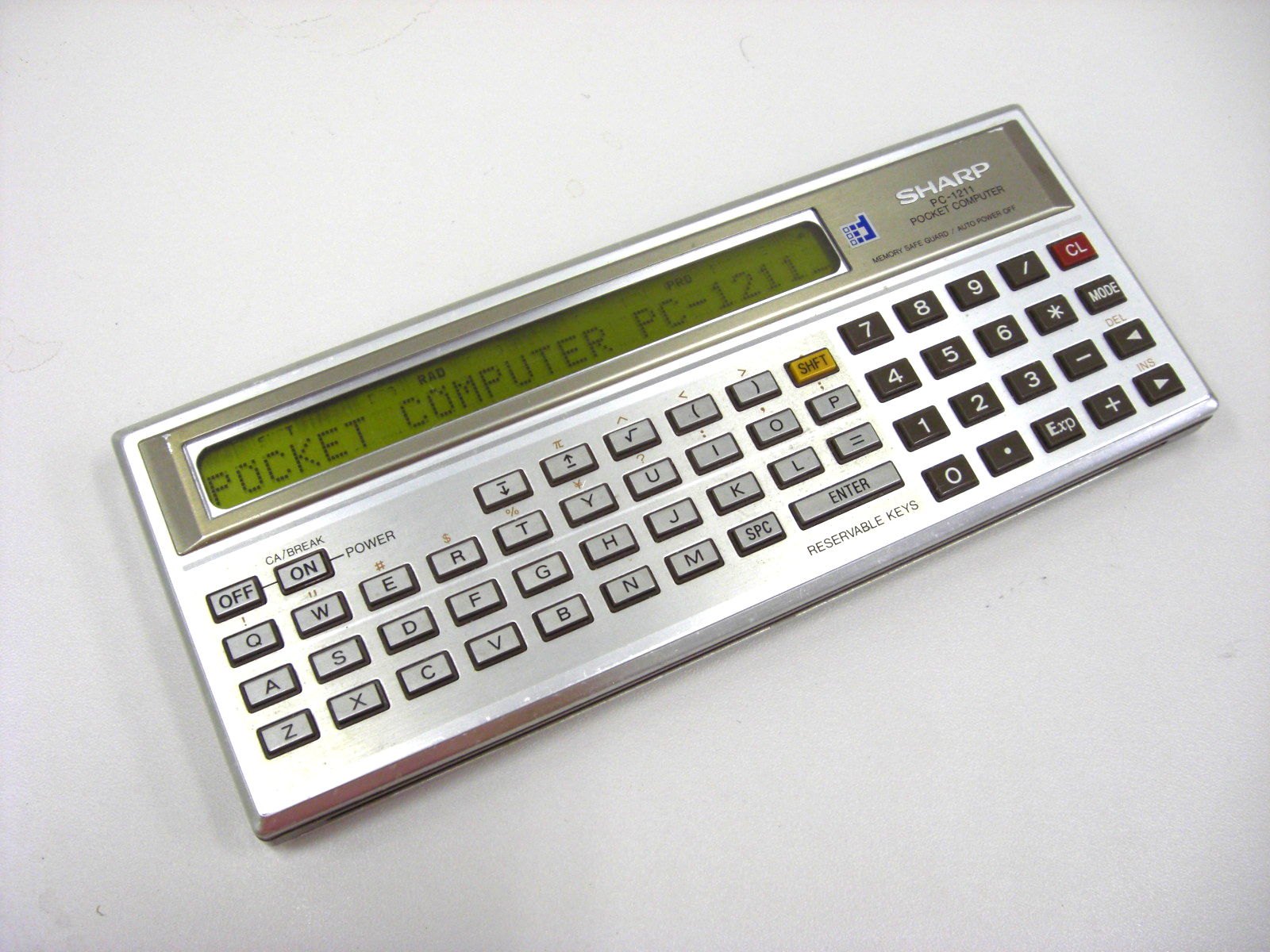
Sharp’s pocket computers came from its calculator group at Nara, not from the computer division in Osaka that later made the larger PC-1500 and PC-1600. The first two models were sold in 1980:
- the PC-1210, with room for 400 program steps, about 0.9 KB of memory in all;
- the PC-1211, the same machine with 1,424 steps and about 1.9 KB.
English Wikipedia gives March 1980 for the PC-1211 and calls it the first pocket computer ever sold; DATAMATH gives June 1980 for the PC-1210, and a German article says the PC-1210 was tried in Japan for about a month before it went to Europe. Japanese sources put the prices at about ¥29,800 for the PC-1210 and ¥43,000 for the PC-1211. In July 1980 the British magazine Practical Computing called the PC-1211 a “contender for the title of the first genuine pocket computer”. No earlier BASIC handheld has been found; Saam’s history begins with the sentence “Pocket computers were first marketed worldwide by the SHARP Corporation of Japan in 1980.”
What made it a computer rather than a calculator was the language. The PC-1211 held a BASIC interpreter in its read-only memory, so its owner typed programs as numbered lines of English-like statements, 10 INPUT A,B and 20 C=√(A*A+B*B), the same way as on a desktop microcomputer. It had a 24-character dot-matrix display that could show any letter, a QWERTY keyboard, string variables, and memory that kept programs and data when it was switched off. Inside were two 4-bit processors, described in the volume on the hardware.
2.3 Radio Shack’s Pocket Computer
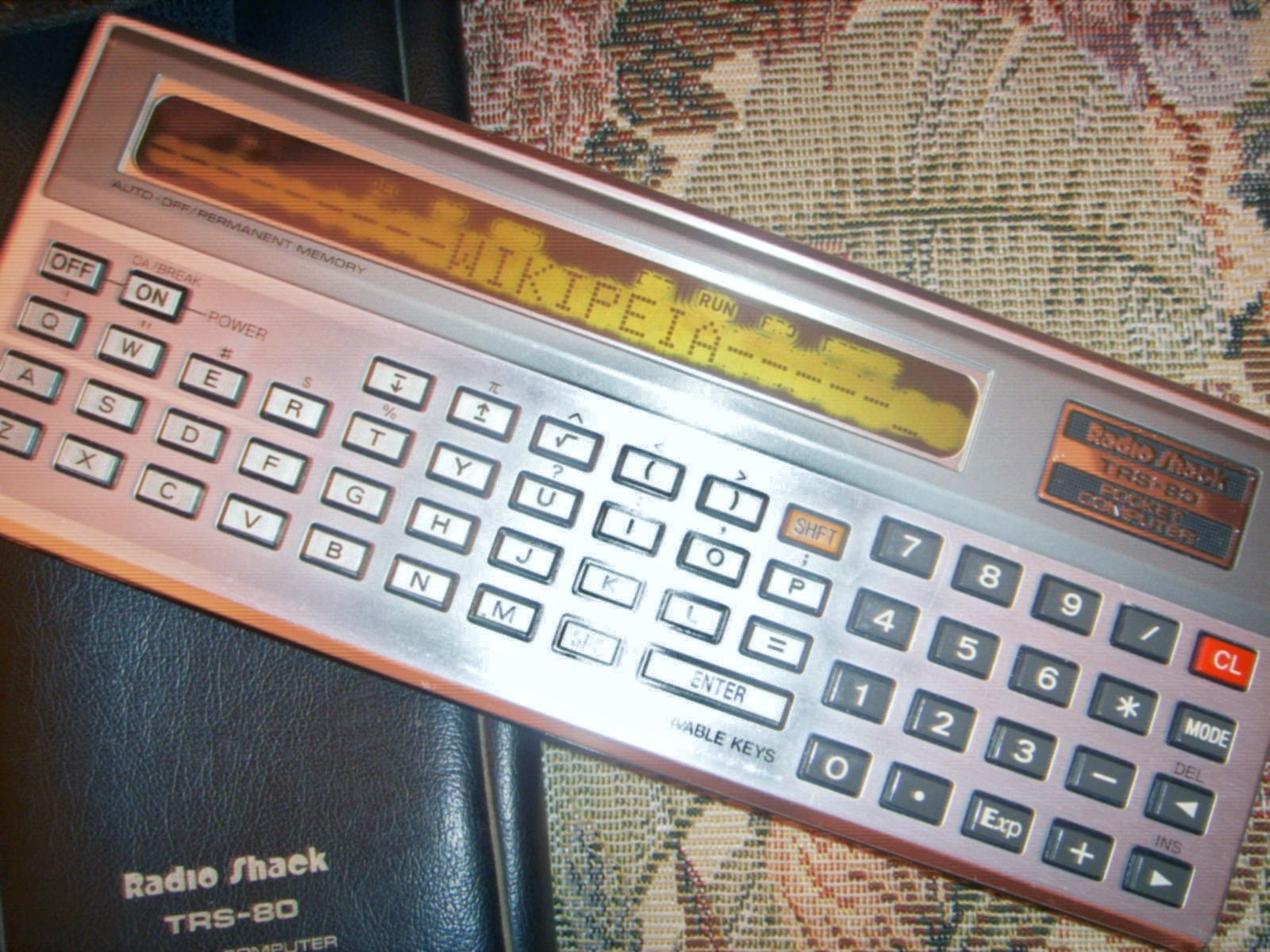
Radio Shack introduced the TRS-80 Pocket Computer, catalogue number 26-3501, on 31 July 1980, the same day as its TRS-80 Model III and Color Computer. It was the PC-1211 in a black case with a silver keyboard and a Radio Shack badge, “custom manufactured in Japan for Radio Shack”, and it was never sold in the United States under Sharp’s own name at the time. Radio Shack called it simply the Pocket Computer; in 1982, when a second model arrived, it became the PC-1.
The launch price is quoted differently by different sources: $249 on trs-80.org, $249.95 in Radio Shack’s advertisements, $230 on another collector’s site; BYTE in December 1980 rounded it to $250. Radio Shack later cut it: to $169.95 in a 1982 advertisement, then to $159.95 and $149.95 by 1983, and dropped it after the PC-3 arrived that year. Sharp’s own PC-1211 cost about $229 in the United States, according to the PROMSoft list on sharppocketcomputers.com.
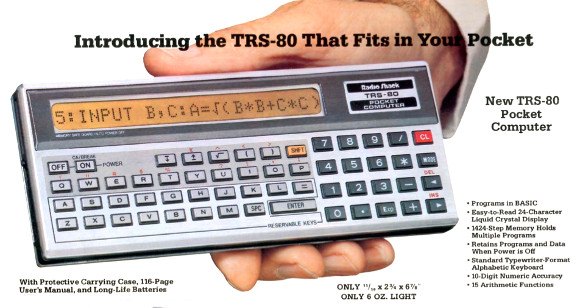
Radio Shack’s catalogue sold it as a TRS-80 that could do most of the smaller jobs of the desktop machines, except graphics. With it came a carrying case, a 126-page owner’s manual and a set of cells. The accessories followed:
Table 2 — Radio Shack's catalogue sold it as a TRS-80 that could do most of the smaller jobs of the desktop machines, except graphics. With it came a carrying case, a 126-page owner's manual and a set of cells. The accessories followed
| Accessory | Cat. no. | Price |
|---|---|---|
| Cassette Interface | 26-3503 | $49, later $29.95 |
| Printer/Cassette Interface (introduced 1982) | 26-3505 | $149, later $127.95 |
| Printer paper, six rolls | 26-3506 | $1.75 |
| Minisette-9 cassette recorder | 14-812 | $79.95 |
On cassette came Radio Shack’s programs: Real Estate, Surveying, Civil Engineering, Aviation, Engineering Math, Statistical Analysis, Math Drill, Games I and II, Golf Scoring, Banners and Calendars among them.
2.4 Asimov and the Foundation
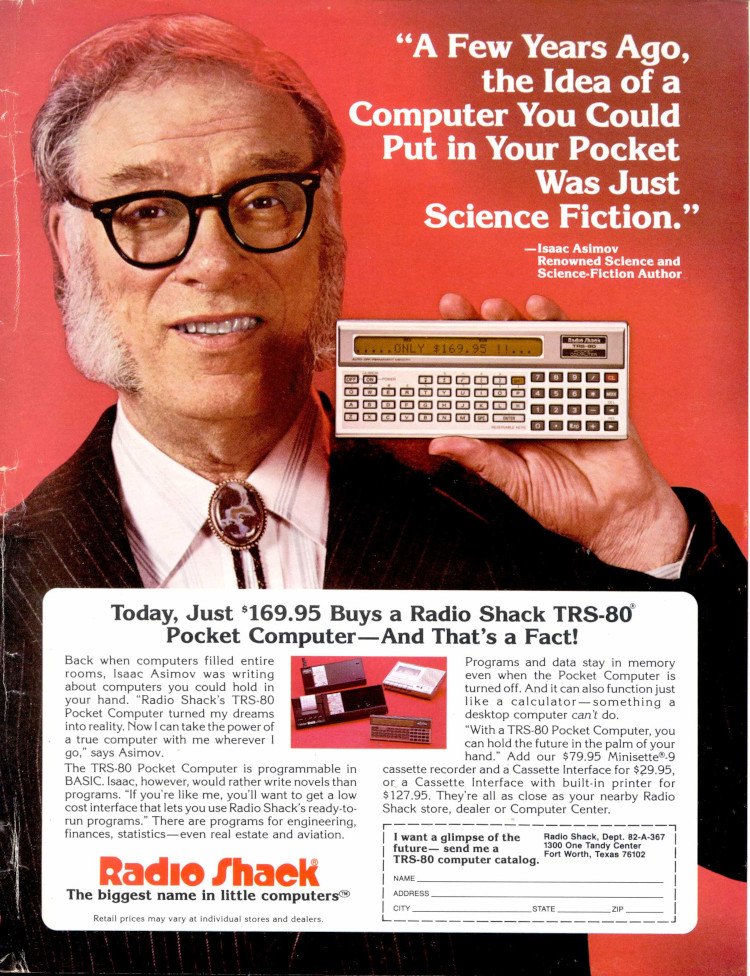
In 1981 and 1982 Radio Shack’s spokesman for its computers was Isaac Asimov. InfoWorld reported in January 1982 that when he was asked whether this was the pocket computer of his Foundation novels, he said, “This is it.” A 1982 advertisement put him beside it under the headline “A few years ago, the idea of a computer you could put in your pocket was just science fiction”, with the price down to $169.95, the cassette interface at $29.95 and the printer interface at $127.95.
2.5 How many were sold
No figure has been found for the PC-1 alone. InfoWorld reported that Radio Shack shipped 70,000 pocket computers in 1982 and 40,000 in 1983, across all its models, and blamed the fall on muddled marketing and buyers discovering what the machines could not do. The whole American pocket-computer market was worth about $150 million in 1983.
2.6 The rival that was not a pocket computer
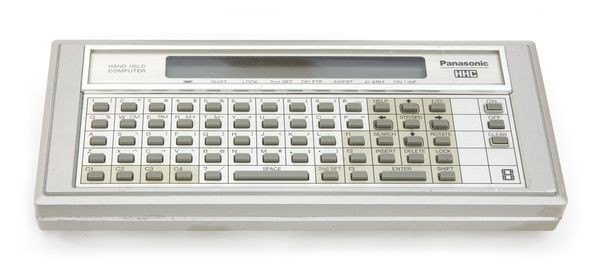
The Panasonic and Quasar HHC, the Hand Held Computer, was designed with the San Francisco firm Friends Amis and reviewed in BYTE’s hand-held computer issue of January 1981. It had a 6502 processor, a 26-character display and an interpreted language called SNAP, with Microsoft BASIC as an extra-cost ROM, and it weighed 620 grams, more than three PC-1s. BYTE reported that Panasonic and Quasar expected to sell a million of them at $400; the Computer History Museum dates its introduction to 1982 and notes that it was “much bigger than a hand”. Many went to insurance salesmen with insurance programs in ROM.
2.7 The timeline
Sources
- Roland J. Saam, “A History of Pocket Computers 1980–2000”, IEEE HISTELCON 2019, in the Library.
- Matthew Reed, “The TRS-80 Pocket Computer”, trs-80.org; Wikipedia, “Sharp PC-1211” and “Pocket computer”; German Wikipedia, “Sharp PC-1210”.
- BYTE, January 1981, “Hand-Held Computers”, and its PC-1211 pages, in the Library (issue section, PC-1211).
- Valentin Albillo, “Know Thy Foe: A New Contender”, a period comparison of the HP-41C and the PC-1211, in the Library.
- Sharp’s PC-1211 brochure and the PC-1210/1211 flyers (first, second).
- Computer Ads from the Past, “Radio Shack TRS-80 Pocket Computer”, for the advertisements and prices; Computer History Museum, Panasonic RL-H1000.
Comments (0)