Pocket Computers · Volume 1
Pocket Computers: My TRS-80 Pocket Computer
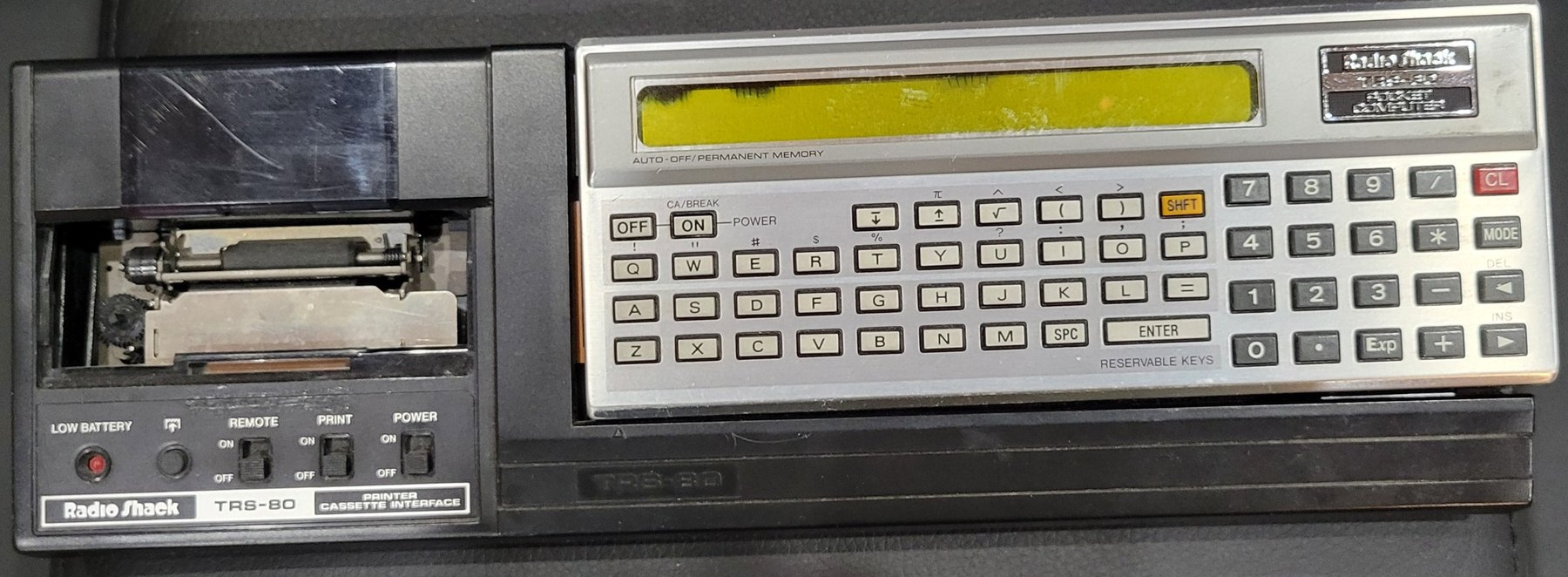
In the summer of 1980 Radio Shack began selling a computer that fitted in a jacket pocket. It was the size of a long calculator, it ran for about three hundred hours on four button cells, and it understood BASIC. Radio Shack called it simply the TRS-80 Pocket Computer; two years later, when a bigger model arrived, it became the PC-1. Inside it was a Sharp machine, the PC-1211, made in Japan, and with it Sharp and Radio Shack had started a new kind of machine: the pocket computer, a programmable calculator that had learned a real programming language.
I have one, with the printer and cassette interface that Radio Shack sold for it. This series is about that machine, the pocket computers that came before and after it, and how to keep one working.
1.1 The machine on my desk
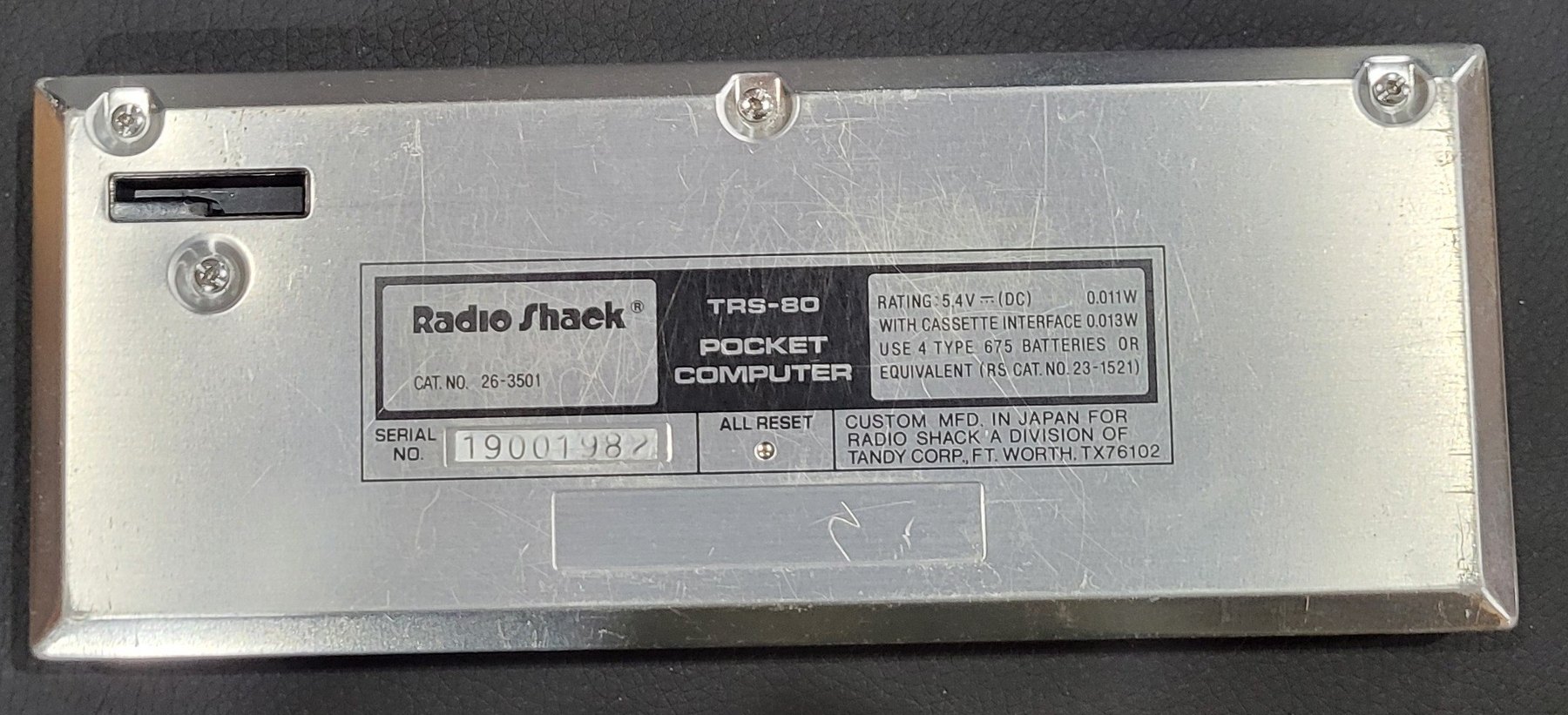
My Pocket Computer is serial number 19001982. The label on the back gives everything else:
- Radio Shack, TRS-80 Pocket Computer, cat. no. 26-3501
- Rating 5.4 V DC, 0.011 W; with cassette interface 0.013 W
- Use 4 type 675 batteries or equivalent (RS cat. no. 23-1521)
- Custom mfd. in Japan for Radio Shack, a division of Tandy Corp., Ft. Worth, TX 76102
Beside the label is a small hole marked ALL RESET, for the button that clears the machine when it locks up.
With it is the TRS-80 Printer/Cassette Interface, catalogue number 26-3505, serial 11003666: a black cradle that the computer slides into, with a 16-column printer at one end, a socket for a cassette recorder, its own rechargeable battery, and three switches, for REMOTE, PRINT and POWER, beside a LOW BATTERY lamp. Its label reads 4.8 V DC, 1.84 W. It is the Radio Shack version of Sharp’s CE-122.
1.2 Its one fault
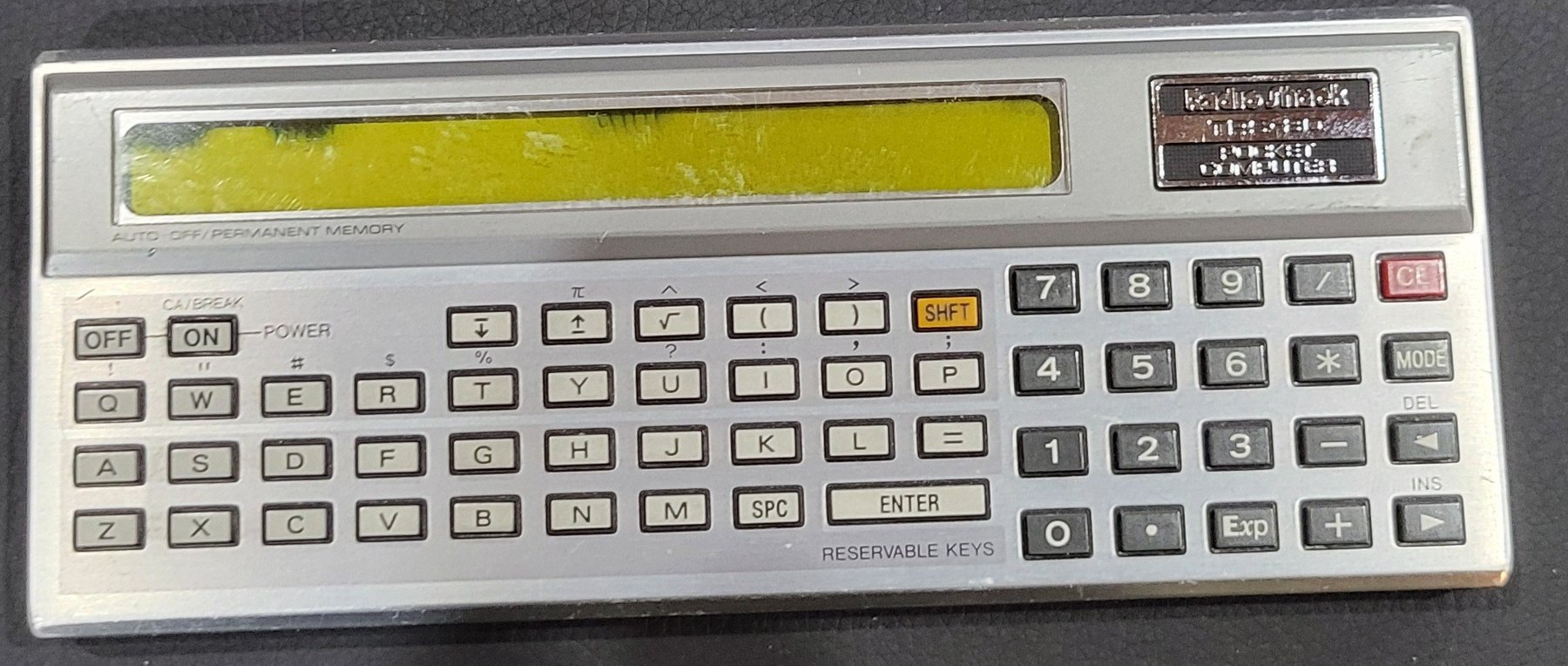
The display on my PC-1 has failed. Dark marks run along the top edge of the glass and a grey patch has spread in from the left end. It is the commonest fault of the whole PC-1 and PC-1211 family: the seal round the edge of the liquid-crystal glass was poor, and over forty years moisture creeps in and spoils the liquid crystal from the edges inwards. Neither Sharp nor Radio Shack ever sold a replacement. In 2019 an American engineer, Robert Baruch, designed a new glass that fits pin for pin, the only reproduction known. I have a new display ready to fit. The repair volume describes the job step by step.
1.3 Why it matters
The Pocket Computer was not the first programmable calculator or the first portable computer, but it was the first machine to put a full BASIC interpreter, a QWERTY keyboard, a text display and permanent memory in a case that went in a pocket and ran for about three hundred hours on button cells. Sharp sold it from March 1980, Radio Shack from 31 July 1980, and for the next twenty years Sharp, Casio, Hewlett-Packard, Texas Instruments, Canon, Psion and even the Soviet Union made machines of the same kind. Radio Shack sold surveying, engineering and real-estate programs for them on cassette, a US Navy school worked out Loran-C navigation fixes on them, a report for the US Air Force solved composite-materials formulas on the PC-1, and in Japan they stayed in technical schools until Sharp stopped making them in 2015.
The other series on this site cover the Soviet calculators, which include the MK-85 and MK-90 pocket computers. Radio Shack’s desktop TRS-80 appears in the Altair 8800 series on the Vintage Digital Computers site.
1.4 What is in this series
- My TRS-80 Pocket Computer: this introduction.
- From Calculator to Computer: the programmable calculators of the 1970s, Sharp’s PC-1210 and PC-1211, and how Radio Shack came to sell the first pocket computer.
- The Pocket Computers, 1980–2015: Radio Shack’s eight PC models and who made them, and the machines from Sharp, Casio, HP, TI, Canon, Psion and the rest.
- Inside the PC-1: the two processors, the memory, the display and the power, from Sharp’s service manual.
- How the PC-1 Thinks: where programs and data live, how BASIC is stored, and how the two processors share the work.
- Operating the PC-1: the modes, calculations, a first program, the reservable keys, display formats and the error codes, checked against the owner’s manual.
- The Printer and Cassette Interface: printing, saving to tape, and how the PC-1 encodes a program as sound.
- Repair and Restoration: the display replacement in detail, cells, the interface’s battery and printer, and a safe first power-up.
- Collecting: what they cost, what to look for, emulators, books and the documents in the Library.
1.5 A note on the sources
The hardware volumes rest on Sharp’s own Service Manual, PC-1211, CE-121 of 1980 and Radio Shack’s service manual for the PC-1, both in the Reference Library with the owner’s manuals, the interface manual and some forty other manuals, books and brochures. The history draws on Roland Saam’s paper A History of Pocket Computers 1980–2000 (IEEE HISTELCON, 2019), Matthew Reed’s pages on trs-80.org, Valentin Albillo’s archive of Sharp material, and the repair notes of Robert Baruch, Jamel Tayeb and N1UGK. Where sources disagree, on prices, dates and even one chip’s part number, the text gives both.
Comments (0)