Financial Calculators · Volume 3
The 12C and Its Rivals, 1981–2026
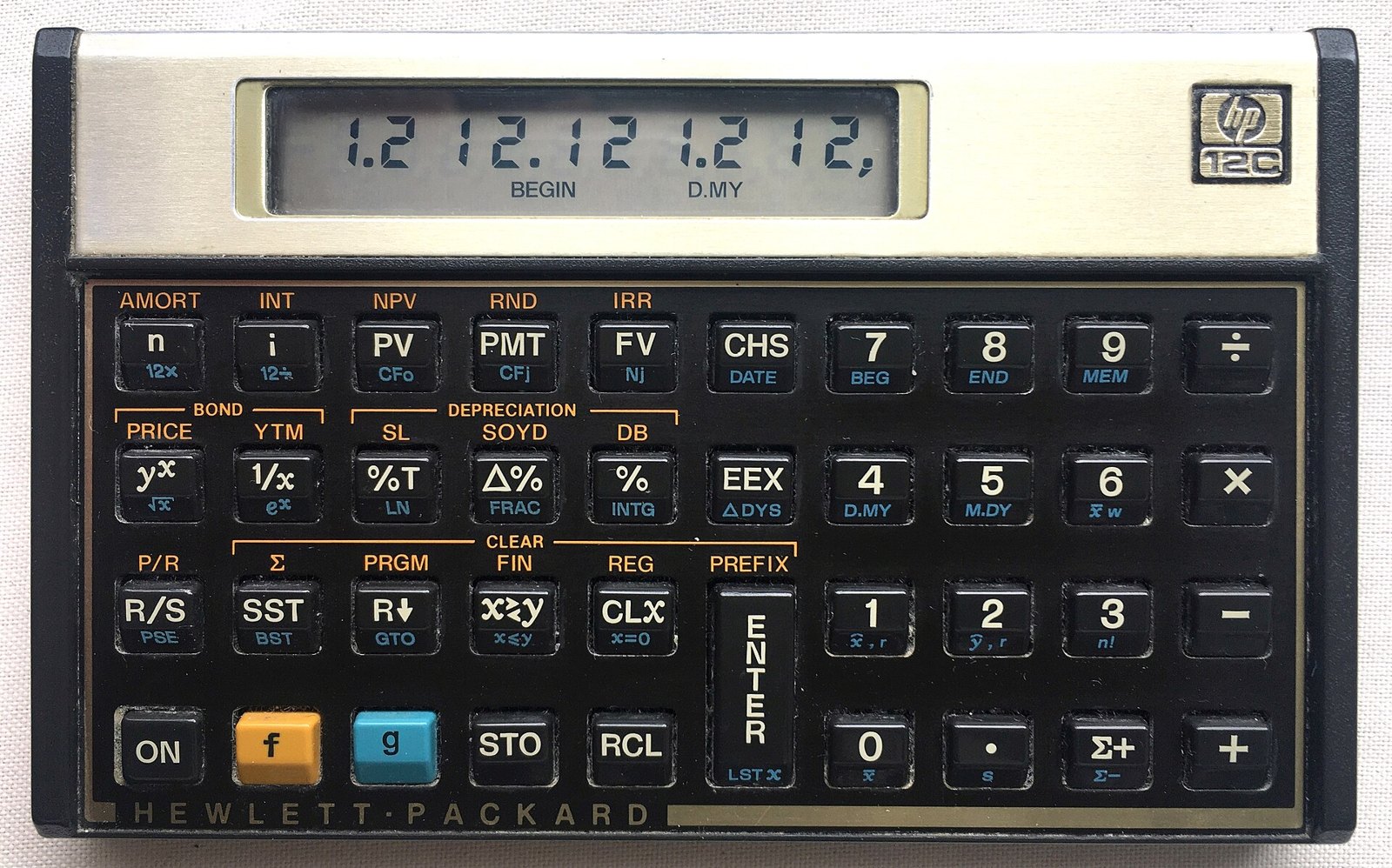
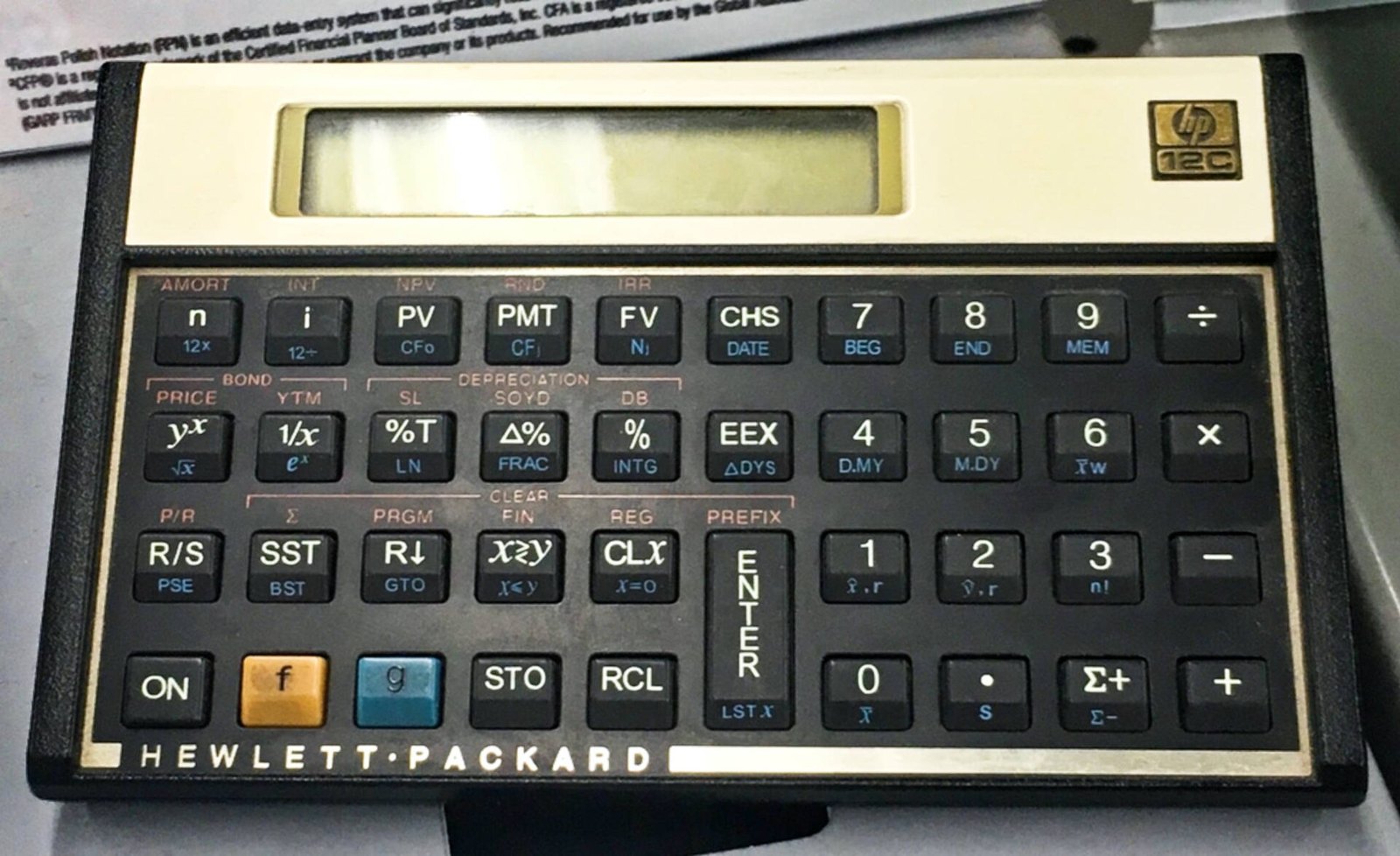
HP expected the 12C to sell for about two years. Forty-five years later it is still in production, with the same keys, the same case and, remarkably, the same program, now running on a processor that pretends to be the one it was written for. This volume follows it from its launch in 1981, through its revisions and imitations, to the trading floors and exam halls where it became a fixture.
3.1 The Voyagers
The 12C was one of five calculators HP designed at its Corvallis, Oregon, division and launched in 1981 and 1982, known as the Voyager series: the 11C scientific and the 12C financial on 1 September 1981, the 15C scientific and the 16C for programmers in July 1982, and the cheap 10C in September 1982. All shared the same horizontal case, 128 × 79 × 15 mm and 113 grams, a ten-digit liquid-crystal display, and the same processor. The 12C cost $150.
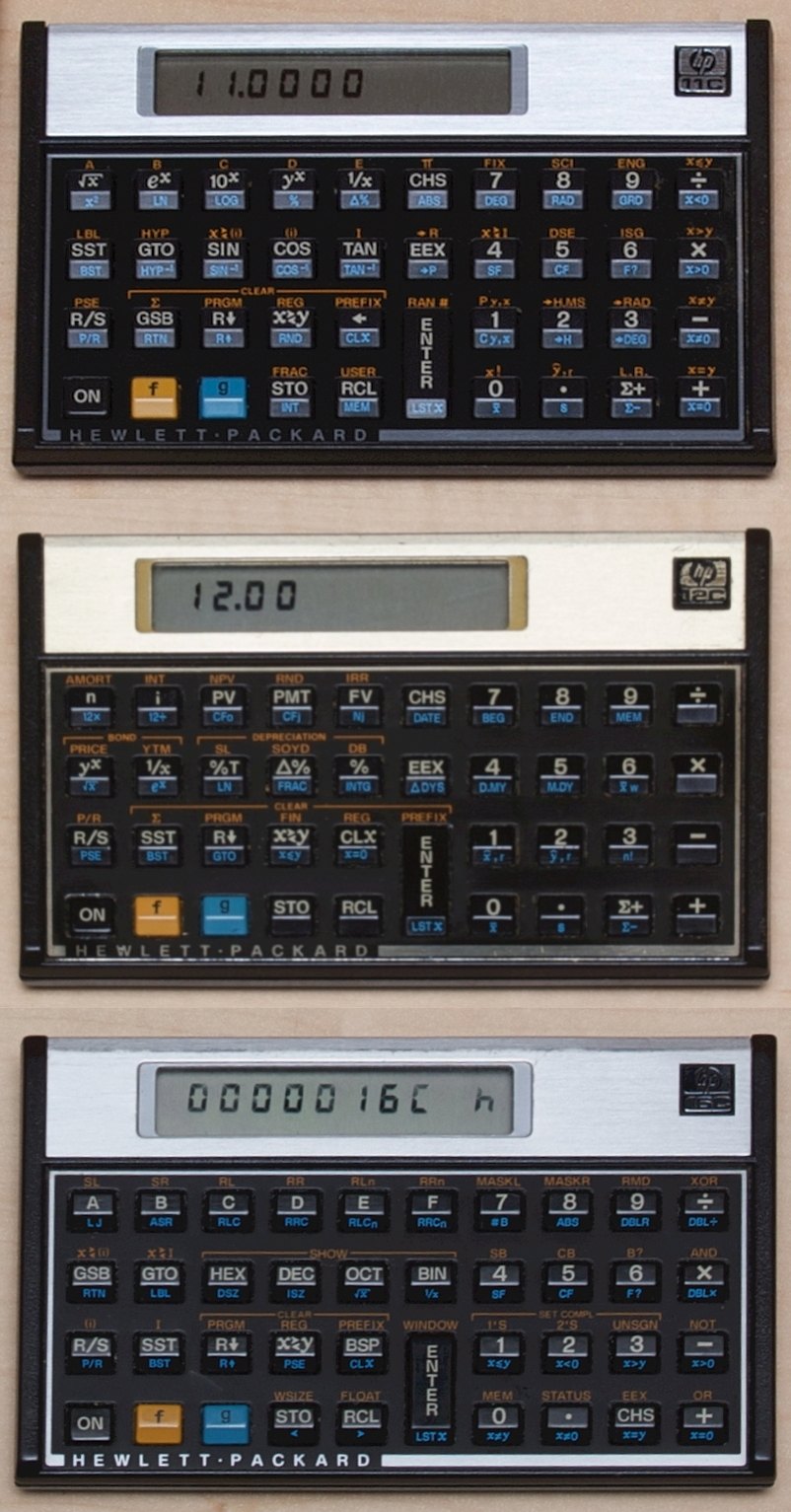
Dennis Harms, the 12C’s project manager, told the Corvallis Gazette-Times in 2006 that “we needed a size that fit into a shirt pocket easily”, and that the landscape shape came from the display: an LCD at the top of a tall case was hard to protect without making the whole calculator bigger. A third battery cell was added late to stretch the worst-case life beyond three months, which made the case thicker across the top and, “quite by accident”, gave it the tilt that makes it easy to read on a desk. The brown-and-gold colours were deliberate: “We designed this thing to look like something a business professional would want. It became a status symbol, like having a Cross pen or a certain brand of watch.” Asked on the calculator’s thirtieth birthday, Harms said: “We thought it would have a two-year life.”
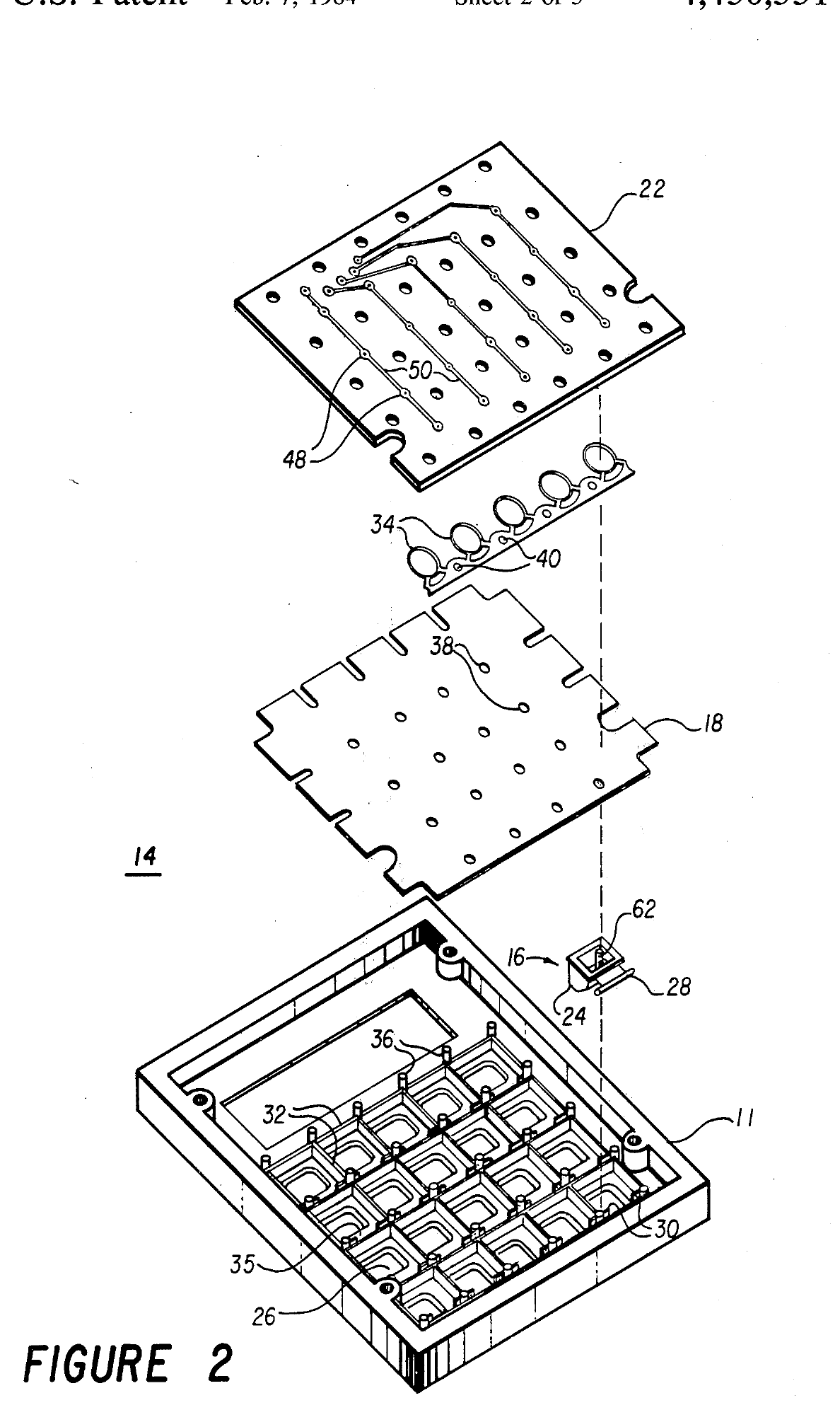
It kept selling, and the price kept falling: $120 in 1983, $99 in 1986, $69.99 in 2003. In 2006 HP said that more than 15 million “12c series” calculators had been sold since 1981, “by far the best-selling calculator series HP has ever produced”; it has given no figure since. HP’s history site calls the 12C “the longest and best-selling Hewlett-Packard product of all time”. Its siblings were withdrawn in 1984 and 1989.
3.2 Forty-five years of revisions
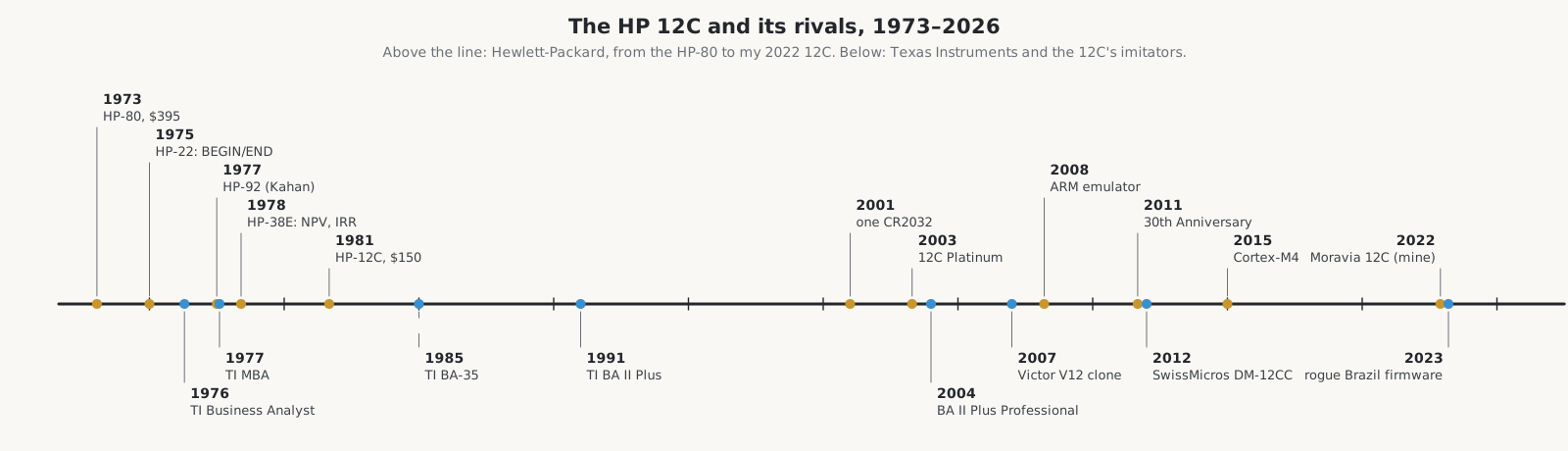
The 12C on sale today looks like the 1981 machine, but Wikipedia counts at least nine hardware revisions. The main ones:
Table 1 — The 12C on sale today looks like the 1981 machine, but Wikipedia counts at least nine hardware revisions. The main ones
| Year | Change |
|---|---|
| 1981 | HP’s Nut processor, three LR44 button cells; made in the USA |
| late 1980s | production moves abroad: Brazil, Singapore, Malaysia, then China |
| 2001 | a 3-volt chip; one CR2032 cell instead of three LR44 |
| 2008 | an ARM microcontroller (Atmel AT91SAM7L128) running an emulator of the Nut, and the original program; two CR2032; tens of times faster |
| 2011 | 30th Anniversary Edition |
| 2015 | a newer ARM chip, the Atmel ATSAM4LC2CA (Cortex-M4); a USB port inside for updating the firmware |
| 2022 | made for HP by its licensees, Moravia and Royal: no “Hewlett-Packard” on the front, a screw on the battery door; made in the Philippines |
Mine is the last of these (volume 1). How much faster the ARM models are is disputed: Wikipedia says sixty to ninety times on most benchmarks, retailers anywhere from twenty to 150. The original’s slowness was, by Wikipedia’s account, partly deliberate: market research found that users “did not trust results obtained too quickly”. The 12C was made in the United States until about 1988; no source confirms a 12C made in Japan.
In 2024 a 12C bought in Brazil turned out to run firmware dated March 2023 that gave slightly wrong answers to some financial problems; HP said it was “aware of the firmware issue on certain HP-12c devices in Brazil”. Volume 5 shows the test that caught it.
3.3 The Platinum and the anniversaries
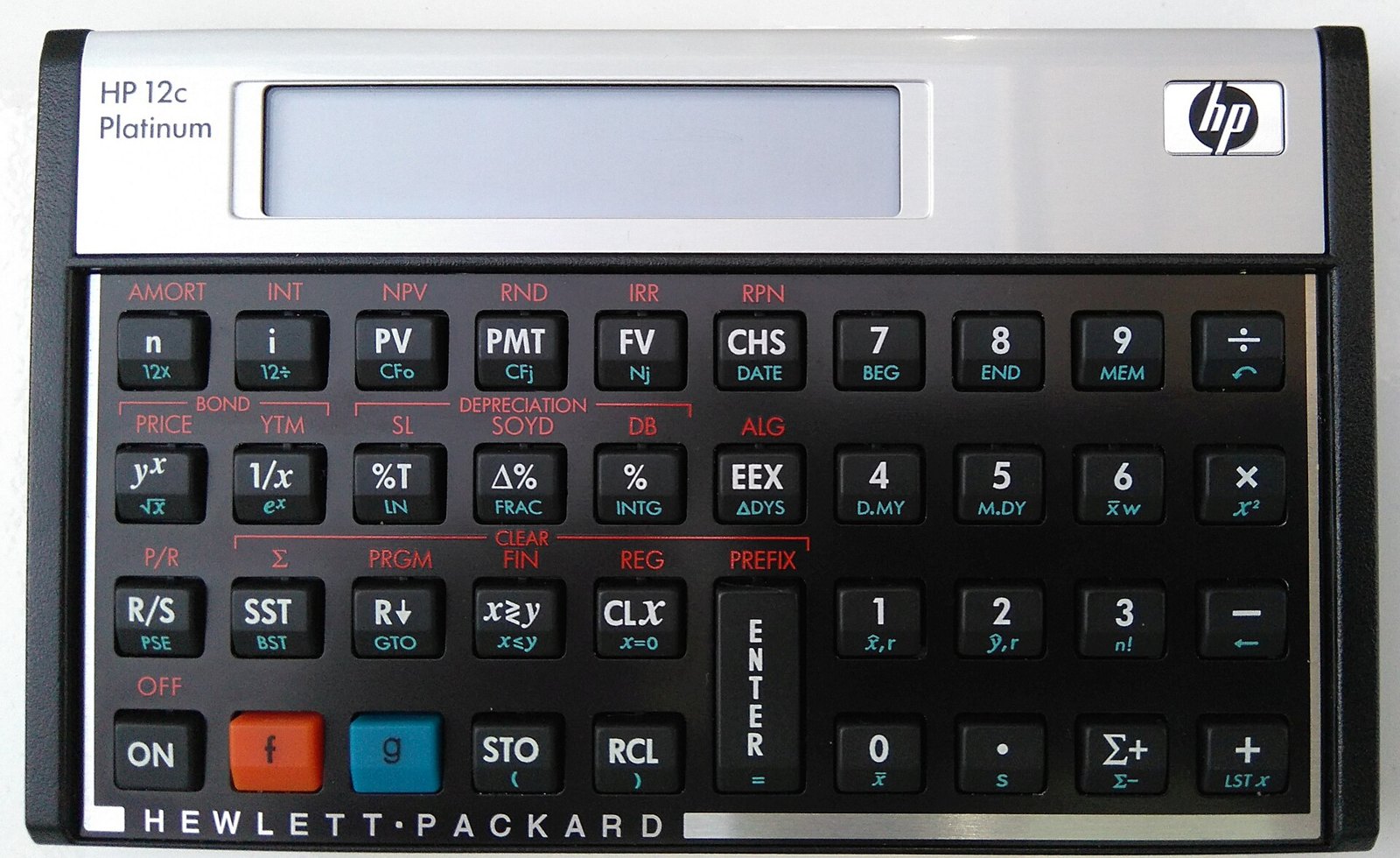
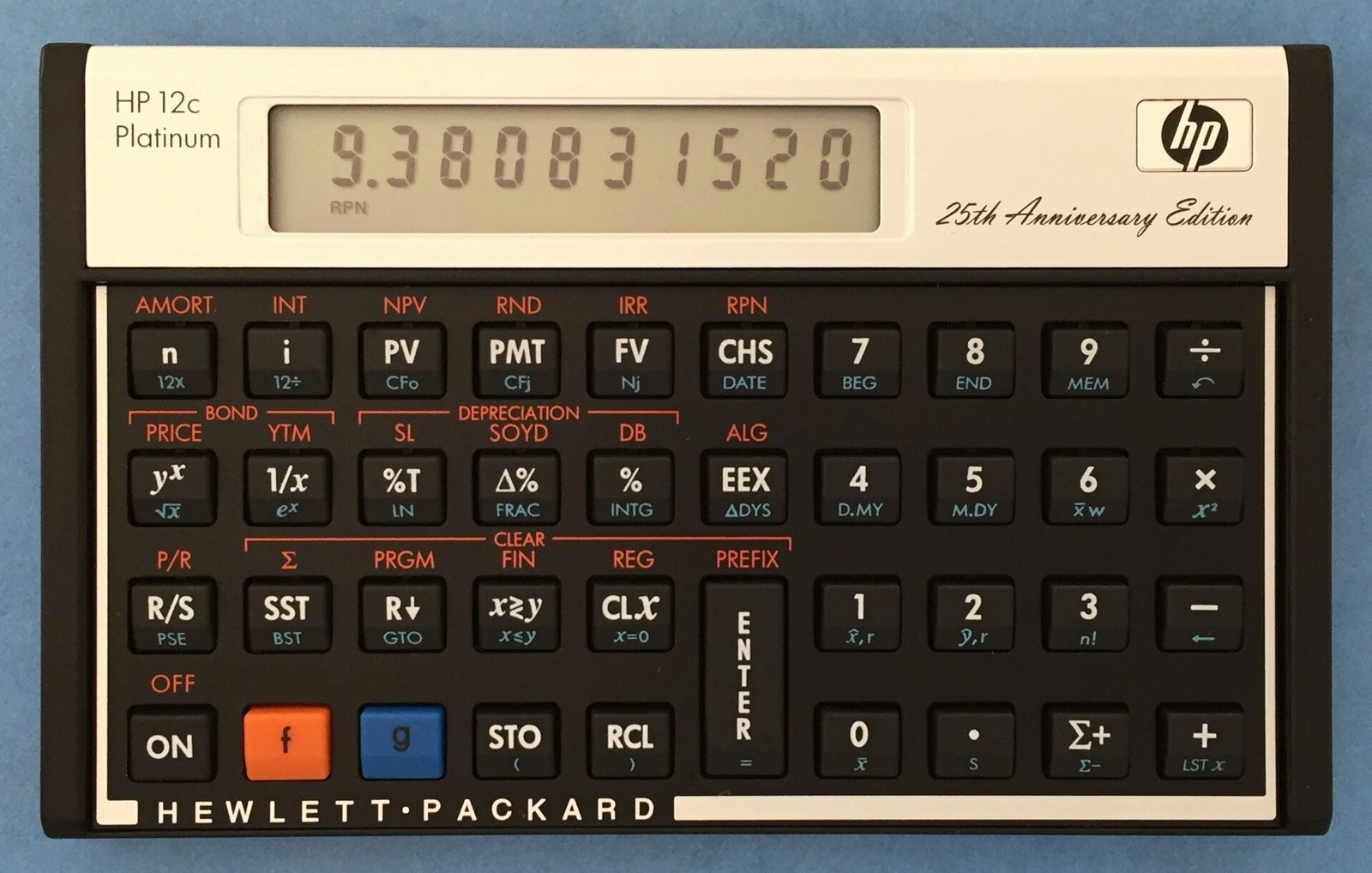
In 2003 HP introduced the 12C Platinum, silver-faced, with an algebraic mode beside RPN, 400 program lines to the gold model’s 99, and a different processor: a 6502-family chip from Sunplus, later Generalplus. It was not the 12C’s program on new hardware but a new implementation, made by the Taiwanese manufacturer Kinpo. HP claimed it was “6 times faster with 4 times more memory”. Its suggested price in 2003 was $104.99. A 25th Anniversary Edition Platinum followed in 2006 at $79.95, a gold-plated 12C Prestige version of the Platinum for Brazil in about 2008, and a 30th Anniversary Edition of the gold 12C in August 2011, at $79.99, each with a laser-etched production number on the back; Wikipedia says 40,000 were made, Finseth 10,000.
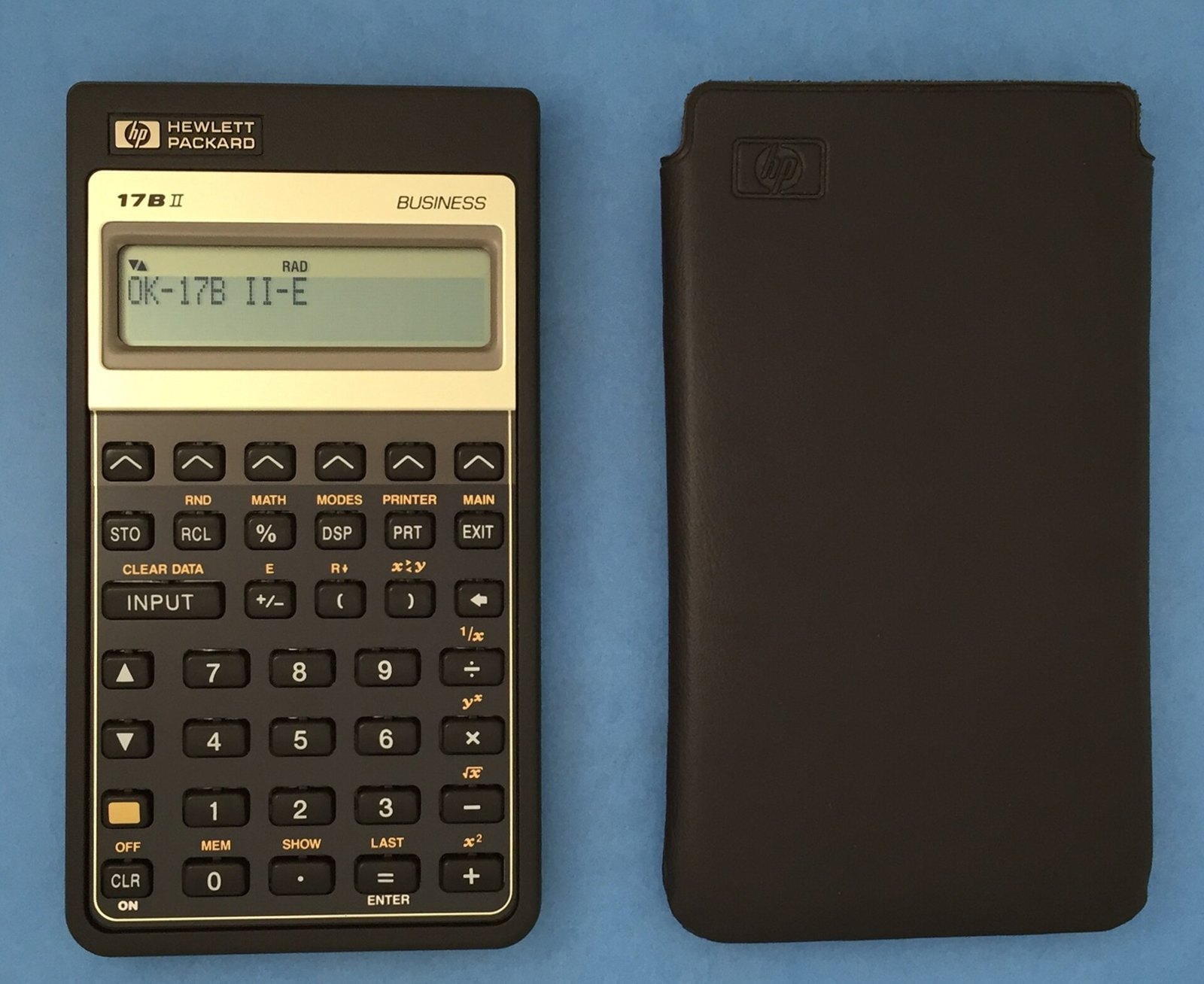
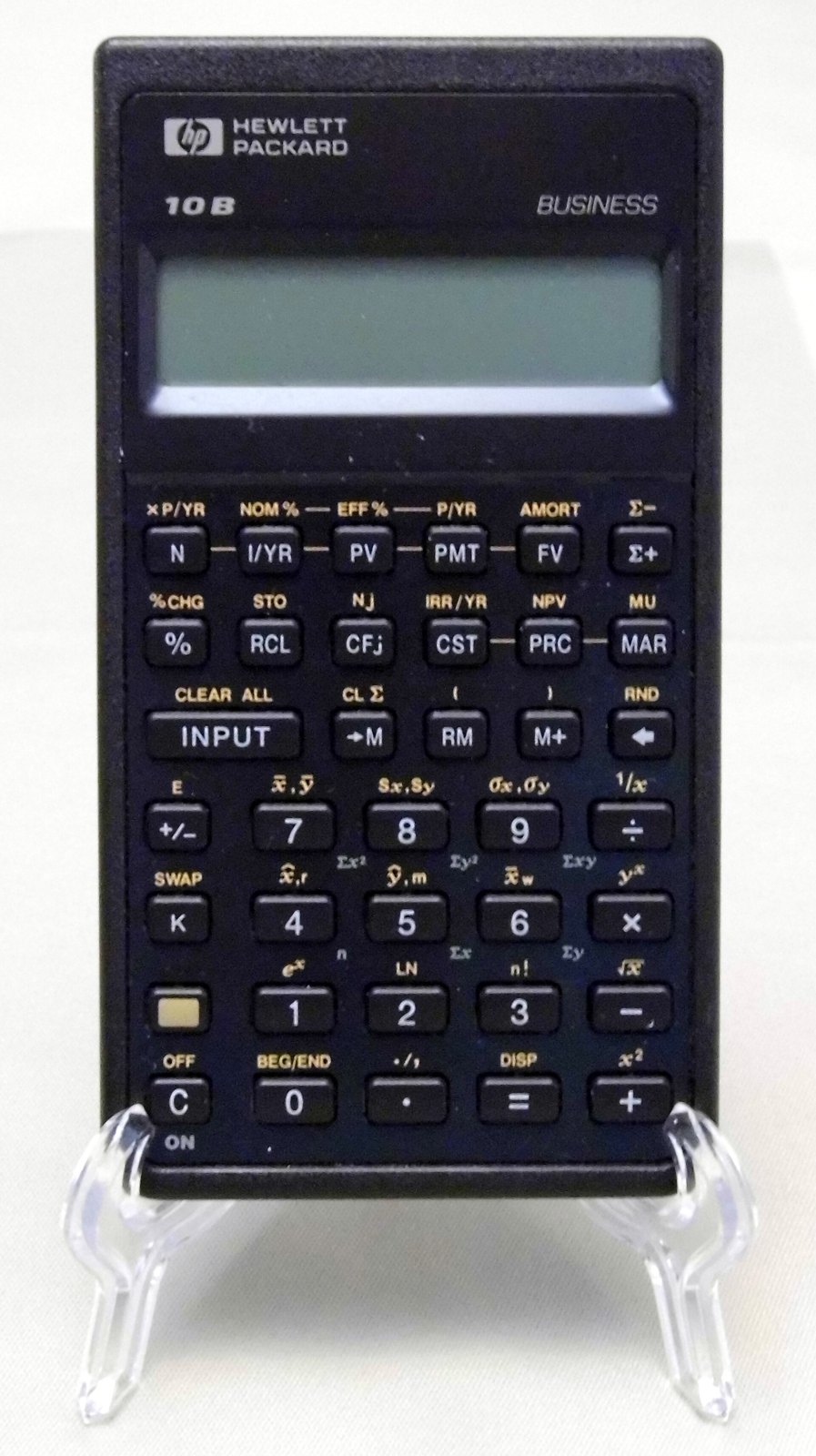
HP’s other financial calculators came and went around the 12C: the HP-18C of 1986, the menu-driven 17B and 19B of 1988, the cheap 10B of 1989 and 10bII of 2000, the 17bII+ of 2003 and the 20b and 30b of 2008 and 2010.
3.4 The rivals
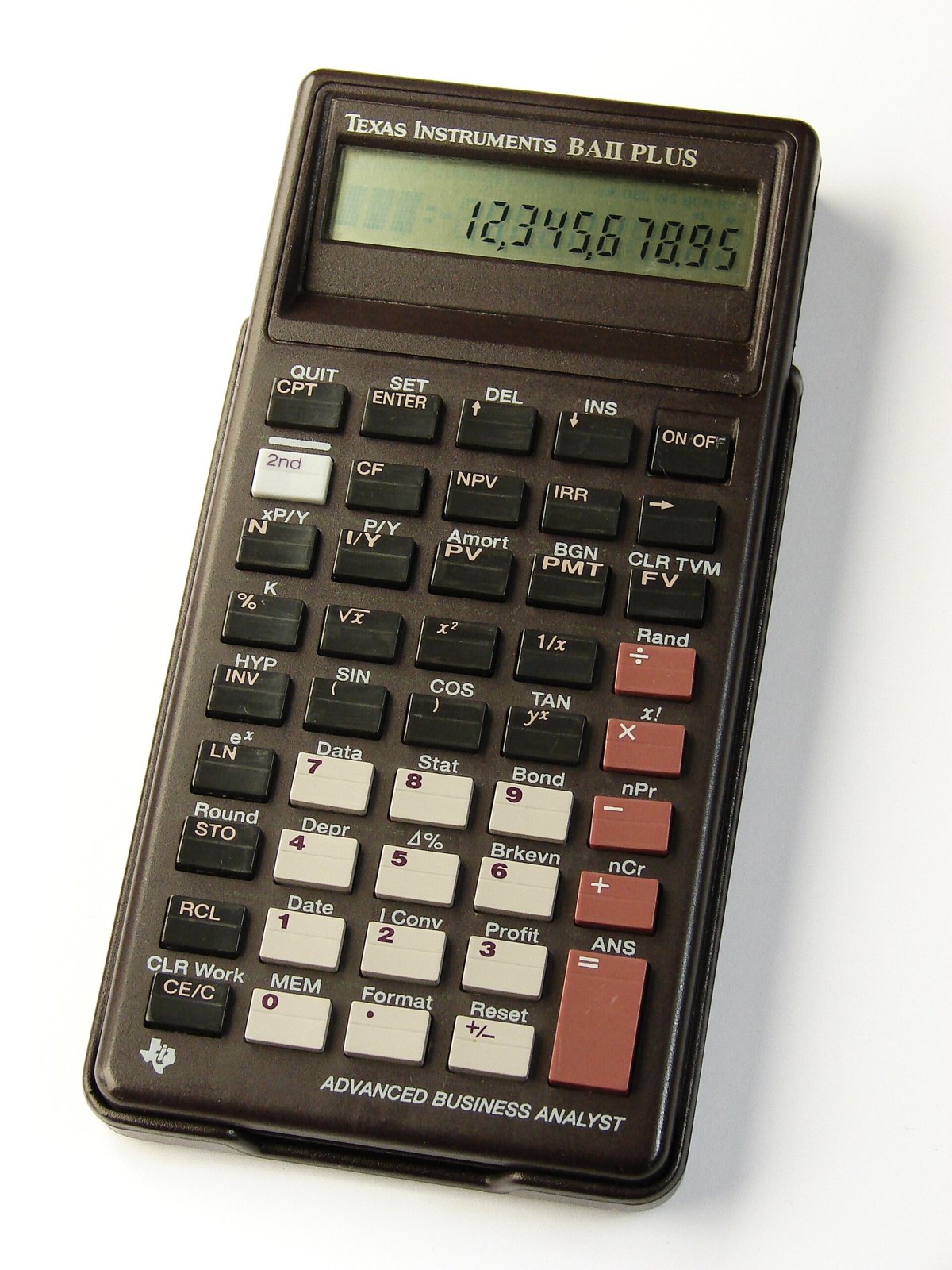
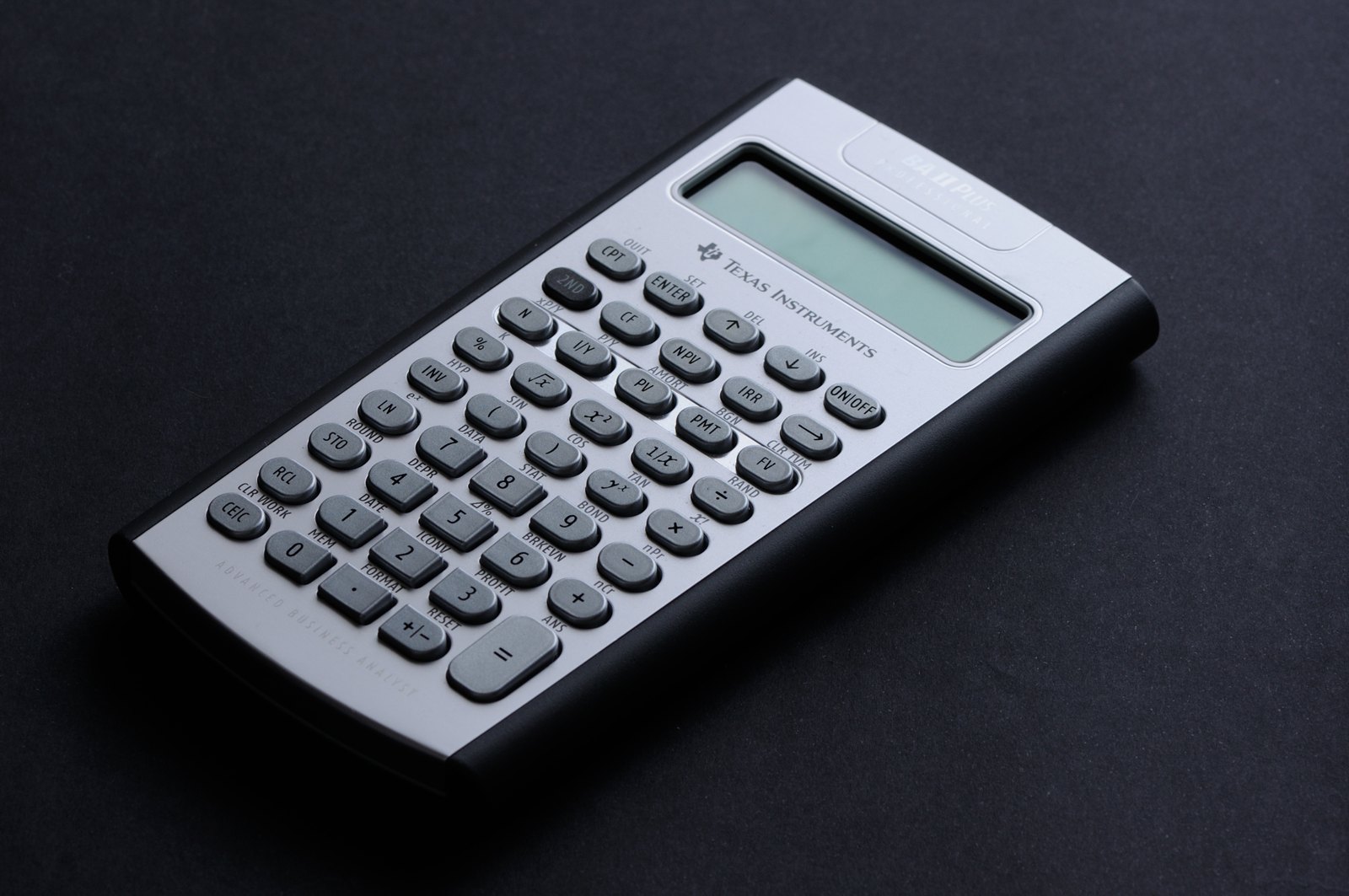
Texas Instruments never stopped selling cheaper financial calculators. After the Business Analyst came the solar BA-35 in 1985 and, in the early 1990s, the BA II Plus, algebraic, menu-driven and today the 12C’s only rival in the CFA exams; the BA II Plus Professional of 2004 added modified IRR, duration and payback. It costs a little less than the 12C and is the calculator most finance students are told to buy. Richard Taylor, who taught finance for over thirty years, preferred it for teaching because of its menus and its handling of bonds between coupon dates.
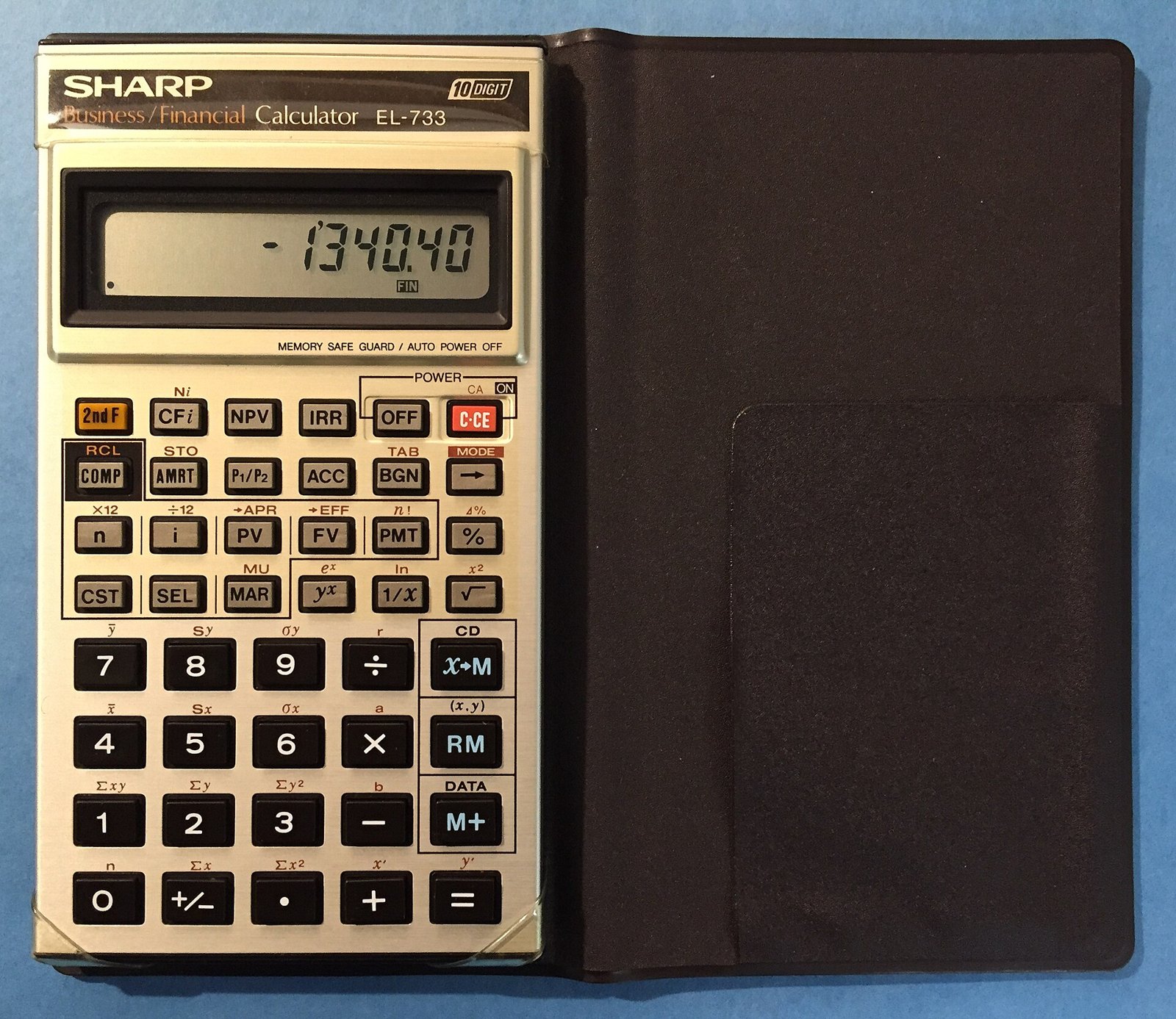
Sharp’s EL-733 and EL-738 and Casio’s FC-100V and FC-200V complete the field; the Sharps are on the CFP Board’s approved list.
And there are the imitations. Wikipedia lists the Aurora FN1000 (2003), the Victor V12 (2007), the Compucessory CCS28956 (2010) and the Truly SC123 (2015), all sold under their own names; and the Swiss SwissMicros makes the DM12 series, which, like the 12C itself since 2008, runs the original program in an emulator. Whether HP licensed that is not on record.
3.5 On the trading floor
“Learning the Reverse Polish Notation entry system of the HP 12c has been a rite of passage for Wall Street moneymen since 1981,” the Wall Street Journal wrote in 2011. Wikipedia says Goldman Sachs and other investment banks issue 12Cs to their new analysts; no primary source confirms it. Lloyd Blankfein, the former chief executive of Goldman Sachs, posted in 2023 that his 12C’s battery had finally died, after about forty years. In 2006 the Oregon State University bookstore said it sold 12Cs “mostly to real estate folk and people taking real estate exams”. In Brazil, the 12C is so standard a tool of finance that it is still sold everywhere.
In 2009 HP put the 12C on the iPhone as an app, $14.99, with the back-label formulas behind the HP logo; Moravia publishes the current app. The emulated 12C now runs on phones, on the ARM chip in my calculator, and on SwissMicros’ hardware, all running the program written in Corvallis in 1981.
Sources
- Finseth, HPDATAbase (HP-11C, 12C, 15C, 16C, 10C, 17B, 19B, 10B, 10bII, 17bII+, serial numbers); Wikipedia, “HP-12C”, “HP Voyager series” and “Texas Instruments Business Analyst”.
- Bennett Hall, Gazette-Times (Corvallis), 3 July 2006, reprinted by the HHC (12CintheNews.pdf); HP history site (hewlettpackardhistory.com).
- Wall Street Journal, May 2011, via ACM and OSNews; VentureBeat, 31 August 2011 (30th Anniversary) and 26 June 2009 (iPhone apps); The Register, 6 May 2011 and 21 September 2024; MSNBC, 28 May 2003 (Platinum); Benzinga, March 2023 (Blankfein).
- Museum of HP Calculators forum on production countries, the 2022 revision and lot numbers.
- R. W. Taylor, “Business Finance and Financial Calculators” (2010); TI, BA II Plus Guidebook.
- HP, 12C Platinum Owner’s Handbook (2003); patent US 4,430,531, “Snap disc keyboard”.
Comments (0)