Financial Calculators · Volume 1
Financial Calculators: My HP 12C
A financial calculator answers the questions that money asks. What will this loan cost each month? How much of this year’s payments went to interest? What is this bond worth at today’s yield? What return does this project earn? For centuries those questions were answered from books of printed tables. In 1973 Hewlett-Packard put the tables into a pocket calculator, the HP-80, and in 1981 it introduced the machine that has done the job ever since: the HP-12C, in continuous production for forty-five years, the longest-lived calculator HP has made, and one of the two calculators the CFA Institute allows in its exams.
Mine is an HP 12C, and I use it for assessing work.
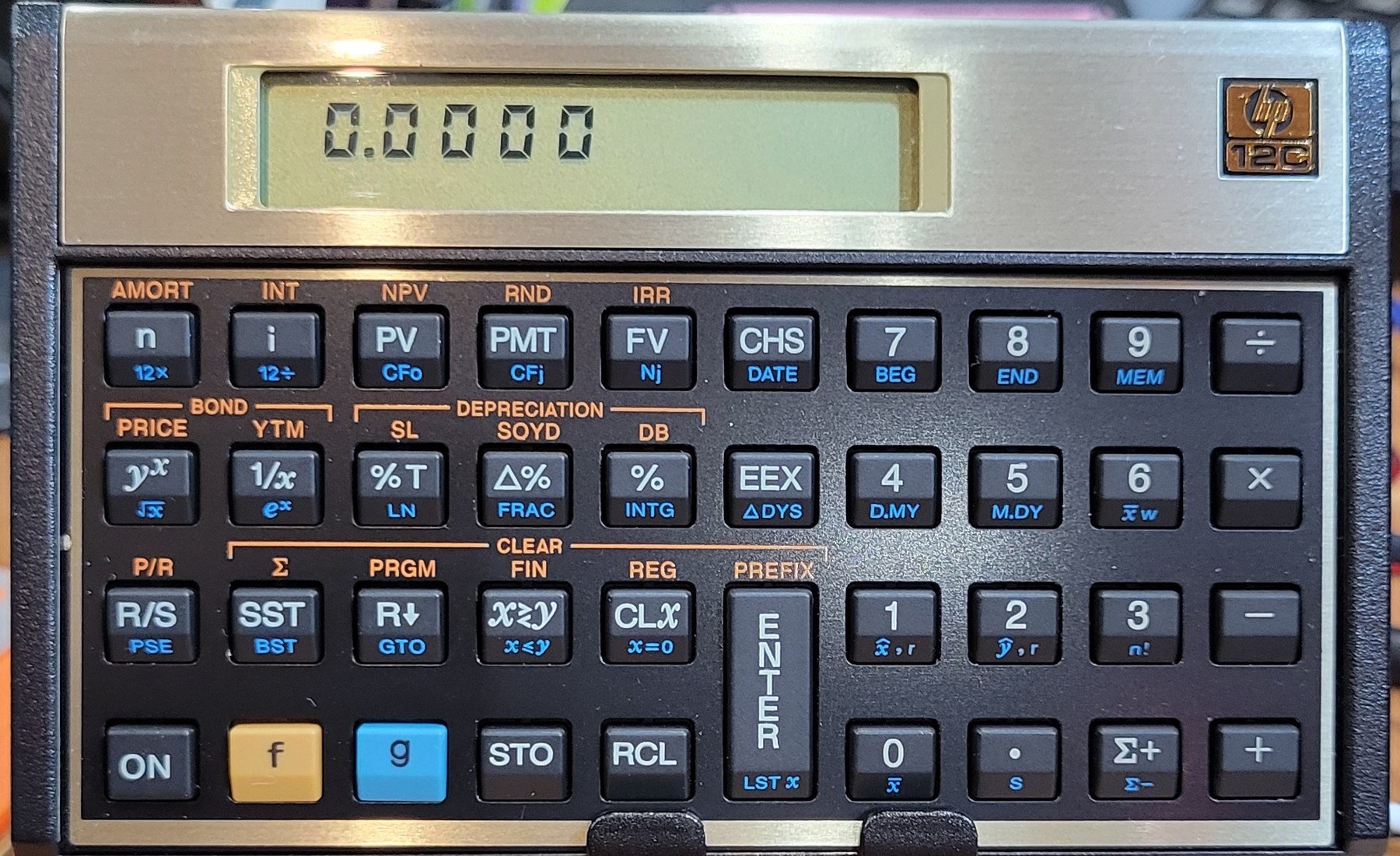
1.1 My 12C
My 12C looks like the 1981 original: the same horizontal “Voyager” case, the same brushed metal face, the same keys and legends. Under the skin it is something else. The label on the back and the details of the case date it to the newest production, made under licence for HP:
- the faceplate carries only the HP logo and “12c”, with no “Hewlett-Packard”, a change made in 2022 when HP’s calculator licensees, Moravia Consulting and Royal Consumer Information Products, took over production;
- the battery door is held by a screw, another 2022 change;
- the label gives the web address www.hpcalcs.com, Moravia’s, the lot number L/NO. 9CJ251, and Made in Philippines;
- it takes 2 × CR2032 lithium cells, the arrangement HP adopted in 2008 when the 12C moved to an ARM processor;
- it carries the UKCA mark, introduced in Britain in 2021.
Members of the Museum of HP Calculators forum read lots with this prefix as a year and a week, and give 9CJ251, my lot number exactly, as week 51 of 2022. HP has never published the code, so that is a collectors’ reading, not a fact; but everything else on the label agrees with it. Inside, according to the same sources, is an ARM Cortex-M4 microcontroller running a software copy of the original 1981 processor, which runs the original 1981 program. Volume 4 explains how.
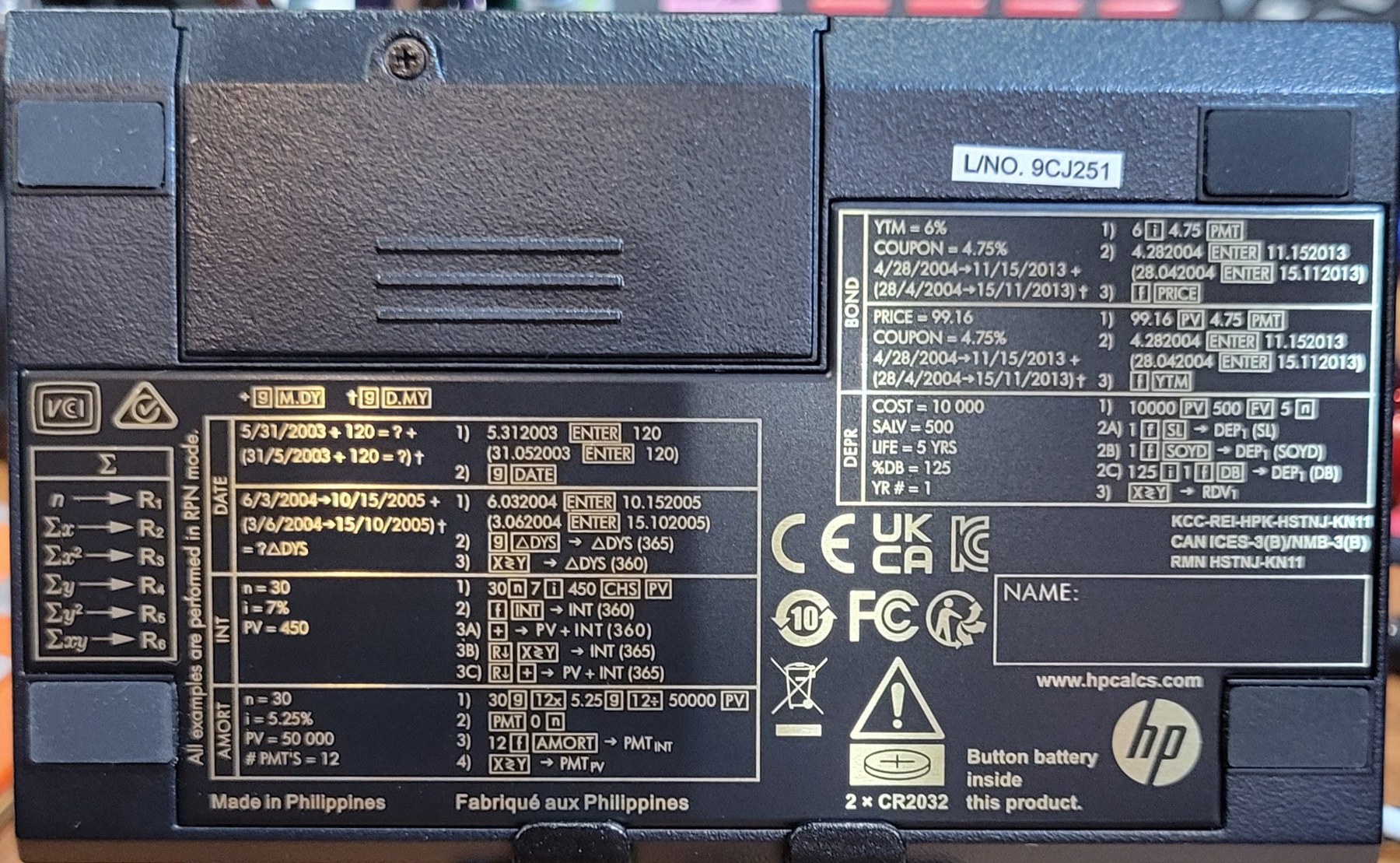
The back carries a reference card in miniature, five worked examples printed in gold on black, and a map of where the statistics functions keep their sums. Volume 6 works every one of them. One line on it, “All examples are performed in RPN mode”, is misleading: the plain 12C has only one mode, HP’s Reverse Polish Notation, and the line appears to have been carried over from the label of the 12C Platinum, which has an algebraic mode as well.
1.2 What a financial calculator does
The 12C’s top row of keys holds the five quantities of every loan, savings plan or annuity:
Table 1 — The 12C's top row of keys holds the five quantities of every loan, savings plan or annuity
| Key | Means |
|---|---|
| n | the number of periods |
| i | the interest rate per period |
| PV | present value: what the money is worth now |
| PMT | the regular payment |
| FV | future value: what is left at the end |
Store any four and press the fifth, and the calculator works it out. Around that core the 12C adds the rest of the financial toolkit:
- amortization: how much of a run of payments is interest and how much repays the loan;
- cash flows: net present value (NPV) and internal rate of return (IRR) for an investment with uneven returns;
- bonds: price and yield to maturity;
- depreciation: straight-line, sum-of-the-years’-digits and declining-balance;
- dates: days between two dates, on the actual calendar or a 360-day year, and the date a number of days ahead;
- statistics, percentages, and keystroke programming of up to 99 steps.
All of this is worked in Reverse Polish Notation, in which numbers are entered first and the operation second, with an ENTER key in place of an equals key. Learning it, the Wall Street Journal wrote on the 12C’s thirtieth birthday, “has been a rite of passage for Wall Street moneymen since 1981”.
1.3 What is in this series
- My HP 12C: this introduction.
- Before the 12C: interest tables from 1613, the desk calculators, the HP-80 of 1973 and HP’s financial calculators of the 1970s.
- The 12C and Its Rivals, 1981–2026: the Voyager series, forty-five years of revisions, the Platinum, the clones, Texas Instruments’ BA II Plus, and the 12C on Wall Street.
- Inside the 12C: the Nut processor and its registers, program memory, and the ARM chips that now emulate it.
- The Mathematics of Money: the time-value-of-money equation, NPV and IRR, searching for a rate, bonds, depreciation, dates, and why ten digits need care.
- Operating the 12C: RPN, the financial keys and every example on the back of my calculator, worked from HP’s user’s guide.
- Programming the 12C: keystroke programs, memory, branching, and programs from HP’s guide.
- Versions, Care, Collecting and the Exam Room: identifying a 12C, batteries and faults, prices, and the exams that allow it.
1.4 A note on the sources
The operating volumes are worked from HP’s HP 12c financial calculator user’s guide, Edition 5 of April 2008, the edition written for the ARM-based 12C, and every result has been checked against HP’s printed answers or computed from HP’s own formulas in its Appendix D. That guide is in the Reference Library with the 1992 Owner’s Handbook and Problem-Solving Guide, the 12C Platinum handbook, the 12C solutions handbook and training guide, the HP-80 owner’s handbook, the Hewlett-Packard Journal articles on the HP-80 and HP-92, TI’s BA II Plus guidebook and HP’s financial-calculator patents. The history draws on Finseth’s HP calculator database, the Museum of HP Calculators and its forum, Wikipedia, The Register and contemporary newspapers. Where sources disagree, the text says so.
The other electronic dives on this site cover the scientific calculators whose chips and arithmetic the financial calculators share, and the graphing calculators that replaced them in the classroom.
Sources
- HP, HP 12c financial calculator user’s guide, Edition 5 (April 2008), part 0012C-90001.
- Wikipedia, “HP-12C”; Finseth, HPDATAbase, “HP-12C”; Museum of HP Calculators forum on lot 9CJ251 (2024) and on the 2022 revision; Moravia Consulting (hpcalcs.com).
- Wall Street Journal, “Wall Street’s Cult Calculator Turns 30” (May 2011), as quoted by ACM and OSNews.
- The markings and photographs are of my own calculator.
Comments (0)