Financial Calculators · Volume 2
Before the 12C
The arithmetic of interest is old; the machine that does it is new. For three and a half centuries anyone who needed to know what a loan or an annuity was worth looked it up in printed tables. Desk calculators made the multiplication easier but not the problem. Then, in 1973, Hewlett-Packard put the tables into a pocket calculator, and in eight years worked through seven more financial models to arrive at the 12C.
2.1 Books of tables
The first book given over wholly to compound interest, according to the actuarial historian C. G. Lewin, was Richard Witt’s Arithmeticall Questions, touching the Buying or Exchange of Annuities, printed in London in 1613. Witt tabulated the growth of money, (1 + i)ⁿ, at 5, 6, 7, 8 and 9 per cent, and the standard annuity functions at 10 per cent, then the legal maximum, and at 6¼ per cent, the usual rate for buying freehold land. Earlier writers, Simon Stevin among them, had printed interest tables in the sixteenth century, but as chapters of larger books.
Tables of that kind lasted into living memory. Richard Taylor, who first taught business finance at Arkansas State University in the spring of 1974, recalled that “time value of money problems were worked with the interest rate tables that came with the textbook. Calculations were made by hand.” The standard American finance textbooks first showed calculator solutions in their 1985 editions, one of which told students that financial calculators, “and not clumsy rounded and incomplete tables”, were “used exclusively in well run, efficient businesses”.
2.2 Desk calculators
The mechanical calculators of Monroe, Friden and Marchant, the three great American makers, did the multiplication; the tables still supplied the powers. The first electronic calculators were sold with financial programs in their firmware. Compucorp’s battery-powered 300 series of about 1972 included a model 360 “Bond Trader”, sold through Monroe; the Science Museum in London has a Monroe 360/65 Bond Trader of 1976, given by Deutsche Bank. Hewlett-Packard’s HP-81 of 1973 was a printing desktop version of its first financial calculator, at $1,025.
2.3 The HP-80
The financial calculator began, according to the Museum of HP Calculators, at breakfast. About a month after the HP-35 scientific calculator went on sale in January 1972, Bill Hewlett breakfasted in New York with some 200 securities analysts, with an HP-35 at every table, and came away convinced that a calculator for business needed business keys. The result was the HP-80, announced on 16 January 1973 at fifteen press conferences around the world according to the Museum, or in February according to other sources, at $395, the price of the HP-35.
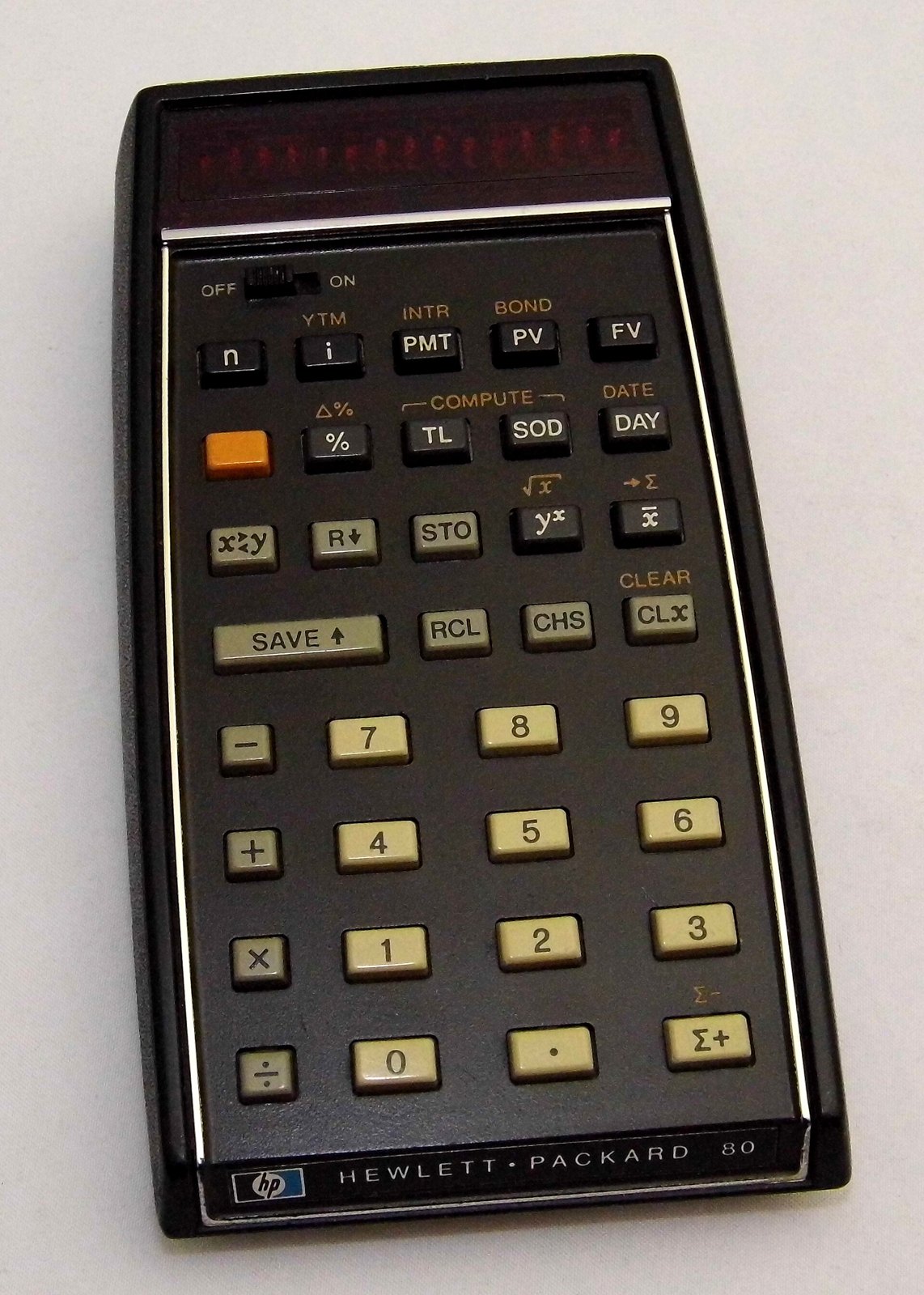
Its designers, William Crowley and France Rodé, described it in the Hewlett-Packard Journal of May 1973 as “A Pocket-Sized Answer Machine for Business and Finance”. “We wanted to produce an ‘answer machine,’ not an ‘equation-solver’,” they wrote. It used the HP-35’s arithmetic hardware but seven read-only memories to the HP-35’s three, holding more than thirty built-in programs that replaced “most commonly used financial tables, such as compound interest, annuities, and bonds”. It was HP’s first pocket calculator with a shift key, and it introduced the five keys that every HP financial calculator has had since: n, i, PMT, PV, FV. It could find any one of the five from the other four, price a bond and find its yield, count the days between dates, work sum-of-the-years’-digits depreciation and fit a straight line to data. It weighed nine ounces and ran on rechargeable cells; it could not be programmed and forgot everything when switched off.
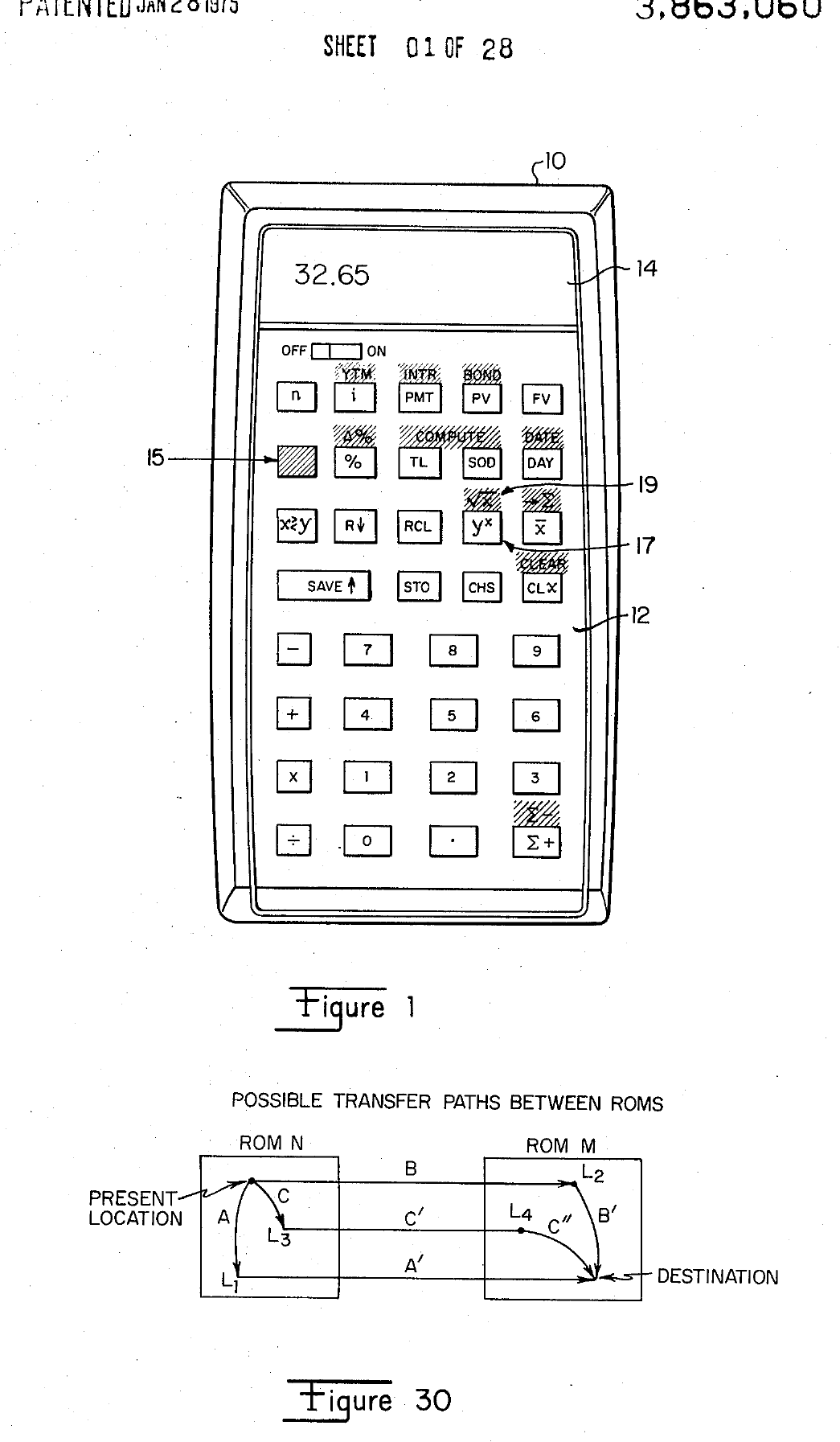
The Journal’s appendix shows how it found an interest rate: by Newton’s method, starting from a guess made from the first three terms of a binomial expansion, i₀ = 2(n − PV/PMT) / [n(n + 1)], and “sawtoothing” down to the answer (volume 5). HP’s patent, filed in October 1972, names David Cochran, the designer of the HP-35’s algorithms, among its four inventors. The price fell to $295 in August 1975, and the HP-80 was discontinued in October 1978. No figure for its sales has been found; HP had sold over 300,000 pocket calculators of both kinds by the end of 1973.
2.4 The financial calculators of the 1970s
Between the HP-80 and the 12C, HP made seven more financial models, each adding something the 12C would keep:
Table 1 — Between the HP-80 and the 12C, HP made seven more financial models, each adding something the 12C would keep
| Model | Introduced | Price | What it added |
|---|---|---|---|
| HP-70 | 1974 | $275 | a cheaper HP-80, soon dropped |
| HP-22 | 1975 | $165 | a switch for payments at the beginning or end of each period |
| HP-27 | 1976 | $200 | scientific and financial functions together |
| HP-92 | 1977 | $625 | a printing desktop “Investor”; Kahan’s accurate algorithms |
| HP-37E | 1978 | $75 | amortization; continuous memory |
| HP-38E | 1978 | $120 | cash flows, NPV and IRR; programming |
| HP-38C | 1979 | $150 | the HP-38E with continuous memory |
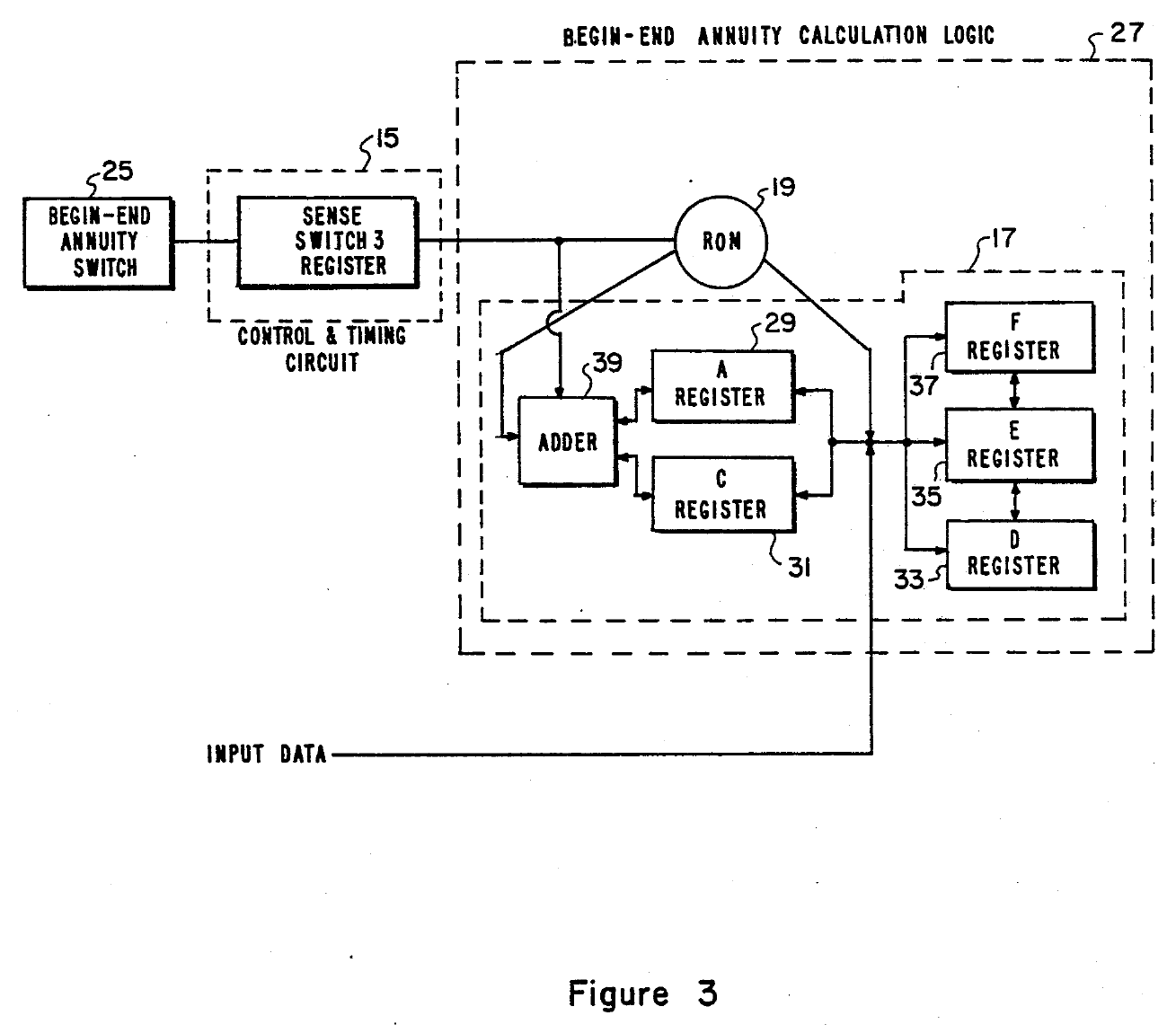
The HP-22’s BEGIN/END switch was patented in 1977 (US 4,055,757). Its patent explains the trick that the 12C’s equation still uses: a payment at the start of a period is worth one period’s interest more than one at the end, so the calculator simply multiplies the payment by 1 + i.
The HP-92 of 1977 mattered most for accuracy. Its algorithms, according to Wikipedia and HP’s own HP-92 applications book, were based on the work of William Kahan of the University of California, Berkeley, HP’s consultant on numerical methods, and the Journal article on it, by Roy Martin, was titled “Printing Financial Calculator Sets New Standards for Accuracy and Capability”. Kahan’s methods, by the accounts of those who have studied the machines, were carried into the 12C.
The 12C’s competition already existed. Texas Instruments’ Business Analyst of 1976, a financial version of the TI-30 on the same chip, sold for $49.95; its MBA of 1977 added NPV, IRR and simple programming for $79.95. In August 1982 a student store advertised the HP-12C at $150, on sale at $135, and TI’s Business Analyst-II at $50.
Sources
- C. G. Lewin, “Compound interest in the seventeenth century”, Journal of the Institute of Actuaries; National Library of Ireland catalogue record for Witt (1613).
- R. W. Taylor, “Business Finance and Financial Calculators”, Journal of Business Administration Online 9(2), 2010.
- Science Museum Group, Monroe 360/65 Bond Trader (2000-1108); John Wolff’s Compucorp pages; hpmuseum.net on the HP-81.
- W. L. Crowley and F. Rodé, “A Pocket-Sized Answer Machine for Business and Finance”, Hewlett-Packard Journal, May 1973, pp. 2–8; HP-80 Owner’s Handbook and problems booklet.
- Museum of HP Calculators on the HP-80’s origin and launch; Finseth’s HPDATAbase (HP-80, HP-22, HP-27, HP-37E, HP-38E, HP-38C, HP-92); Computer History Museum, “Revolution: Calculators”.
- R. E. Martin, “Printing Financial Calculator Sets New Standards for Accuracy and Capability”, Hewlett-Packard Journal, October 1977, pp. 22–28; HP-92 Owner’s Handbook (1977); Wikipedia, “HP-12C”.
- Patents: US 3,863,060, US 3,946,218 and US 3,955,074 (HP-80); US 4,055,757 (BEGIN/END).
- Industrial Alchemy on the TI Business Analyst; Computing History UK on the TI MBA; Daily Tar Heel, 25 August 1982, p. 4 (advertisement).
Comments (0)