Dial Adders · Volume 7
The Relatives: Addometer, Ray, Kes-Add, Dial-A-Matic and Others
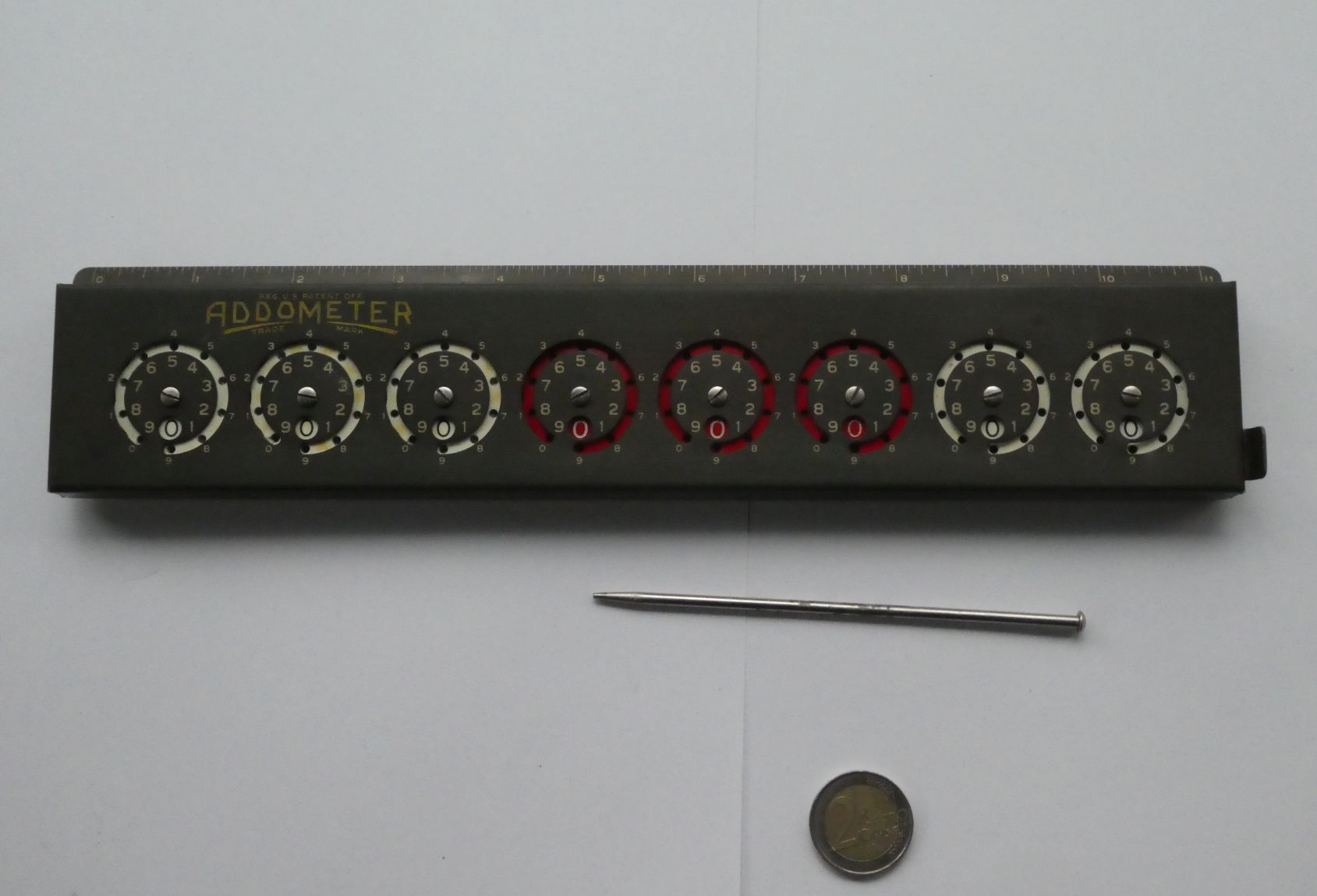
The Lightning was the best-selling dial adder but never the only one. Through the 1920s it competed with the Addometer of Chicago, which had the clearing lever and direct subtraction twenty years before the Lightning did. After the war it was undercut by plastic dial adders that fitted in a shirt pocket and cost a few dollars. This volume covers the machines of the same type: stylus dials in a row, each a decimal place, with a geared carry. They are the ones a Lightning owner is most likely to meet at the same flea-market table. The earlier members of the family (Roth, Webb, the Calcumeter, Bonham & Schram, The Calculator and Pangborn) are in the history volume. The Lightning’s direct copies, the Smallwood of Oakland and the Champion of Cleveland, are in the volume on the company.
7.1 The Addometer (Chicago, 1927–1960s)
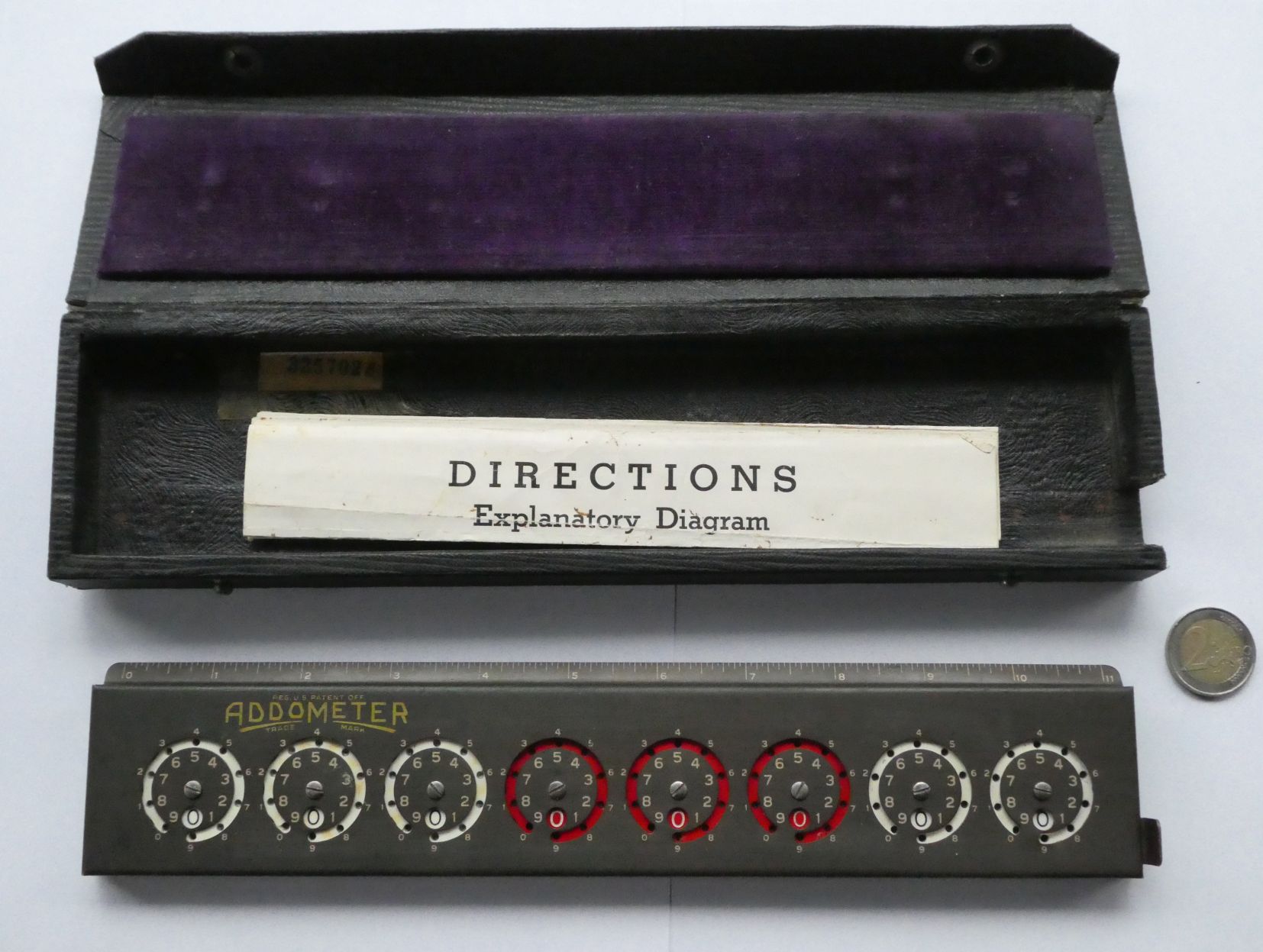
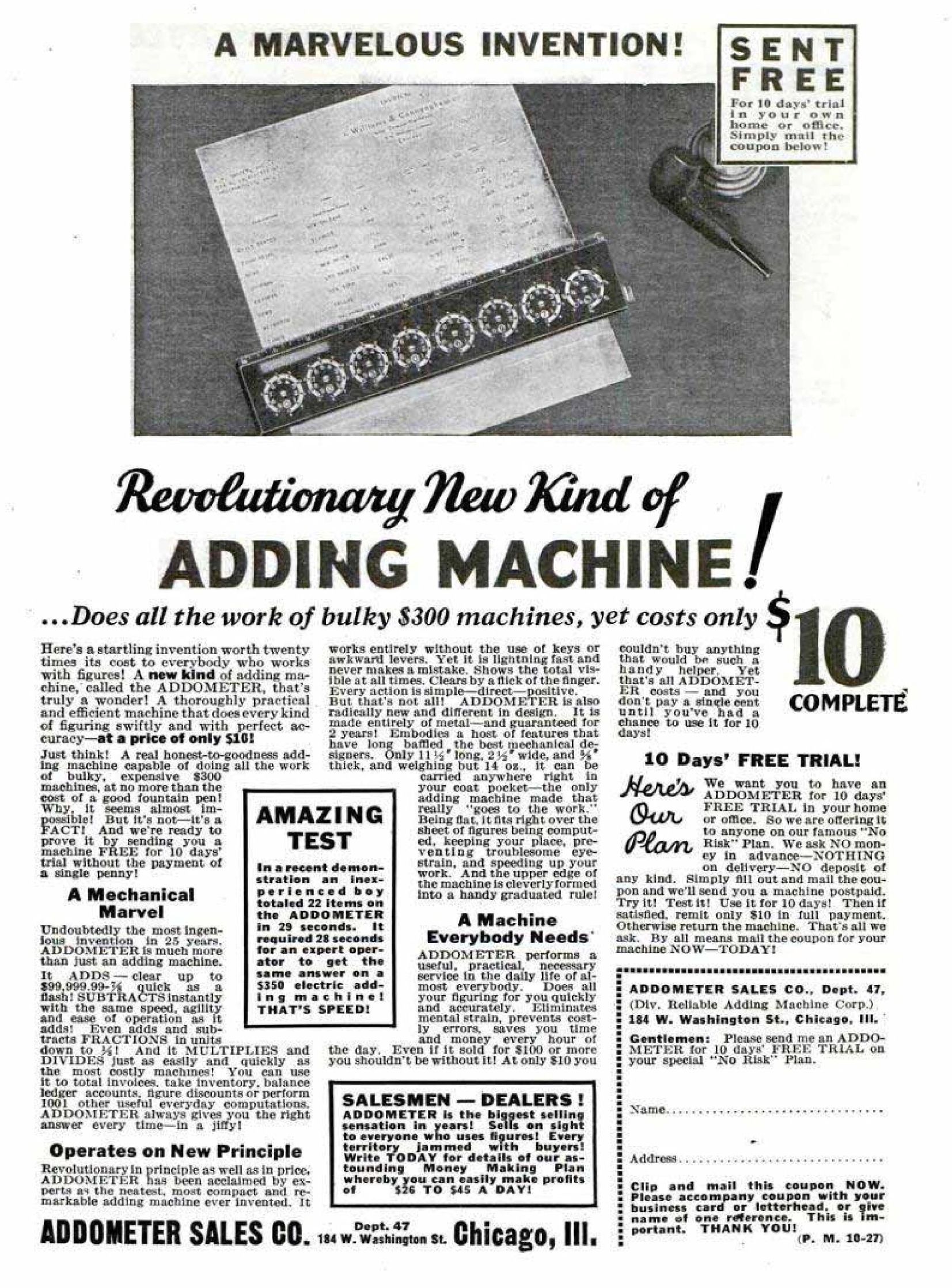
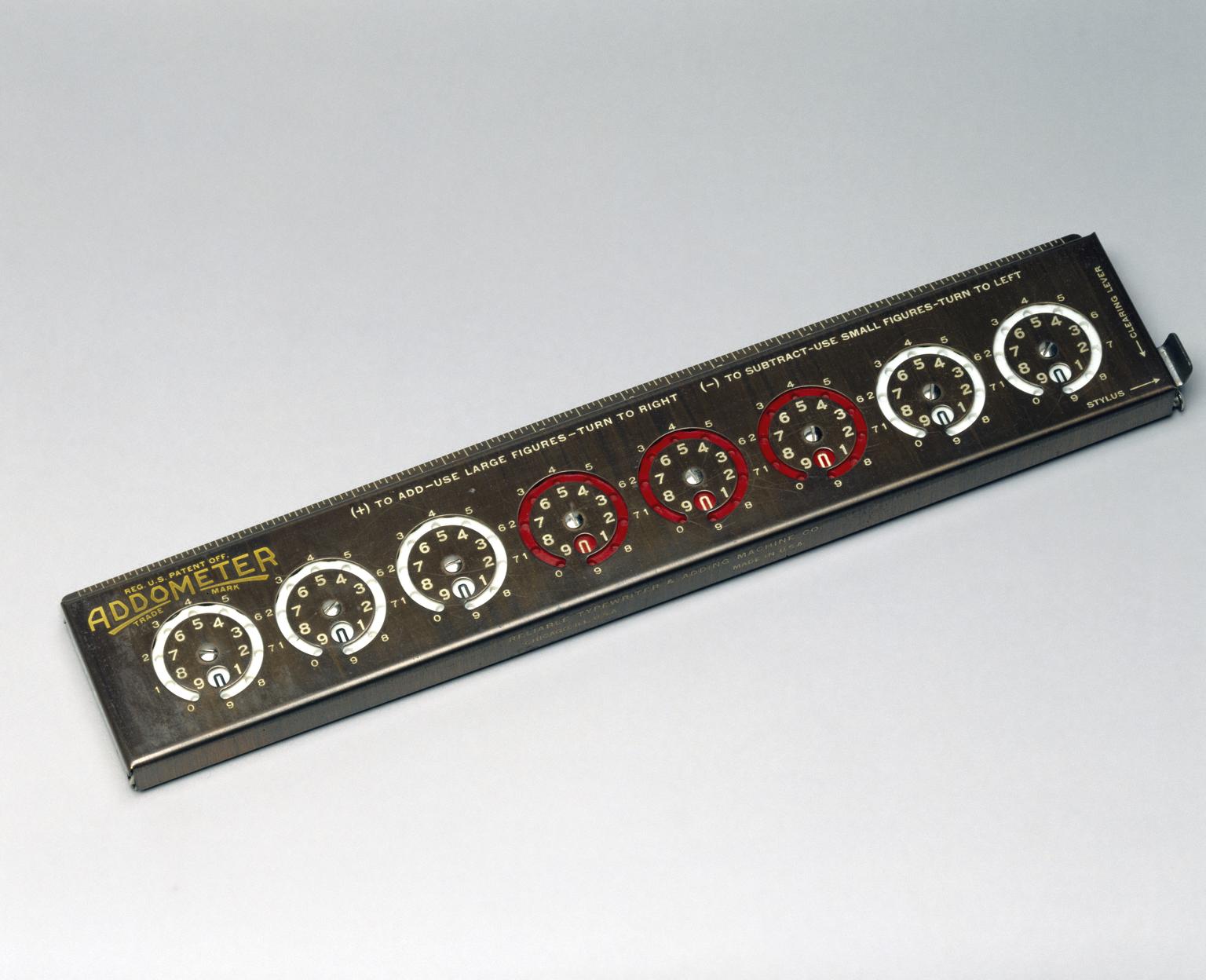
The Addometer was the Lightning’s most serious competitor and in several ways the better machine. It was made by the Reliable Typewriter & Adding Machine Company of Chicago and sold through a subsidiary, the Addometer Sales Co., from 170 and 184 West Washington Street and then, from 1929 to 1959, 303 West Monroe Street. Its trademark was filed in November 1927. It was still advertised in 1961, after the Lightning had gone, and passed to Lyons Associates in 1960 and later to Robert B. Zajesky’s Addometer Co. of Dolton, Illinois, which in the end moved over to electronic calculators.
Its designer was Anders E. Vethe, of Oslo and Chicago, later with Bull in Paris. His patents are US 1,829,379 (filed 20 October 1926, granted 27 October 1931) and US 1,764,915 (filed in 1928, granted 17 June 1930), with Canadian and German equivalents.
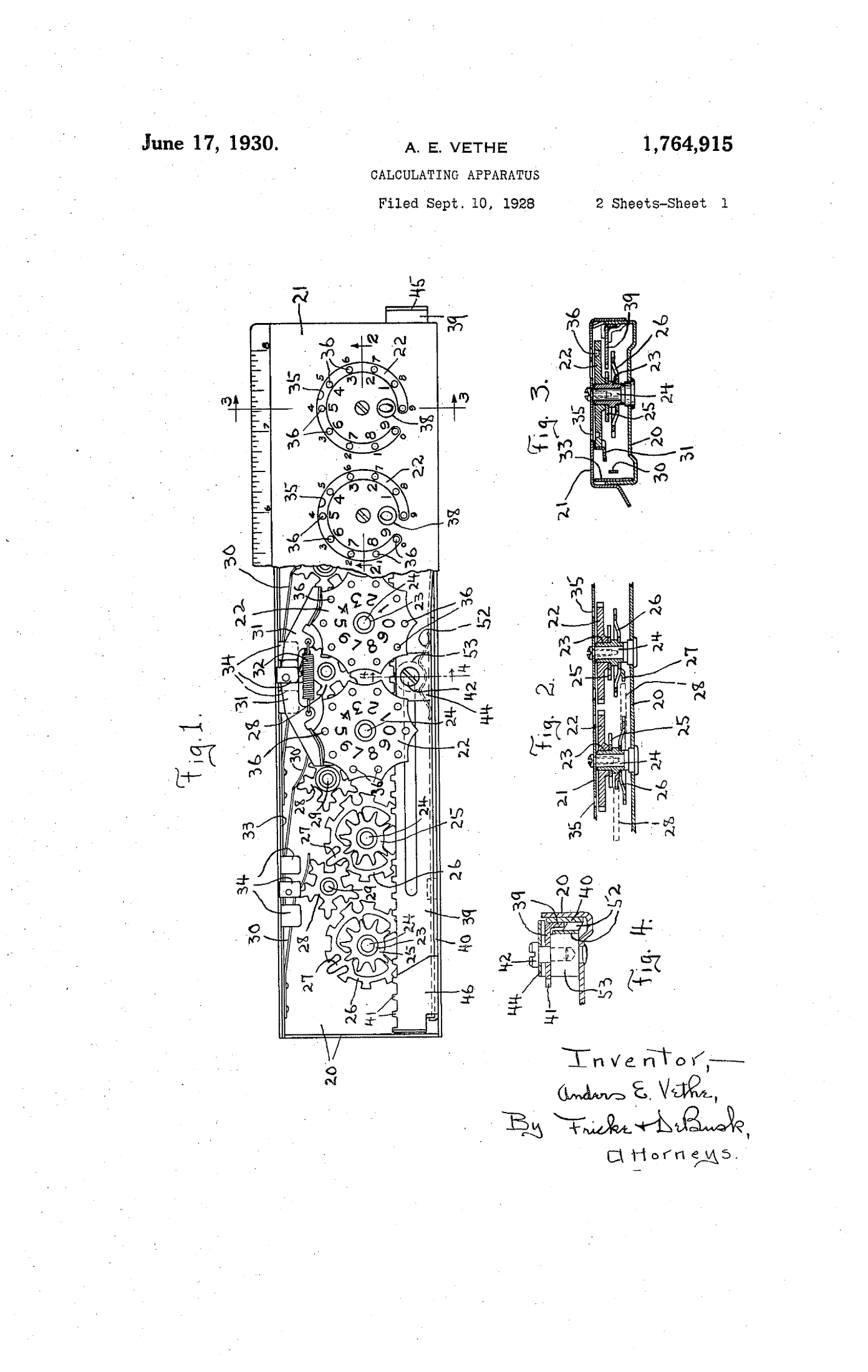
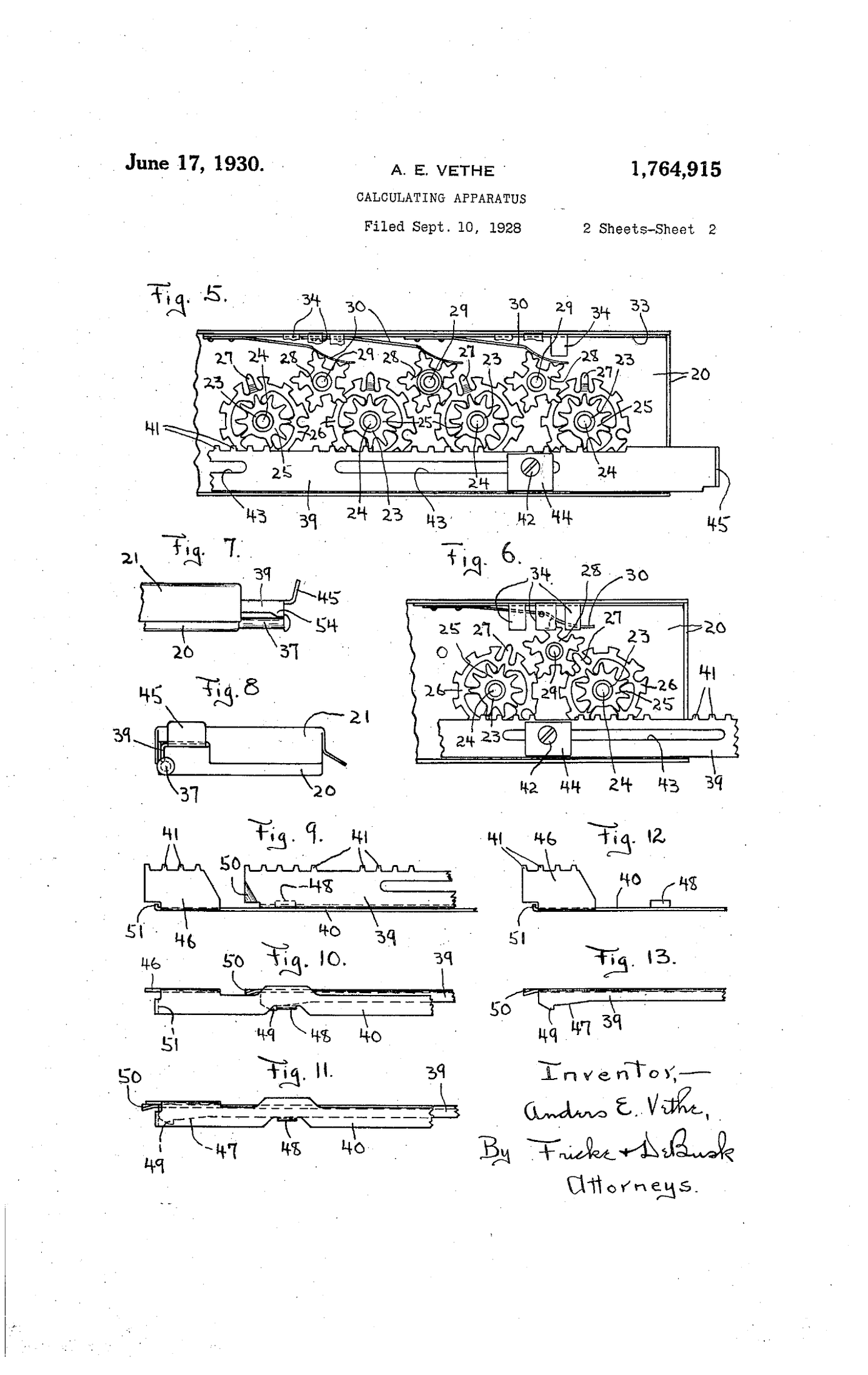
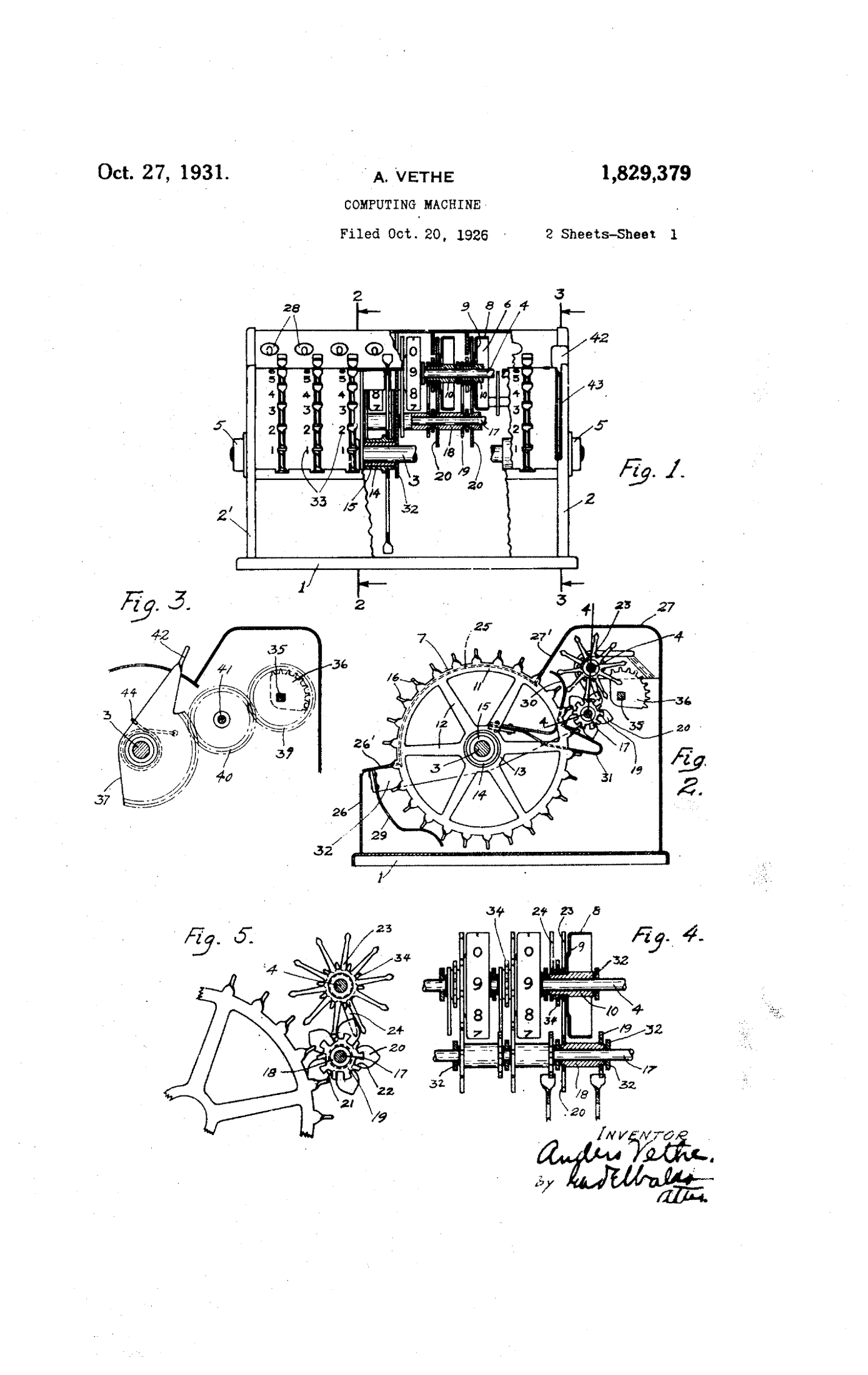
Where the Lightning differs, the Addometer was usually ahead:
- Eight dials, not seven. The dials are grouped by colour, white–red–white.
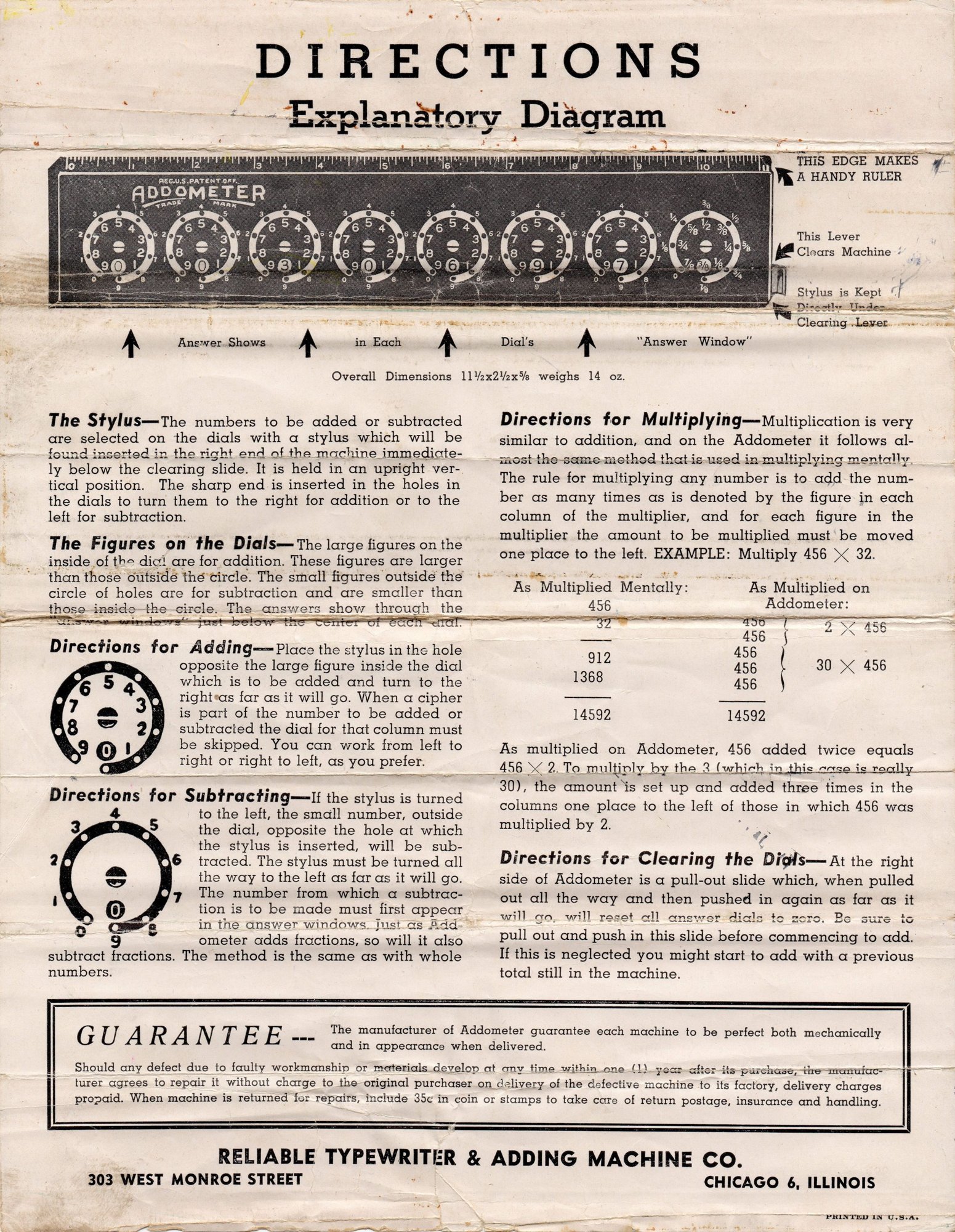
- Direct subtraction from the start. The carry works both ways, and the faceplate reads ”(+) To add — use large figures — turn to right / (−) To subtract — use small figures — turn to left.” Scherphuis calls it “the first successful dial adder” with this feature. It uses five-toothed intermediate wheels set at alternating heights, and a carry arm on each number wheel that advances the intermediate wheel on 9 → 0 or 0 → 9.
- A clearing lever from the start. A toothed rack runs past every number wheel. Each wheel has a ten-tooth gear with one tooth missing, and the rack is cut in alternating four- and five-tooth sections. “The lever must be pulled out twice the wheel spacing”, about 50 mm in one movement. It is the best-documented example of the rack-and-gap-gear clearing that the Lightning adopted in 1948, and the reason for the clearing diagram in the volume on theory of operation.
- The stylus lives in the machine. It sits in a hole by the clearing lever, and pulling the lever ejects it.
- A ruler along the edge. An 11-inch scale on most models.
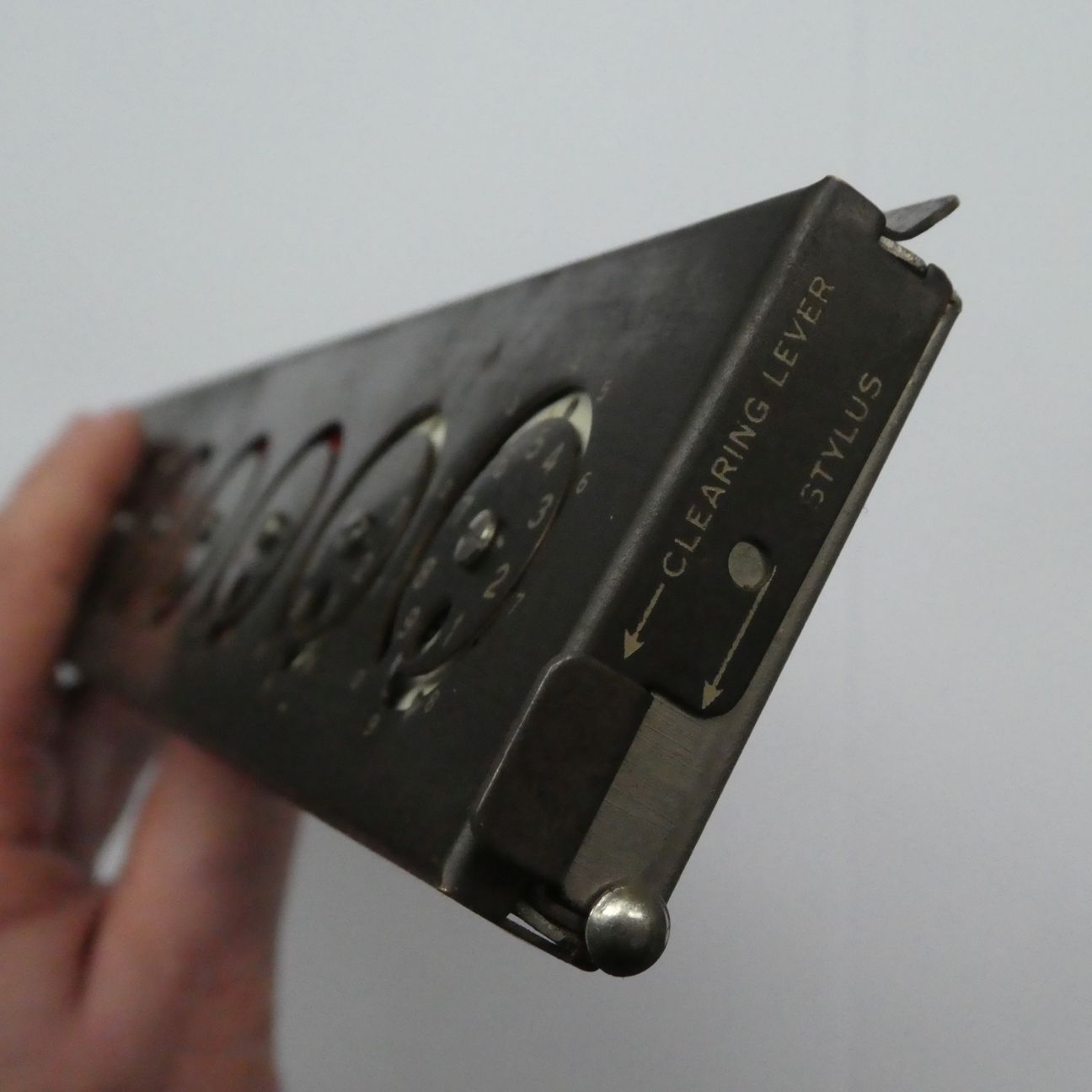
Models were lettered by scale: A (last dial in eighths), B (decimal, inch ruler), C (feet, inches and eighths), D (centimetre ruler), E (unknown) and F (pounds, shillings and pence). A British version was sold by Taylor’s of 74 Chancery Lane, London. The Science Museum in London holds one dated about 1925. Smithsonian records, seen only in summary, give prices of $10 to $15 in the 1920s and about $13 to $15 in the 1950s, close to the Lightning’s.
Two older and unrelated machines used the name too: an “Addometer” of the Gubelman Manufacturing Co. of Buffalo, patented in 1893, and a concentric-disc “Gordon’s Addometer” of the Addometer Corporation of New York, 1914–17. Neither has anything to do with Reliable’s machine.
7.2 The Ray Subtractor-Adder (Virginia and New York, 1916–24)
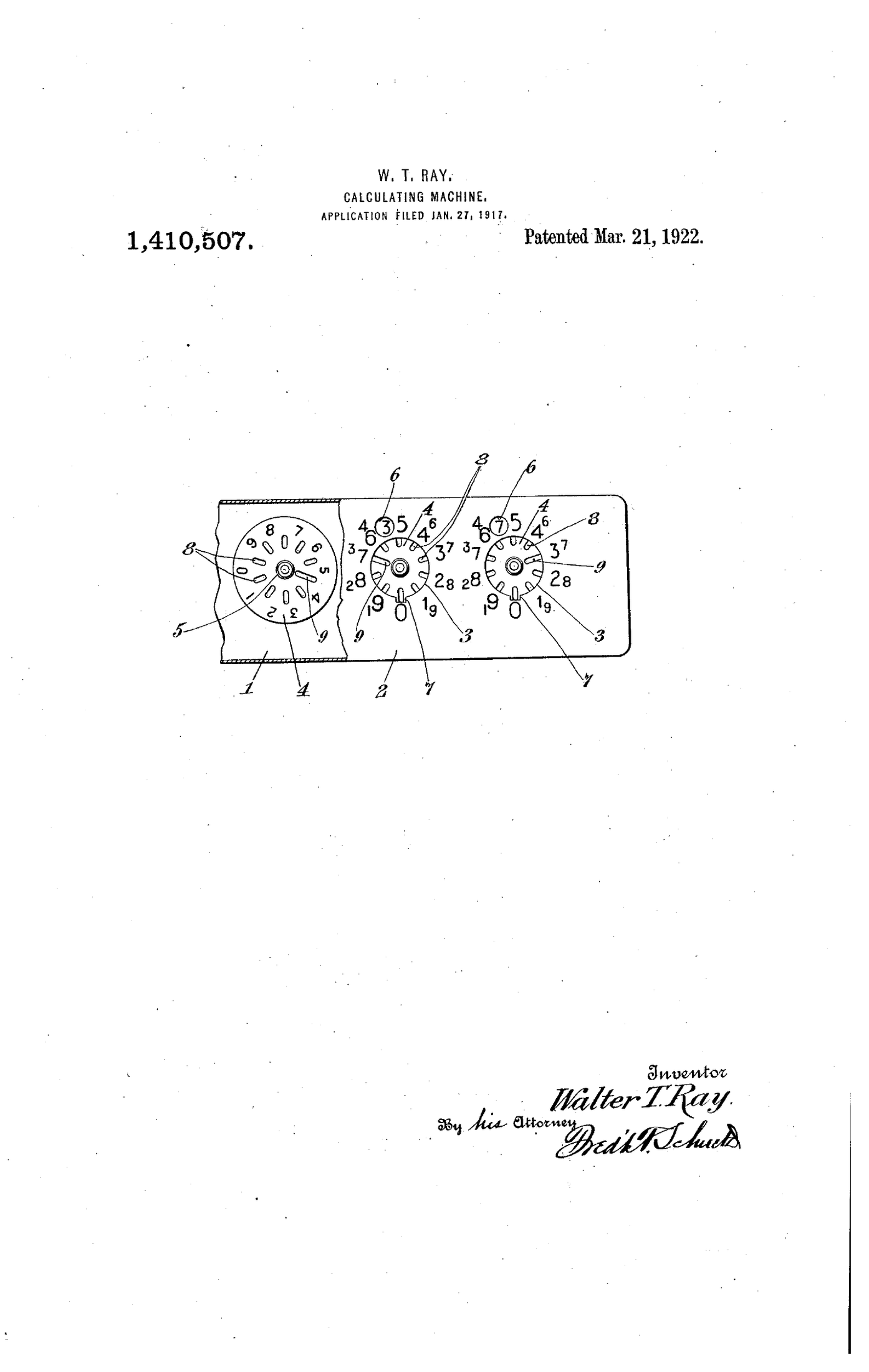
Walter T. Ray of Virginia Beach patented a stylus dial adder with reversible disks, turned one way to add and the other to subtract, with an elongated depression for a quick reset to zero: US 1,410,507, granted 21 March 1922 (a division of an application filed 19 November 1915). It was sold by the Ray Subtractor-Adder Co. of Richmond, Virginia, in 1916–17 and by the Ray Adding Machine Co. of New York from 1920 to 1924, at $15 in 1916 and $25 from 1917. It shows that direct subtraction on a dial adder was patented and sold years before either the Addometer or the Lightning offered it.
7.3 The Quixsum (1923)
A row-of-dials adder with geared carry, add only, under US patent 1,497,570 of 1923. Little is published on it beyond Otnes’s taxonomy.
7.4 The Kes-Add (St Louis, 1940s–1950s)
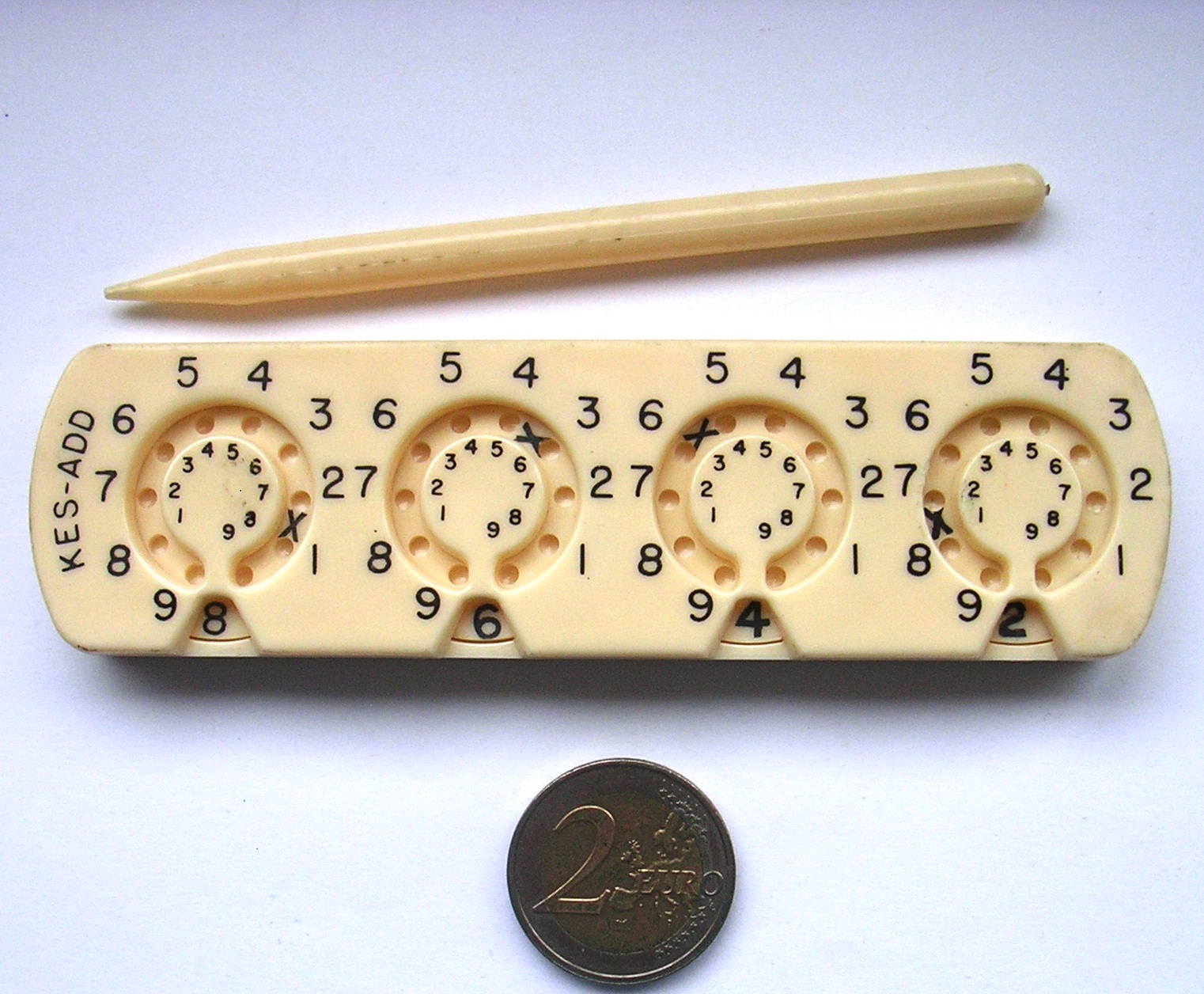
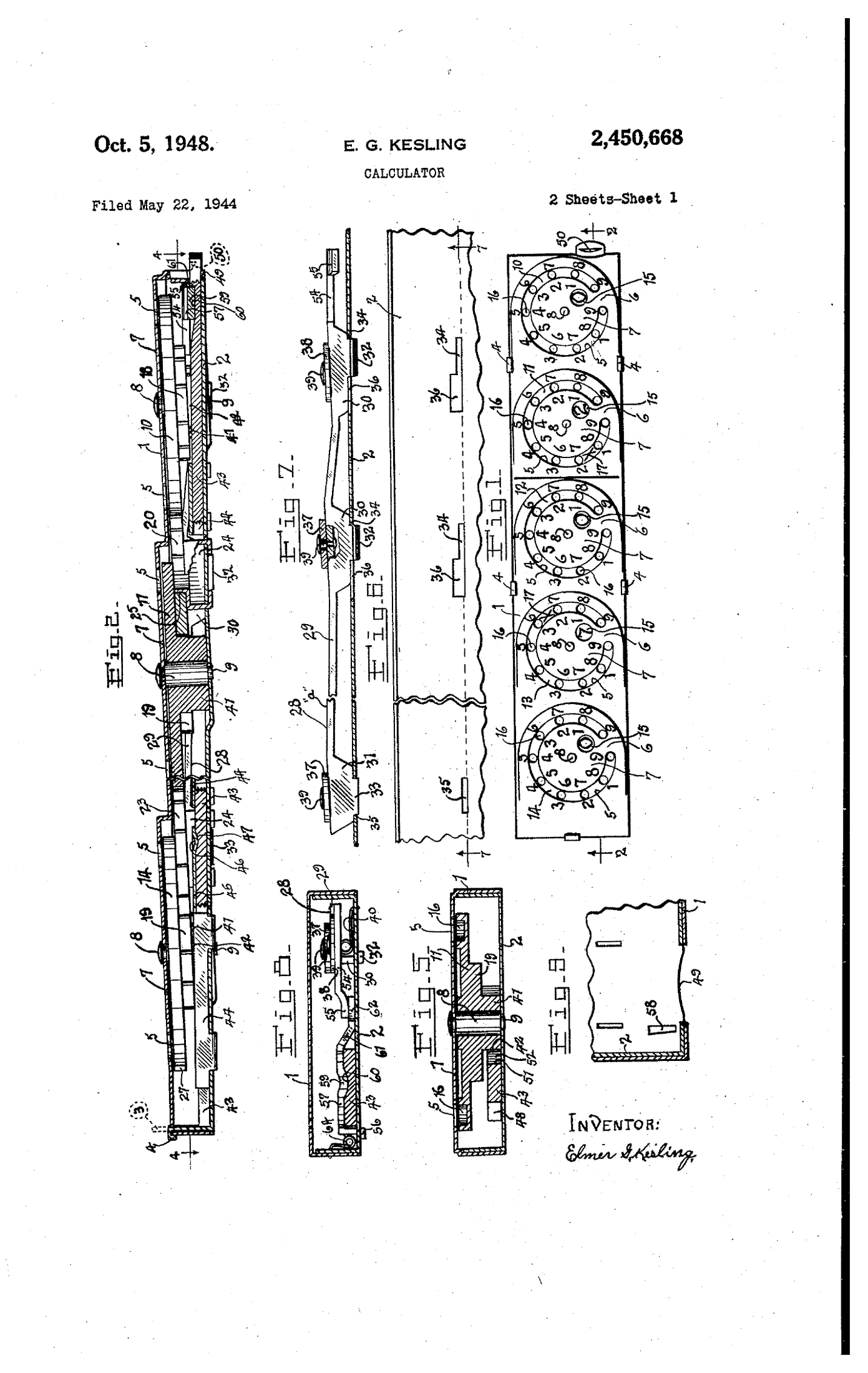
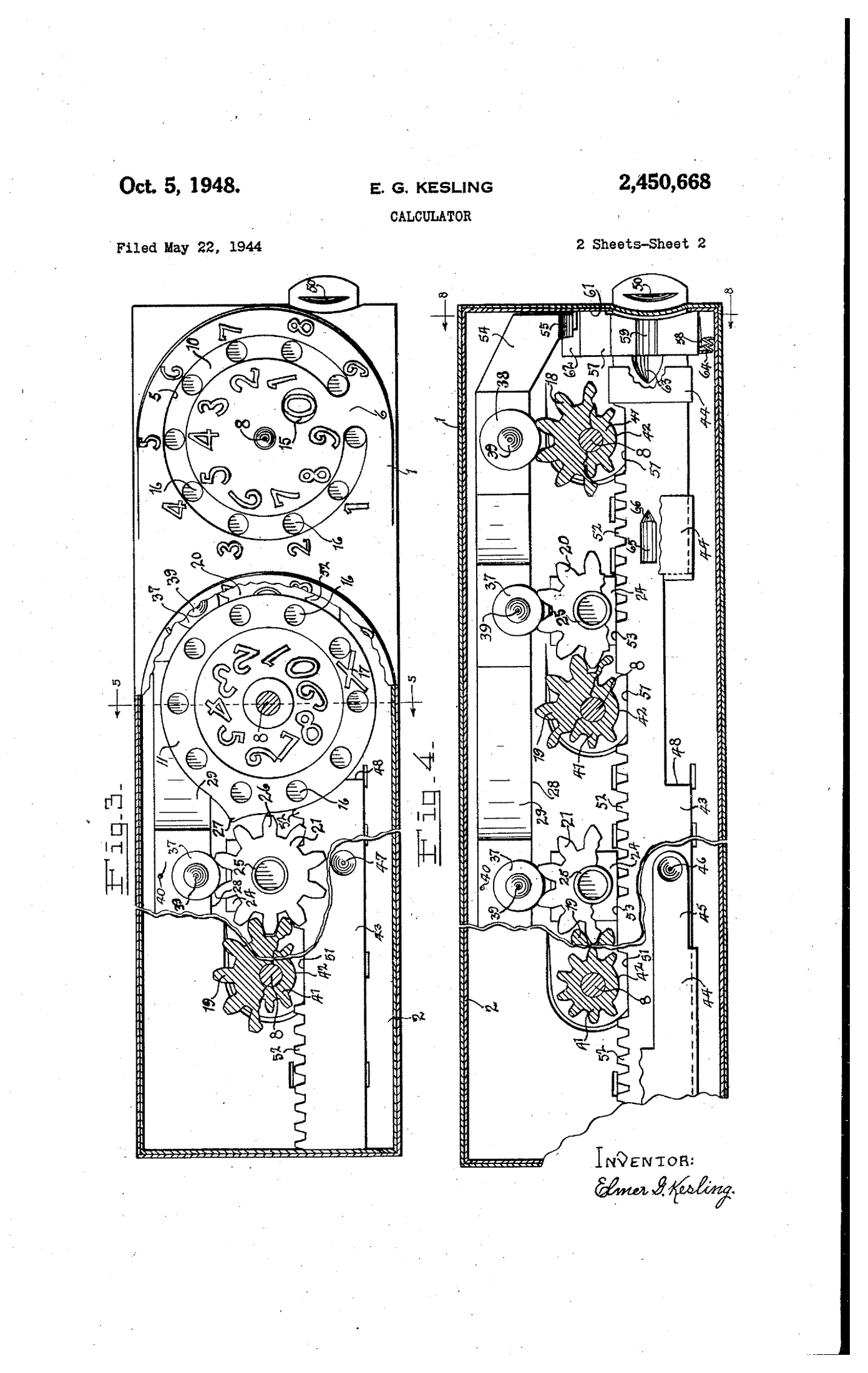
The Kesling Pocket Adder, or Kes-Add, was designed by Elmer G. Kesling (1881–1961), a St Louis dentist, and sold by its exclusive distributor, the Hart Vance Co. of St Louis 3. It has four plastic dials, weighs 34 grams, carries both ways, has small reversed figures for subtraction and no clearing. Kesling’s patent is US 2,450,668 (filed 22 May 1944, granted 5 October 1948), with a later one, US 2,935,257, in 1960. Scherphuis dates production from about 1954 but also holds a newspaper item about it from July 1946. Hasbro sold licensed versions, one of them in a yellow box with kitchen utensils.
7.5 The Ken+Add (Minnesota, c. 1950–58)
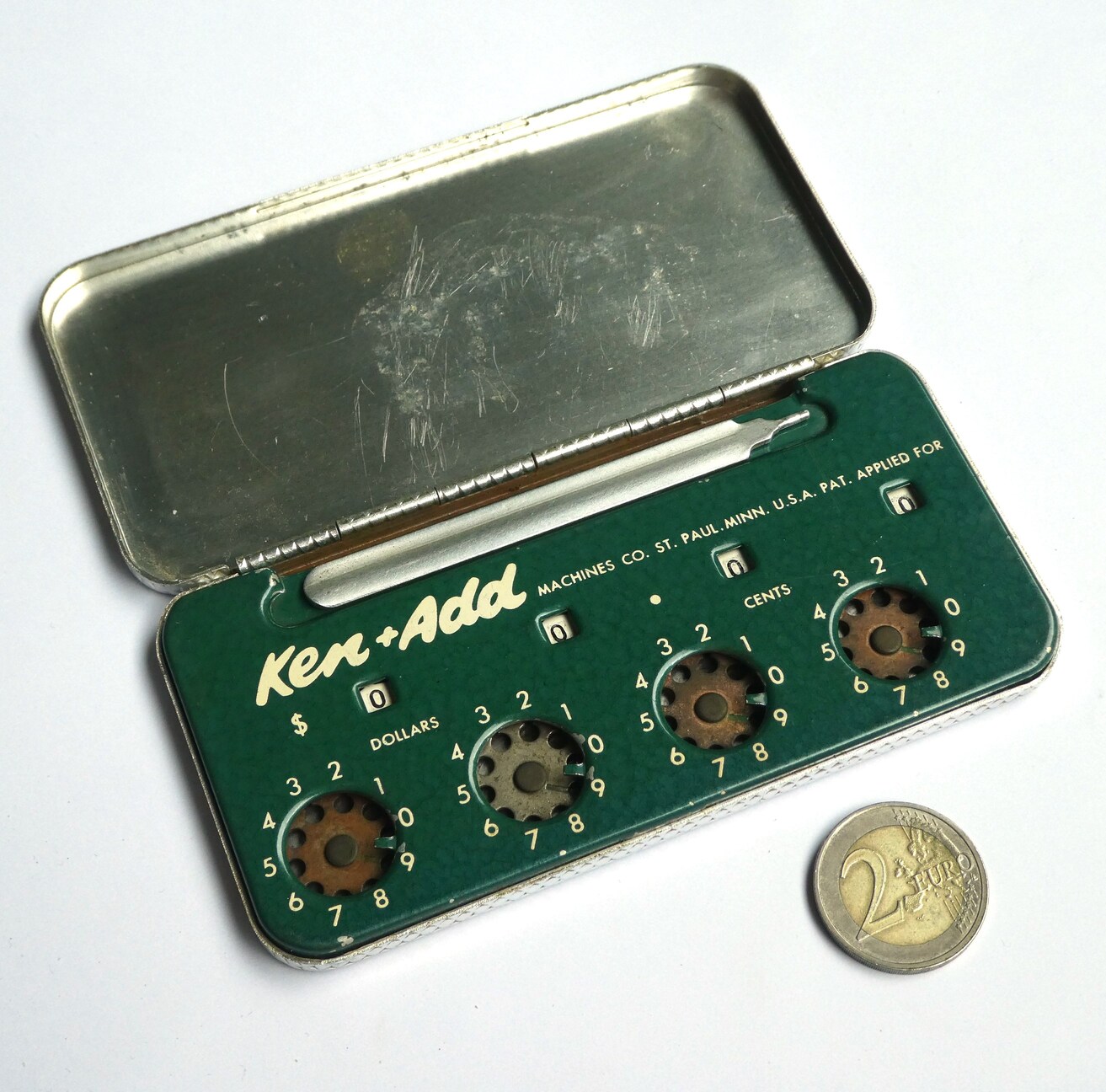
A four-dial pocket adder in a hinged metal case like a cigarette case, with a “Magic Slate” writing pad in the lid. It was made by the Ken+Add Machines Co. The first version is marked Duluth and the second St Paul, Minnesota. Its designer was Kenneth R. Pangburn, who is not known to be related to the Pangborn of Grand Rapids despite the near-identical name. Only design patents protect it (US D163,135 and D163,136, both of 1 May 1951). Scherphuis describes its mechanism as “virtually identical” to the Lightning’s. It adds only and has no clearing. A cheaper “Purse Adding Machine” uses the same mechanism.
7.6 The Sterling Dial-A-Matic (New Jersey, 1954–c. 1970)
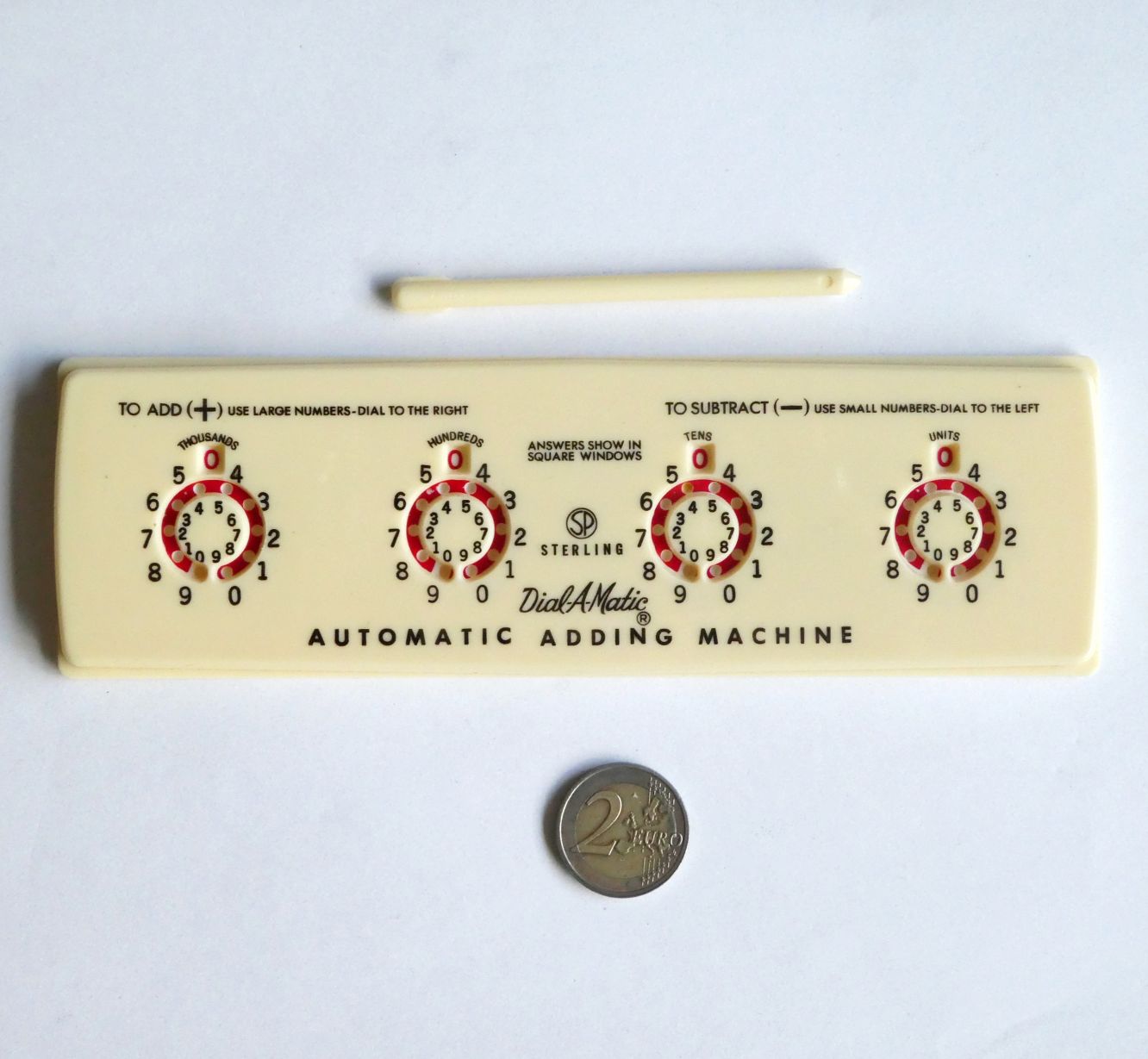
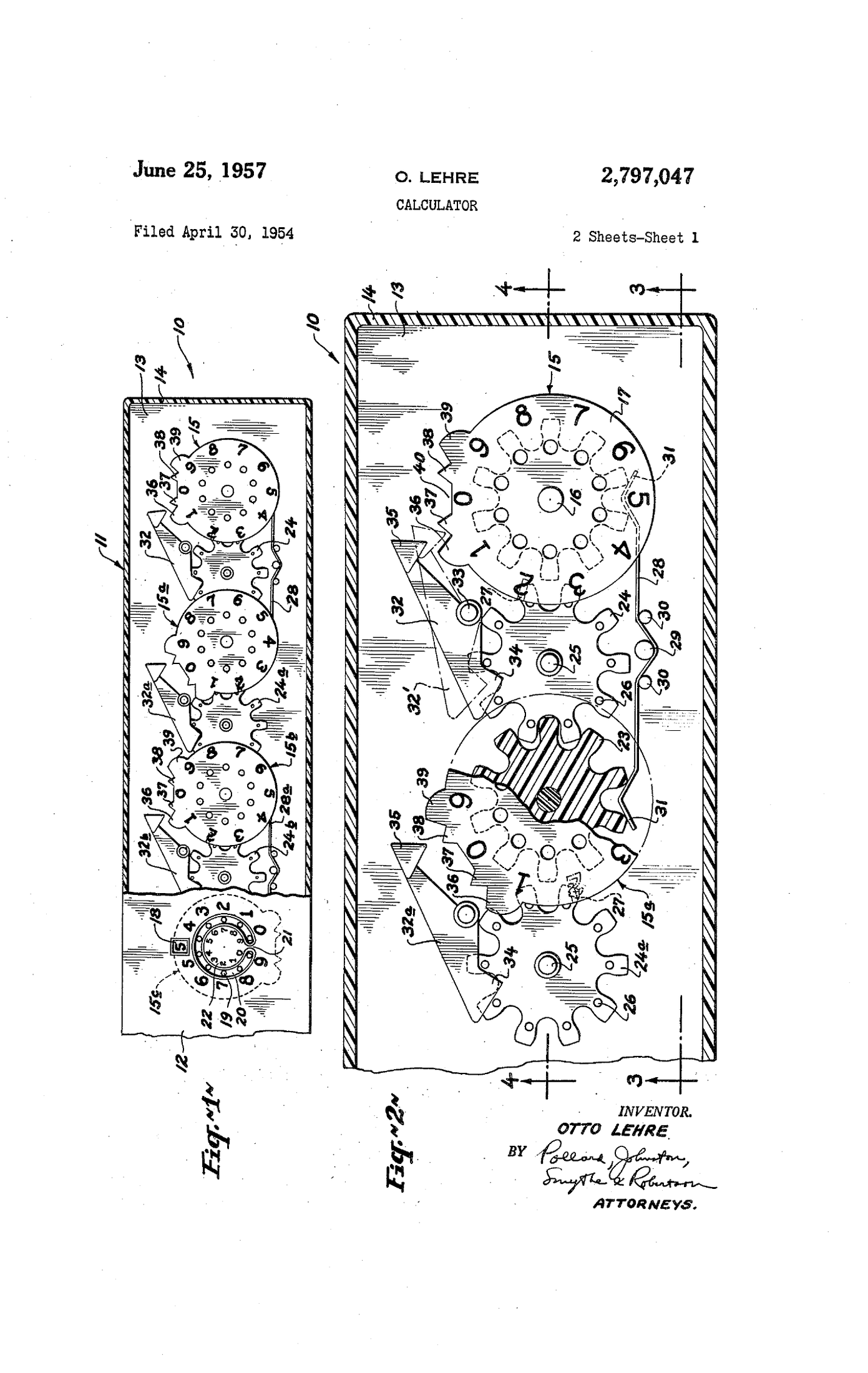
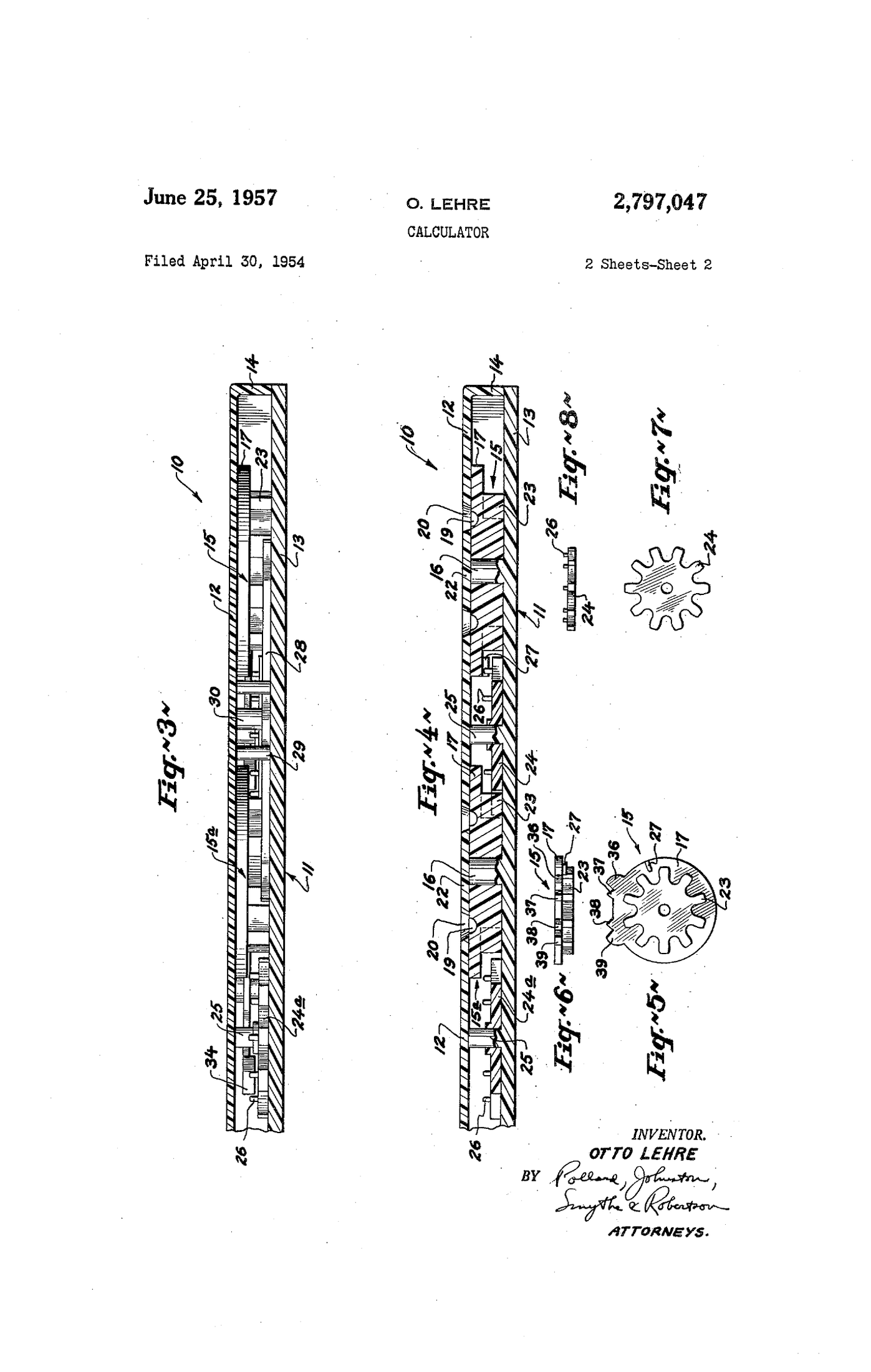
The plastic dial adder that outlived the Lightning was the Dial-A-Matic of the Sterling Plastics Co. of Union (later Mountainside), New Jersey, invented by Otto Lehre. Its trademark claims first use on 10 October 1954. The patent is US 2,797,047 (filed 30 April 1954, granted 25 June 1957), with British and Canadian equivalents. It carries both ways and was made for about fifteen years, to about 1970, in four models:
Table 1 — The plastic dial adder that outlived the Lightning was the Dial-A-Matic of the Sterling Plastics Co. of Union (later Mountainside), New Jersey, invented by Otto Lehre. Its trademark claims first use on 10 October 1954. The patent is US 2,797,047 (filed 30 April 1954, granted 25 June 1957), with British and Canadian equivalents. It carries both ways and was made for about fifteen years, to about 1970, in four models
| Model | Description |
|---|---|
| 565 | four dials |
| 566 | in a pencil-box lid |
| 567 | five dials, desk |
| 568 | six dials, with clearing |
The 4-, 5- and 6-dial machines sometimes described as Lightnings are Dial-A-Matics.
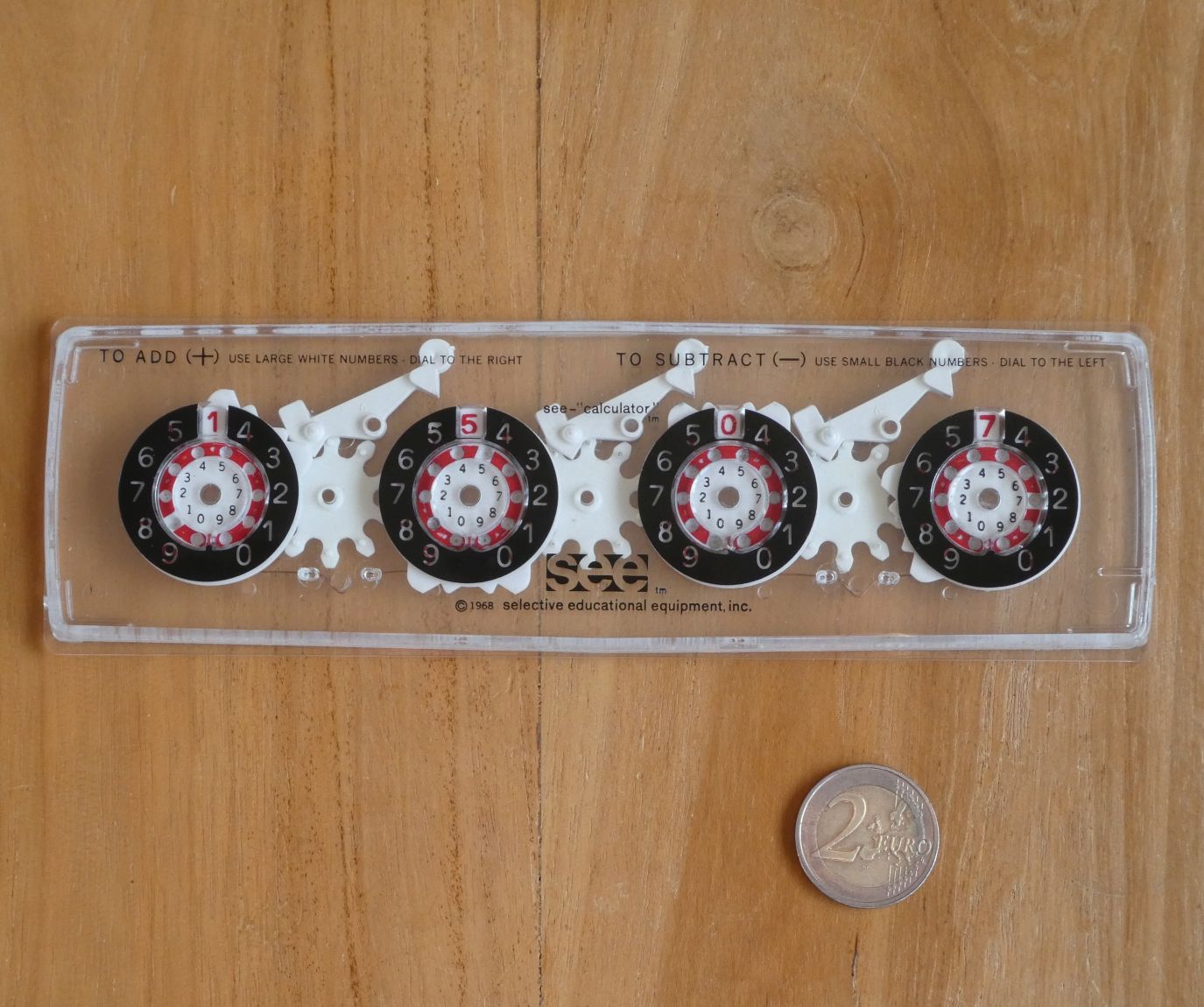
The Dial-A-Matic had two remarkable offspring. IBM had a hexadecimal version made in the late 1960s for programmers. The SEE Calculator of 1968, made in a transparent case for Selective Educational Equipment, let students watch the carry happen. It was reissued in 1982 by Burt Harrison as the “Pascal-type Calculator”. For anyone who wants to see inside a dial adder without opening a Lightning, a SEE Calculator is the way to do it.
7.7 Others
Otnes and Scherphuis list several more stylus dial adders that have not been researched for this series. Some are borderline members of the type.
- Bair and Bair-Fulton (1928, 1933; US 1,940,069). Otnes calls them “essentially a Kummer” with an assisted manual carry, closer to a slide adder than a true geared-carry dial adder.
- SHOP-N-ADD, Curran, Itemizer, Checkbook Balancer and Dial-Admatic: small post-war household adders.
- ADCO, with a manual carry, and Addist, made of cardboard.
- Schildkröt Minirechner 99, a German toy.
- Swift Handy Calculator, a 1960s Hong Kong copy with a different, spring-driven design. John Wolff’s internal view shows four-lobed snail cams, carry pawls and a clearing lever that lifts every detent so that springs return the dials to zero.
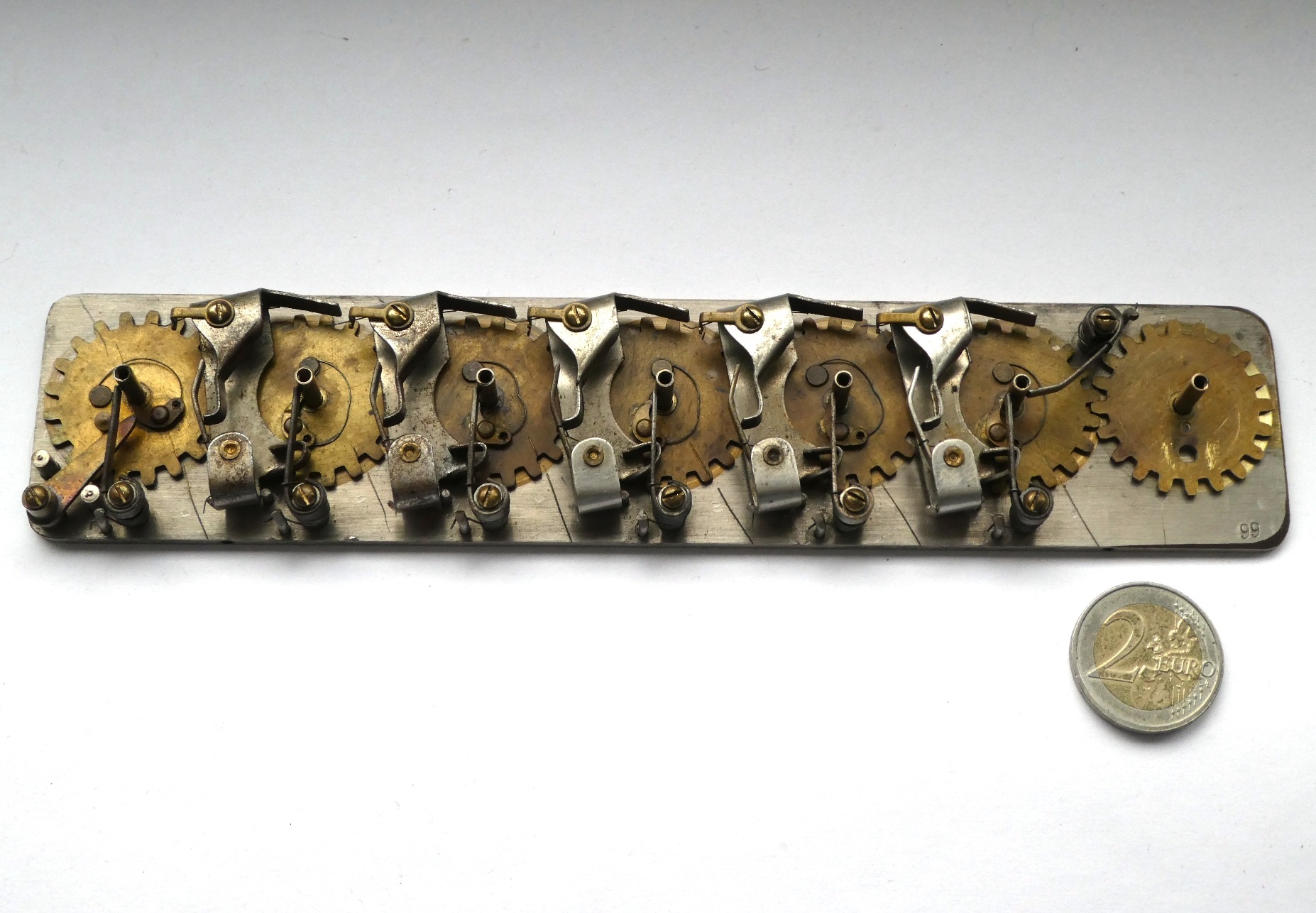
- The Calcumeter’s carry is shown here for comparison with the Lightning’s. It, too, stores no energy: a rod on each driving wheel pushes a latch that turns the next wheel.
7.8 Cousins of other types
Several other kinds of small adder are often filed with the dial adders and work on different principles. Each will get its own series.
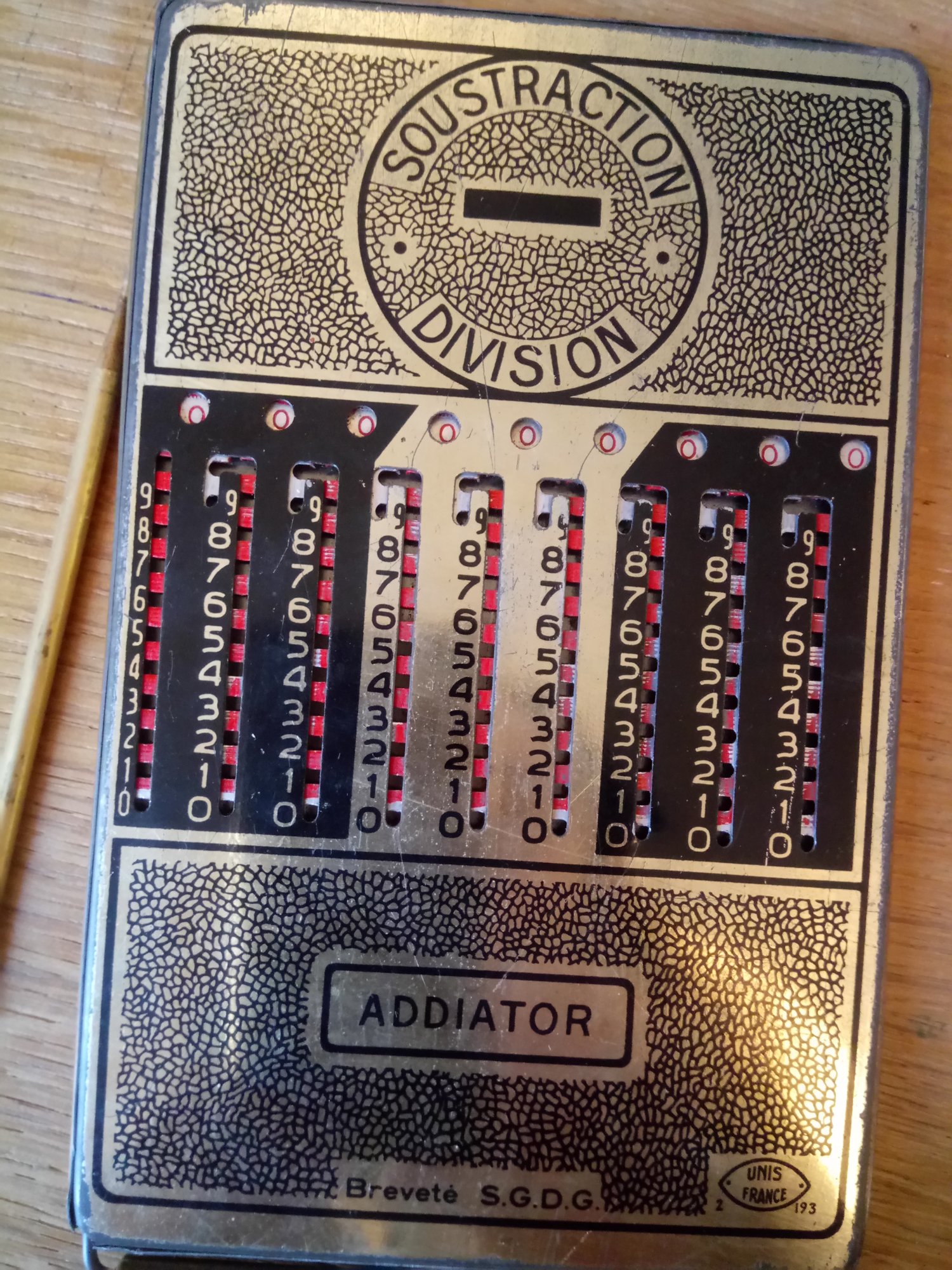
- Slide adders (the Troncet–Kummer type): the stylus pulls a toothed slide along a slot, and the carry is made by hooking the stylus round the top of the slot. The Addiator of Berlin (1920–82) is the best known; the Tasco and the Reliable company’s own Ve-Po-Ad are others.
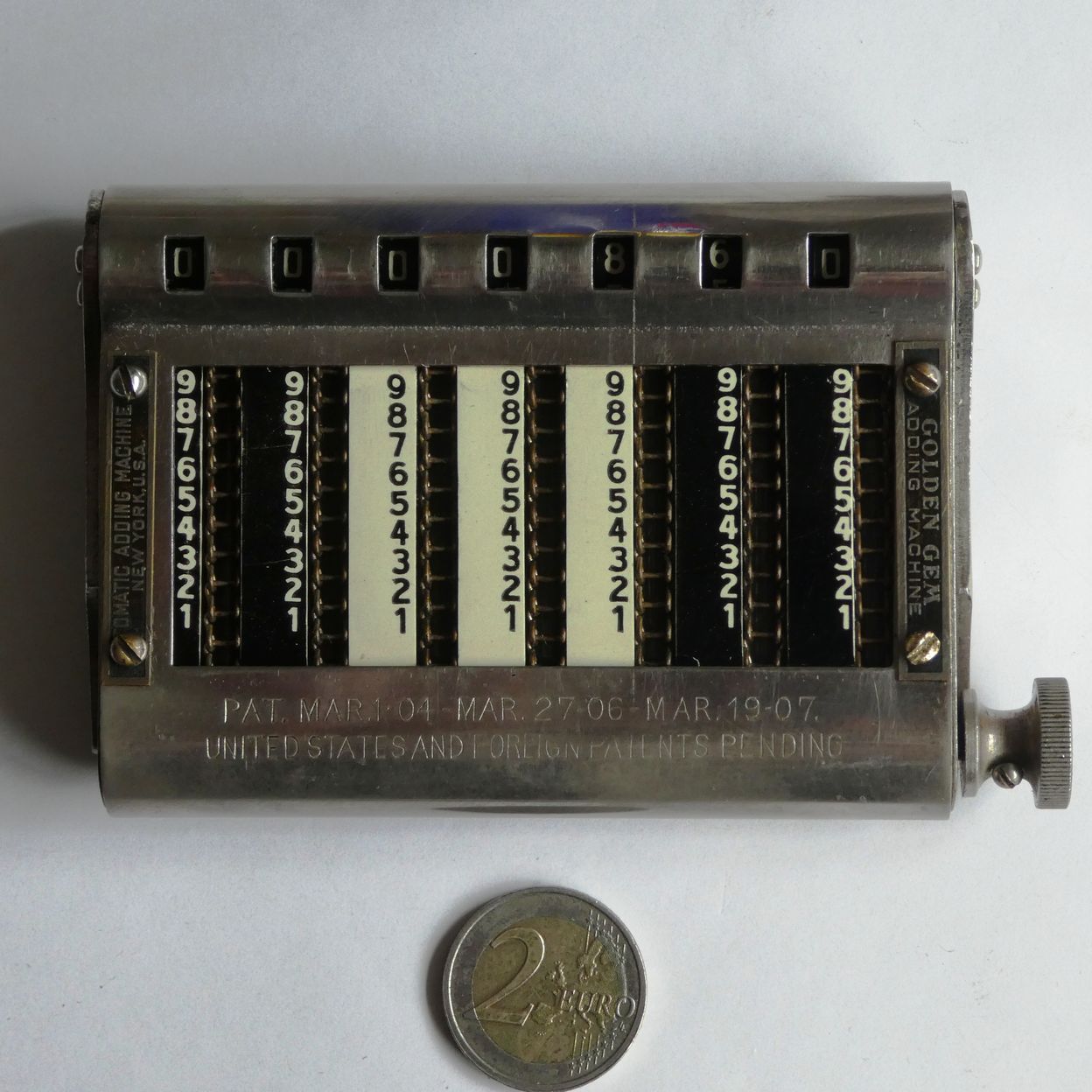
- Chain adders: the Golden Gem, of the Automatic Adding Machine Co. of New York, advertised from 1906 to 1941 at $10 to $25.
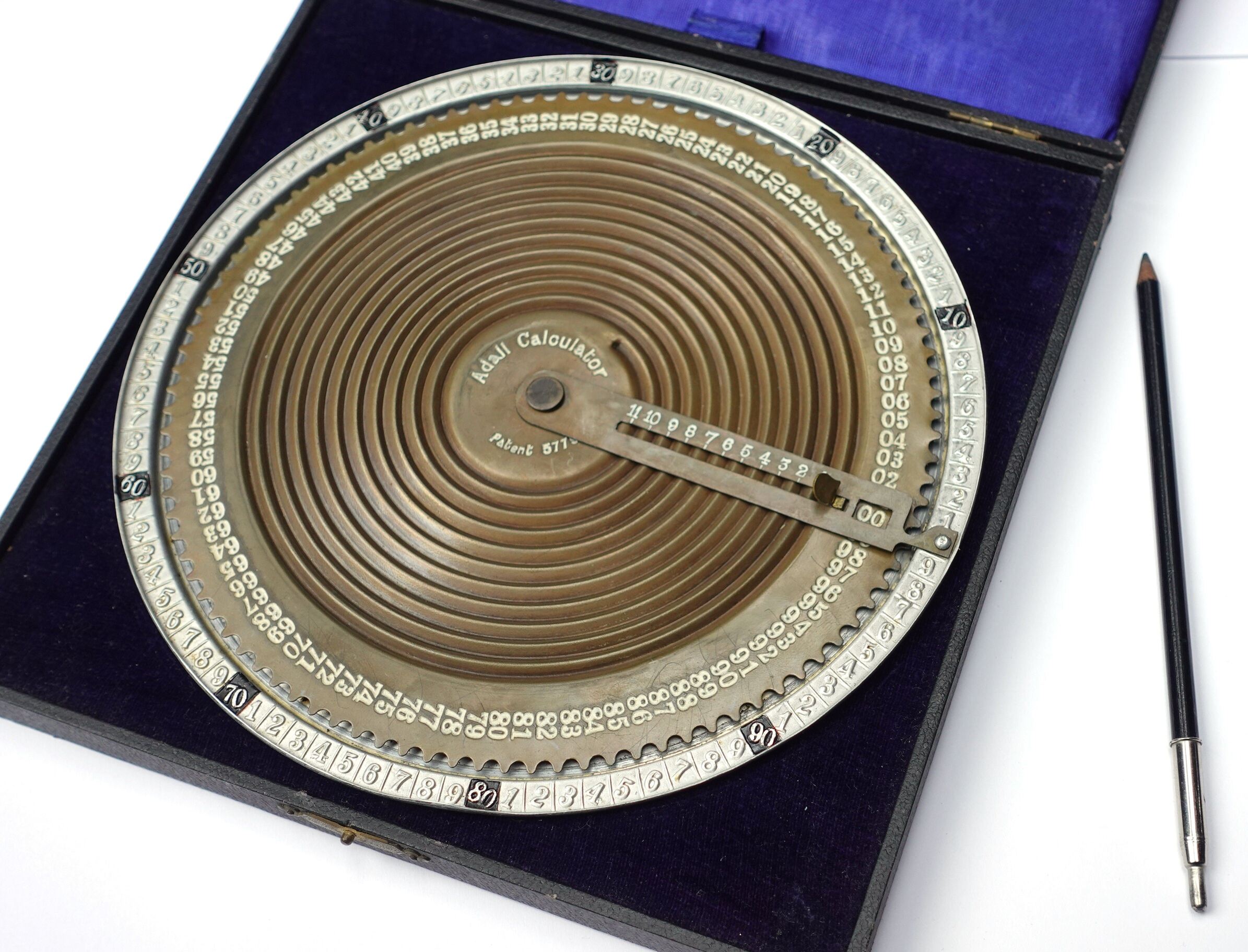
- Band and spiral adders: the Bassett and Clark’s New Adder (Chicago, 1909–38), and the Adall, whose figures run on a spiral.
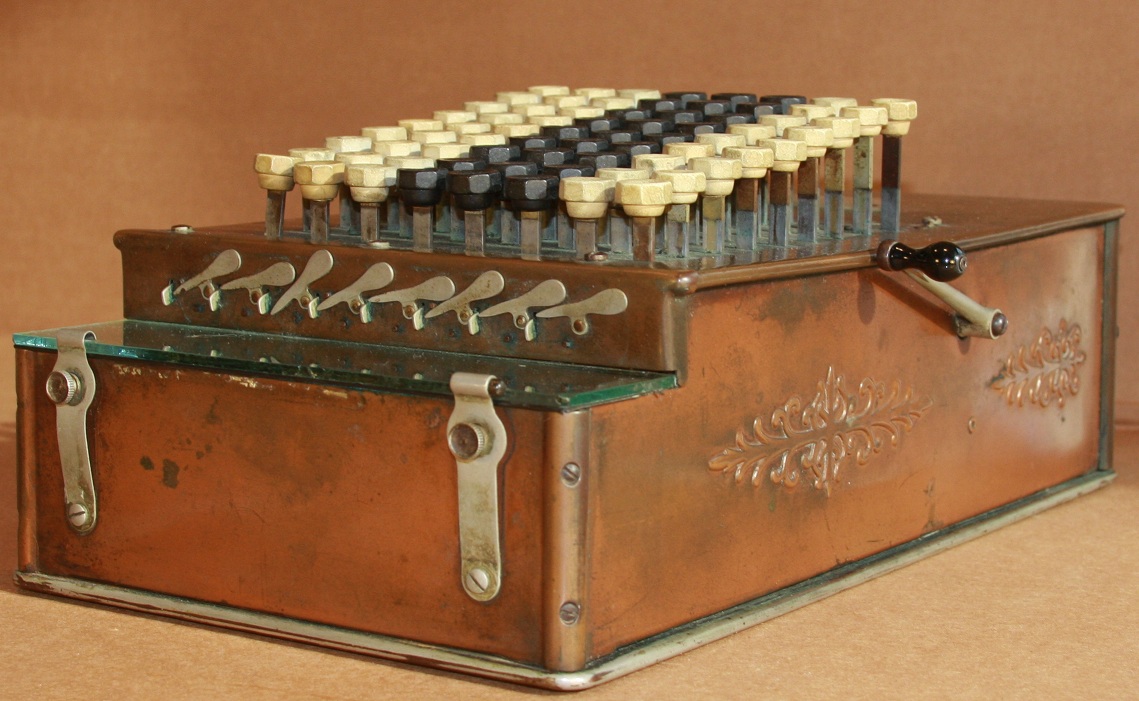
- Key-driven adding machines, such as the Felt & Tarrant Comptometer: the office machines that the dial adders were sold as a cheap alternative to.
Comments (0)