Dial Adders · Volume 3
The Lightning Company: Grand Rapids to Los Angeles
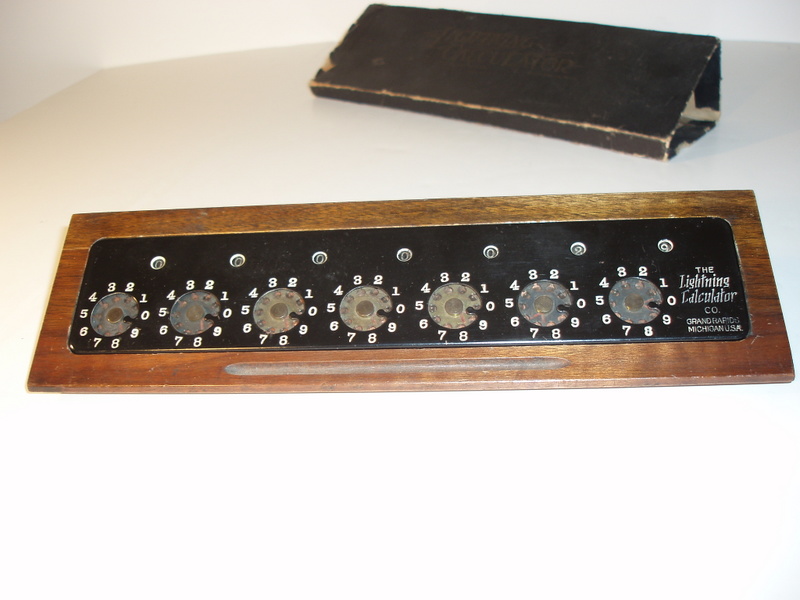
The Lightning was made for almost forty years under three company names in two cities, and for most of that time its makers left almost no paper trail except advertisements. Its history has had to be reconstructed from city directories, trade-journal notices, trademark filings and the machines themselves. The outline is now reasonably clear. Russell Wallace Hook redesigned the Grand Rapids machine and patented the redesign. His family ran the company through the 1920s and 1930s. The war stopped production. A Los Angeles typewriter dealer revived it in 1945–46, and it was sold again in 1953 and ended around 1959, by which time it may have been made in the millions.
3.1 Hook’s patent
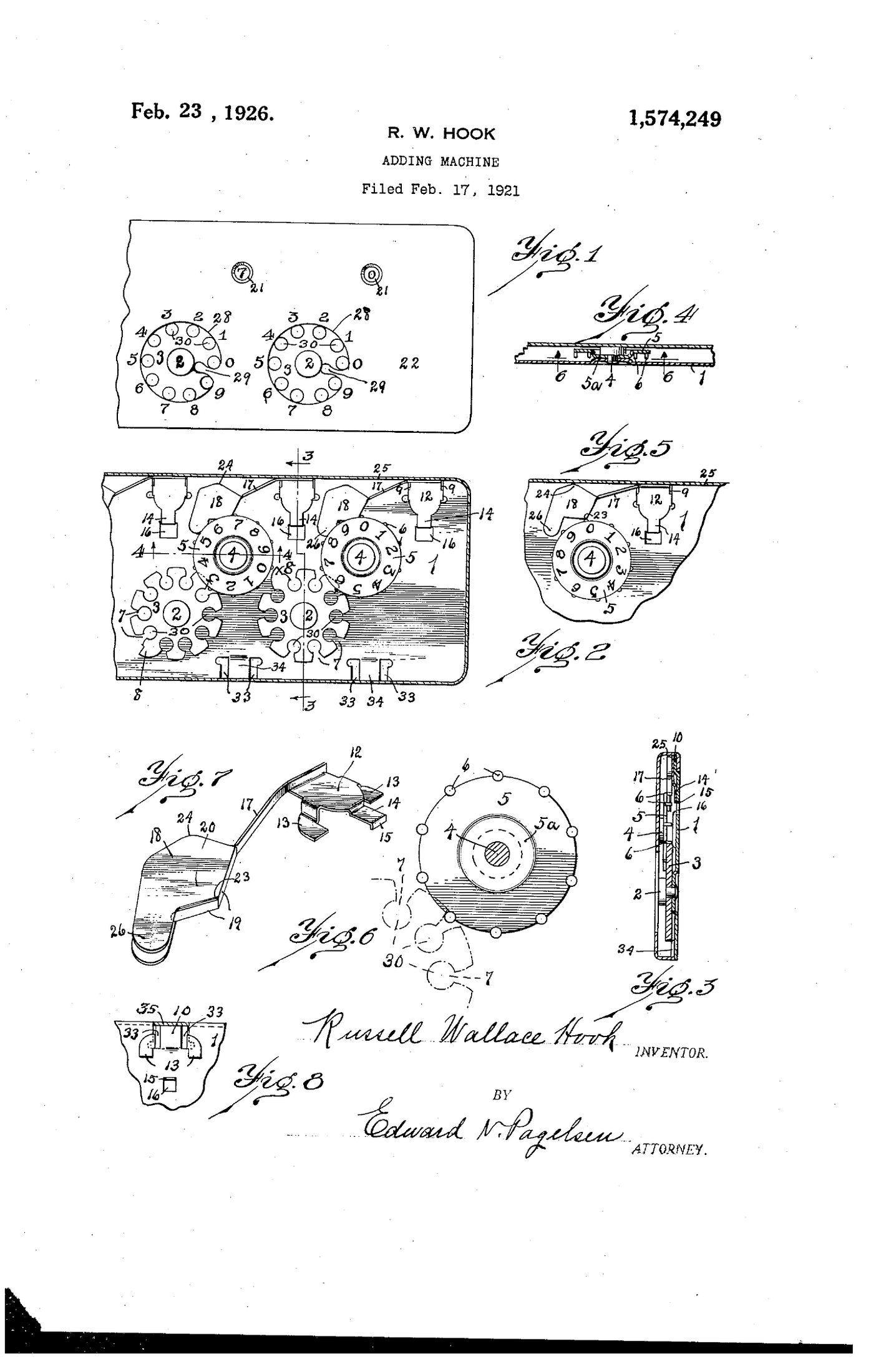
Hook filed his application on 17 February 1921 (serial 445,581), and it was granted on 23 February 1926 as US 1,574,249, “Adding machine”, with no assignee. It is the only patent known to cover the Lightning.
The patent’s stated object is narrow: “to provide means to prevent the overthrow of these wheels when actuated in the usual operation of the machine.” Its claims cover a sheet-spring pawl with a weighted head. When a numeral wheel is spun fast, the pawl is thrown outward. Its weighted end then “drops in behind the next pin after the one which has raised the pawl and absolutely prevents overthrow”, but it still lets the wheels turn backwards, “so that problems in subtraction may be solved.”
What Hook changed from The Calculator matters more than what he claimed. Otnes identifies three changes:
- Separate result windows. The answer moved out from under the input dials into a straight row of windows. Hook did this by printing the digits on the gears that carried the tens from one place to the next, so the carry wheels became the register. The rightmost digit, having nothing to its right to carry from, needed an extra wheel of the same kind purely to show the units.
- No rivets on the top face. The top plate is held on by metal tabs folded round the bottom plate.
- A larger, heavier machine.
The first of these is the one the user sees. Every later Lightning, including both of mine, reads its total in a neat row of windows above and to the right of the dials, and that is Hook’s arrangement.
3.2 Grand Rapids, 1921–c.1942
The company appears in the 1921 Grand Rapids directory as the Lightning Calculator Co., on the fifth floor of the William Alden Smith Building, with R. W. Hook, his father F. E. Hook as secretary-treasurer and Russel Reeve as assistant manager.
Table 1 — Grand Rapids, 1921–c.1942
| Years | Address | People |
|---|---|---|
| 1921 | 5th floor, Wm Alden Smith Bldg | R. W. Hook; F. E. Hook sec.-treas.; Russel Reeve asst. mgr. |
| 1923 | L. L. Hook sec.-treas. | |
| 1924 | 504, 30 Ionia Ave SW | |
| 1926–29 | Houseman Bldg | R. W. Hook president; F. E. Hook general manager |
| 1930 | H. T. Landefeld manager | |
| 1931–39 | F. E. Hook | |
| 1940 | no manager named | |
| 1941 | 363 Houseman | Morris Zuckerman manager |
| 1942–44 | 504, 41 Pearl NW | Zuckerman |
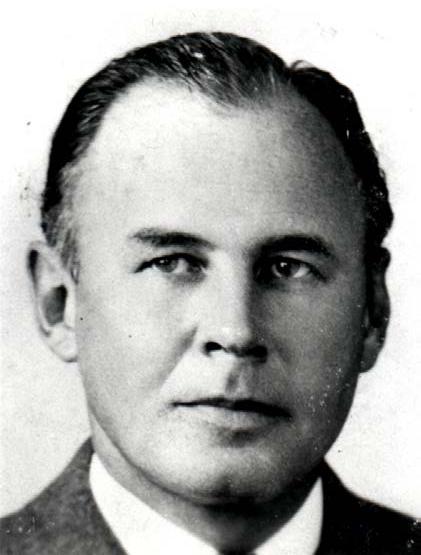
R. W. Hook died on 2 January 1948.
The Grand Rapids Lightning was black enamel over iron and copper-plated brass, with stamped lettering filled with paint, and Otnes believed that “only the black machine with wooden base was made and sold” from 1921 to 1940. Rechnerlexikon records a system of model designations. A letter gave the scale: D for US decimal currency, L for lineal measure (feet and inches), S for pounds sterling. A suffix gave the presentation: -1 bare, -2 in a case, -3 on a sloped wooden base. A D-3 is therefore a decimal machine on its wooden stand. Around 1926 the three presentations cost $10, $12.50 and $15.
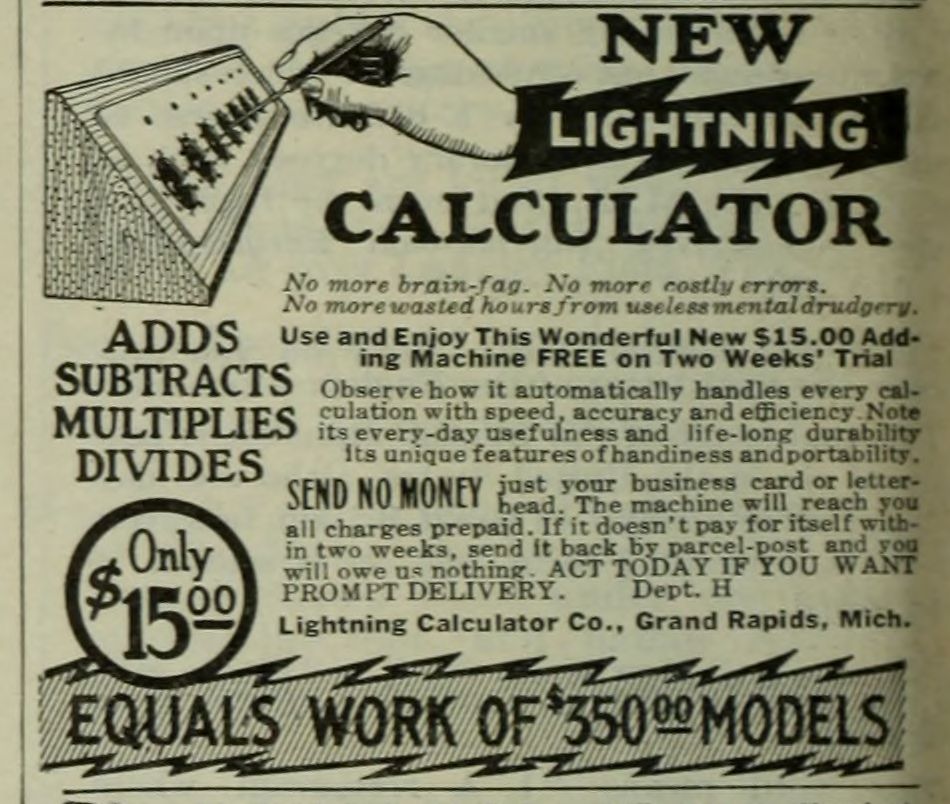
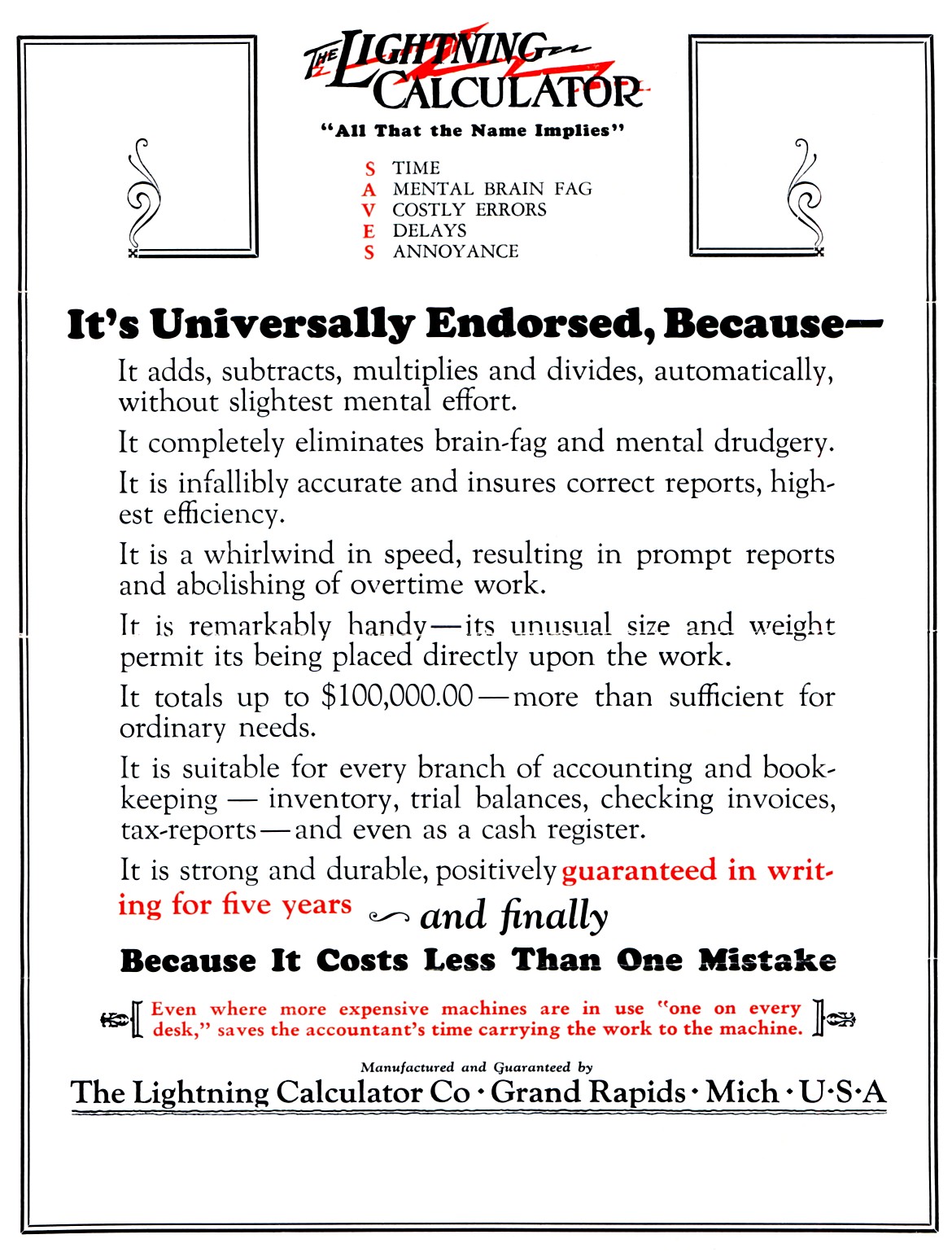
The machine was advertised through the 1920s and 1930s: the Washington Herald (October 1921), the Literary Digest (December 1922), Popular Science (September 1925), Popular Mechanics (April 1927 and September 1937), Life (7 October 1940) and the Arizona Republic (May 1941), and in European newspapers from Freiburg, Salzburg and Pilsen between 1922 and 1929.
Two companies copied it in the 1920s. The Smallwood Calculator Company of Oakland, California, made a close copy, at 13.05 ounces slightly heavier than the Lightning’s 12.5, with a decal instead of stamped lettering. A Smithsonian example is marked “patent 1926”, a reference to Hook’s patent. A Champion Computer of Cleveland, Ohio, near-identical but from a different factory and claiming “patent pending”, is reported by Scherphuis. Nothing else is known of either company.
Production stopped during the Second World War. Otnes suggests that the stamping capacity it depended on went to war work. Rechnerlexikon dates the end of Grand Rapids production to 1942, Scherphuis to 1941.
3.3 Los Angeles, 1945/46–1959
The machine’s second life began in Los Angeles. According to Scherphuis, Ernest E. Thornton, founder and owner of the California Typewriter Exchange, bought the company and its rights and restarted production after the war. The trademark registration for the lightning-bolt logo, published in the Official Gazette in 1947, claims use from October 1945. Office Appliances reported the “improved Lightning” and the move west from June 1945, and Scherphuis’s own early Los Angeles machine carries a factory date stamp of February 1946. Otnes, working from the directories, has the machine “surfaced again in Los Angeles in 1946”. The dates fit together if Thornton bought the company in 1944–45 and shipments began early in 1946.
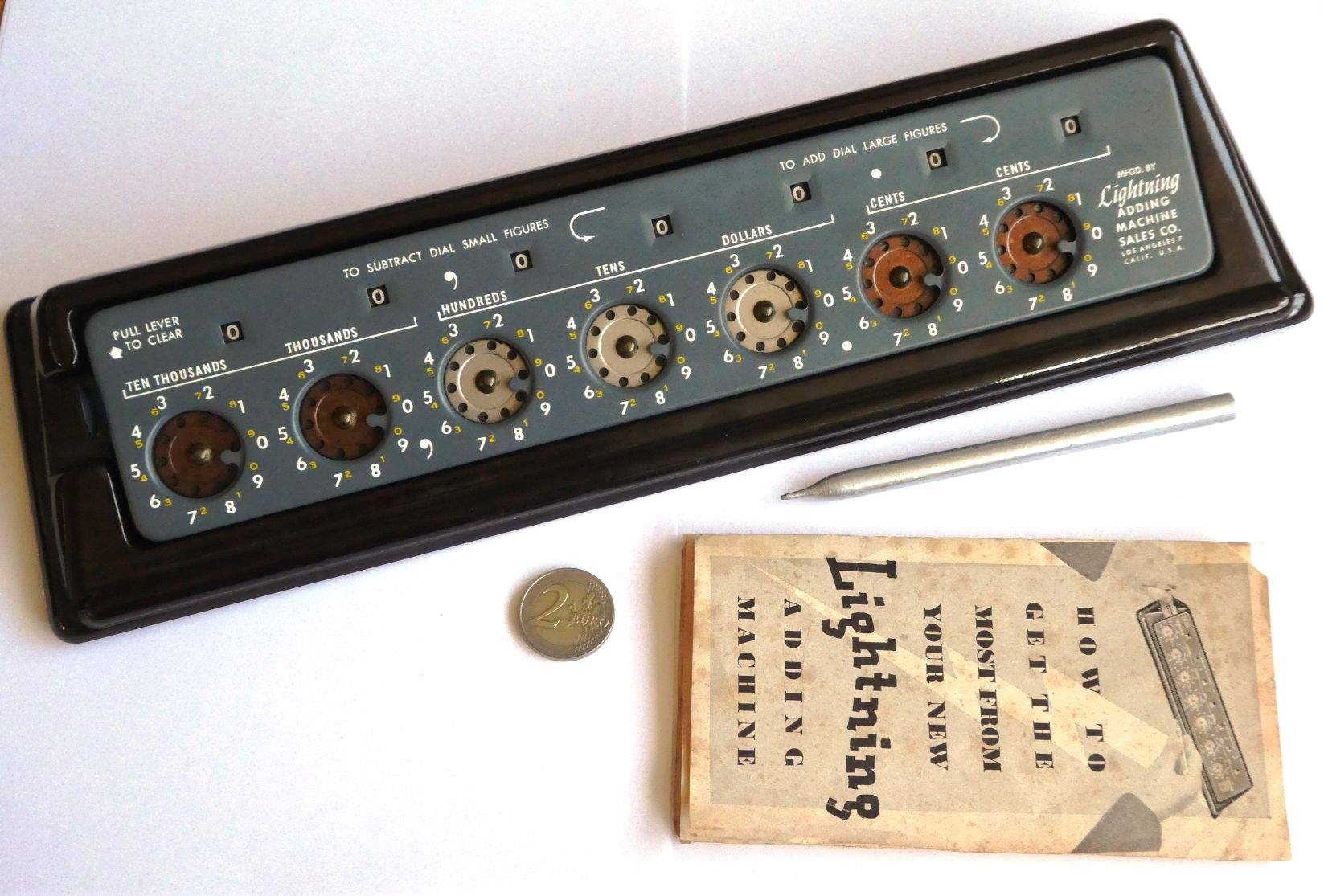
The Los Angeles machine was renamed. It became the Lightning Adding Machine, not “Calculator”. Its body was still painted steel, but it now sat in a moulded Bakelite stand, black on the earliest machines and brown on most later ones, that tilted it at about 30 degrees, on a felt pad, with an aluminium stylus resting on a ridge along the front of the stand. And it came in colours. Otnes lists tan, red, dark red, green and blue-grey, and had “even heard of plaid ones!”
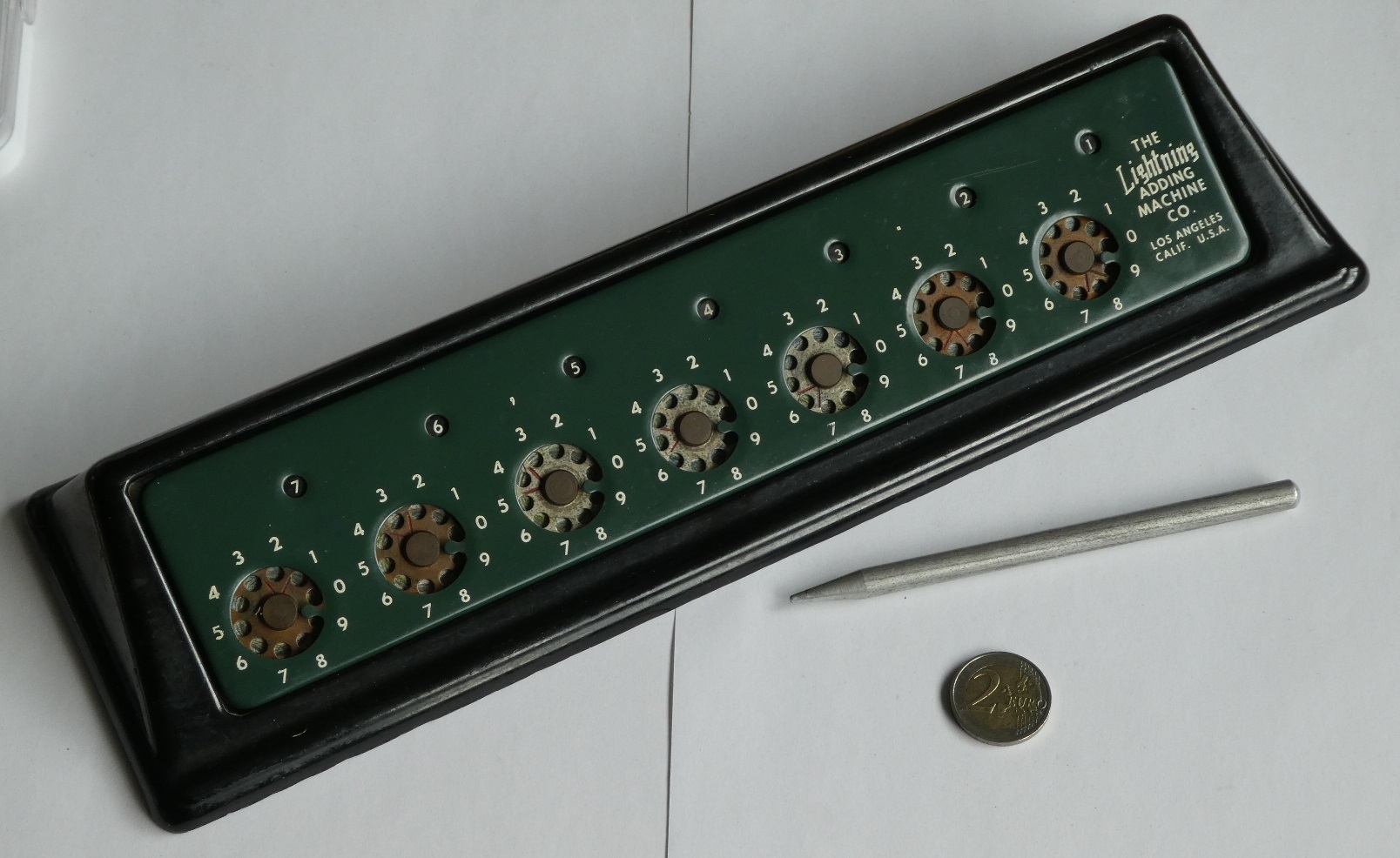
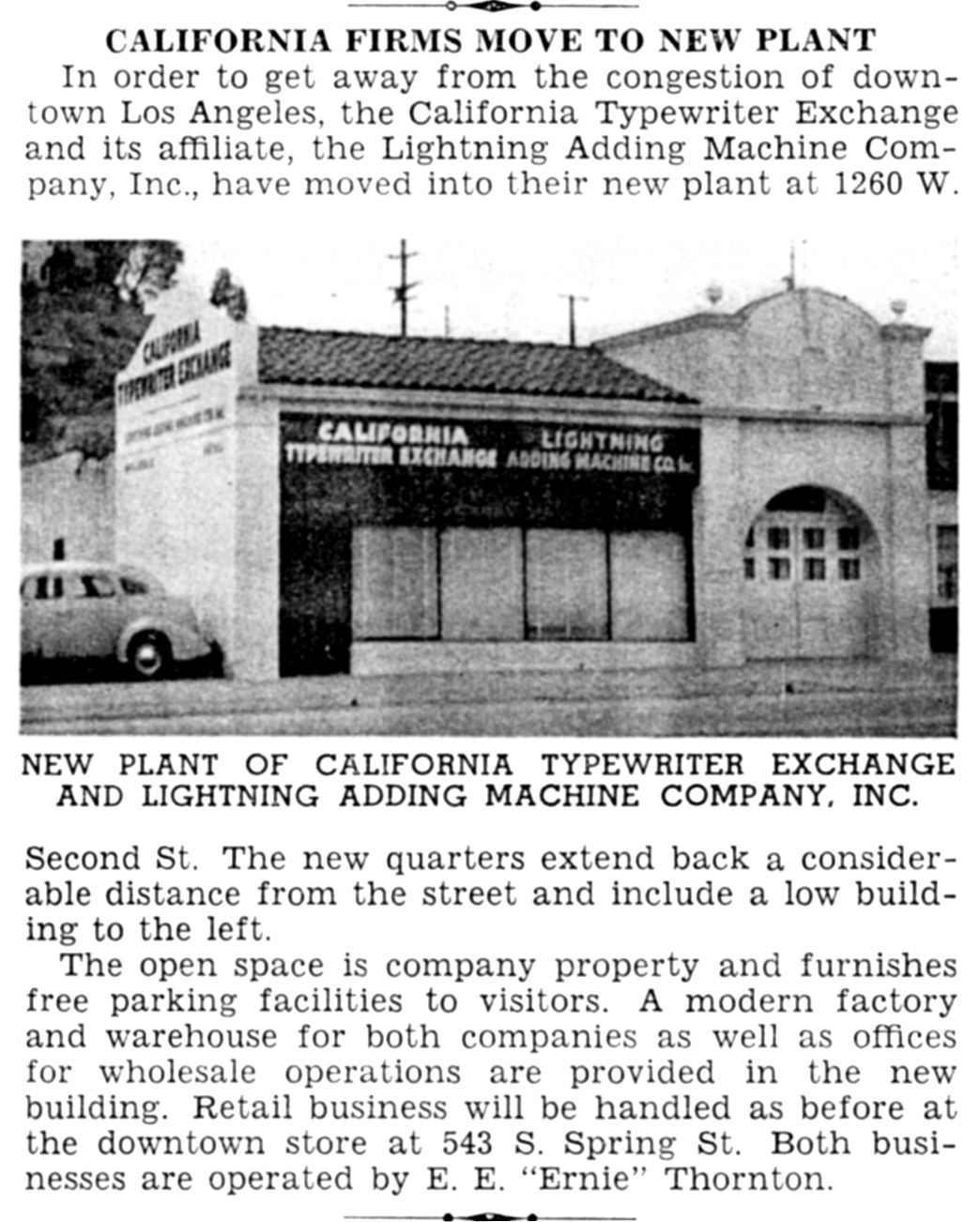
The Los Angeles directories run two company names at two addresses in parallel, perhaps one for manufacturing and one for sales:
Table 2 — The Los Angeles directories run two company names at two addresses in parallel, perhaps one for manufacturing and one for sales
| Years | Lightning Adding Machine Co. | Lightning Calculator Co. |
|---|---|---|
| 1946–47 | 543 S. Spring St | 325 W. 2nd St |
| 1950–53 | 1260 W. 2nd St | 543 S. Spring St |
Table 3 — Los Angeles, 1945/46–1959
| Years | Lightning Adding Machine Sales Co. |
|---|---|
| 1955 | 234 W. 37th Place, “Manufacturers and Distributors” |
| 1956–59 | 2306 W. Slauson Ave; Earl Coffin, president |
Office Appliances reported a factory move in October 1950. In 1953 the company and the California Typewriter Exchange were bought by Max Dworsky and Martin Walsbren, who also owned the Los Angeles Adding Machine Co. The trade press reported the sale in December 1953. The new owners’ Lightning Adding Machine Sales Company, at 234 West 37th Place, Los Angeles 7, was advertising in Newsweek by 14 December 1953. By 1956 Earl Coffin was its president.
3.3.1 Two redesigns
The Los Angeles machine changed twice, and the changes are the key to dating one.
The clearing lever. Until 1948 every Lightning was cleared one dial at a time: the stylus went into the red triangle on each dial and the dial was turned anticlockwise to its stop. Rechnerlexikon has the Office Appliances advertisements for March 1948, showing a machine without the lever, and for June–July and December 1948, showing one with it. So the “PULL LEVER TO CLEAR” tab arrived in the spring or early summer of 1948. The June–July notice quotes E. E. Thornton, “president of the Lightning Adding Machine Inc.”: “A flick of the clearance lever brings every answer window back to zero.” Scherphuis records that the redesigned body was the same length and width but “twice as thick” and that the stand gained a cut-out on the left for the tab. The price did not change. The December 1948 advertisement has “New features! Precision built! Yet it still retails for $12.95.”
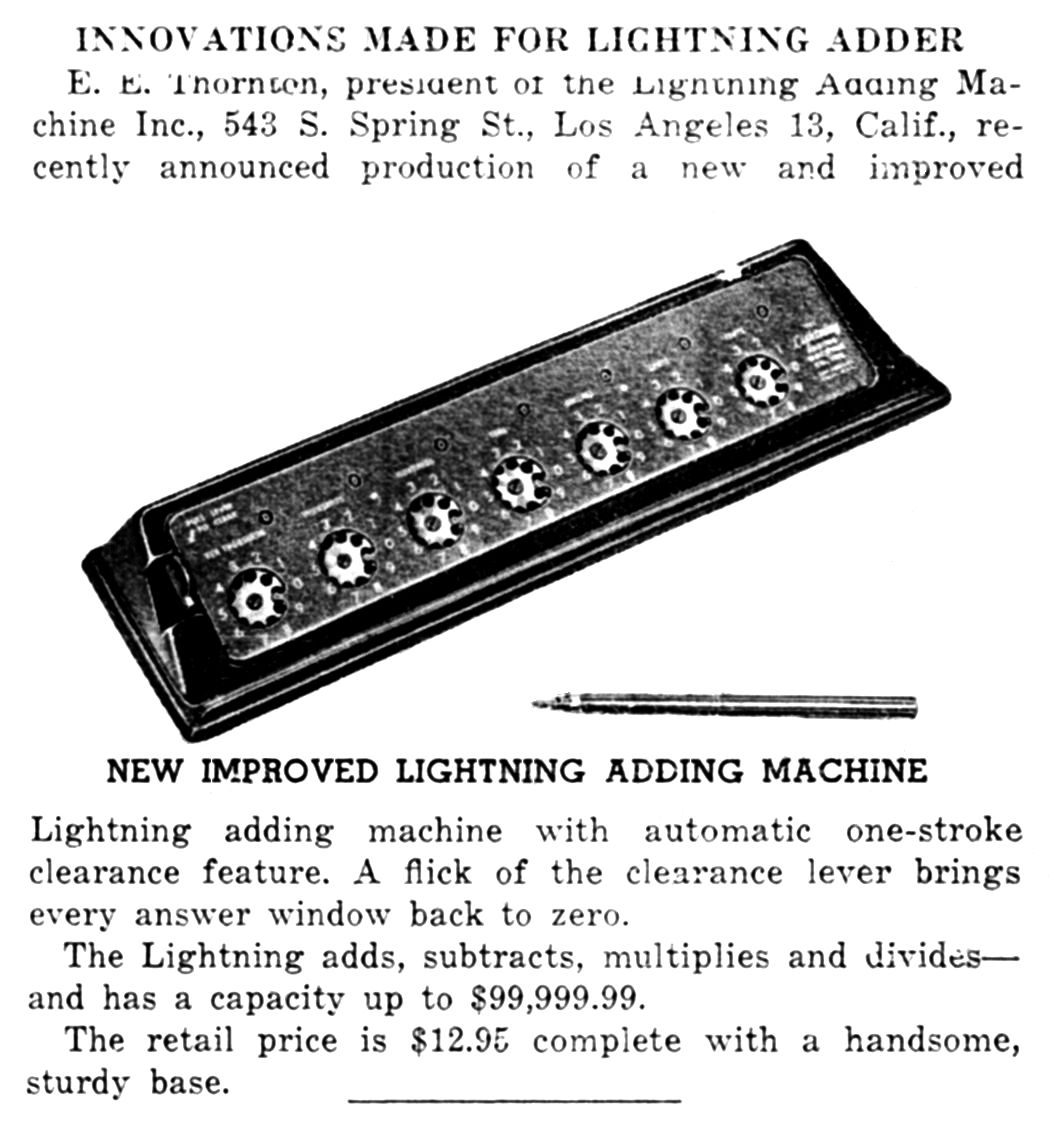
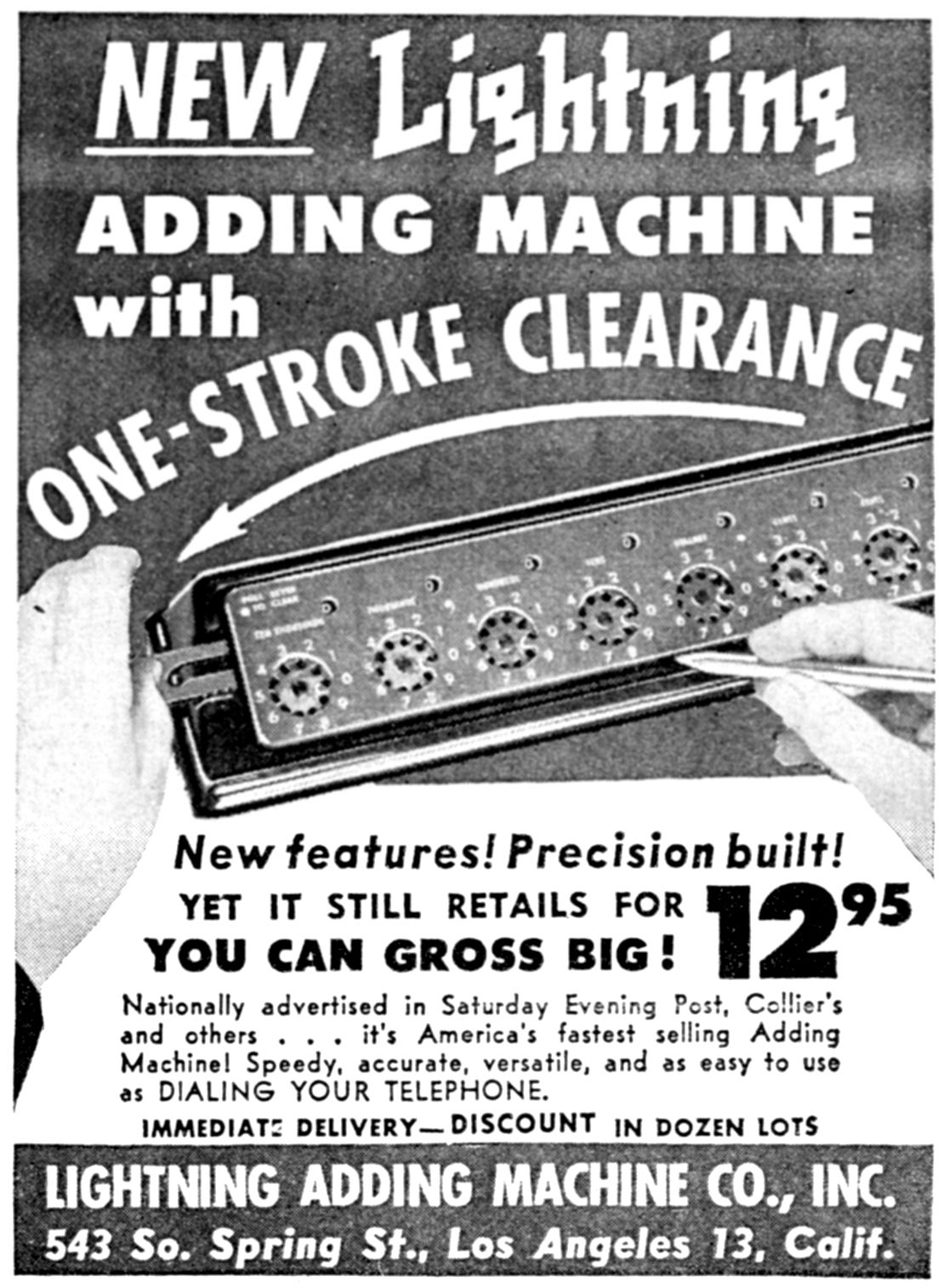
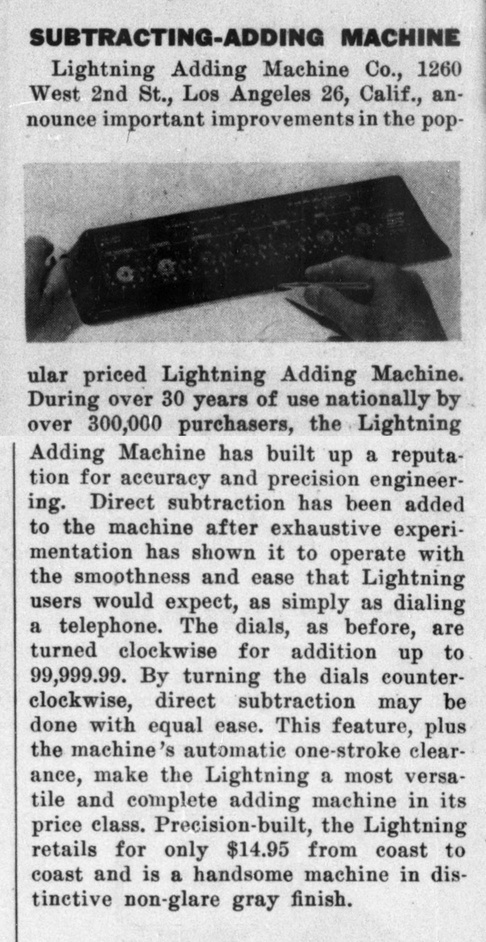
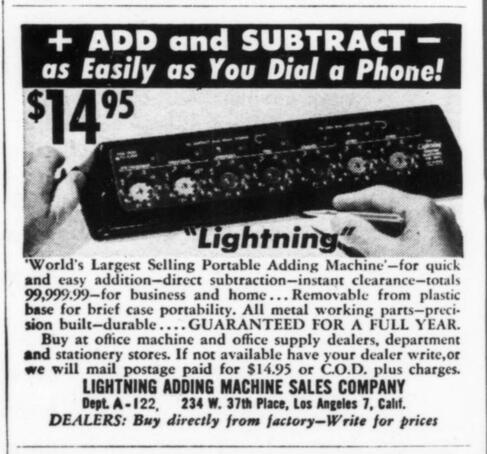
Subtraction. The last Lightnings carry the second ring of small yellow figures and the legend TO SUBTRACT DIAL SMALL FIGURES, and their carry works in both directions. Scherphuis describes a single 1948 redesign that added both the lever and subtraction. Otnes (“Next, it got a clearing mechanism (green model) and finally the subtraction feature (gray model)”) and Rechnerlexikon describe two steps, and the company’s own trade notices bear the two-step account out. A notice headed “Subtracting-Adding Machine”, from the Lightning Adding Machine Co. at 1260 West 2nd Street, Los Angeles 26, announced that “Direct subtraction has been added to the machine after exhaustive experimentation… By turning the dials counterclockwise, direct subtraction may be done with equal ease. This feature, plus the machine’s automatic one-stroke clearance, make the Lightning a most versatile and complete adding machine in its price class.” It gives the new price, $14.95, and a “distinctive non-glare gray finish”. Scherphuis’s archive files the notice under The Office, February 1959. But 1260 West 2nd Street is the address in the 1950–53 directories, and the notice’s “over 30 years of use” counts from 1921, so it most probably dates from about 1951–53. By December 1953 Newsweek was carrying “ADD and SUBTRACT — as Easily as You Dial a Phone! $14.95” from the Sales Company. An example dated 1950 in the small-adder collection published by the Berliner Hochschule für Technik has the lever but needs nine’s-complement addition to subtract, which fits a date for subtraction after 1950. My green machine is one of the in-between machines: lever, no subtraction.
3.3.2 Selling it
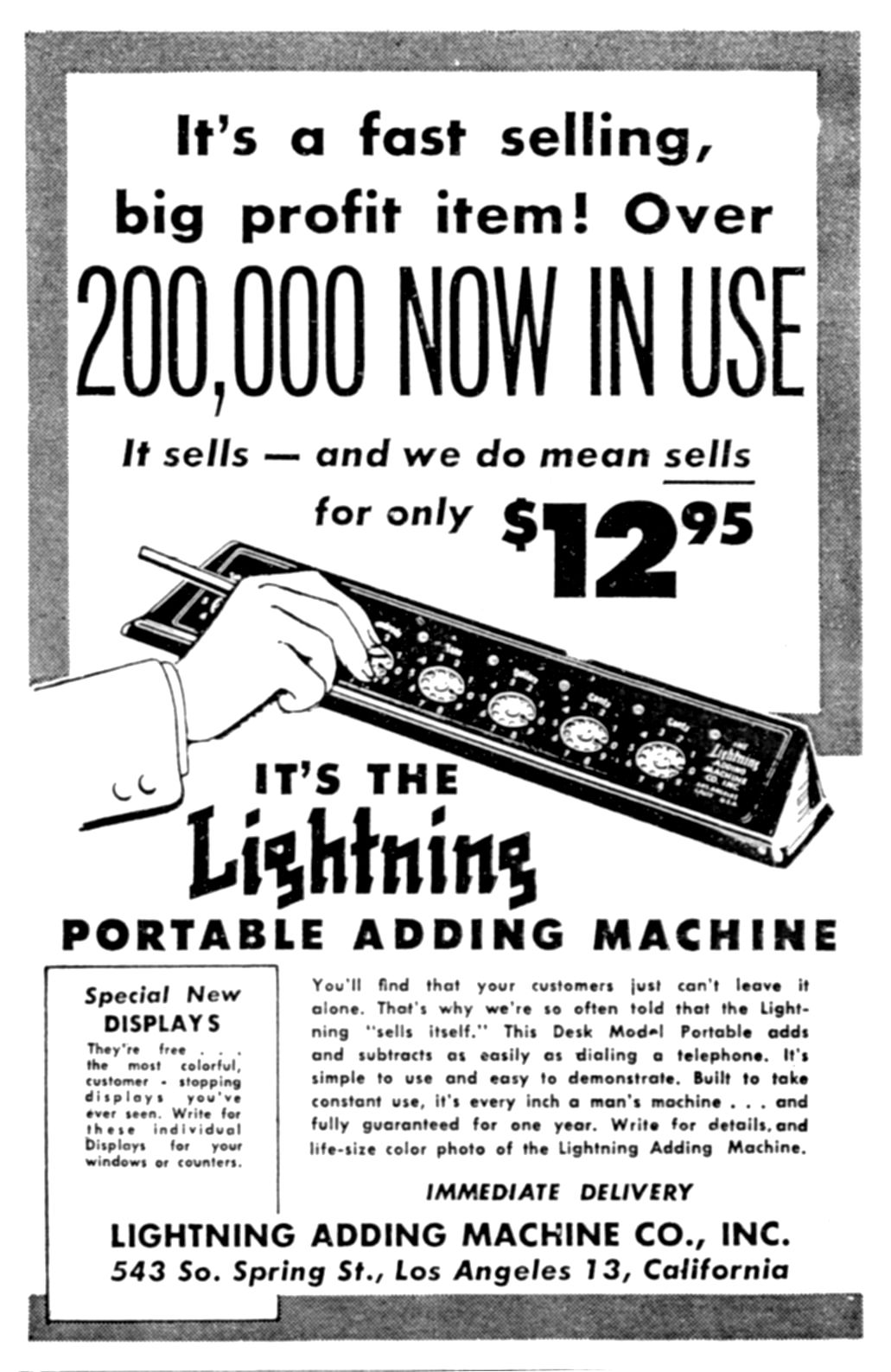
The Los Angeles Lightning was advertised everywhere a $15 gadget could be: the Saturday Evening Post (March 1946, November 1948), Hardware Age (June 1946), Collier’s (December 1947), the American Legion Magazine (April 1948), Popular Mechanics (January and May 1949, January 1952), Look (December 1949), Popular Science (December 1952), Desert Magazine (August 1953), Newsweek (December 1953) and the men’s magazine Sir! (February 1954), alongside a steady run in the trade journal Office Appliances from 1946 to 1954. Eaton’s of Canada sold it in its 1950–51 catalogue. In 1950 the actress Ellen Drew was photographed with one for publicity.
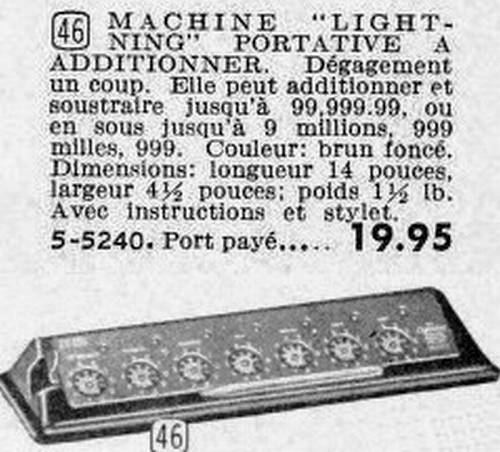
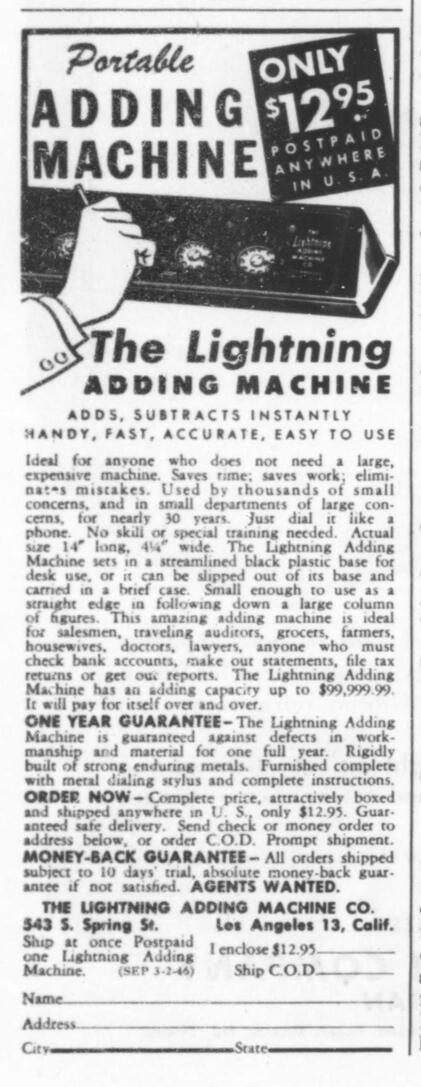
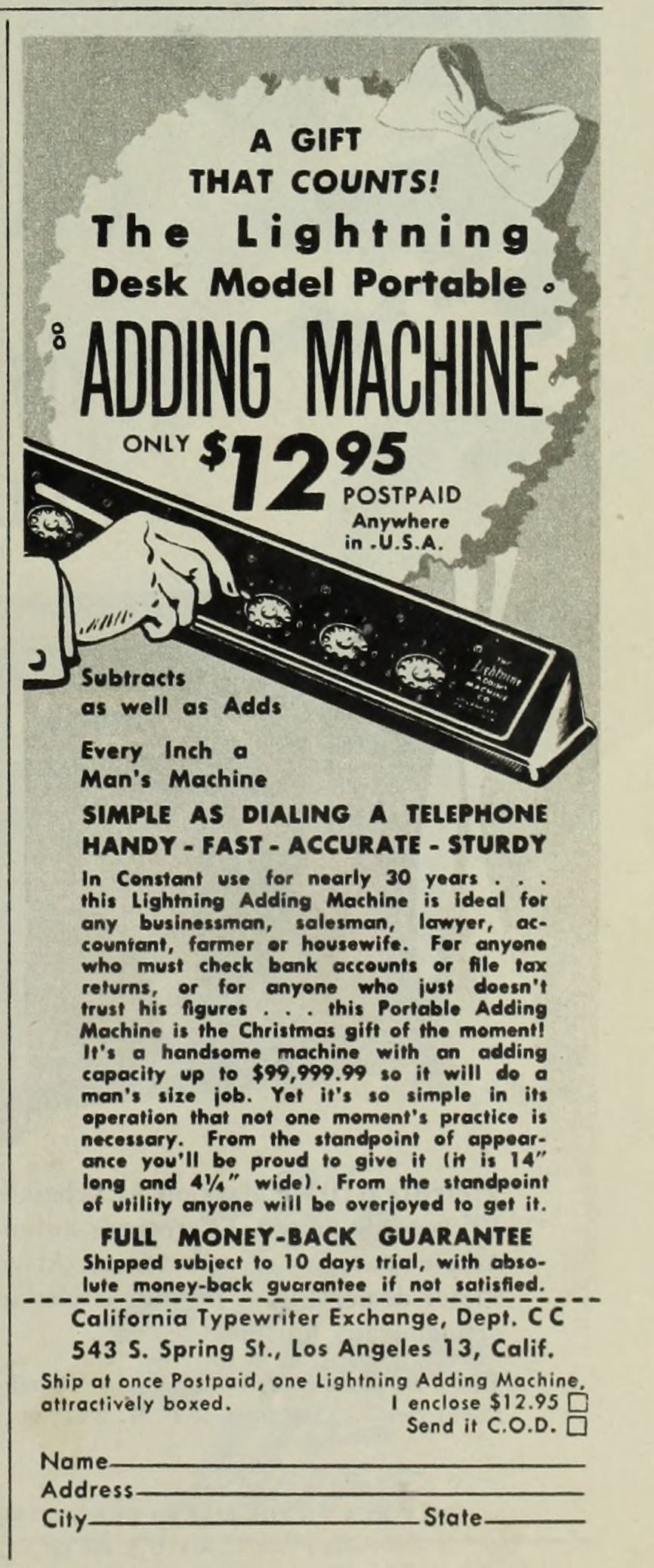
The mix of magazines says who bought it: households, farmers, small shopkeepers, salesmen and anyone keeping a cheque book, as much as offices. A late leaflet claims “over 300,000 satisfied Lightning users” and customers who “have relied on Lightnings for the last thirty two years”. The order slip in the box offered a Lightning as a gift, “GIVE A LIGHTNING! $14.95 POSTPAID”.
3.4 How many, and how it ended
Nobody knows how many were made. Otnes wrote that Los Angeles “may have made over two million”, and that figure is now repeated everywhere, but it is a collector’s estimate, not a company figure. The only company number is the leaflet’s 300,000 users. What is certain is that the Lightning is common. Otnes found them “in almost every flea market in the United States”.
The last directory entry is 1959. (The trade notice that Scherphuis dates to February 1959 appears, from its address, to be earlier; see above.) A retailer’s claim that they were made into the early 1960s is unsupported. Why production stopped is not recorded. It was not electronics: the first pocket electronic calculators were more than a decade away, and cheaper plastic dial adders such as the Sterling Dial-A-Matic and the Kes-Add went on selling into the 1960s, as did the Addometer. The 1953 change of owners and the arrival of plastic competitors at a lower price are the obvious candidates. Neither is documented as the cause.
Comments (0)