Giant Curta · Volume 1
Who Actually Built It
The machine is widely known by Adam Savage’s name, and that name is how most people found it. It is also, on its own, misleading — so the correction belongs at the top rather than buried three volumes down.
Adam Savage did not design the oversized 3D-printed Curta, and did not print it. It was designed and built by Marcus Wu, a software developer in North Carolina with no mechanical-engineering background, who modelled the entire machine from the original Contina engineering drawings, printed it at 3:1 scale, and released the files free. Savage’s role was to see the project, publicise it enthusiastically, and ask Wu to make him one.
That distinction matters beyond simple credit. Savage’s channel showcases other people’s work regularly and does not pretend otherwise; the error is not his. But a page that lets a well-known name absorb an unknown maker’s eighteen months of work gets the most interesting part of the story backwards. The interesting part is that a self-taught hobbyist reproduced, in plastic, a mechanism that a Liechtenstein precision-engineering company needed nine to ten hours of skilled hand assembly to build in metal.
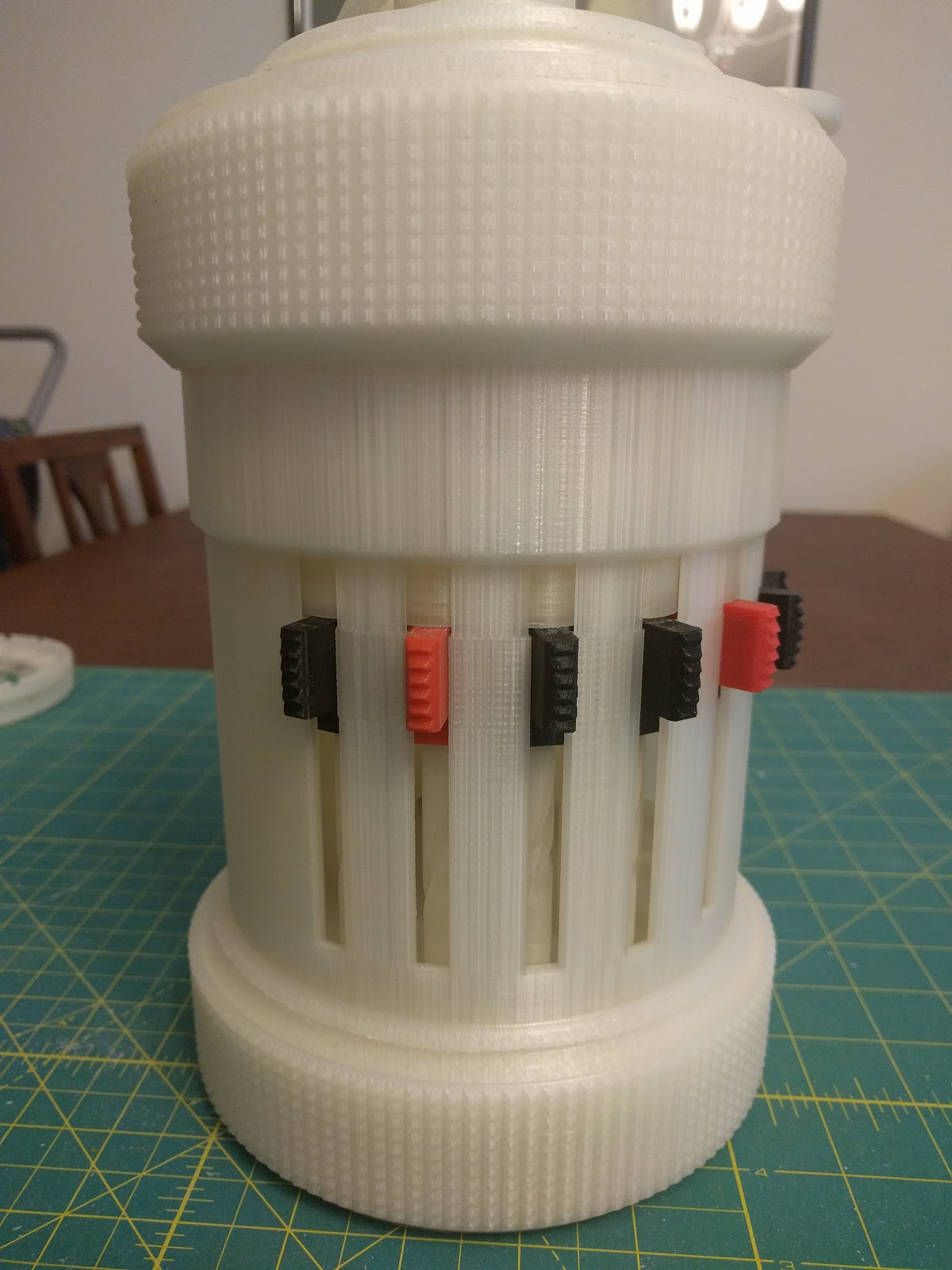
1.1 The machine in one paragraph
A working Curta Type I, scaled three times linear, built almost entirely from FDM-printed PLA. Around 240 separate printed parts, plus roughly a hundred non-printed items — screws, springs, ball bearings — and a mass of about three pounds. Modelled in Onshape from the original engineering drawings. Roughly eighteen months of spare time. It adds, subtracts, multiplies by carriage shift, and carries.
1.2 How the attribution actually runs
The sequence, from the published record:
Wu began the project after concluding that nobody had done it. His own first write-up frames it as, to his knowledge, unprecedented in 3D printing at that time.
Adam Savage noticed it early. He posted about the project on 12 May 2016 — “What’s that you say? A 3d printed Curta computer can’t be built? Wrong!” — while the build was still in progress.
Wu finished. The Onshape account of the project describes him spending nearly every bit of spare time across eighteen months designing, printing and building a fully functional 3:1 scale Curta from 240 separate printed parts, and reports the published model passing 28,000 downloads.
Savage then asked Wu to make a custom version for his show. A Tested segment titled The 3D-Printed Curta Calculator was published on 31 August 2017, in which Savage walks through his analogue calculator collection and ends on the printed machine. His assessment of Wu’s work, quoted in the coverage: “I applaud your insanity, your dedication, your perseverance and your building and finishing techniques. This is truly magnificent!” The following day he posted again: “@marcuswu, you are a madman! This 3D-printed Curta calculator is SO pretty.”
A Tested VR piece exists under the title Adam Savage’s Giant Curta Calculator, which is presumably where the “giant Curta” phrasing in circulation originates.
1.3 What could not be established
Three things about Savage’s specific machine could not be confirmed from any source consulted, and are recorded here as open rather than guessed:
Its scale. Wu’s own machine is 3:1. Savage’s is described as a “custom version” made at his request. Whether “custom” means a different scale, a different finish, or simply a second machine built to the same drawings is not stated anywhere that could be found. The phrase “giant Curta” is not, on the evidence available, a documented scale claim.
Who physically printed and assembled Savage’s unit. The coverage says Savage asked Wu to create a version for the show, which implies Wu built it, but no source consulted states this explicitly, and Wu’s own articles do not describe building a second machine for Savage. (They do describe building a second machine, but in the context of photographing an assembly manual.)
Whether any material change was made for the show. Nothing was found either way.
Where the volumes that follow describe the machine, they describe Wu’s documented build, from his own articles, because that is the build with a technical record. Statements about Savage’s particular unit are limited to what is quoted above.
1.4 Why an oversized Curta is a reasonable thing to build
Two reasons, and neither is “because it is funny”.
The first is that the Curta’s argument is internal and a real one is opaque. The mechanism volume of the Curta dive covers the complemented stepped drum, the carry levers and the clearing racks; all of it happens inside a 53 mm cylinder that owners are explicitly told never to open. Three times linear is twenty-seven times the volume, and the parts become objects a hand can hold and an eye can follow.
The second is that the impulse is old. The Museum Enter in Solothurn displays an oversized wooden model of the Curta from a Swiss collection — the same instinct, decades earlier, executed in a material that cannot calculate. The printed machine is that model with the mechanism put back in.
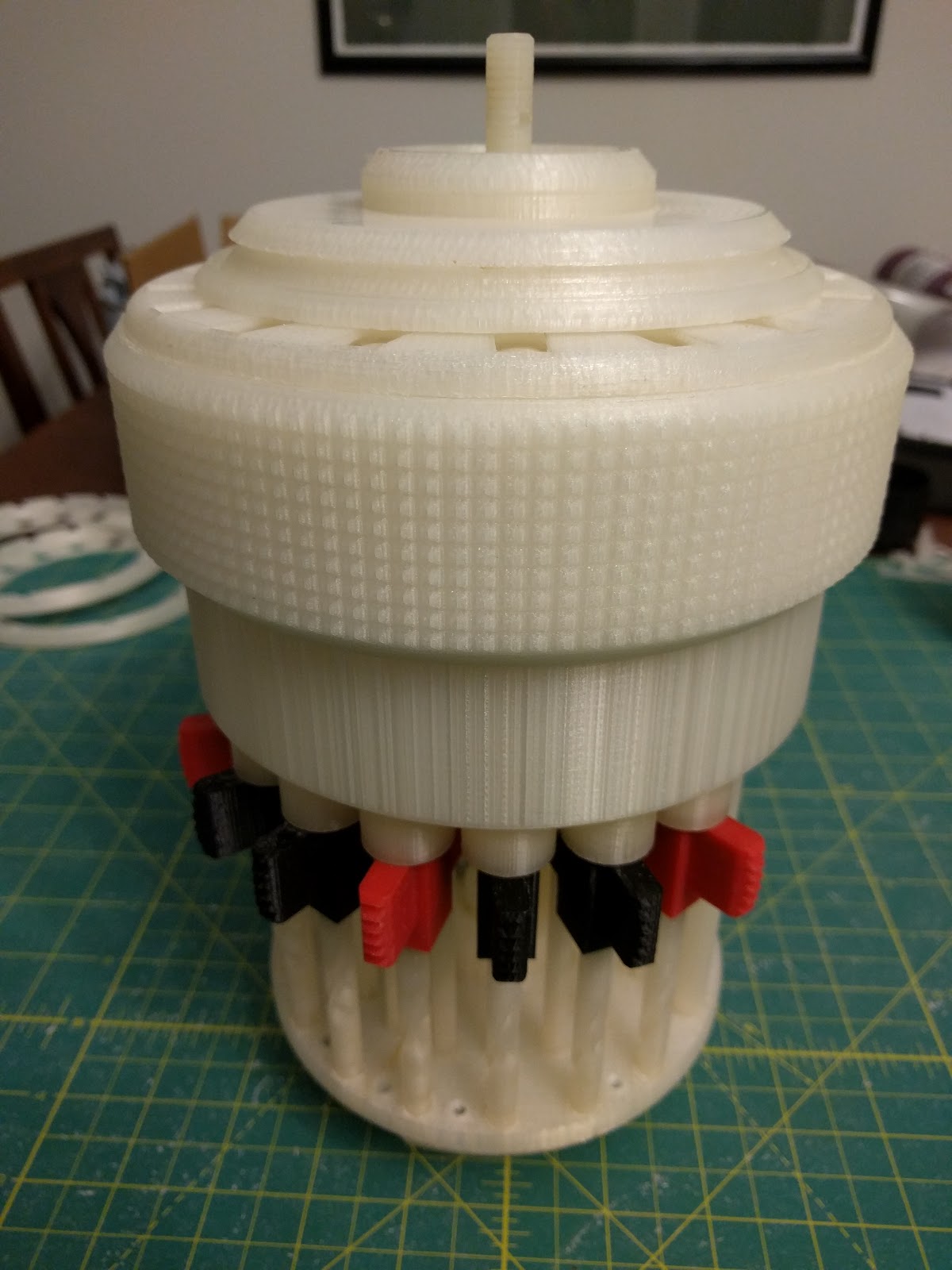
1.5 What the scaling costs
Scaling a precision mechanism up does not make it easier. It changes which problems you have.
Some things get easier: a 3:1 part is three times the size, so a printer’s fixed positional error is proportionally a third as significant, and features that would be unprintable at true scale become printable.
Other things get worse, and the build record is mostly a record of those. Clearances do not scale the way a naive reading suggests — a printer’s tolerance is roughly absolute, so it eats a fixed amount out of every fit regardless of the part’s size. Plastic is not aluminium or steel, and an FDM part is anisotropic: strong within a layer and weak between layers, which destroys any component loaded across the print direction. Mass goes up by the cube while printed cross-sections do not, so shafts and pins carry loads the original’s steel never had to think about. And springs cannot be printed usefully at all, so they have to be wound from music wire and heat-treated by hand.
Each of those turned into a specific failure in the build, and the volume on the mechanism at printed scale works through them.
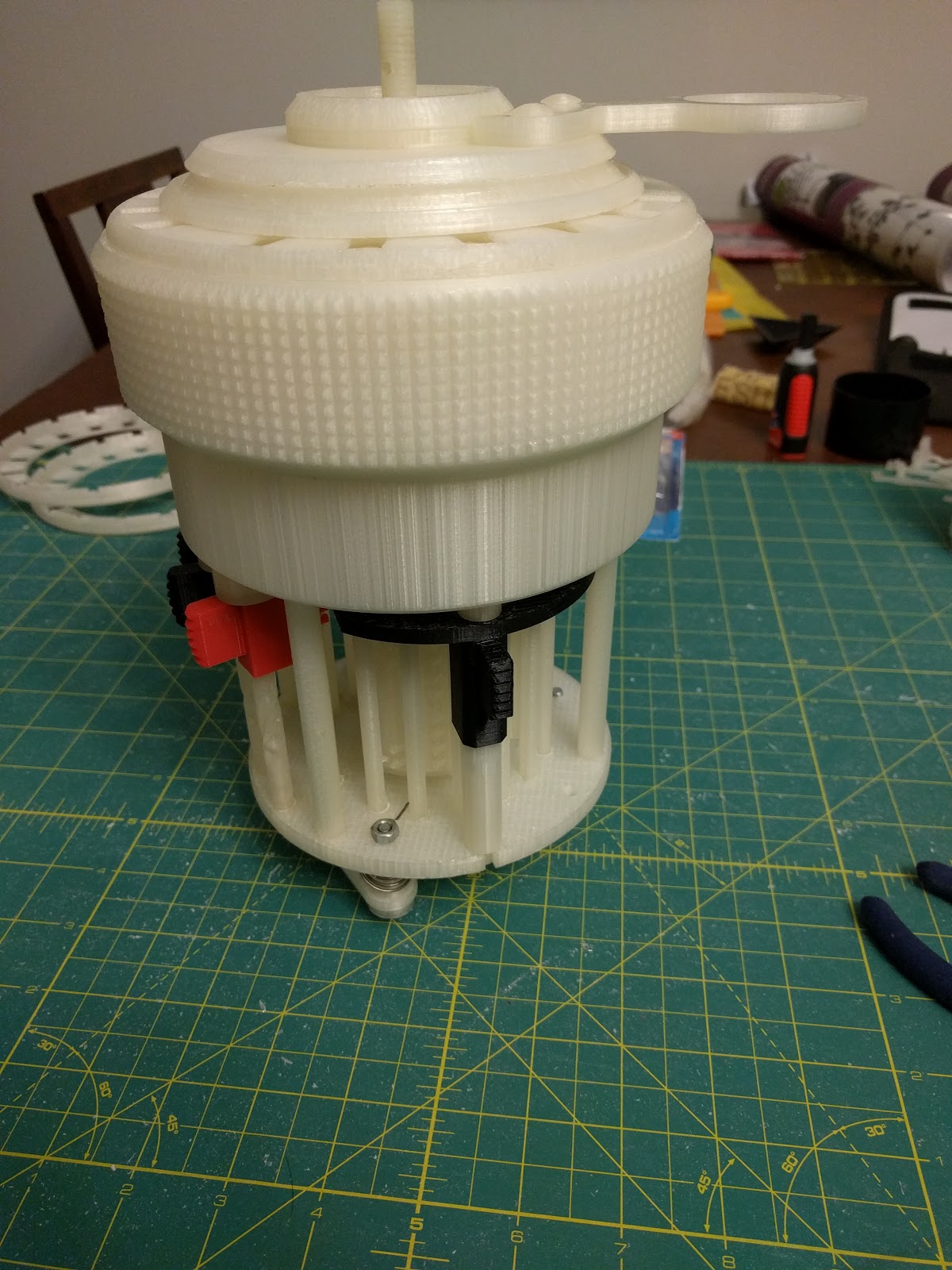
1.6 The volumes that follow
The next volume covers the modelling: 145 original engineering drawings reduced to 116 CAD models, what was consolidated and why, and the point at which the drawings themselves turned out to be wrong.
The third covers the mechanism at printed scale — the tolerance testing, the materials, the hand-wound springs, and a plain list of everything that broke.
The fourth is a gallery of the finished machine.
A note on the imagery. Every photograph in these volumes is Marcus Wu’s own, taken during his build and published alongside his project articles. They are reproduced here with credit because no equivalent record exists elsewhere; the provenance of each file is logged in photo_credits.txt beside the figures.
Comments (0)