Arithmos · Volume 3
Arithmos — The Tens-Carry Problem
Every question about a mechanical adding machine is downstream of one: what happens when a digit wheel passes nine. Materials, finish, price and assembly time are all decisions that can be revisited. The carry either fires reliably ten thousand times or the machine is an ornament. The project’s own design record states this plainly — the carry is the first unsolved engineering problem, and everything else is contingent on it.
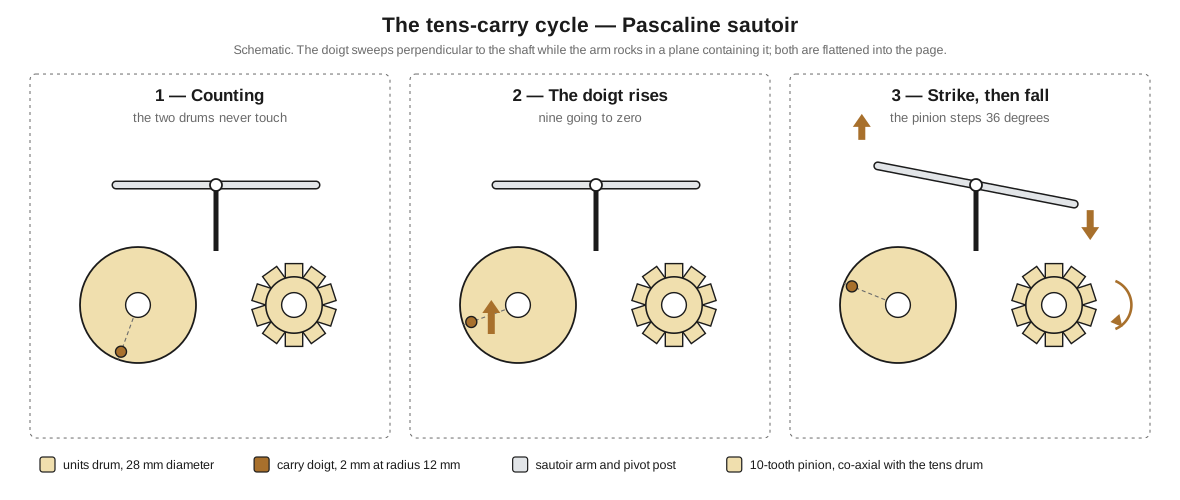
03-outputs/make_carry_cycle_svg.py in this project.3.1 Why it is hard
The difficulty is that a carry is a rare, violent event in an otherwise smooth motion. For nine tenths of a revolution the units drum should turn freely and the tens drum should not move at all. For the remaining tenth, a definite quantity of motion has to be handed across, exactly once, with no skipping and no doubling. A mechanism that meshes continuously has to be accurate enough that nothing drifts across thousands of counts. A mechanism that engages only at the moment of transfer has to catch reliably at whatever speed the crank happens to be turning.
Worse, carries cascade. Going from 9999 to 0000 fires all four stages in a single crank turn, and the last stage in the chain is driven by the accumulated motion of everything before it.
3.2 Five architectures on the table
The design record compares five, three seriously.
The Pascaline sautoir places a single projecting finger on the driving wheel. Once per revolution that finger lifts a weighted arm — Pascal’s sautoir, the acrobat — which then drops under gravity and strikes a toothed wheel on the next digit, advancing it by one. Four moving parts per stage: the arm, its pivot, a leaf spring, and the finger. Its defining property is that the two wheels never touch during ordinary counting.
The Curta mutilated gear puts teeth only at the carry position on a stepped drum, and selects which teeth engage by shifting the drum along its axis. It supports subtraction by nines-complement, which the sautoir does not. It costs eight to twelve parts per stage and demands precision that the record describes as project-killing at 1:1 in hand-assembled brass.
A pawl and ratchet lift runs a spring-loaded pawl on a cam on the driving wheel; the cam lifts the pawl once per revolution and it drops onto a ratchet tooth on the driven wheel. Around six parts. It tolerates looser fits because the spring absorbs slack, at the cost of more friction and a risk of the pawl bouncing and advancing twice at speed.
Two more were included for completeness and dismissed. A Geneva drive indexes the driven wheel on every revolution of the driver; a digit carry needs indexing once in ten, so a Geneva would need a 10:1 reduction upstream and would add parts rather than remove them. It is the wrong primitive, not a worse one. The Leibniz stepped drum is a multiplication mechanism — variable-length teeth engaging a sliding pinion — and is not a carry mechanism at all.
3.3 Why the sautoir was chosen
Four reasons are recorded, and the second is the substantial one.
The part count is lowest: four per stage against six for pawl and ratchet and eight to twelve for the Curta family. Fewer parts means fewer things to tune, which means faster iteration on a mechanism that will need several rounds.
More importantly, nothing meshes during counting. A continuously engaged mechanism converts every manufacturing tolerance into either drag or drift; a sautoir converts tolerance into nothing at all for nine tenths of the cycle, and only has to be accurate enough to catch once. For a machine that may end up 3D printed before it is ever machined, that is an enormous concession from the geometry.
There is precedent at hobby scale. Several working 3D-printed Pascalines exist, including an open-source teaching kit and a modular design published on a print-sharing site. If the mechanism works in printed plastic, brass at machinist tolerances should be comfortable.
And there is an aesthetic argument, which in a machine designed to be looked at is not frivolous. Arithmos has clear acrylic on three faces. A brass arm visibly falling once per revolution behind a window is a better object than a pawl ticking over.
3.4 What was given up
Two things, both accepted deliberately.
The sautoir is add-only. There is no mechanism here for subtraction, and adding one later is a re-architecture rather than an extension. Since the stated target is a four-digit adding machine, this is within scope, but it does close a door.
It is also gravity-dependent. The arm falls; it does not spring. The machine has to sit upright, which a walnut-based desk object does anyway.
A third cost is geometric. The sautoir’s asymmetry means adjacent stages are mirror images of one another, so a four-digit machine needs two mirrored stage designs laid out A-B-A-B rather than one design repeated four times.
3.5 What replaces confidence
The chosen architecture is not the interesting part of the record. The test protocol is. Before any carry geometry is allowed into the main enclosure, a two-digit bench rig has to clear a set of stated gates: a hundred or more consecutive clean nine-to-zero carries at one revolution per second in printed plastic, then the same in brass; no observable drift end to end; the arm back in its cocked position within 0.2 seconds; and crank torque at the units drum below 0.2 newton-metres. There is a closing arithmetic check — drive the units drum a hundred times and count the tens ticks, which must equal exactly ten.
The record also lists, in advance, the four things expected to go wrong: the arm engaging the pinion too early or too late because of spring preload; the 2 mm finger shearing at speed; a double advance if the arm rebounds off its stop; and axial drift if the drums are journalled directly in printed plastic, which creeps.
Writing down the expected failures before building is the most professional thing in the document. Volume five follows what actually happened, which was none of them — the rig failed on the layout instead.
3.6 Pawl and ratchet remains the fallback
The record keeps the pawl-and-ratchet design explicitly on the shelf as a plan B, to be picked up if the sautoir bench test fails. That is worth noting because it means the architecture decision is reversible at the cost of one bench rig, which is exactly the property the two-digit test was built to provide.
Comments (0)