Arithmos · Volume 1
Arithmos — A Mechanical Calculator Built From Scratch
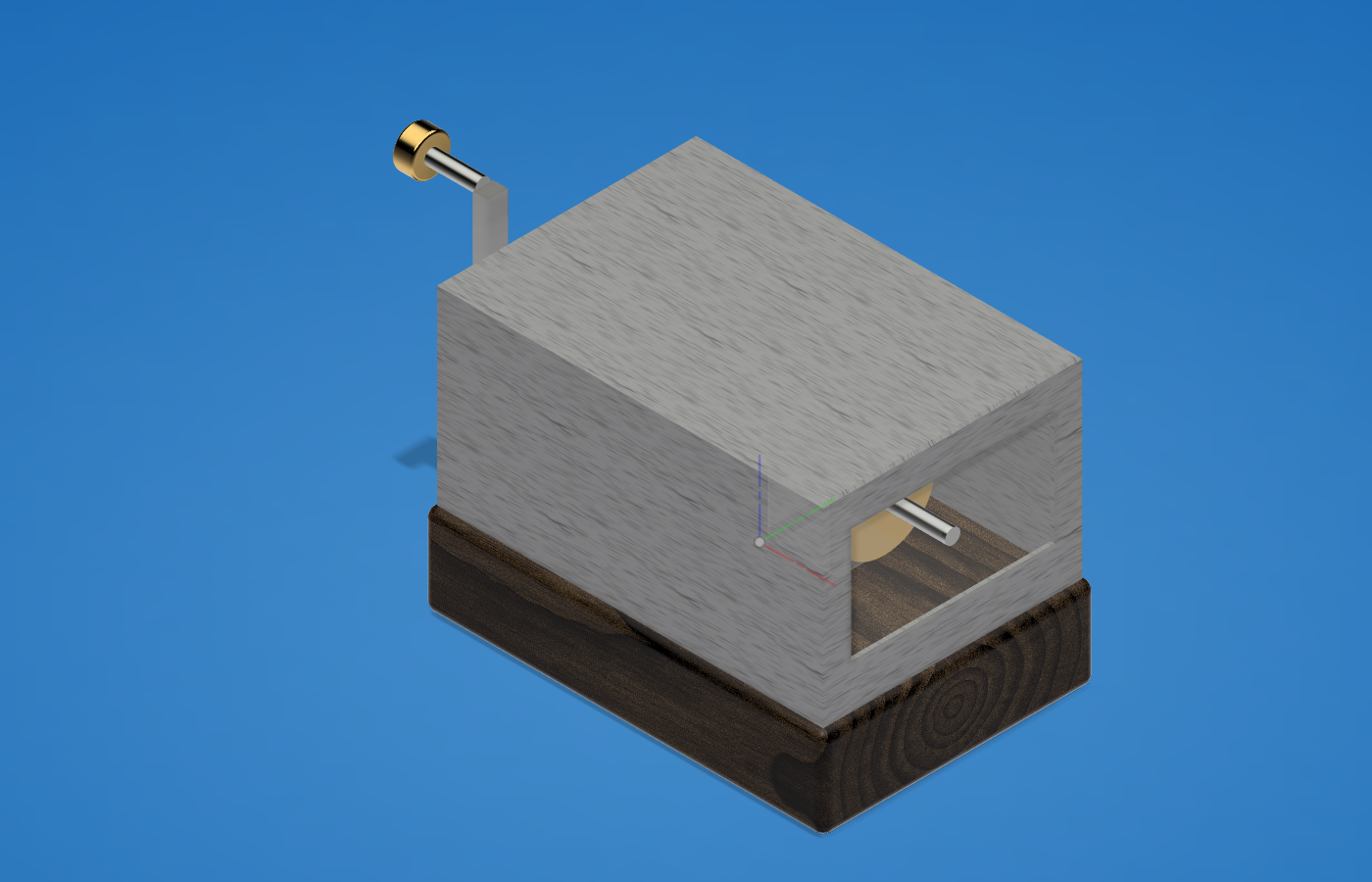
Arithmos is a four-digit mechanical adding machine designed from a blank sheet: a stainless enclosure on a walnut base, brass register drums turning behind clear acrylic, and a crank on the right-hand side that advances the count one digit at a time. It exists as a complete parametric CAD model and a separate two-digit bench rig for the one mechanism nobody sensible takes on trust. It has not yet been printed or machined. This dive documents what has been designed, what the design record claims, and — where the two disagree — what the build scripts actually say.
03-outputs/).1.1 What the machine is meant to do
The specification is deliberately narrow. Arithmos adds. It does not subtract, multiply, or divide. Turning the crank advances the units drum by one digit; when that drum passes nine and returns to zero, a carry mechanism advances the tens drum by one, and so on across four digits. The result is read through a horizontal window in the front wall, where one engraved digit from each brass drum shows through.
That is a smaller ambition than it sounds, and the narrowing was the important decision. An earlier plan sketched three options: a purely decorative machine with visible gearing that turns but does not compute; a fully functional calculator on the Leibniz or Curta pattern; and a simplified adding machine in between. The middle option was skipped entirely and the simplified adder taken up directly. The reasoning recorded at the time is that a decorative piece would have to be sold honestly as sculpture, and a full calculator is a different order of problem — the Curta has 571 parts and tolerances that a small shop cannot hold.
1.2 The Curta lineage
The obvious ancestor, and the one the project names, is the Curta. Designed by Curt Herzstark and produced in Liechtenstein between 1948 and 1972, the Curta Type I takes six digits of input and returns eleven, fits in a closed hand, and does so with a stepped drum whose teeth are selected by an axial shift. Roughly 150,000 were made. Surviving examples now sell for four figures and rare variants considerably more, which is the whole reason a modern homage has an audience: the supply is fixed and the demand is not.
The Curta is the aesthetic ancestor and explicitly not the mechanical one. The project record is blunt about why. A modern attempt to reproduce the Curta by CNC demonstrated both the depth of interest and the depth of the difficulty. A well-known 3:1-scale 3D-printed reprint by Marcus Wu took about a year of tuning to work reliably — and at 3:1 scale, every clearance is three times more forgiving than at 1:1. The conclusion drawn was that Herzstark’s mechanism should supply the look and the story, and that the working parts should come from somewhere simpler.
So Arithmos borrows the register: exposed brass, jewel-like finish, digits reading through a slot. It does not borrow the stepped drum.
The other ancestor is older and less glamorous. Blaise Pascal’s Pascaline, from the 1640s, solved the carry problem with a weighted arm — the sautoir — that is cocked by the driving wheel, then released to fall under its own weight and knock the next wheel forward. That is the mechanism Arithmos actually uses, and volume three explains why.
1.3 The parts, as modelled
The enclosure is a hollow stainless box, 152 by 102 by 76 mm, with 1.6 mm walls, standing on a walnut base 158 by 108 by 36 mm. Three windows are cut through it: two side windows 80 by 45 mm on the left and right walls, and a register slot 130 by 15 mm across the front. Each opening carries a rabbet — a 1.0 mm deep step leaving a 0.6 mm shoulder — so that 3 mm clear acrylic panels drop in from the inside during assembly and seat against the shoulder rather than being glued into a through-hole.
Inside, a 6 mm stainless shaft runs 179 mm along the long axis, emerging on the right to carry a radial crank arm, handle, and brass knob. Three brass gears of 40 mm diameter and 8 mm thickness sit on the drive train. Four brass register drums, each 28 mm in diameter and 8 mm wide with a 6 mm bore, sit at 30 mm centres on the drum axis, and each carries ten engraved digits at 36-degree intervals.
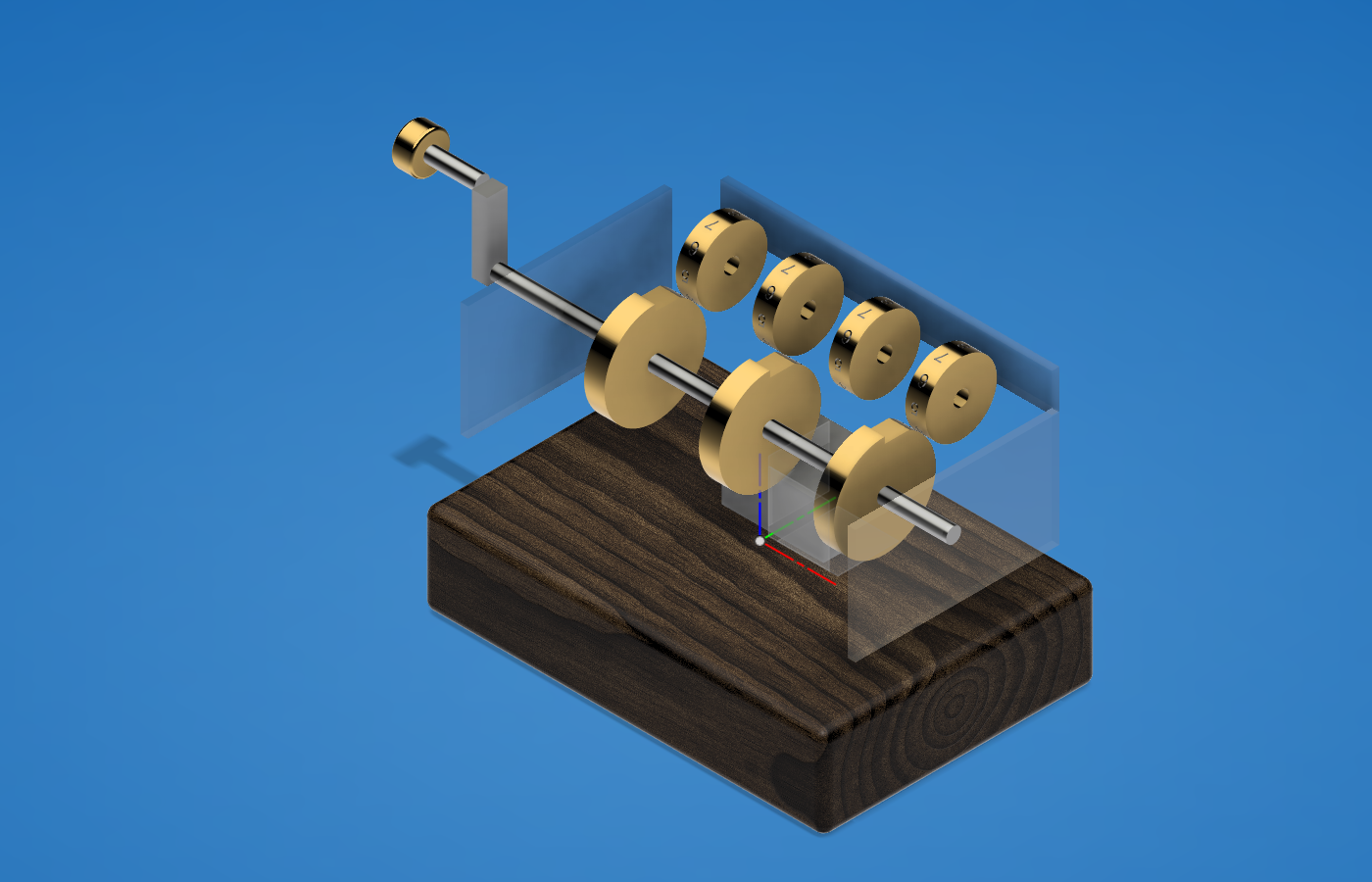
03-outputs/).One body in the main model is not a part at all. It is a 40 by 30 by 20 mm box named Carry_Mechanism_PLACEHOLDER, and it is there precisely to stop anyone modelling carry detail into the enclosure before the carry has been proved to work in isolation. It has never been replaced. That restraint is the most consequential design decision in the project.
1.4 What the series covers
Volume two follows the register drums and the surprisingly stubborn problem of engraving ten digits so that they read upright and the right way round. Volume three states the tens-carry problem properly and works through the five architectures that were compared before one was chosen. Volume four is about designing the thing through a scripting interface rather than a mouse, which turns out to change what kinds of mistakes are possible. Volume five follows the two-digit bench rig through three rounds of geometry that did not fit together. Volume six reconciles the written design record against the scripts that actually built the model, and the gaps between them are the most useful thing in the dive.
Nothing here has been printed, machined, or cranked. Every dimension quoted is a modelled dimension. Where the design notes and the build scripts disagree, this dive follows the scripts, because the scripts are what produced the geometry.
1.5 Related elsewhere
- The Curta itself, and a giant 3D-printed Curta, are documented separately within Calculators.
- Slide rules cover the analogue side of the same instinct — calculation you can hold.
Comments (0)