Planimeters · Volume 7
Collecting Planimeters
Planimeters are among the easiest scientific instruments to collect. They were made in great numbers for a century, they live in neat fitted cases, they rarely wear out, and most of them sell for a few tens of dollars. The interest lies in the makers, the models and the completeness of the outfit, and at the top end in early Amsler instruments and integrators.
7.1 The K&E planimeters
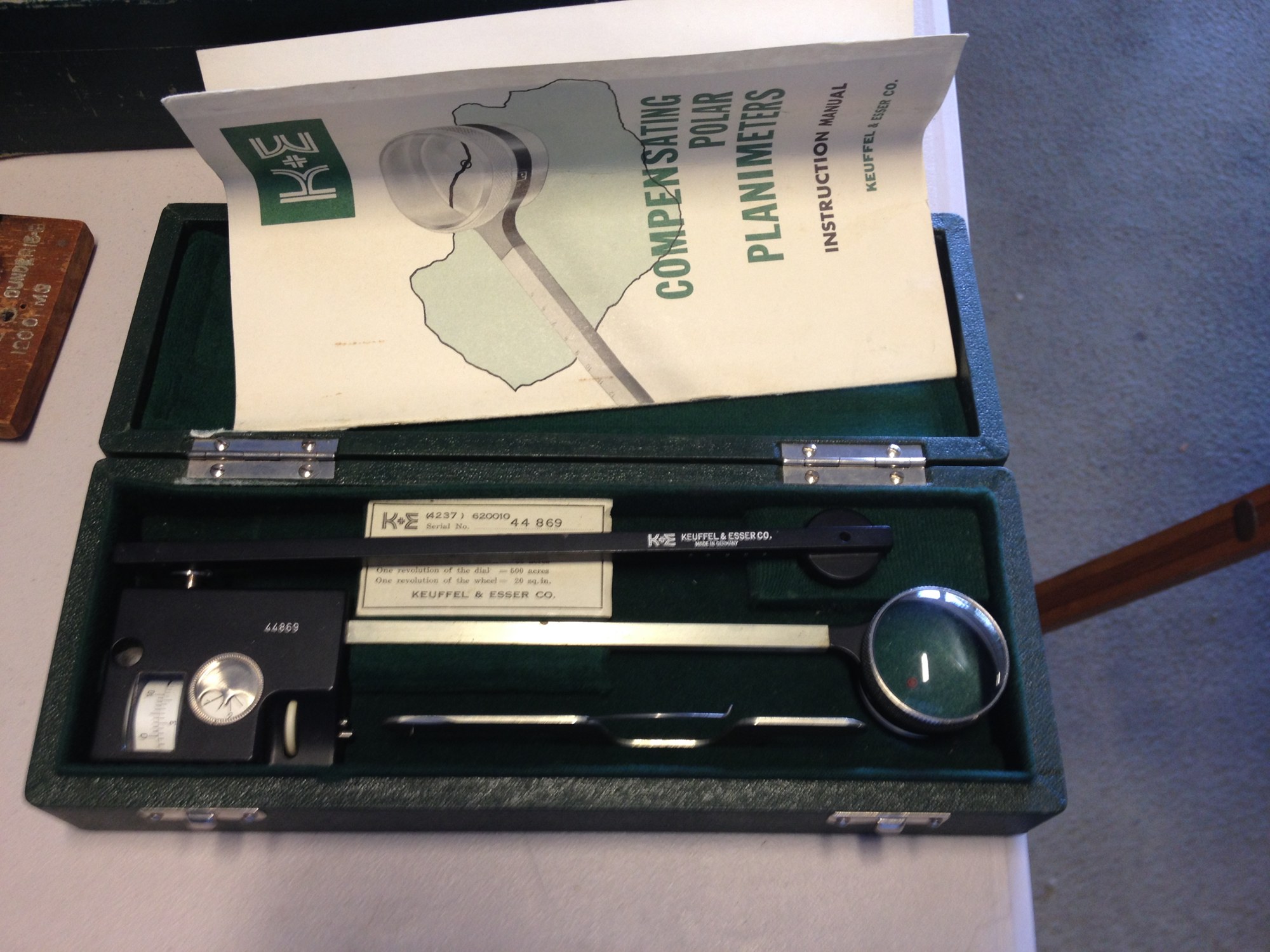
K&E sold planimeters from the 1870s to the 1980s, made for it by Amsler, Coradi, Haff and Ott. The main polar models, from the K&E catalogues documented by Clark McCoy:
Table 1 — K&E sold planimeters from the 1870s to the 1980s, made for it by Amsler, Coradi, Haff and Ott. The main polar models, from the K&E catalogues documented by Clark McCoy
| Model | What it is |
|---|---|
| 4236 / 4236M | fixed-arm compensating polar planimeter, reading in square inches or square centimetres |
| 4237 | fixed-arm, reading directly in acres for one map scale |
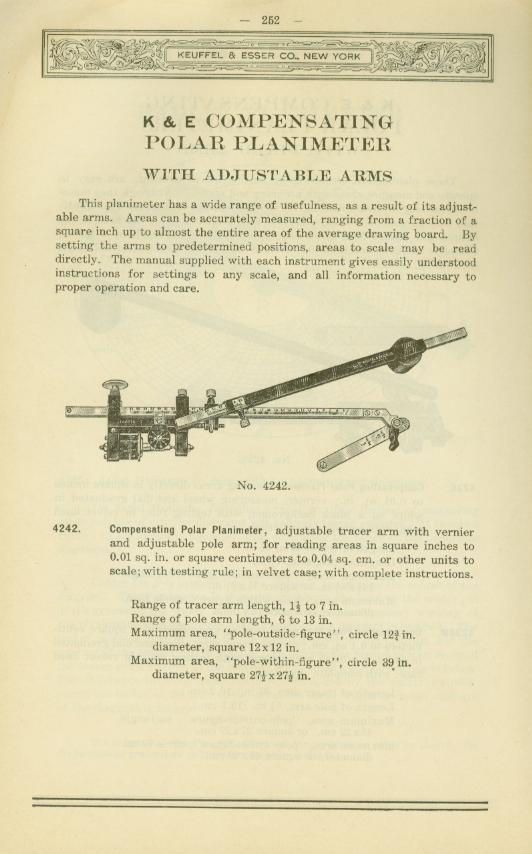
| 4240 | compensating polar planimeter with adjustable tracer arm |
| 4242 “Paragon” | the best adjustable compensating planimeter, with adjustable tracer and pole arms; 1901–1962 |
| 4242½ “Anvil” | a slightly less precise 4242: from 1930 (English settings only), reissued 1954 |
| 62 0015 / 62 0020 / 62 0022 | the 4242 and 4242½ renumbered in 1962; the 62 0022 replaced the 62 0020 in 1972 |
| 4260 / 4262 | Coradi rolling and rolling-disc planimeters |
| 4215 | radial planimeter for circular charts |
Dating a K&E 4242 or 4242½: Coradi-made until about 1936 (look for a Coradi signature); then German-made, probably by Haff, marked “Made in Germany” and later “Germany”; an open carriage before about 1958–60, an enclosed one with a lens after; and from 1962 the new six-digit model numbers. A 4242½ with English and metric settings on its card belongs to the post-war generation; one with English only, to the 1930s.
7.2 What they cost
Most of the market is asking prices; eBay and WorthPoint’s sold records need a logged-in browser to check.
Table 2 — What they cost
| Instrument | Price | When / where |
|---|---|---|
| K&E 4242 | $80–90 asking | eBay, Mercari, Whatnot, 2025–26 |
| K&E 4242 | $51 asking | Etsy |
| K&E 620000 | $24.99 sold | eBay, May 2025 |
| K&E 4236, cased | $20 sold | eBay.de |
| K&E 4236, 4237, 62 0010 | $44–50 asking | eBay.de |
| Coradi planimeter | $45–£65 asking | eBay.de, Antiques Atlas |
| Ott, Kempten | €65 sold; €120 asking | eBay.de |
| Haff 313E / 317 | £40–$99 | eBay, second-hand shop |
| Early Amsler | $113.50 sold | eBay, 2017 |
| Amsler integrator No. 157, cased | £1,375 with premium | Bonhams, May 2015 |
| Three Amsler instruction books, 1876–c.1892 | estimate £250–350 | Sotheby’s, 2018 |
In short, an ordinary twentieth-century K&E, Haff or Ott compensating planimeter sells for about $20–60 and is asked at $45–120; an adjustable K&E 4242 is at the top of the K&E range. For reference, K&E’s own price for the 4242 was $36 in 1901 and $98 in 1949.
7.3 What adds value
- Completeness: the testing rule, the pole weight with its needle, the tracer point and stop, the magnifier on later models, and the settings card.
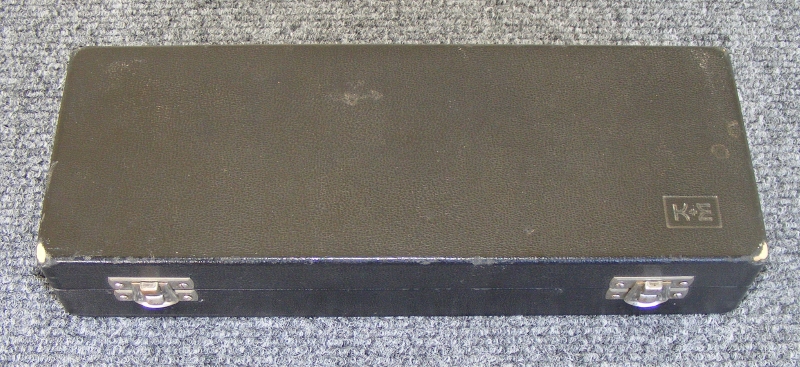
- The original case, with its lid label or card, and the manual.
- Condition of the measuring wheel rim: rust or pitting on it is the one fault that cannot be cured.
- Maker and age: signed Coradi instruments, early Amslers (look for low serial numbers and the early hinge forms), and integrators are the prizes.
- Unusual types: rolling, disc, radial and hatchet planimeters.
7.4 Before buying: a checklist
- Is the measuring wheel rim clean and free of rust? Ask for a close photograph.
- Does the wheel spin freely with no end-play? Does the dial step cleanly?
- Is the pole weight there, with its needle? The testing rule? The tracer point?
- Is the settings card in the lid? It is individual to the instrument.
- Is it the right model for the case? Cases and instruments get separated and recombined.
- Is there a manual? K&E’s is in the Library, so a missing one is no loss, but an original adds value.
7.5 Where to look
- eBay, searching “K&E planimeter”, “Keuffel Esser planimeter”, “4242”, “compensating planimeter”, “polar planimeter”, “Ott planimeter”, “Coradi”, “Haff planimeter”, “Amsler planimeter”; eBay.de for Ott, Haff and Coradi.
- Etsy, Mercari and Whatnot.
- Auction houses: Auction Team Breker, Bonhams, and the scientific-instrument sales of Tesseract, Skinner and others for the rare instruments.
- Slide rule collectors’ circles: the International Slide Rule Group, the Oughtred Society and the UK Slide Rule Circle, whose journals have published planimeter histories (Bob Otnes, “American Planimeters”, 2002; Vossepoel and Zerfowski, “A contribution to the history of planimeters”, 2023), and whose members trade them.
- Engineering and surveying office clear-outs, estate sales and flea markets: planimeters turn up wherever draughtsmen worked.
7.6 Reference collections and sources
- Clark McCoy’s K&E catalogue site, with the K&E planimeter catalogue pages from 1901 to 1972 and his own collection: mccoys-kecatalogs.com.
- David Green’s Planimeter Vault, with the Amsler serial-number time-line: uraone.com/PlanimeterVault.
- Robert Foote’s planimeter pages at Wabash College.
- The Smithsonian National Museum of American History’s planimeter collection, the Science Museum Group, and the Deutsches Museum.
- In the Library: K&E’s manual, Wheatley’s 1903 book, Shaw’s 1886 survey, Trunk’s 1865 history, Haff’s current manual, and the articles by Otnes, Frost, van der Salm, Vossepoel and Zerfowski, Eggers, and Foote.
Comments (0)