Hamann Manus · Volume 3
The Manus Line, Model by Model
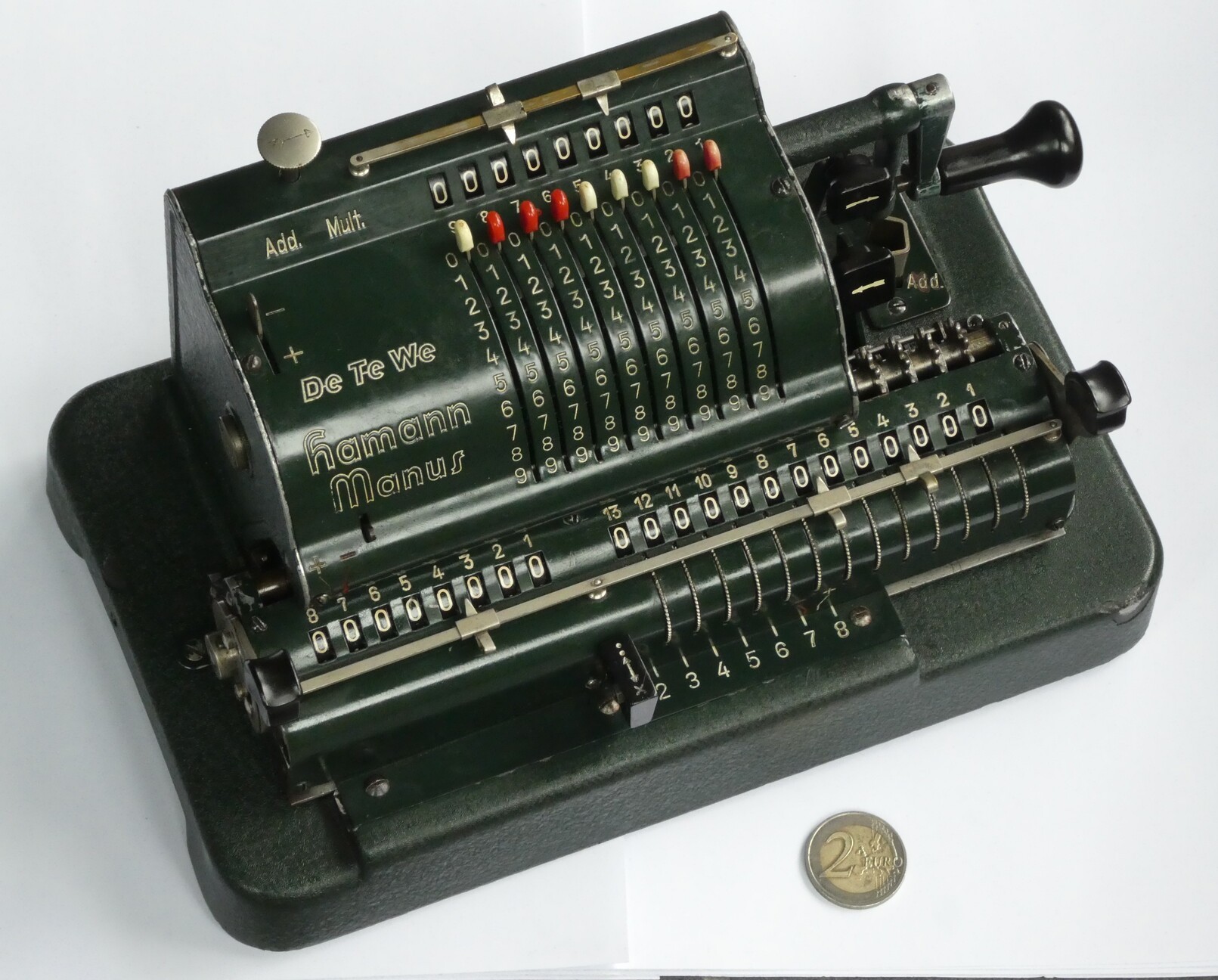
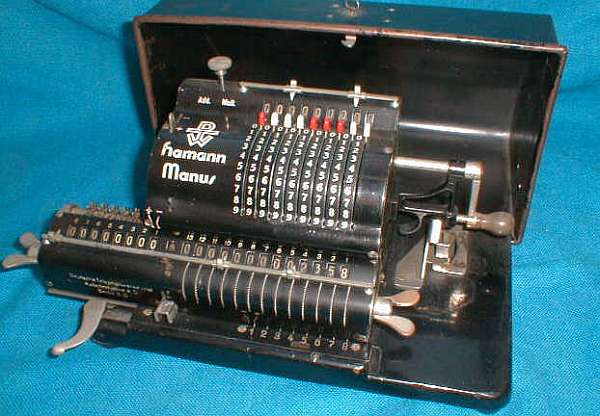
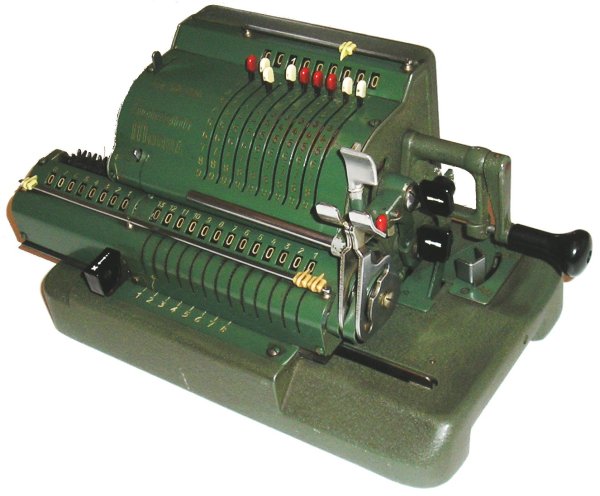
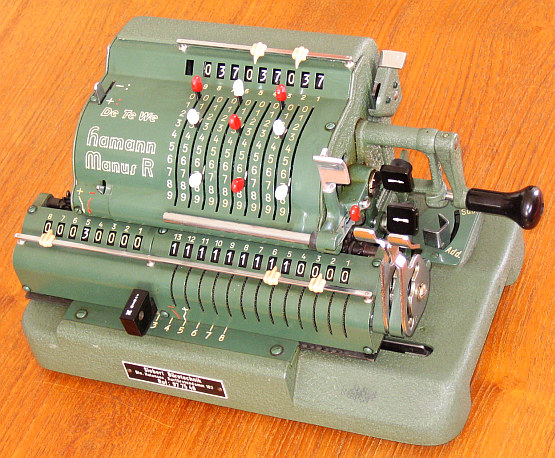
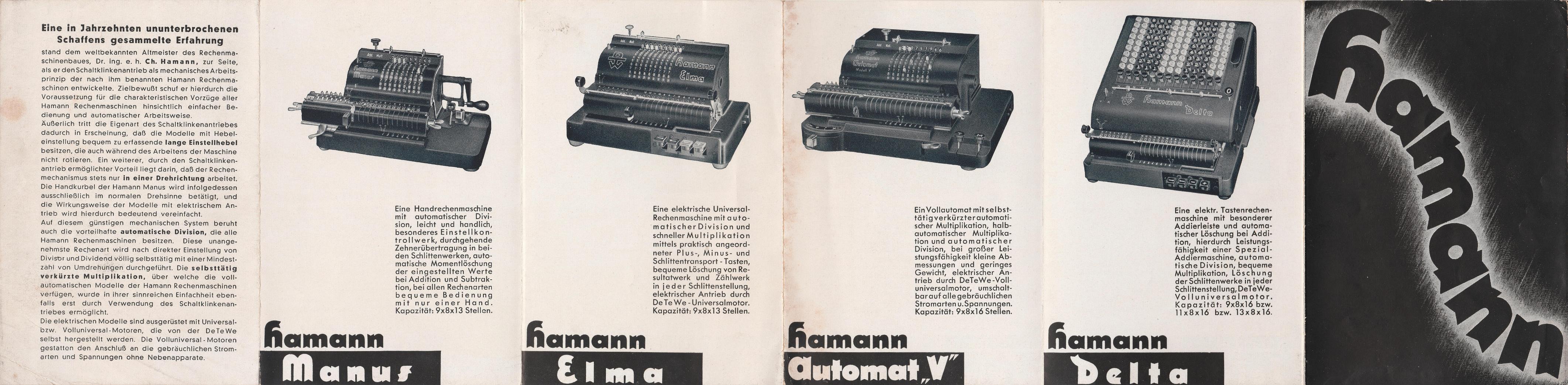
Over 34 years the Hamann Manus kept its capacity, 9 × 8 × 13, and its switching-latch drive. Almost everything around them changed: the clearing controls, the base, the carriage levers, the colour, the badge, and finally a back-transfer device that justified a new letter. DeTeWe never put a model plate on the early machines, so collectors have had to reconstruct the sequence from the machines themselves, by matching features to serial numbers across hundreds of examples. This volume sets out that sequence, the features that identify each model, and how they place my machine.
3.1 Two lettering schemes
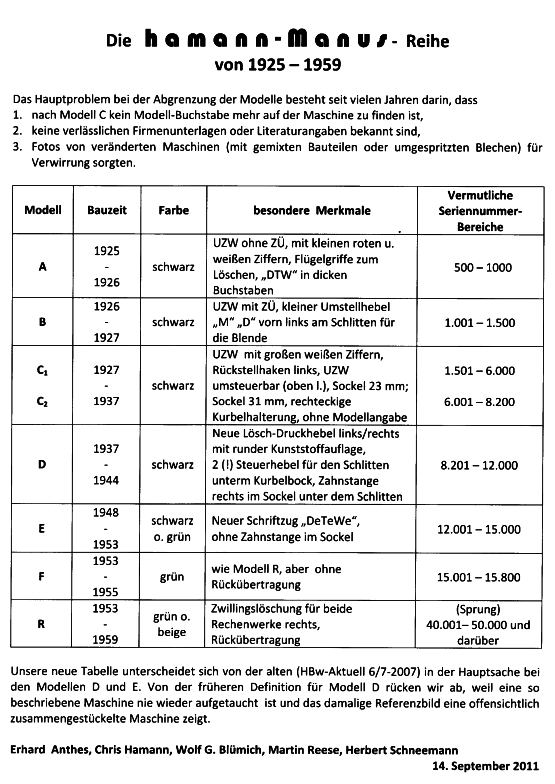
The model letters A to F are collectors’ letters. DeTeWe stamped some of them beside the serial number on early machines, but never published a model list. The standard reconstruction appeared in the German collectors’ journal HBw-aktuell in 2007 (Anthes, Reese and Schneemann) and was revised in 2011. The revision dropped a supposed model D of about 1939, known from a single photograph, and moved the letters along:
Table 1 — The model letters A to F are collectors' letters. DeTeWe stamped some of them beside the serial number on early machines, but never published a model list. The standard reconstruction appeared in the German collectors' journal HBw-aktuell in 2007 (Anthes, Reese and Schneemann) and was revised in 2011. The revision dropped a supposed model D of about 1939, known from a single photograph, and moved the letters along
| 2011 scheme (used here) | Older scheme (Rechnerlexikon) |
|---|---|
| A, B, C | A, B, C (C split into C1 and C2) |
| D, 1937–44 | ”D” (c. 1939, one photo) + E1 (1940–44) |
| E, 1948–53 | E2 |
| F, R | F, R |
This series uses the 2011 scheme, as Wolf-G. Blümich and Jaap Scherphuis do. Where an older source says “E1”, read “D”.
3.2 The models
Table 2 — The models
| Model | Years | Serial numbers | Identifying features |
|---|---|---|---|
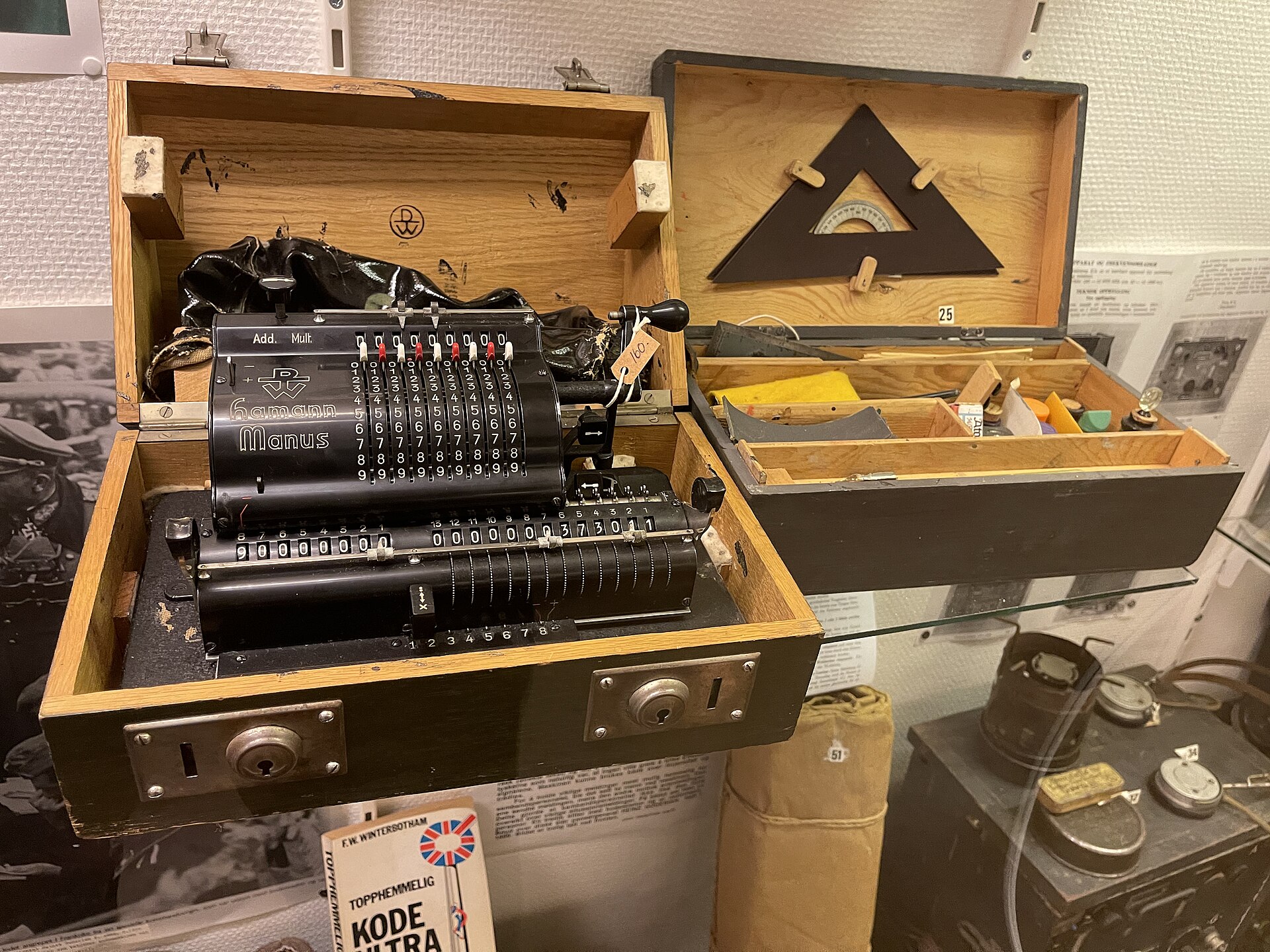
| A | 1925–26 | c. 501–1000 | Black; hollow-letter DTW badge; counter with red and white figures and no tens carry; overflow bell outside the carriage at the far left; wing nuts clear result and counter; curved crank-axle bearing; metal carriage levers |
| B | 1926–27 | c. 1001–1500 | Counter tens carry added; a small “M”/“D” switch front-left of the carriage for a counter shutter (B only); crank-reverse release tab |
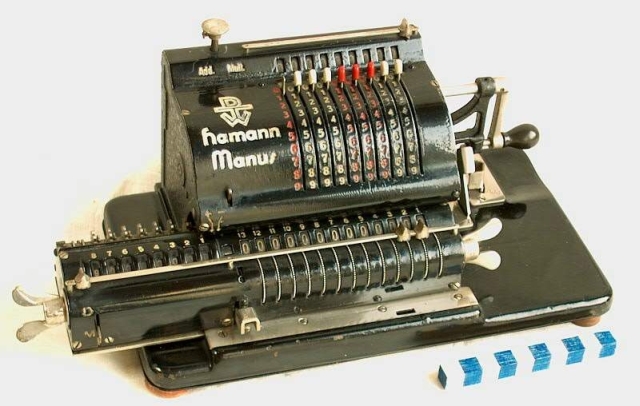
| C | 1927–37 | c. 1501–8200 | Hook-shaped right-shift lever at the left; large white counter figures; underflow window between the registers; counter and result clear only with the carriage fully left; wing nuts |
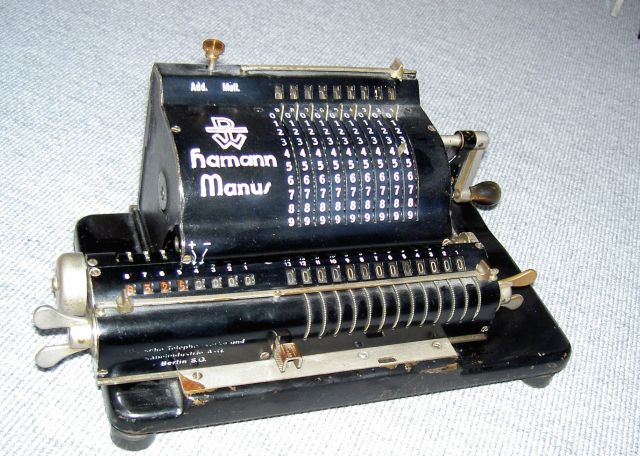
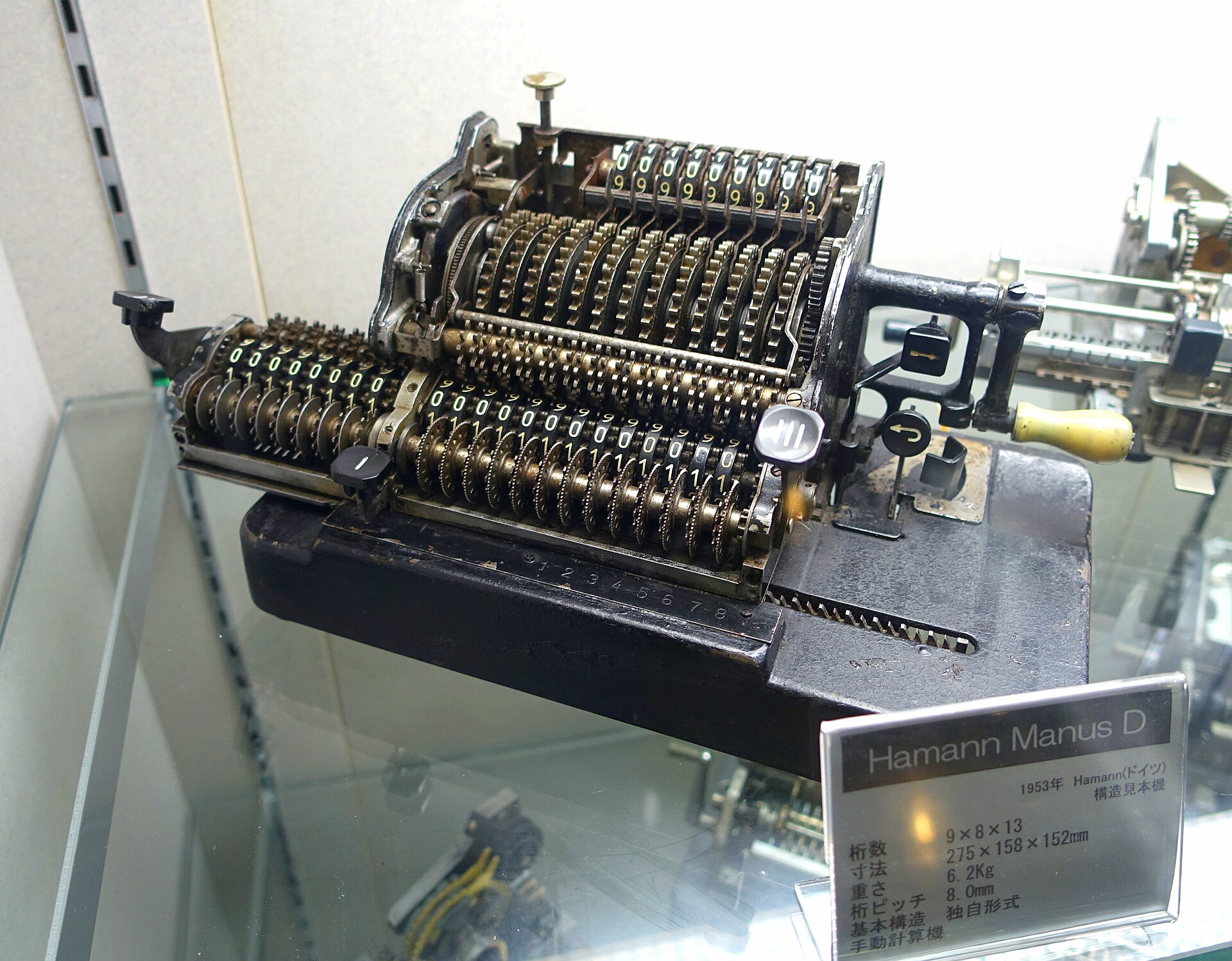
| D | 1937–44 | c. 8201–12000 | Higher base (31/39 mm); toothed rail in the base at the front right; push-down clearing levers replace the wing nuts, clearing in any carriage position; plastic carriage-shift buttons both sides |
| E | 1948–53 | c. 12001–15000 | ”DeTeWe” lettering instead of the DTW monogram; no toothed rail; black or green |
| F | 1953–55 | c. 15001–15800 (Jaap: 16000) | Two pressure levers at the right of the carriage; bevelled front base; clearing bar instead of the knob; levers no longer spring-loaded; green |
| R | 1953–59 | c. 40001–54000 | Back-transfer (Rückübertragung) of the result into the setting levers; green or beige; DM 598 in 1958 |
Sources: Blümich, Entwicklungsstadien der Hamann Manus (2007, rev. 2016); Scherphuis; Rechnerlexikon. Blümich and Rechnerlexikon disagree on whether the C has an internal bell or none; Blümich, who lists the underflow window, says none.
3.2.1 The model C in detail
The C was made for about ten years, longer than any other model, and changed in steps along the way. Blümich ties each step to a serial number:
Table 3 — The C was made for about ten years, longer than any other model, and changed in steps along the way. Blümich ties each step to a serial number
| From about serial | Change |
|---|---|
| 1501 | Variant 1 begins: low base (10/18 mm), curved crank-axle bearing, metal carriage levers without an eyelet, hollow-letter “Manus” with a stretched final “s” |
| 2700 | Carriage levers with an eyelet |
| 4600 | No more metal cover with hooks at the rear of the base |
| 5000 | Plastic carriage lever |
| 5700 | Straight, covered crank axle |
| 6001 | Variant 2: higher base (23/29 mm), no model letter beside the serial, normal “s” |
| 6201 | Plastic grip on the right-side lever |
| 7201 | Wedge-shaped crank arm |
3.3 Dating my machine
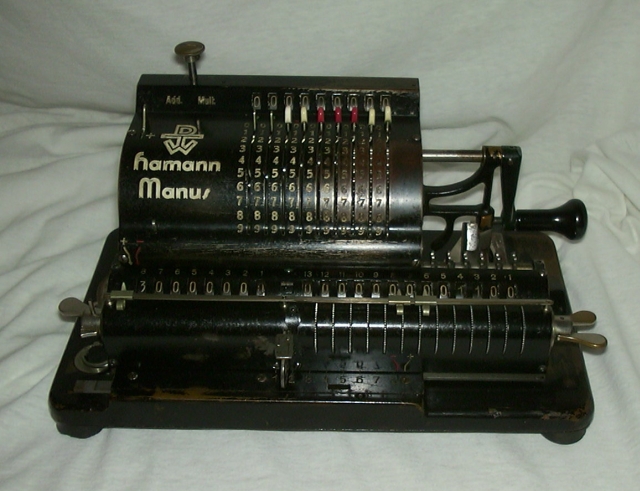
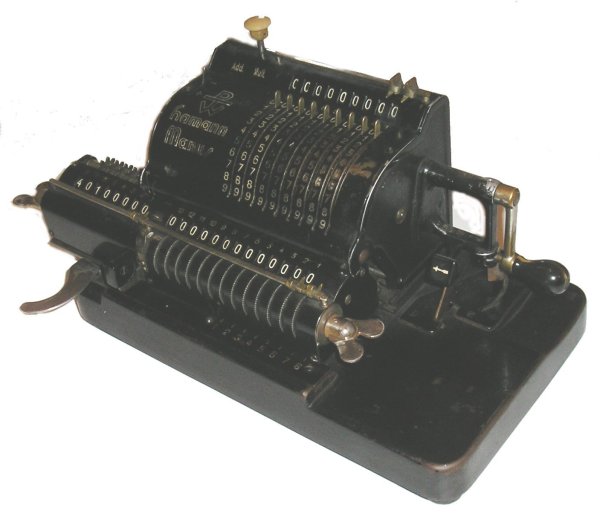
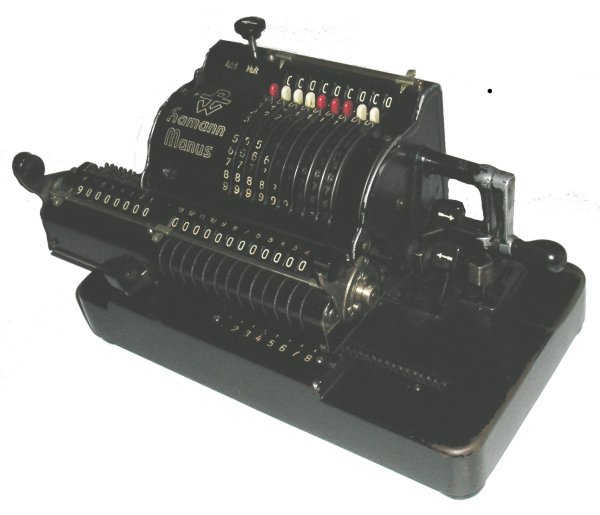
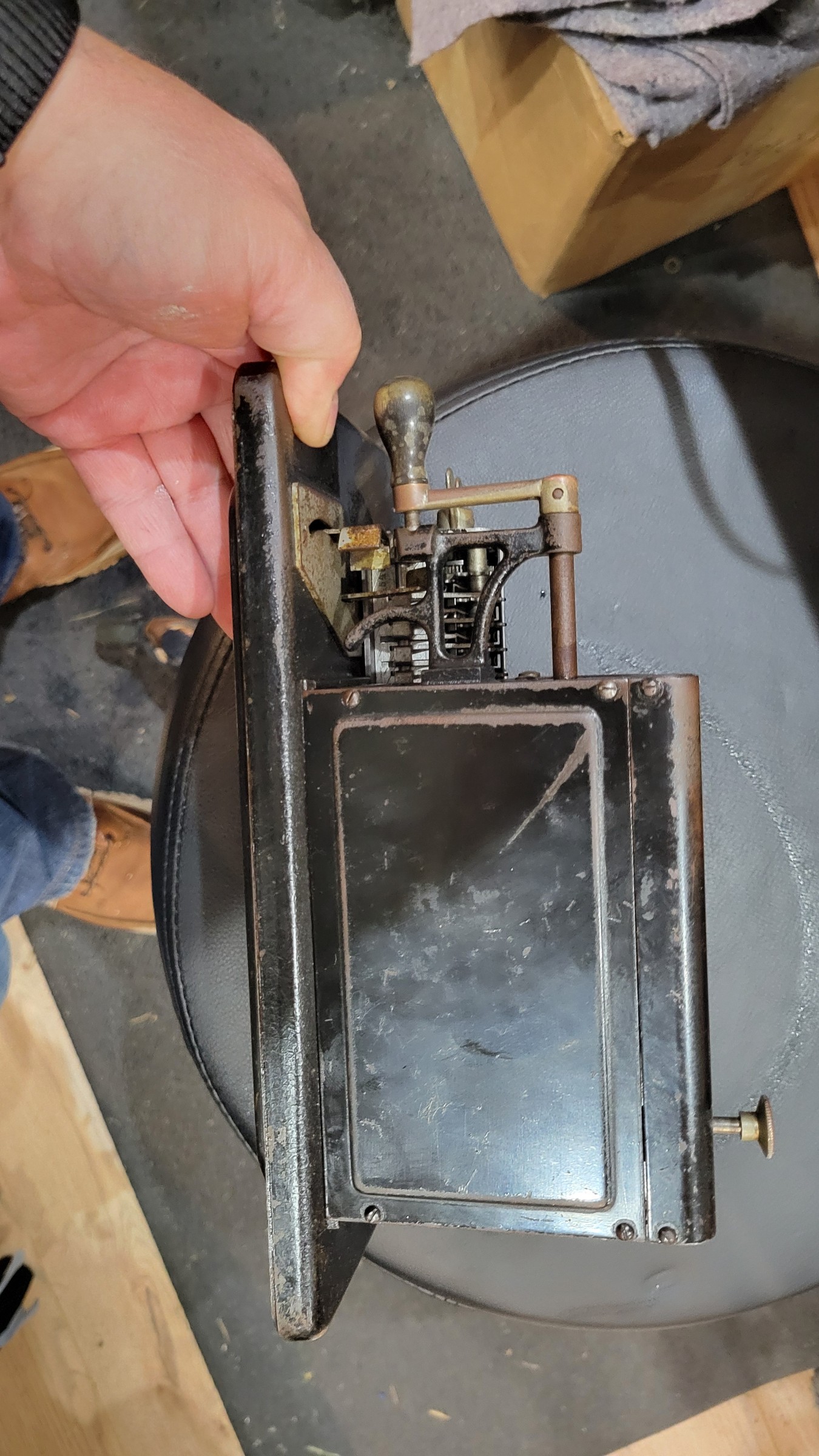
My machine carries a stamped C and the number 1545; the worn first digit may be a 2.
- The letter and the number agree. Both 1545 and 2545 fall in the C range, and both are below 6001, the point after which the letter was no longer stamped.
- Both are in the first variant. That means a low base, a curved crank-axle bearing, levers without eyelets, and the stretched “s”, all of which I can check on the machine.
- The date. The C ran from about serial 1501 in 1927 to 8200 in 1937. Spreading those numbers evenly across the years puts 1545 in 1927 and 2545 in about 1928–29. That is an estimate, not a record: production was certainly not even, and the Depression of 1930–33 must have slowed it. Christian Hamann dates his own C, serial 6229, to 1930, which suggests the early numbers were used up faster than an even spread implies.
3.3.1 Two quick tests
The research for this series turned up two simple tests that separate the early models without opening anything:
- Counter carry. Set a 1, put the carriage in position 1 and turn the crank ten times. If the counter’s second place moves to 1, the counter carries, and the machine is a B or later.
- Bell or window. An overflow bell on the outside of the carriage at the left means an A or B. A small underflow window between the counter and the result register means a C.
3.4 Model plates, serial numbers and where to look
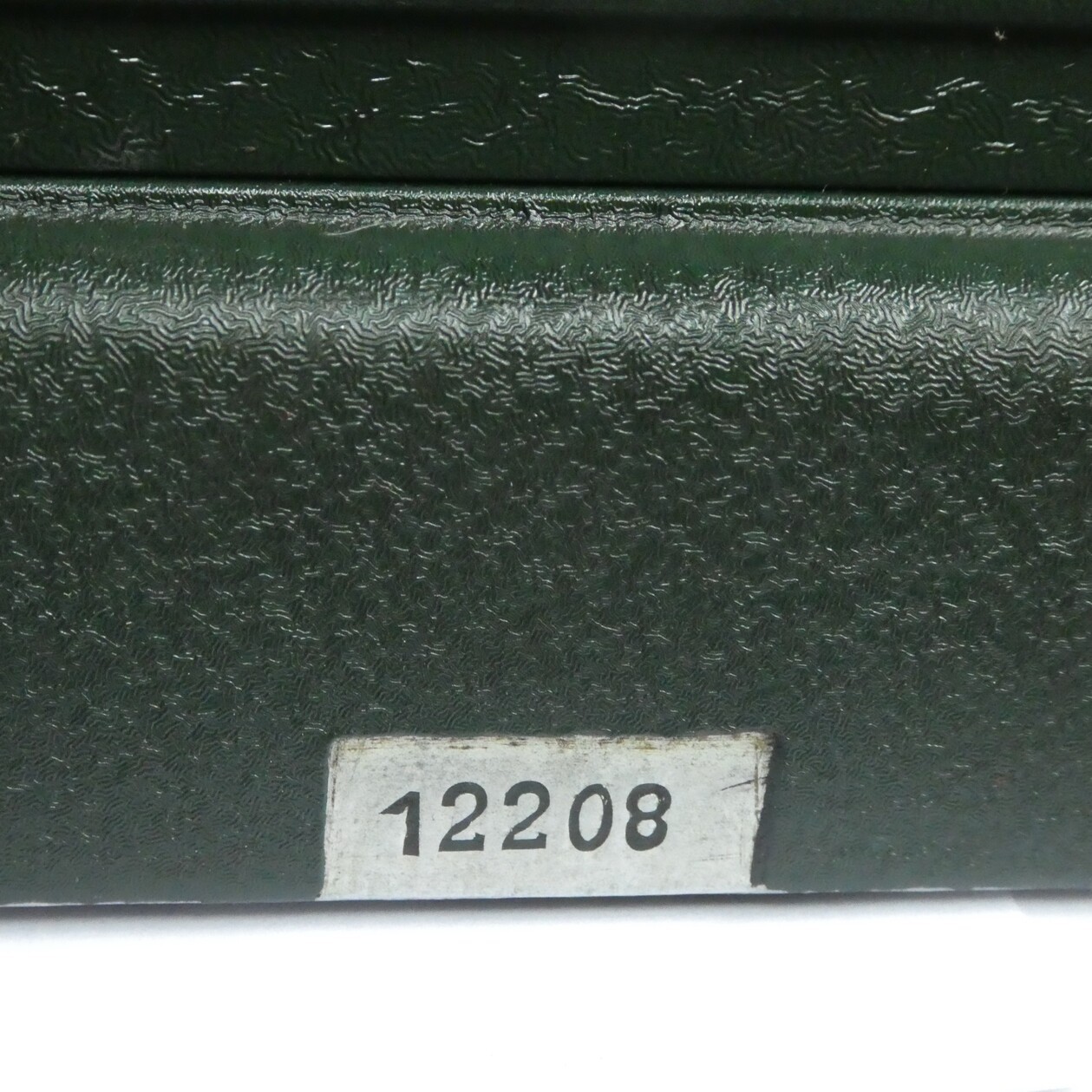
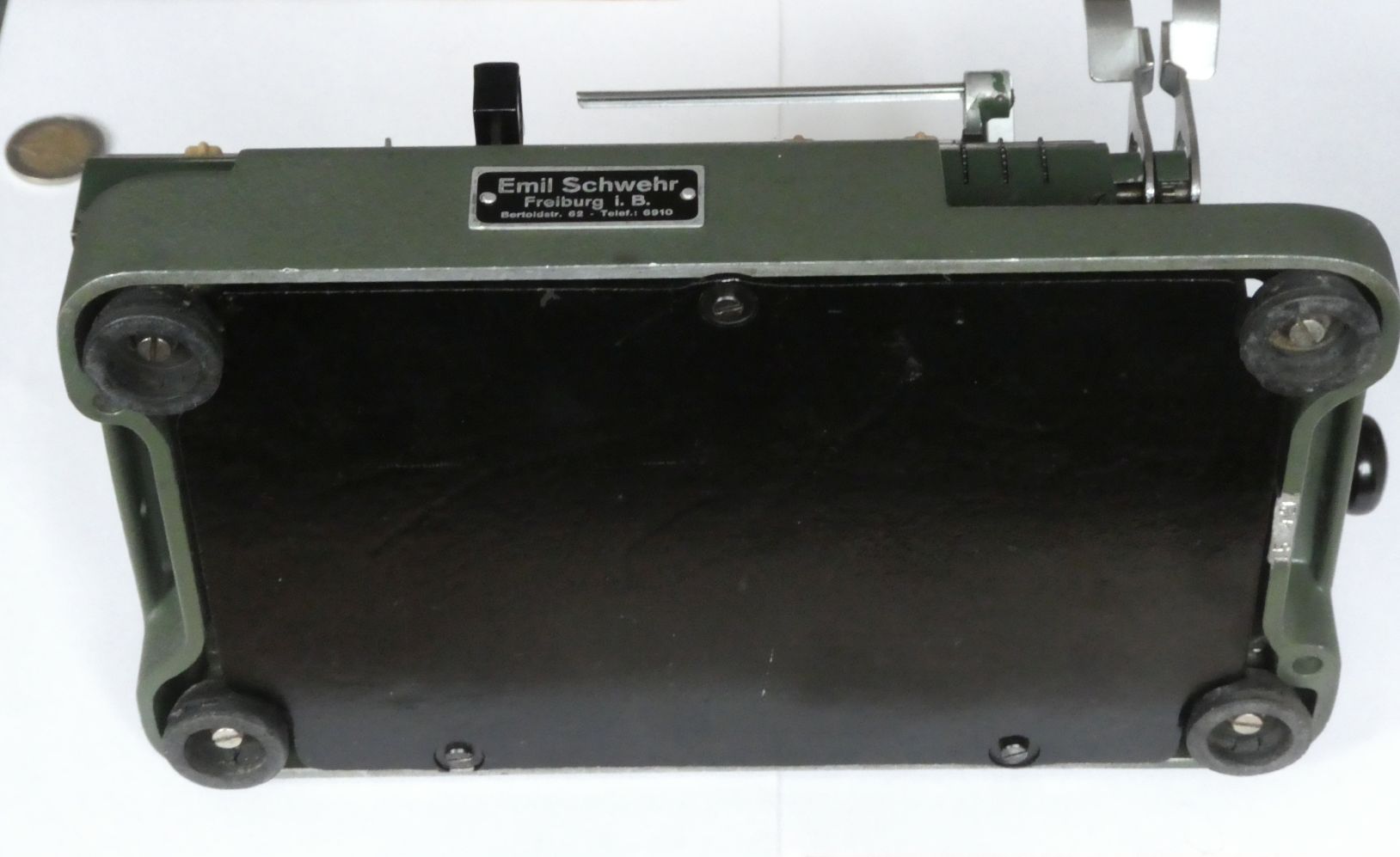
Early machines carry the model letter beside the machine number on the base frame. On my machine both are stamped on the bottom, where the base pan’s frame meets the body. On at least one model D the same serial number also appears on the carriage. No source I have found says where DeTeWe stamped the number on every model, so a buyer should look at the bottom first, then under the carriage.
3.5 How many were made
DeTeWe published no production figures. The serial ranges imply about 15,000 to 16,000 machines of models A to F and another 10,000 to 14,000 of the R. That makes perhaps 25,000 to 30,000 Manus in all, a modest number beside the hundreds of thousands of pinwheel machines made by Brunsviga or Triumphator. The estimate is mine, from the published ranges.
3.6 Prices
Table 4 — Prices
| Year | Model | Price | Source |
|---|---|---|---|
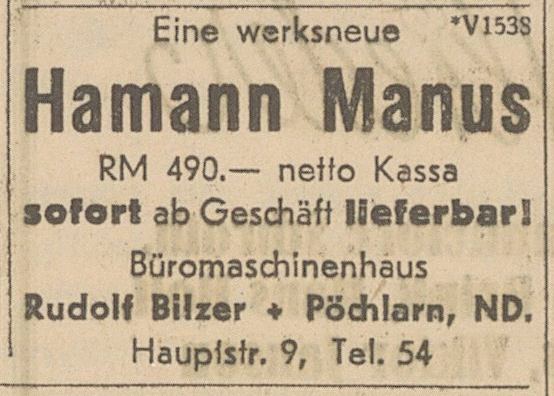
| 1940 | Manus (model D) | RM 490 net cash, new, “available immediately from stock” | advertisement, Salzburger Volksblatt, 18 May 1940 |
| 1956 | Manus R | DM 665 | vintage-calculators.nl |
| 1958 | Manus R | DM 598 | Büromarkt 1958, via Rechnerlexikon |
| 1958 | Manus E | DM 1,375 (as listed; looks high beside the R) | Büromarkt 3/1958, via Rechnerlexikon |
Comments (0)